
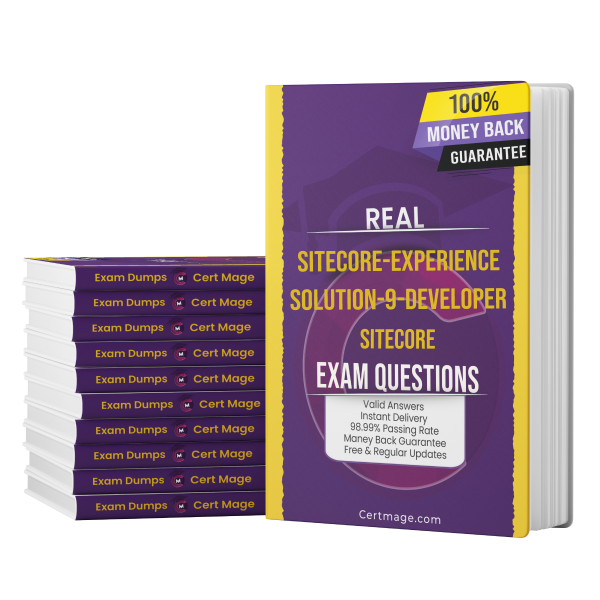

The Sitecore-Experience-Solution-9-Developer certification exam, offered by Sitecore, validates a developer’s technical competence in building, deploying, and maintaining enterprise web applications on the Sitecore Experience Platform 9. Candidates take this test to earn the Sitecore Certified Platform Associate Developer credential, establishing their ability to implement MVC solutions, structure content architectures, customize publishing pipelines, and leverage Sitecore architecture frameworks like Helix. To support thorough preparation, Cert Mage provides updated PDF-based exam-style practice questions, an interactive test engine, instant PDF download access, 24/7 customer support, and clear refund and pass-guarantee options based on published policy terms.
What the Sitecore Experience Solution 9 Developer Exam Covers
The Sitecore Experience Solution 9 Developer exam is designed for backend developers, solution architects, and full-stack software engineers who write .NET code and implement content management solutions on Sitecore XP 9. Passing this exam demonstrates that you understand the platform’s API surface, item structures, presentation details, security mechanisms, indexing engines, and data pipeline extensions.
Sitecore targets candidates who have hands-on experience developing real-world MVC solutions. While the platform offers broad marketing automation, analytics, and personalization features, this developer exam focuses on implementation mechanics. You are evaluated on how cleanly you can translate visual layouts into Sitecore presentation components, query content items efficiently through search indexes, enforce field-level security, and apply modular software engineering principles.
Candidates who use Cert Mage materials find that familiarizing themselves with realistic scenario questions helps bridge the gap between building custom templates in Visual Studio and answering focused, multi-choice technical questions under timed exam conditions.
| Exam Detail | Official Specification |
| Exam Code | Sitecore-Experience-Solution-9-Developer |
| Exam Title | Sitecore Experience Solution 9 Developer Certification Exam |
| Certification Provider | Sitecore |
| Credential Awarded | Sitecore Certified Platform Associate Developer |
| Target Version | Sitecore Experience Platform 9 (XP 9.x) |
| Exam Status | Active |
| Question Count | 50 multiple-choice questions |
| Exam Duration | 100 minutes |
| Passing Score | 80% (40 out of 50 correct) |
| Exam Format | Multiple choice, single or multiple response |
| Delivery Method | Online proctored through Kryterion Webassessor |
| Available Language | English |
| Exam Fee | 350 USD (standard registration fee) |
| Recertification Policy | Credential is tied to the major version; upgrade exams offered for newer platform releases |
Official Exam Competencies and Syllabus Breakdown
Sitecore divides the Experience Solution 9 Developer syllabus into distinct technical competencies. Each area evaluates specific development tasks you face while implementing enterprise solutions.
Sitecore Architecture and Foundation
This domain covers the overall structural framework of the platform. You must understand the roles of core databases, specifically Master, Web, and Core. Master stores all working content and versions, Web serves live, published content to site visitors, and Core contains system settings, user membership tables, and definitions for the Sitecore Desktop and Content Editor applications.
Questions in this section test your knowledge of publishing pipelines and how content flows from authoring environments to live delivery instances. You must also understand how the Sitecore runtime initializes, how configuration patching functions through XML include files, and how Helix principles govern solution architecture. Helix defines strict dependency rules: Project layer modules orchestrate Features, Feature layer modules encapsulate business capabilities without referencing other Features, and Foundation layer modules provide cross-cutting, shared infrastructure.
Template and Item Architecture
Templates serve as the data schema of Sitecore. You need to know how base templates pass inherited fields to derived templates, how standard values supply default content and presentation settings, and how insert options control what types of items authors can create in the content tree.
Expect scenarios that ask how to handle shared versus unversioned fields. Shared fields retain a single value across all languages and numbered versions, while unversioned fields vary by language but remain identical across numbered versions. Misunderstanding field scope leads to data corruption during localization, making this a frequent topic on the test.
Presentation Details and Rendering Architecture
Presentation is central to any Sitecore project. The exam tests layout definitions, view renderings, controller renderings, and placeholder settings. You must know how components bind to placeholders, how layout deltas function within item inheritance, and how standard values dictate default presentation across content items.
You must be comfortable with dynamic placeholders, which allow component reuse within the same container item without hardcoding indexed placeholder keys. You should also understand how rendering parameters allow content authors to modify component presentation without changing the underlying content item.
Search and Indexing Architecture
Sitecore 9 relies heavily on search providers such as Solr and Azure Search. This domain tests the ContentSearch API, search index configuration, computed index fields, and bucket creation. You need to know how to construct LINQ queries against an IProviderSearchContext to fetch items without loading heavy item trees directly from the database.
Pay attention to when to run a search query instead of traversing the content tree using Axes.GetDescendants(). Sitecore penalizes direct tree traversal for large datasets in production environments, and the exam reflects this best practice.
Data Access and Content Management
This section evaluates programmatic interaction with Sitecore items using the native .NET API. You need to know how to retrieve items by path or ID, create items programmatically using SecurityDisabler or UserSwitcher, edit fields within EditContext blocks, and work with different field types such as General Link, Droplist, Droplink, and Multilist.
Understand the distinction between Droplist, which stores field values as plain strings, and Droplink, which stores the GUID reference of the target item. Using string values when an item reference is required causes rendering bugs and breaks referential integrity.
| Domain Area | Exam Weight | Key Implementation Focus |
| Sitecore Architecture and Environment | 16% | Core/Master/Web databases, Helix principles, config patching, publishing pipelines |
| Templates and Fields | 20% | Template inheritance, standard values, field types, shared vs. unversioned data |
| Presentation Details | 24% | Layouts, view vs. controller renderings, dynamic placeholders, rendering parameters |
| Media and Content Management | 14% | Media library handling, workflow states, versioning, item manipulation APIs |
| Search and Indexing | 16% | ContentSearch API, Solr integration, index configuration, item buckets |
| Custom Pipelines and Security | 10% | HttpRequestBegin pipeline, role-based access control, security rights inheritance |
Practical Study Advice for Exam Candidates
Succeeding on the Sitecore 9 Developer exam requires balancing theoretical understanding with active coding practice. Because Sitecore sets the passing standard at 80 percent, you cannot afford gaps in core domains like Presentation Details and Template Architecture.
Begin your preparation by setting up a local Sitecore 9 instance using SIF (Sitecore Install Framework). Verify that you can create custom templates, set up standard values with layout details, and patch custom configuration files cleanly using the App_Config/Include folder structure. Practice overriding default pipeline processors by hooking a custom class into the httpRequestBegin pipeline.
Avoid relying on passive reading alone. Developers often make the mistake of reading documentation without verifying behavior inside the Content Editor and Visual Studio. For example, test how Sitecore behaves when an author denies read access on a base template versus an individual item, and trace how security inheritance cascades through the tree.
Combine your practical work with structured question practice. Cert Mage provides PDF-based exam-style practice questions and a test engine that mirror the multiple-choice format of the official test. Reviewing exam dumps in this structured way helps you identify subtle question phrasing, practice eliminating incorrect distractors, and verify your comprehension before sitting for the proctored exam.
Preparing with Cert Mage Study Material and Exam Simulator
Cert Mage provides targeted study resources designed to give candidates a structured, flexible path to exam readiness. Whether you need quick reference sheets for offline study or timed testing sessions to assess your pacing, our resources fit your study routine.
Our material includes PDF-based exam-style practice questions that you can download immediately upon purchase. The instant PDF download lets you start studying right away on your laptop, tablet, or phone. This format works well for short study sessions during work breaks, commutes, or evening review periods. You can work through questions at your own speed, review detailed answer explanations, and revisit challenging technical scenarios until you master them.
Alongside the PDF, Cert Mage includes an interactive test engine and exam simulator. The simulator reproduces the testing conditions of Kryterion Webassessor, giving you a realistic preview of the 100-minute testing window and 50-question workload. Using the test engine lets you:
-
Complete timed practice sessions that train you to manage your 100-minute time limit effectively.
-
Take full-length simulation tests that randomize questions to build confidence under real exam pressure.
-
Track your scores across all six exam domains to pinpoint technical weak areas that require extra reading.
-
Review detailed answer explanations immediately after completing an interactive session.
To get the most out of both formats, adopt an integrated revision workflow:
-
Study an official exam domain, such as Presentation Details or Search.
-
Open your Cert Mage PDF and work through the corresponding practice questions.
-
Review any incorrect answers and check the official Sitecore documentation to clarify the underlying rule.
-
Launch the Cert Mage exam simulator to take a timed practice test covering that specific domain.
-
Note your score, highlight recurring mistakes, and repeat targeted revision before moving to the next competency.
Cert Mage backs its products with dedicated 24/7 customer support to assist with download queries, software access, or account questions at any time. We also offer a clear refund policy and a pass-guarantee policy governed by our published policy terms. If you follow our recommended preparation program, utilize our updated exam-style questions, and do not achieve a passing result on your test, you may request assistance or a refund according to our published policy criteria. Our materials are developed as responsible revision resources, giving you authentic practice questions and structured simulation tools without unauthorized exam material.
Detailed Technical Pitfalls to Avoid on the Exam
Certain platform concepts cause regular difficulty for developers taking the Sitecore 9 certification exam. Reviewing these topics closely will prevent lost marks on tricky questions.
Configuration Patching Attributes
Sitecore uses XML patch files to modify its core configuration without altering the base Web.config or Sitecore.config files. You must understand XML patch namespaces (patch:before, patch:after, patch:attribute, and patch:instead).
A common pitfall is misunderstanding the load order of configuration folders under App_Config. In Sitecore 9, configuration files load according to explicit roles and layers defined in Layers.config. Make sure you know how role:require and environment:require attributes conditionally include or exclude settings based on whether an instance runs as Content Management (CM), Content Delivery (CD), Processing, or Reporting.
Dynamic Placeholders Syntax
In older versions of Sitecore, reusing a component with placeholders on the same page resulted in duplicate placeholder keys, causing content to render in the wrong place. Sitecore 9 provides native support for dynamic placeholders using the @Html.Sitecore().DynamicPlaceholder() helper.
The platform appends unique suffixes to dynamic placeholder keys. The exam frequently evaluates whether you recognize the proper rendering code, how placeholder settings rules apply to dynamic keys, and how content authors bind nested renderings within dynamic containers.
Helix Module Dependencies
Helix architecture enforces strict dependency boundaries between layers:
[Project Layer]      --> Can reference Feature and Foundation modules
       |
[Feature Layer]      --> Can reference Foundation modules ONLY
       |
[Foundation Layer]   --> Can reference other Foundation modules or third-party libraries
Questions often describe a scenario where a developer wants to share logic between two Feature modules, such as a Navigation component and a Search component. The correct Helix approach is never to let one Feature reference another. Instead, you must extract shared models, templates, or business services down into a new or existing Foundation module.
Career Value and Job Roles for Certified Sitecore Developers
Earning the Sitecore Certified Platform Associate Developer credential demonstrates that you possess verified technical capabilities on one of the leading enterprise digital experience platforms. Enterprise organizations and digital agencies look for certified developers when bidding on major client implementations, as Sitecore Partner status requires firms to maintain a minimum number of certified professionals on staff.
Once certified, developers commonly move into several key roles:
-
Sitecore Developer: Responsible for day-to-day component development, template construction, workflow setup, and backend API integration using ASP.NET MVC and C#.
-
Senior Sitecore Engineer: Leads component architecture, implements complex Solr indexing configurations, customizes publishing pipelines, and optimizes high-traffic delivery environments.
-
Sitecore Solution Architect: Designs enterprise Helix architectures, orchestrates multi-site multi-language setups, coordinates headless migrations, and guides deployment architectures across cloud environments.
-
Technical Lead / Delivery Consultant: Oversees agency delivery teams, conducts code reviews for Helix compliance, and ensures project standards meet Sitecore implementation guidelines.
Certified developers enjoy strong demand in enterprise markets across North America, Europe, and Asia-Pacific. While exact salaries depend on geographic location, years of backend experience, and architectural depth, Sitecore expertise commands above-average compensation across enterprise content management careers.
Developers preparing for this credential often look to extend their expertise toward composable and cloud-native CMS architectures. If your team is moving toward SaaS deployments, GraphQL APIs, and headless frontends, reviewing our Sitecore XM Cloud Developer exam practice questions provides an effective way to master modern rendering hosts, Experience Edge delivery, and cloud serialization alongside your traditional platform prep.
Frequently Asked Questions
What is the Sitecore-Experience-Solution-9-Developer exam?
It is the official certification exam offered by Sitecore to validate that developers know how to build, maintain, and deploy enterprise web solutions on the Sitecore Experience Platform 9. Passing the exam awards the Sitecore Certified Platform Associate Developer credential.
Is the Sitecore 9 developer exam difficult for junior developers?
The exam is moderately difficult because it requires an 80 percent passing score, allowing only 10 incorrect answers out of 50. Developers without hands-on experience building MVC components, editing standard values, and configuring search indexes often struggle without thorough study.
Who should take the Sitecore Experience Solution 9 Developer exam?
The exam is intended for .NET software developers, backend engineers, and web architects working on Sitecore implementations. It is ideal for developers working at Sitecore Solution Partner agencies or enterprise companies running Sitecore XP 9.
How long should candidates study before taking the exam?
Developers who already have two to three months of hands-on Sitecore 9 experience typically need two to three weeks of focused study. Developers new to the platform should spend four to six weeks building sample components, reading documentation, and working through practice questions.
Does Cert Mage provide updated Sitecore-Experience-Solution-9-Developer questions?
Yes. Cert Mage supplies updated PDF-based exam-style practice questions and exam simulator materials that reflect the current syllabus domains, question patterns, and core competencies of the Sitecore 9 developer exam.
Can I download the Cert Mage PDF questions immediately?
Yes. All Cert Mage PDF study materials are available for instant download immediately after purchase, allowing you to begin offline study and revision on your computer, tablet, or smartphone right away.
Does Cert Mage include a test engine or exam simulator?
Yes. Cert Mage provides an interactive exam simulator that recreates the timed environment of the official 100-minute, 50-question test, helping you evaluate your pacing, track scores, and identify weak technical domains.
What is the Cert Mage pass-guarantee policy?
Cert Mage offers a pass-guarantee policy governed by our published terms. If you prepare thoroughly using our practice material and test engine but do not pass your official exam, you may submit your result for a refund or account credit in accordance with our published policy guidelines.
Does Cert Mage offer 24/7 customer support?
Yes. Our support team is available 24 hours a day, 7 days a week to answer product access questions, assist with download troubleshooting, and resolve account inquiries promptly.
Reviews
There are no reviews yet.