BCS certification preparation

CTFL4 Practice Questions

Practice exam-style questions, check your answers, and review explanations and source references where they are available.

Exam
CTFL4
Provider
BCS
Full set
148 questions
Last Update Check

The ISTQB Certified Tester Foundation Level v4.0 (CTFL4) certification is the global standard for software testing professionals, requiring a firm grasp of agile methodologies, test design techniques, and defect management. Because this exam places a heavy emphasis on applying testing principles to real-world software development lifecycles, relying solely on the official syllabus is rarely enough to guarantee a passing score. Utilizing a highly realistic CTFL4 practice quiz is the smartest strategy to bridge the gap between theoretical knowledge and practical application.

Cert Mage offers an interactive online platform where you can try free CTFL4 exam questions that closely simulate the actual ISTQB testing environment. Every scenario you complete is backed by detailed answer explanations that demystify complex equivalence partitioning and boundary value analysis techniques, ensuring you truly understand the mechanics of software quality assurance. Take advantage of our free PDF demo to pinpoint exactly which testing domains need more focus, and whenever you are ready to secure your certification, upgrade to our premium files for the most comprehensive and up-to-date question bank available.
Which one of the following is a typical entry criteria for testing?
Answer options
Which of the following statements about checklist-based testing is TRUE?
Answer options
To be able to define testable acceptance criteria, specific topics need to be addressed. In the table below are the topics matched to an incorrect description. Match the topics (the left column) with the correct description (the right column) Topic Description A: Functional behaviour A: How the system performs the specific behaviour. 8: Quality characteristics B: A sequence of actions between an external actor and the system, to accomplish a specific goal or business task. C: Scenarios C: The externally observable behaviour with user actions as input operating under certain configurations. D: Business rules D; Description of the connections between the system to be developed and the outside world. E: External interfaces E: Activities that can only be performed in the system under certain conditions defined by outside procedures and constraints.
Answer options
As a tester, as part of a V-model project, you are currently executing some tests aimed at verifying if a mobile app asks the user to grant the proper access permissions during the installation process and after the installation process. The requirements specification states that in both cases the app shall ask the user to grant access permissions only to the camera and photos stored on the device. However, you observe that the app also asks the user to grant access permission to all contacts on the device. Consider the following items: [I]. Test environment [ii]. Expected result [iii]. Actual result. [IV] Test level. [V]. Root cause. Based on only the given information, which of the items listed above, are you able to CORRECTLY specify in a defect report?
Answer options
A test status report SHOULD:
Answer options
A typical objective of testing is to
Answer options
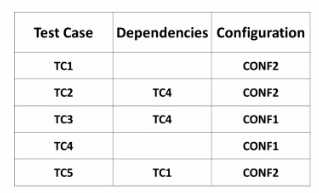
For each test case to be executed, the following table specifies its dependencies and the required configuration of the test environment for running such test case: BCS CTFL4 question Assume that C0NF1 is the initial configuration of the test environment Based on this assumption, which of the following is a test execution schedule that is compatible with the specified dependencies and allows minimising the number of switches between the different configurations of the test environment^
Answer options
During iteration planning, a scrum team uses an estimation technique called planning poker to estimate the effort required to deliver a critical user story. In advance of the estimation session, the team agreed on some ground rules to limit the number of poker rounds and save time. The team agreed on the following: 1. They will use the following progression for estimation: Extra-small, Small, Medium, Large, Extra- large, and Extra-extra-large. 2. If estimation values differ significantly, the highest score will be used for estimation purposes. The result of the first round of planning poker: Team Member Estimation Business Large Development Extra-extra-large Testing Extra-extra-large Which of the following options best represent the team’s next actions?
Answer options
Which of the following is a factor that contributes to a successful review?
Answer options
Which of the following statements about retrospectives is TRUE?
Answer options
Question 1 of 10

Source context

How this practice set is maintained

Maintained by the CertMage content team, this page loads questions from the exam dataset connected to its preparation resource. When an answer includes a supporting reference, it is shown with that answer so you can review the underlying vendor documentation.

Certification objectives, interfaces, and vendor services can change. Verify important details against the provider's current exam guide and documentation before your exam.

Scroll to Top