
CompTIA certification practice
DS0-001 Practice Questions
Try 10 free DS0-001 exam-style questions for CompTIA DataSys+. Check each answer and review the explanation and source references.
- Exam code
- DS0-001
- Provider
- CompTIA
- Free questions
- 10
- Full set
- 80 questions
- Last update check
If you are interested in advancing your career in database management or looking to expand your technical knowledge, the DS0-001 certification exam is a phenomenal place to start. This exam tests your foundational knowledge of database concepts, security, and deployment. With the help of our CompTIA DataSys+ DS0-001 real exam questions, you can prepare effectively and greatly increase your chances of passing. We design our practice questions to closely simulate the real test environment, ensuring we cover the exact same topics as the actual exam to test your understanding.
RAID 10 (a stripe of mirrors) provides the best write performance among the choices. This is because it combines the mirroring of RAID 1 with the striping of RAID 0, avoiding the computational overhead associated with parity calculations. For every write operation, data is simply written to two disks in a mirrored pair simultaneously. This process does not involve the read-modify-write sequence, known as the "write penalty," which significantly slows down write operations in parity-based arrays like RAID 3, RAID 5, and RAID 6.
A. RAID 3: Uses a dedicated parity disk that becomes a bottleneck for write operations, as every write must update this single disk, serializing the I/O.
B. RAID 5: Incurs a significant write penalty. Each logical write requires four physical I/O operations (read old data, read old parity, write new data, write new parity).
C. RAID 6: Suffers from the highest write penalty. Updating its dual parity blocks requires six physical I/O operations for a single logical write, making it the slowest.
1. Patterson
D. A.
Gibson
G.
& Katz
R. H. (1988). A case for Redundant Arrays of Inexpensive Disks (RAID). SIGMOD '88: Proceedings of the 1988 ACM SIGMOD international conference on Management of data
109–116. In Section 3
"The RAID Proposal
" the paper details the performance of small writes
noting for RAID 5 (and by extension
RAID 3 and 6) that a single write requires four disk I/Os
a significant performance penalty not present in mirrored arrays (RAID 1/10). https://doi.org/10.1145/50202.50214
2. Arpaci-Dusseau
R. H.
& Arpaci-Dusseau
A. C. (2018). Operating Systems: Three Easy Pieces. Arpaci-Dusseau Books. In Chapter 40
"Redundant Arrays of Inexpensive Disks (RAIDs)
" Section 40.6 discusses RAID-5 write performance
stating
"For each logical write
the RAID controller has to perform four physical I/Os
" which is known as the read-modify-write penalty.
3. University of California
Berkeley. (2014). CS 162: Operating Systems and System Programming
Lecture 14: Filesystems
Disks
and RAIDs. On slide 51
the "RAID IOPS Calculation" table shows that for 100% random writes
the I/Os per second for RAID 10 is N/2
whereas for RAID 5 it is N/4 and for RAID 6 it is N/6 (where N is the number of disks)
clearly demonstrating the superior write performance of RAID 10.
A database administrator is creating a table, which will contain customer data, for an online business. Which of the following SQL syntaxes should the administrator use to create an object?
A)
B)
C)
D)
D
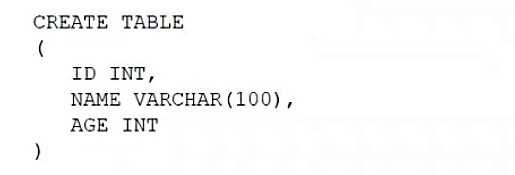
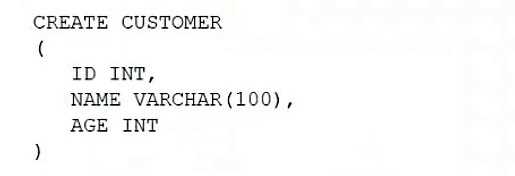
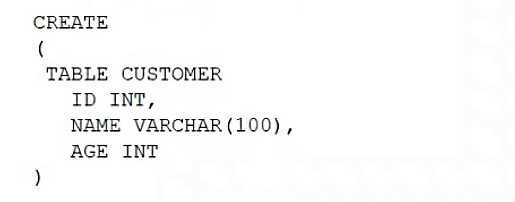
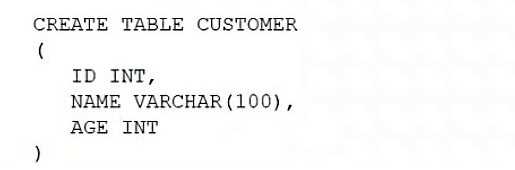
The correct command to create a database table uses the CREATE TABLE syntax, which is part of SQL's Data Definition Language (DDL). The standard structure is CREATE TABLE table_name, followed by a pair of parentheses. Inside the parentheses, each column is defined with its name and data type (e.g., ID INT). Option D is the only choice that correctly places the table name CUSTOMER after the CREATE TABLE keywords and properly encloses the column definitions in parentheses.
A) This syntax is incorrect because it omits the required table name (CUSTOMER) immediately after the CREATE TABLE keywords.
B) This syntax is incorrect because it omits the mandatory TABLE keyword. CREATE CUSTOMER is not a valid SQL command for creating a table.
C) This syntax is invalid. The TABLE keyword and the table name CUSTOMER must be placed before the opening parenthesis, not inside it.
Stanford University (Courseware): In the course notes for "CS 145: Introduction to Databases," the syntax for creating tables is explicitly defined.
Reference: Stanford University, CS 145: Introduction to Databases, "SQL - Data Definition" lecture notes, Section: "Creating Tables." The syntax is given as: CREATE TABLE