
Arcitura certification practice
S90-09 Practice Questions
Try 10 free S90-09 exam-style questions for SOA Design & Architecture Lab. Check each answer and review the explanation and source references.
- Exam code
- S90-09
- Provider
- Arcitura
- Free questions
- 10
- Full set
- 40 questions
- Last update check
If you are interested in starting a career in service-oriented computing or are actively looking to expand your architectural knowledge, the S90-09 certification exam is a phenomenal place to begin. This exam is expertly designed to test your foundational understanding of complex SOA design patterns as covered in the SOA Design & Architecture Lab. With the direct assistance of our S90-09 real exam questions, you can prepare much more effectively and significantly boost your chances of passing the assessment on your very first try.
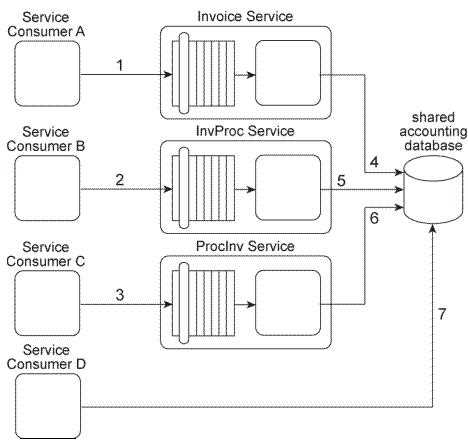 Assuming that the Invoice service, InvProc service, and ProcInv service are part of the same service
inventory, what steps would be required to fully apply the Official Endpoint pattern?
Assuming that the Invoice service, InvProc service, and ProcInv service are part of the same service
inventory, what steps would be required to fully apply the Official Endpoint pattern?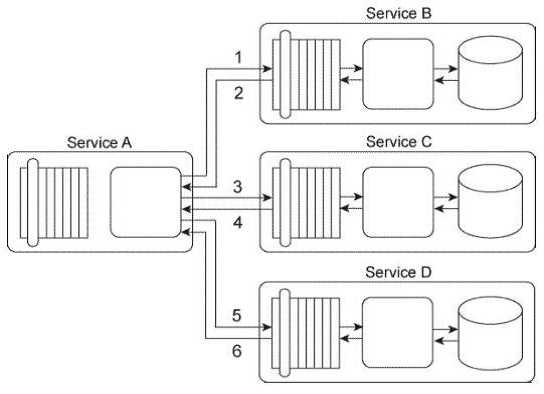 You've been given a requirement that all database updates must either be completed successfully or
not at all. This means that if any of the three response messages received by Service A contain a
failure code, all of the updates carried out until that point must be reversed. Note that if Service A
does not receive a response message back from Services B, C, or D, it must assume that a failure has
occurred. How can this service composition architecture be changed to fulfill these requirements?
You've been given a requirement that all database updates must either be completed successfully or
not at all. This means that if any of the three response messages received by Service A contain a
failure code, all of the updates carried out until that point must be reversed. Note that if Service A
does not receive a response message back from Services B, C, or D, it must assume that a failure has
occurred. How can this service composition architecture be changed to fulfill these requirements?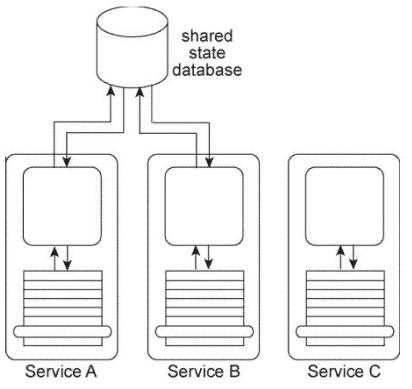 You are asked to redesign this architecture in order to increase the opportunity for agnostic service
logic to be reused and in order to decrease the runtime processing demands so that performance can
be improved. What steps can be taken to achieve these goals?
You are asked to redesign this architecture in order to increase the opportunity for agnostic service
logic to be reused and in order to decrease the runtime processing demands so that performance can
be improved. What steps can be taken to achieve these goals?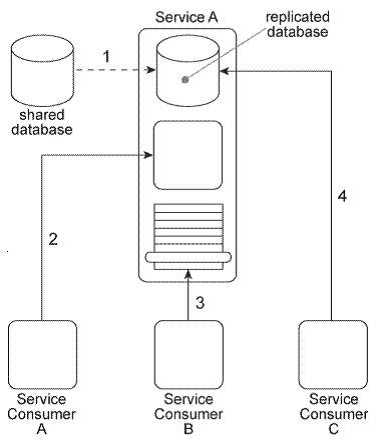 You've been told that the reason Service Consumers A and C bypass the published Service A service
contract is because, for security reasons, they are not allowed to access a subset of the operations in
the WSDL definition that expresses the service contract. How can the Service A architecture be
changed to enforce these security restrictions while avoiding negative forms of coupling?
You've been told that the reason Service Consumers A and C bypass the published Service A service
contract is because, for security reasons, they are not allowed to access a subset of the operations in
the WSDL definition that expresses the service contract. How can the Service A architecture be
changed to enforce these security restrictions while avoiding negative forms of coupling?Upon reviewing these requirements it becomes evident to you that the Orchestration compound pattern will need to be applied. However, there are additional requirements that need to be fulfilled. To build this service composition architecture, which patterns that is not associated with the Orchestration compound pattern need to also be applied? (Be sure to choose only those patterns that relate directly to the requirements described above. Patterns associated with the Orchestration compound pattern include both the required or core patterns that are part of the basic compound pattern and the optional patterns that can extend the basic compound pattern.)
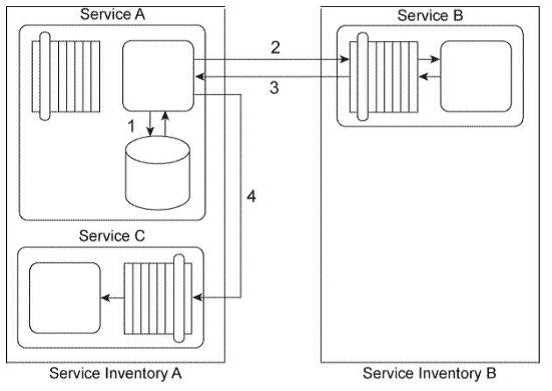 You are told that the services in Service Inventory A are all SOAP-based Web services designed to
exchange SOAP 1.1 messages and the services in Service Inventory B are SOAP-based Web services
designed to exchange SOAP 1.2 messages. Therefore, Service A and Service B cannot currently
communicate. Furthermore, you are told that Service B needs to access a shared database in order to
retrieve the data required by Service A . The response time of the database can sometimes be
lengthy, which would cause Service A to consume too much resources while it is waiting and keeping
the code values in memory. How can this service composition architecture be changed to avoid these
problems?
You are told that the services in Service Inventory A are all SOAP-based Web services designed to
exchange SOAP 1.1 messages and the services in Service Inventory B are SOAP-based Web services
designed to exchange SOAP 1.2 messages. Therefore, Service A and Service B cannot currently
communicate. Furthermore, you are told that Service B needs to access a shared database in order to
retrieve the data required by Service A . The response time of the database can sometimes be
lengthy, which would cause Service A to consume too much resources while it is waiting and keeping
the code values in memory. How can this service composition architecture be changed to avoid these
problems?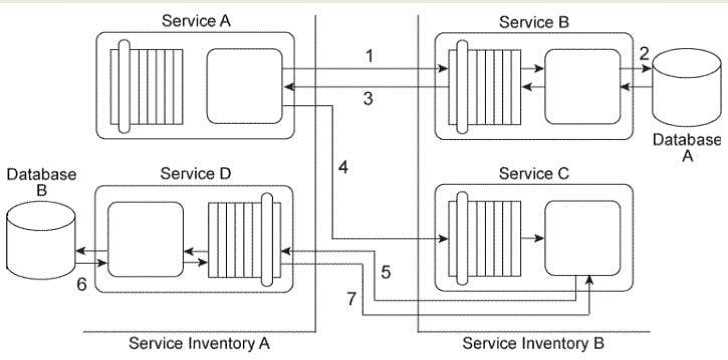 You are an architect with a project team building services for Service Inventory A . You are told that
the owners of Service Inventory A and Service Inventory B are not generally cooperative or
communicative. Cross-inventory service composition is tolerated, but not directly supported. As a
result, no SLAs for Service B and Service C are available and you have no knowledge about how
available these services are. Based on the service contracts you can determine that the services in
Service Inventory B use different data models and a different transport protocol than the services in
Service Inventory A . Furthermore, recent testing results have shown that the performance of Service
D is highly unpredictable due to the heavy amount of concurrent access it receives from service
consumers from other organizations. You are also told that there is a concern about how long Service
Consumer A will need to remain stateful while waiting for a response from Service A . What steps can
be taken to solve these problems?
You are an architect with a project team building services for Service Inventory A . You are told that
the owners of Service Inventory A and Service Inventory B are not generally cooperative or
communicative. Cross-inventory service composition is tolerated, but not directly supported. As a
result, no SLAs for Service B and Service C are available and you have no knowledge about how
available these services are. Based on the service contracts you can determine that the services in
Service Inventory B use different data models and a different transport protocol than the services in
Service Inventory A . Furthermore, recent testing results have shown that the performance of Service
D is highly unpredictable due to the heavy amount of concurrent access it receives from service
consumers from other organizations. You are also told that there is a concern about how long Service
Consumer A will need to remain stateful while waiting for a response from Service A . What steps can
be taken to solve these problems?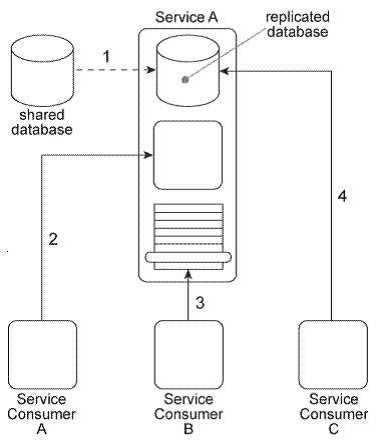
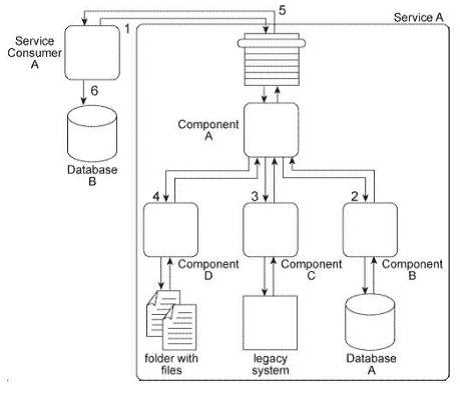 Service A is a task service that completes an entire business task on its own without having to
compose other services. However, you have received many complaints about the reliability of
Service A . Specifically, it has three problems. First, when Component B accesses Database A, it may
not receive a response for several minutes when the database is being accessed by other
applications in the IT enterprise. Secondly, the legacy system accessed by Component C frequently
crashes and therefore becomes unavailable for extended periods of time. Third, for Component D to
respond to Component A, it must first wait for the batch import of the files to occur. This can take
several minutes during which Service Consumer A remains state ful and consumes excessive
memory. What steps can be taken to address these three problems?
Service A is a task service that completes an entire business task on its own without having to
compose other services. However, you have received many complaints about the reliability of
Service A . Specifically, it has three problems. First, when Component B accesses Database A, it may
not receive a response for several minutes when the database is being accessed by other
applications in the IT enterprise. Secondly, the legacy system accessed by Component C frequently
crashes and therefore becomes unavailable for extended periods of time. Third, for Component D to
respond to Component A, it must first wait for the batch import of the files to occur. This can take
several minutes during which Service Consumer A remains state ful and consumes excessive
memory. What steps can be taken to address these three problems?Service Consumer A sends a message to Service A . There are currently three duplicate implementations of Service A (Implementation 1, Implementation 2, Implementation 3). The message sent by Service Consumer A is intercepted by Service Agent A (1), which determines at runtime which implementation of Service A to forward the message to. All three implementations of Service A reside on the same physical server. 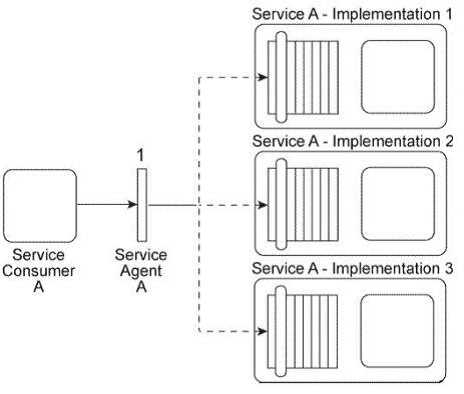 You are told that despite the fact that duplicate implementations of Service A exist, performance is still poor at times. Also, you are informed that a new service capability will soon need to be added to Service A that will introduce functionality that will require access to a shared database that is used by many other clients and applications in the IT enterprise. This is expected to add further performance demands on Service A . How can this service architecture be changed to improve performance in preparation for the addition of the new service capability?
Source context
How this practice set is maintained
Maintained by the CertMage content team, this page loads questions from the exam dataset connected to its preparation resource. When an answer includes a supporting reference, it is shown with that answer so you can review the underlying vendor documentation.
Certification objectives, interfaces, and vendor services can change. Verify important details against the provider's current exam guide and documentation before your exam.