TL;DR: If your goal is a career in risk (market risk, credit risk, operational risk, treasury, model validation, risk consulting), the FRM from GARP is the more direct credential. It has two exams, about US 1,600 to US 2,000 in total fees, and it is built entirely around risk. If your goal is investment management, equity research, portfolio construction or a broad finance career where risk is one of several skills, the CFA charter carries more weight, but it takes three exams, a lot more study time and a longer road to the charter. Many people in risk end up holding both, but the sensible order is to pick the one that matches your next job and add the second later if it still makes sense.
Most “FRM vs CFA” advice online is a list of features. The more useful question is what you want your title to say in three years. This guide answers that, then backs it up with exam structure, cost, time and pass rates so you can plan properly.
Quick Facts
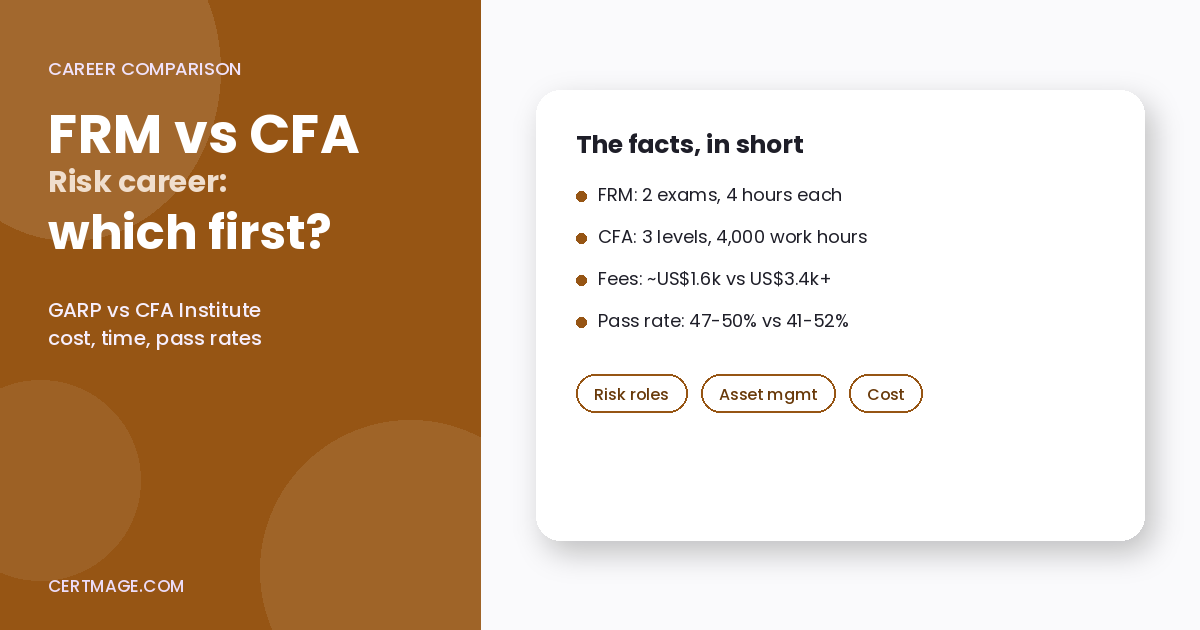
| Item | FRM (GARP) | CFA (CFA Institute) |
| Full name | Financial Risk Manager | Chartered Financial Analyst |
| Focus | Risk measurement and risk management | Investment analysis and portfolio management, with ethics at the core |
| Number of exams | 2 (Part I and Part II) | 3 (Level I, II and III) |
| Format | Multiple choice, 4 hours per part. Part I has 100 questions, Part II has 80 | Level I is multiple choice (4.5 hours, two sessions of 135 minutes). Levels II and III use item sets, and Level III adds constructed response |
| Exam windows | Twice a year, May and November | Level I several times a year. Levels II and III less often, so check the current calendar |
| Enrollment fee | US$400 one time | US$0 at 2026 rates |
| Exam fee | US600earlyorUS800 standard per part | Roughly US1,140toUS1,590 per level depending on when you register (2026 rates) |
| Typical total fees if you pass first time | About US1,600(early)toUS2,000 (standard) | About US3,420toUS4,770 before books and prep |
| Recommended study time | About 240 hours per part per GARP’s guidance | About 300 hours per level per CFA Institute’s guidance |
| Pass rates | Nov 2025: 47% (Part I) and 50% (Part II) | 10-year averages: about 41% (Level I), 45% (Level II), 52% (Level III) |
| Work experience | Two years of relevant professional experience to earn the designation | 4,000 hours of qualifying work over at least 36 months for the charter |
| Best for | Risk, treasury, credit, model risk, regulatory and quant-risk roles | Asset management, equity research, wealth, investment banking, broad finance leadership |
Fee figures change from year to year. We could not find confirmed 2027 CFA fees at the time of writing, so treat the CFA numbers as 2026 rates and check the CFA Institute site before you budget.
What Each Credential Actually Signals
The FRM says: I understand how things go wrong
GARP built the FRM around the practical business of identifying, measuring and controlling risk at financial institutions. The content is risk from top to bottom: the foundations of risk management, quantitative analysis, financial products and markets, valuation and risk models in Part I, and then market risk, credit risk, operational and resilience risk, liquidity and treasury risk, risk management in investment settings and current issues in Part II.
When a hiring manager in a bank’s risk department sees FRM on a CV, the signal is clear. This person has seen VaR, expected shortfall, credit models, stress testing, Basel concepts and operational loss data in one structured programme. You do not need to explain what you studied.
The CFA says: I can analyze securities and manage money, and I follow a strict ethics code
The CFA Program is broader. It covers ethics, quantitative methods, economics, financial statement analysis, corporate issuers, equity, fixed income, derivatives, alternatives, portfolio management and wealth planning. Risk shows up throughout (portfolio risk, return measurement, fixed income risk, derivatives pricing), but it is one theme among many.
The charter is among the most recognized in investment management, and the ethics requirement and professional conduct standard are a real part of why employers trust it. In risk teams inside asset managers, hedge funds, pension funds and insurers, the CFA is common and respected. In risk teams inside banks, the FRM is usually the more familiar letters.
Exam Structure Side by Side
FRM Part I
Part I has 100 multiple-choice questions over 4 hours. The four areas are:
| Topic | Weight |
| Foundations of Risk Management | 20% |
| Quantitative Analysis | 20% |
| Financial Markets and Products | 30% |
| Valuation and Risk Models | 30% |
Part I is the more technical and calculation-heavy of the two. Candidates who come from engineering, math or data backgrounds usually find the quantitative section comfortable and the products section new. Candidates from business backgrounds often have it the other way around.
FRM Part II
Part II has 80 multiple-choice questions over 4 hours. It is applied rather than introductory:
| Topic | Weight |
| Market Risk Measurement and Management | 20% |
| Credit Risk Measurement and Management | 20% |
| Operational Risk and Resilience | 20% |
| Liquidity and Treasury Risk Measurement and Management | 15% |
| Risk Management and Investment Management | 15% |
| Current Issues in Financial Markets | 10% |
The “Current Issues” section is the one that catches people out. It reflects what is happening in markets and regulation now, so reading GARP’s own material and recent industry papers matters more than a static textbook summary.
CFA Level I
Level I is 180 multiple-choice questions in two 135-minute sessions. It tests breadth: ethics, quantitative methods, economics, financial statement analysis, corporate issuers, equity, fixed income, derivatives, alternatives and portfolio management. If you are planning a Level I attempt, our guide to the CFA Level I 2027 curriculum changes explains what moved in Quantitative Methods and Equity, and our CFA Level I practice material shows what the question style feels like.
CFA Level II
Level II uses item sets, which are case-based mini scenarios with several questions each. The focus shifts from knowing concepts to applying them, mostly in valuation. Most candidates say Level II is the hardest jump in the program because the volume of material stays high while the questions demand real analysis. You can see how the format works in our CFA Level II practice questions.
CFA Level III
Level III moves into portfolio management and wealth planning and adds constructed-response questions. Writing answers under time pressure is a different skill from picking an option, and candidates who did well on the first two levels sometimes underestimate it.
Cost: What You Will Really Spend
FRM
| Item | Early | Standard |
| Enrollment (one time) | US$400 | US$400 |
| Part I exam | US$600 | US$800 |
| Part II exam | US$600 | US$800 |
| Total fees | US$1,600 | US$2,000 |
That is fees only. Most candidates also buy a question bank or video course, so plan on a few hundred dollars more, and more again if you choose a premium provider. We did not find late or deferral fee details on GARP’s fees page, so check the current schedule before you register if you think you may need to move your exam date.
CFA
| Item | Range at 2026 rates |
| Enrollment | US$0 |
| Each level | About US1,140toUS1,590 depending on registration timing |
| Three levels, no retakes | About US3,420toUS4,770 |
A failed level means paying the exam fee again. With the 10-year average Level I pass rate around 41%, a meaningful share of candidates pay for at least one retake. Add prep courses and you can see why total CFA spend often reaches several thousand dollars more than the exam fees alone.
Cost verdict
The FRM is cheaper in fees and in time. It is not a close contest. Even if you fail one FRM part, you are still likely to finish well under the cost of a clean pass through all three CFA levels.
Time: How Long Each Path Takes
GARP recommends about 240 hours of study per part. Plan on roughly 4 to 6 months per part, so a realistic route to passing both parts is 8 to 12 months, or longer if you work full time and travel.
CFA Institute recommends about 300 hours per level. Three levels means roughly 900 hours at the recommended pace, and most candidates take two to four years in total because the exam windows are limited and retakes are common.
If you are in a hurry to change roles, that is a major factor. A person starting the FRM in January can reasonably hold Part I by May and Part II by November, then move into a risk role while finishing the experience requirement. The CFA route rarely moves that fast.
Pass Rates: What the Numbers Say
For the November 2025 FRM sitting, the reported pass rates were 47% for Part I and 50% for Part II. CFA Institute lists 10-year average pass rates of roughly 41% for Level I, 45% for Level II and 52% for Level III.
These are not directly comparable. FRM candidates tend to be working professionals who already live in finance, while the CFA candidate pool is much larger and includes many first-year students. But the practical message is the same for both: roughly half of candidates do not pass on a given attempt, so do not plan your job change around a single sitting.
Work Experience and When You Can Use the Letters
The FRM requires two years of relevant full-time professional experience before you can be awarded the designation. You can sit the exams earlier, and many people do. Once you pass the exams you are an FRM candidate until the experience is verified.
The CFA charter requires 4,000 hours of qualifying work experience accumulated over at least 36 months, plus membership with CFA Institute, a professional conduct statement and a pass at all three levels. The experience does not need to be investment-analysis work in the strict sense, but it does need to be related to the investment decision-making process, and CFA Institute reviews what you submit.
For students and early-career candidates, both credentials let you pass first and complete the experience later, which makes the exam stage a good move even before you have a risk role.
Career Fit: Which Path Matches Which Job
| Your target role | Better fit | Why |
| Market risk analyst at a bank | FRM | The content mirrors the daily work: VaR, stress testing, limits, Basel |
| Credit risk analyst or portfolio credit | FRM, then CFA if you move to credit research | Credit models and loss estimation are a core part of Part II |
| Operational or enterprise risk | FRM | Operational risk and resilience are explicit parts of the exam |
| Treasury and liquidity risk | FRM | Liquidity and treasury risk have their own section |
| Model risk or model validation | FRM, plus strong quant skills | Valuation and risk models in Part I are directly relevant |
| Risk analyst at an asset manager or fund | Either, and often CFA | Portfolio context is CFA territory, but risk skills come from the FRM |
| Equity research or portfolio management | CFA | The program is built for this and hiring managers expect it |
| Investment banking or corporate finance | Neither is required, but CFA is better known | Valuation depth helps more than risk theory |
| Wealth management and advisory | CFA | Portfolio management and ethics content line up with the work |
| Compliance and financial crime | Neither is the first choice | Our CFE guide covers a more suitable path |
| Internal audit with a risk focus | Neither first | Look at the CIA path |
If you are not sure yet, think about who will read your CV. If the person reviewing it sits in a bank’s risk function, FRM works. If they sit on an investment team, CFA works.
How to Choose: A Simple Decision Path
- Do you already work in, or want to move into, a risk function? Take the FRM first.
- Do you want to manage money or analyze securities? Take the CFA first.
- Are you a student who does not know yet? Start with CFA Level I if you want to keep options open across finance, or FRM Part I if you are sure about risk. Both Level I and Part I are broad enough to teach you something useful either way.
- Do you have limited time and budget? The FRM is the lower-cost, lower-time path to a recognized credential.
- Does your employer sponsor one of them? Sponsorship often decides the question. Take what they will pay for, and add the other if your plans change.
- Do you already hold one and are considering the other? The overlap is real. Fixed income, derivatives, portfolio risk and ethics-adjacent content appear in both, so the second program is faster than the first.
If you are specifically interested in risk and AI, GARP also offers a newer certificate that sits beside the FRM. Our guide to the GARP Risk and AI certificate explains how it fits.
Study Plans That Work
FRM: 8 to 10 months for both parts
| Period | What to do |
| Months 1 to 4 | Work through Part I: foundations and quant first, then products, then valuation and risk models |
| Month 5 | Full Part I practice exams and a close review of weak areas |
| Part I exam | May or November window |
| Months 6 to 9 | Part II: spend the most time on market and credit risk, then operational and liquidity |
| Final 4 weeks | Read recent GARP articles and industry papers for the Current Issues section, then take timed mocks |
| Part II exam | Following window |
CFA: 3 levels over about 2 to 3 years
| Phase | What to do |
| Level I | 4 to 6 months. Start with Ethics and Quantitative Methods, and treat Ethics as a scoring area, not a formality |
| Level II | 5 to 6 months. Focus on valuation and item-set practice rather than rereading |
| Level III | 5 to 6 months. Practice written answers early, because speed and clarity matter |
For both programs, practice questions beat passive reading. Do them in timed blocks and review every wrong answer until you can explain it in your own words.
Common Mistakes
- Choosing by prestige alone. A CFA charter does not automatically beat the FRM in a risk interview. The relevant question is what the team does.
- Underestimating the quant in FRM Part I. Candidates from non-technical backgrounds often treat it as a theory exam and get caught by the numerical questions.
- Ignoring Ethics in the CFA. It carries real weight and it is a place where preparation pays off quickly.
- Using out-of-date prep material. Both programs update their content. Confirm your materials match the current year.
- Starting both at once. The workloads overlap in topic but not in schedule, and doing both in the same cycle tends to produce a weaker result in each.
- Skipping the experience requirement planning. Keep records of your roles and responsibilities from the start so verification does not become a scramble later.
Is It Worth It?
For a risk career, the FRM is worth it if you can use it quickly. The fees are modest, the time is manageable, and the content maps to real job tasks. For a broader finance or investment career, the CFA is worth the longer commitment, but only if you are ready to see it through. A half-finished CFA (passing Level I and stopping) is still useful as a signal of commitment and knowledge, but it does not carry the weight of the charter.
We have deliberately left salary figures out of this comparison. We could not find a source that isolates people who hold these credentials from the wider finance population, and loose averages tend to mislead more than they help.
If you are asking which one to start this year, the answer for most risk-focused candidates is the FRM. Add the CFA later if your role moves toward portfolio management. For the official program details, fee schedule and exam calendar, GARP maintains the current information on its FRM program page.
FAQs
1. Is the FRM or the CFA harder?
They are hard in different ways. The CFA has more volume and more levels, with a 10-year average Level I pass rate near 41%. The FRM has fewer exams, but the questions are technical and the November 2025 pass rates were 47% for Part I and 50% for Part II.
2. Which is better for a risk career?
The FRM is more targeted and more widely recognized inside bank risk functions. The CFA is strong in asset management, insurance and investment risk teams.
3. Can I do the FRM without a finance degree?
Yes. There is no degree requirement to sit the exams. Candidates from engineering, math and science backgrounds often do well, though they will need extra time on financial products.
4. How much does the FRM cost in total?
Plan on about US1,600ifyouregisterearlyforbothparts,oraboutUS2,000 at standard rates, including the one-time US$400 enrollment. Add your prep materials on top.
5. How much does the CFA cost in total?
At 2026 rates, three levels without a retake come to roughly US3,420toUS4,770 in exam fees. 2027 fees were not confirmed when we wrote this, so check the CFA Institute site.
6. How long does each take?
The FRM typically takes 8 to 12 months for both parts. The CFA typically takes two to four years for all three levels.
7. Do I need work experience to take the exams?
No for both, in the sense that you can sit the exams before you have the experience. The FRM designation requires two years of relevant experience, and the CFA charter requires 4,000 hours over at least 36 months.
8. Should I take Part I of the FRM and Level I of the CFA in the same year?
It is possible, but the schedule is heavy. Most candidates get better results by finishing one and then starting the other.
9. Does holding both help?
It can, particularly in asset management risk, model validation and senior risk roles. For early-career candidates, one credential plus strong work experience is usually enough to start.
10. How many times can I retake?
Both programs allow retakes, but each attempt costs a new exam fee. Check the current retake policy on the GARP and CFA Institute sites before you plan.
11. Which one is better for a career change into finance?
If you want to move into risk specifically, the FRM is faster. If you want a broad entry into finance and are willing to invest time, the CFA opens more doors across roles.
12. Is the CFA useful if I want to work in risk at an asset manager?
Yes. It gives you the portfolio and investment context that risk teams in those firms rely on. Many people there add the FRM for the risk-specific techniques.
13. Which one should a student choose first?
If you are certain about risk, start with FRM Part I. If you are keeping your options open across finance, CFA Level I gives you the broader foundation.