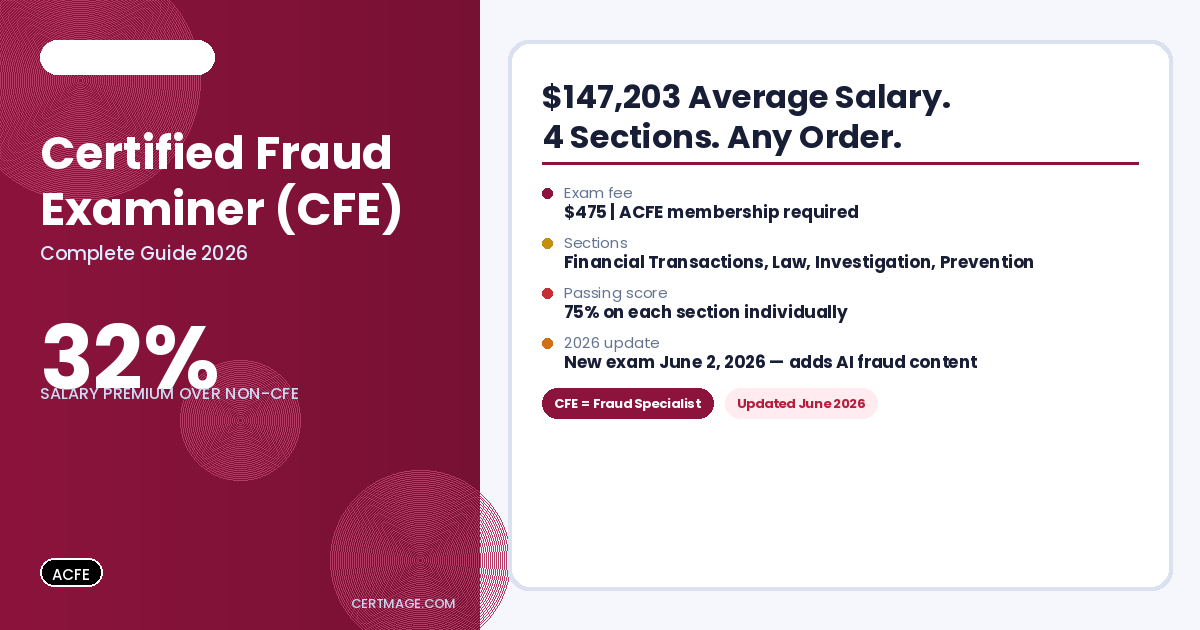
The Certified Fraud Examiner (CFE) is the professional credential issued by the Association of Certified Fraud Examiners (ACFE) that validates expertise in detecting, preventing, and investigating fraud and white-collar crime. CFEs earn an average US salary of $147,203 annually – 32 to 34 percent more than non-certified colleagues in the same roles – and work across banking, insurance, government, law enforcement, forensic accounting, and corporate internal controls. The ACFE updated the CFE exam on June 2, 2026 based on its 2024 Job Task Analysis, making any study materials from before June 2026 partially outdated.
Who Should Pursue the CFE
The CFE is not a beginner credential. It is designed for professionals who already work with financial data, investigations, compliance, or audit – and want to specialize in fraud specifically.
The CFE is the right credential if you:
- Work in internal audit or compliance and want to add fraud examination specialization
- Work in forensic accounting or financial investigations
- Work in banking, insurance, or financial services in a risk or compliance role
- Work in law enforcement or government investigations involving financial crime
- Are a CPA, CIA, or CISA holder seeking anti-fraud specialization
- Work as a consultant advising organizations on fraud prevention programs
The CFE may not be your first credential if you:
- Are just entering the workforce without relevant audit or financial experience
- Have no exposure to financial statements, legal concepts, or investigative processes
- Need a certification that satisfies DoD 8570 requirements (CISA or CISSP are better fits)
CFE Exam: Full Details
| Detail | Specification |
| Issuing organization | Association of Certified Fraud Examiners (ACFE) |
| Exam fee | $475 USD (per exam attempt; ACFE membership required) |
| ACFE membership fee | $125-$300/year depending on membership category |
| Prep course cost | $849 (member) / $1,062 (non-member); includes $100 exam credit |
| Total first-year investment | $600-$1,300+ depending on whether you purchase prep materials |
| Format | 4 separate sections, taken individually, computer-based |
| Questions per section | 70-120 multiple choice per section |
| Passing score | 75% on each section (must pass all 4 individually) |
| Time per section | Timed but not publicly specified |
| Score delivery | Preliminary score within 24 hours of each section |
| Where to test | Pearson VUE test centers globally |
| Current exam version | Updated June 2, 2026 (based on 2024 Job Task Analysis) |
| Renewal | 20 CPE hours per year minimum |
| ACFE membership required to certify | Yes (must be a member when granted CFE designation) |
The Four CFE Exam Sections
The CFE exam is structured around four sections that collectively define the fraud examiner’s professional domain. You must pass all four. You can take them in any order and do not need to complete them all at once.
Section 1: Financial Transactions and Fraud Schemes
This is the largest section and the one that most directly tests technical accounting and fraud knowledge.
| Topic | What it covers |
| Fraudulent financial statements | Earnings manipulation, fictitious revenues, understated liabilities |
| Asset misappropriation | Skimming, cash larceny, billing schemes, payroll fraud, expense reimbursement |
| Corruption | Bribery, conflicts of interest, illegal gratuities, economic extortion |
| Money laundering | Placement, layering, integration; trade-based money laundering |
| Healthcare fraud | Billing for non-rendered services, upcoding, kickbacks, phantom patients |
| Contract and procurement fraud | Bid rigging, change order fraud, defective delivery schemes |
| Bankruptcy and insurance fraud | Common schemes and red flags in each sector |
This section directly overlaps with knowledge from CPA, CMA, and CIA preparation. Candidates from accounting backgrounds often find this section the most intuitive.
Section 2: Law
This section covers the legal framework within which fraud investigations operate. It is tested from a US-centric perspective but covers international concepts.
| Topic | What it covers |
| Legal elements of fraud | Criminal vs civil fraud standards, intent requirements |
| Transaction documents as evidence | Admissibility, chain of custody, document authentication |
| Interviewing and confession law | Miranda rights, right to counsel, voluntary statement requirements |
| Fourth Amendment considerations | Search and seizure in fraud investigations, warrants |
| Expert witness | Qualifying as an expert, testimony standards, Daubert standard |
| Civil law options | Injunctions, attachments, alternative dispute resolution |
| Employment law | Wrongful termination in fraud investigation context |
| Digital evidence | Computer forensics legal considerations, electronic discovery |
The Law section is the one that most surprises candidates without legal backgrounds. It does not require law school knowledge, but it does require understanding how investigators must operate within legal boundaries.
Section 3: Investigation
This section covers the practical tools and methodologies fraud investigators use to find, document, and present evidence of fraud.
| Topic | What it covers |
| Interviewing techniques | Cognitive interview approach, detecting deception, rapport building |
| Obtaining information | Public records, databases, background checks, surveillance techniques |
| Covert and physical evidence | Document analysis, net worth analysis, source/use of funds analysis |
| Tracing illicit transactions | Following the money, bank record analysis, asset tracing |
| Report writing | Structure, objectivity, evidence presentation, expert report standards |
| Data analysis | Sampling, Benford’s Law, data mining for anomaly detection |
| Digital forensics | Computer evidence collection, preservation, chain of custody |
Benford’s Law – the mathematical principle that leading digits in naturally occurring datasets follow a predictable distribution – is specifically tested. Knowing how to apply it to financial data to detect potential manipulation is a concrete exam-day requirement.
Section 4: Fraud Prevention and Deterrence
This section tests your ability to design and evaluate organizational fraud prevention programs, not just investigate fraud after it occurs.
| Topic | What it covers |
| Why fraud occurs | Fraud Triangle (pressure, opportunity, rationalization) and extensions |
| Ethics programs | Code of conduct design, ethical training, tone-at-the-top frameworks |
| Corporate governance | Board oversight, audit committee roles, whistleblower program design |
| Internal controls | Control environment, preventive vs detective controls, separation of duties |
| Fraud risk assessment | Identifying fraud risk, mapping to controls, residual risk analysis |
| Fraud risk management programs | Building an anti-fraud program: components, governance, reporting |
| Employee awareness programs | Training design, hotline management, culture surveys |
CFE Eligibility Requirements: The Point System
The CFE uses a point-based eligibility system rather than a fixed number of years of experience. You must accumulate at least 50 points from the combination of education and professional experience.
| Credential / Experience | Points |
| Bachelor’s degree | 40 points |
| Master’s degree | 50 points (satisfies education requirement alone) |
| CPA, CA, CIA, CISA, CGAP, or similar professional designation | 10-20 points each |
| Each year of relevant professional experience | 10 points per year |
| Relevant associate degree | 20 points |
The most common qualification path: Bachelor’s degree (40 points) + 2 years of relevant experience (20 points) = 60 points. This is the minimum most working professionals in audit, accounting, or compliance easily meet.
You must be an ACFE member when you apply to take the exam, and you must remain a member when the CFE designation is granted. Non-members cannot receive the CFE credential even if they pass all four sections.
How CFE Compares to Related Audit Credentials
| Factor | CFE | CIA | CISA |
| Issuing body | ACFE | IIA | ISACA |
| Specialty | Fraud examination | Internal auditing | IT/IS auditing |
| Exam sections | 4 separate sections | 3 parts | 1 exam |
| Experience required | 50 points (typically 2yr + degree) | 1 year | 5 years in IS |
| Average US salary | $147,000 | $95,000-$145,000 | $100,000-$155,000 |
| Salary premium | 32-34% over non-CFE | Significant | Significant |
| DoD 8570 recognition | Limited | No direct mapping | Yes (technical IA) |
| Best for | Fraud specialists, forensic accountants | Internal audit generalists | IT audit specialists |
CFE is not a replacement for CIA or CISA – it is a specialization. Many of the most effective fraud examiners hold CIA or CPA alongside CFE, using the combination to signal both general audit competence and specific fraud expertise.
CFE Salary and Career Roles
According to the ACFE’s 2024 Compensation Guide for Anti-Fraud Professionals and corroborated by ZipRecruiter data, CFE holders earn a consistent premium across every career stage.
| Role | Industry | US Salary Range |
| Fraud Analyst | Banking, Insurance | $60,000-$85,000 |
| Anti-Fraud Specialist | Healthcare, Government | $70,000-$95,000 |
| Fraud Investigator | Corporate, Law Enforcement | $80,000-$110,000 |
| Forensic Accountant | Consulting, Advisory | $90,000-$130,000 |
| Senior Fraud Examiner | Financial Services | $110,000-$145,000 |
| Director of Fraud Risk Management | Banking, Insurance | $130,000-$170,000 |
| Chief Fraud Examiner / VP Financial Crime | Enterprise | $150,000-$200,000+ |
The ACFE documents that CFE holders earn over $600,000 more than non-CFEs across the span of a 30-year career when the 32 percent salary premium is applied cumulatively.
The June 2026 CFE Exam Update
The ACFE released an updated CFE exam on June 2, 2026, based on a comprehensive 2024 Job Task Analysis surveying practicing CFEs worldwide. Key areas of update include:
- Enhanced coverage of cryptocurrency and digital asset fraud
- Expanded content on AI-facilitated fraud schemes including deepfake-based fraud and synthetic identity fraud
- Updated legal content reflecting current digital evidence standards
- Revised fraud risk management content incorporating updated ACFE Anti-Fraud Program standards
- Additional coverage of third-party and vendor fraud risk
Candidates using study materials created before June 2026 should supplement with ACFE’s updated content specifically in the cryptocurrency/digital fraud and AI fraud areas.
How to Prepare for the CFE Exam
Step 1: Join ACFE and qualify. Calculate your points using the 50-point system. If you have a bachelor’s degree and 2 years of relevant experience, you qualify. Join ACFE as an associate member before registering.
Step 2: Choose your study materials. ACFE’s official Self-Study CFE Exam Prep Course is the gold standard. It is available to members at a discounted rate ($849) and includes the study guide, practice questions, and an exam credit. CertMage’s CFE exam practice questions provide additional scenario-based preparation across all four sections.
Step 3: Plan your section order. Most candidates take Financial Transactions and Fraud Schemes first because it covers the most familiar content (accounting and fraud concepts) and builds confidence before tackling Law and Investigation. Fraud Prevention and Deterrence is often taken last as it synthesizes concepts from the other three.
Step 4: Study Benford’s Law specifically. This appears in virtually every CFE exam sitting as a practical data analysis tool. Know what it predicts, how deviations signal fraud risk, and how to apply it to different datasets.
Step 5: Master the Fraud Triangle. Donald Cressey’s Fraud Triangle (pressure, opportunity, rationalization) and its modern extensions are foundational to the Prevention and Deterrence section. Understand each element thoroughly and know how organizational controls can address each.
| Candidate background | Recommended prep time |
| Accountant or auditor with 3+ years experience | 3-4 months across all 4 sections |
| Financial analyst with some audit exposure | 4-6 months |
| Legal or law enforcement professional | 5-7 months (stronger on Law/Investigation; supplement Financial) |
| New to financial investigations | 6-9 months + ACFE training course |
FAQs
What is the CFE certification?
CFE stands for Certified Fraud Examiner. It is issued by the ACFE (Association of Certified Fraud Examiners) and validates professional expertise in detecting, preventing, and investigating fraud and financial crime. CFEs earn 32-34% more than non-certified colleagues and work across banking, accounting, government, law enforcement, and corporate compliance.
How much does the CFE exam cost in 2026?
The CFE exam fee is $475. You must also be an ACFE member ($125-$300/year). The official prep course costs $849 for members and includes a $100 exam credit. Most candidates invest $600 to $1,300 total in their first year depending on study material choices.
What is the CFE passing score?
75% on each of the four sections individually. You cannot average across sections – each must be passed at or above 75%.
What changed in the June 2026 CFE exam update?
The ACFE released an updated exam on June 2, 2026 based on its 2024 Job Task Analysis. Key additions include cryptocurrency and digital asset fraud, AI-facilitated fraud schemes (deepfake fraud, synthetic identity), and updated digital evidence legal standards. Pre-June 2026 study materials need to be supplemented for these areas.
How long does it take to become a CFE?
Most working professionals with relevant experience complete all four sections in 3 to 6 months. You have 18 months from the date of your first section to complete all four. Taking one section per month is a common pacing strategy.
What experience counts toward CFE eligibility?
Relevant experience includes roles in auditing, accounting, fraud investigation, financial analysis, compliance, law enforcement, legal practice involving financial matters, and similar fields. Volunteer auditing and pro bono forensic accounting work can also count.
Do I need to be a CPA or have an accounting degree to become a CFE?
No. A bachelor’s degree in any field plus 2 years of relevant experience meets the eligibility threshold. Many CFEs come from law enforcement, legal, or business backgrounds without accounting degrees.
How do I maintain my CFE certification?
CFEs must complete 20 hours of CPE per year and pay annual ACFE membership dues. A minimum of 10 of the 20 CPE hours must be in subjects directly related to fraud prevention, detection, deterrence, or investigation.
What is Benford’s Law and why does it matter for the CFE?
Benford’s Law states that in many naturally occurring datasets, the leading digit is 1 approximately 30% of the time, 2 approximately 18% of the time, and so on decreasing to 9. Fraudulent data often deviates from this distribution because people making up numbers tend to distribute digits more evenly. It is a practical fraud detection tool tested in the CFE exam and used in real investigations.
Where can I practice CFE exam questions?
CertMage provides CFE practice questions covering all four exam sections aligned to the current ACFE exam blueprint. Visit our CFE exam questions page for detailed preparation material.