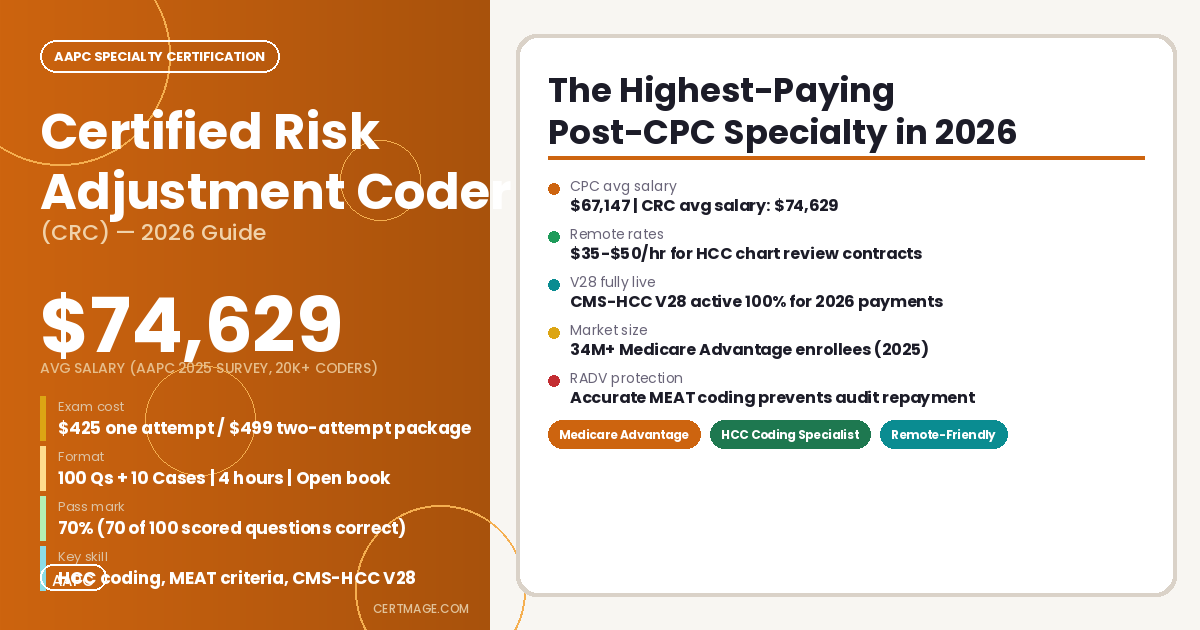
The CRC (Certified Risk Adjustment Coder), issued by AAPC, is the professional credential that validates expertise in Hierarchical Condition Category (HCC) coding – the specialized medical coding discipline that determines how much Medicare Advantage and ACA health plans pay to insure their members. CRC holders earn an average of $74,629 annually, according to AAPC’s 2025 Salary Survey of over 20,000 US coders, compared to $67,147 for CPC holders, and remote HCC chart reviewer contract rates reach $35 to $50 per hour for experienced specialists. With CMS-HCC Model V28 now fully active for payment year 2026 and Medicare Advantage enrollment exceeding 34 million Americans, risk adjustment coding is the single fastest-growing specialty in the entire medical coding profession.
Who Should Read This Guide
This guide is for:
- CPC holders who have heard about risk adjustment and want to understand whether CRC is the right next step
- Professionals already working in Medicare Advantage, ACA marketplace, or Medicaid managed care plans who want to formalize their expertise
- New medical coding students deciding which specialty track to pursue
- Healthcare compliance professionals whose work overlaps with risk adjustment auditing
If you are still working toward your first coding credential, see our CPC vs CCA guide first. The CRC is most valuable as a second credential for established coders, though it does not formally require CPC as a prerequisite.
What Risk Adjustment Coding Actually Is
Risk adjustment is the financial mechanism that makes health insurance markets work. Without it, insurance companies would have a financial incentive to only enroll healthy people. With it, plans that enroll sicker patients receive higher payments from CMS or the government to compensate for expected higher costs.
Here is how it works in practice:
Step 1: A patient with documented chronic conditions (Type 2 diabetes with complications, congestive heart failure, chronic obstructive pulmonary disease) visits their primary care provider.
Step 2: The provider documents each active condition in the medical record.
Step 3: A coder – specifically a risk adjustment coder – reviews that documentation and assigns ICD-10-CM codes for every chronic condition that meets risk adjustment criteria.
Step 4: Each qualifying diagnosis maps to an HCC (Hierarchical Condition Category) – a grouping of related diagnoses assigned a relative Risk Adjustment Factor (RAF) score.
Step 5: CMS adds all of an individual patient’s HCC scores together to create a total RAF score. A higher RAF score = higher payment to the health plan that covers that patient.
Step 6: If chronic conditions are not coded accurately – because documentation is incomplete, conditions are undercoded, or previous conditions are not recaptured in the current year – the health plan receives less payment than it is entitled to, creating both a financial loss and a compliance risk.
Risk adjustment coders are the professionals who make Step 3 happen accurately, compliantly, and at scale.
What Makes HCC Coding Different From Standard Medical Coding
This is the most important concept for any CPC holder considering the CRC. HCC coding is not just regular coding applied to sicker patients. It operates under a fundamentally different set of rules.
| Standard Medical Coding (CPC) | Risk Adjustment / HCC Coding (CRC) |
| Code the diagnosis documented for this visit | Code all active chronic conditions, not just the reason for the visit |
| Follow CPT for procedures | No procedure coding – ICD-10-CM diagnosis codes only |
| Code what was done today | Code what the patient has, if documented and still active |
| Acute conditions often drive coding | Chronic conditions drive risk adjustment value |
| Each claim is a standalone billing event | The annual risk score is built across all encounters over the year |
| Focus on claim accuracy | Focus on clinical condition completeness |
The biggest conceptual shift: in standard coding, you code what was treated. In risk adjustment coding, you code what the patient has – every active chronic condition that is documented, assessed, and addressed, whether or not it was the primary reason for the visit.
MEAT Criteria: The Foundation of Everything
MEAT stands for Monitoring, Evaluating, Assessing/Addressing, and Treating. These are the four documentation elements that determine whether a chronic condition can be used in risk adjustment.
| MEAT element | What it means in the medical record |
| Monitoring | The provider is watching the condition – labs ordered, vital signs relevant to the condition |
| Evaluating | The provider is reviewing test results, tracking progression, assessing control |
| Assessing / Addressing | The provider is discussing the condition with the patient, noting its current status |
| Treating | Medication is prescribed, therapy is ordered, management plan is active |
At least one MEAT element must be present in the record for the encounter for a chronic condition to be reportable for risk adjustment purposes. A diagnosis mentioned in the past medical history section without any current MEAT support cannot be coded for risk adjustment even if the condition still exists.
This is one of the most tested concepts on the CRC exam and the most common compliance error in risk adjustment coding. Coders who understand MEAT can distinguish between:
- A condition that is documented and MEAT-supported (codeable for risk adjustment)
- A condition that appears in the chart but has no current MEAT evidence (not codeable this encounter)
- A condition that should be coded but is missing from documentation despite clinical evidence (a coding gap requiring provider query)
CMS-HCC Model V28: The 2026 Critical Update
CMS updates its risk adjustment models periodically. The current model – CMS-HCC Version 28 (V28) – is now fully implemented for payment year 2026, completing a three-year phase-in that began in 2024.
Why V28 matters for CRC candidates and holders:
V28 changed which diagnoses map to HCCs, how conditions are grouped, and what RAF scores are assigned. It added specificity requirements, removed some broadly defined HCC categories, and created new ones for conditions where clinical evidence now supports more precise risk stratification.
| V28 change category | Impact on coding practice |
| New HCCs added | Some conditions that did not risk-adjust under V24 now do under V28 |
| Retired HCCs | Some previously high-value HCCs were split or eliminated – old coding patterns may miss new groupings |
| Increased specificity requirements | More diagnosis codes now require a higher level of specificity to map to an HCC |
| Hierarchies revised | Some condition relationships changed, affecting which code in a hierarchy should be reported |
Any CRC candidate studying from pre-2024 materials should verify that their study content reflects V28. Materials based on V24 or the transition period will not reflect the model used for payment year 2026 claims.
CRC Exam: Full Breakdown
| Detail | Specification |
| Issuing body | AAPC (American Academy of Professional Coders) |
| Exam cost | $425 (one attempt) or $499 (two-attempt package) |
| AAPC membership | Required – $199/year |
| Total first-year investment | $624-$698 exam + membership (plus study materials) |
| Questions | 100 multiple choice (90 scored + 10 pretest) + 10 medical record cases |
| Duration | 4 hours |
| Passing score | 70% (70 of 100 scored questions correct) |
| Format | Open book – ICD-10-CM codebook allowed |
| Prerequisites | No CPC or other certification required; AAPC membership required |
| Experience recommended | 2 years relevant experience (knowledge prerequisites include anatomy, medical terminology, ICD-10-CM) |
| Renewal | 36 CEUs per 2-year cycle + active AAPC membership |
| Salary (AAPC 2025 Survey) | $74,629 average (vs $67,147 for CPC-only holders) |
The Five CRC Exam Domains
The CRC exam tests across five domains. Compliance and the Medical Record Cases are the two areas that most candidates underestimate.
| Domain | Questions | What it covers |
| 1. Risk Adjustment Coding | 30 questions | ICD-10-CM application for HCC-eligible conditions, coding hierarchy rules, condition specificity |
| 2. Clinical Documentation | 20 questions | MEAT documentation requirements, provider query process, clinical documentation improvement (CDI) |
| 3. Compliance | 15 questions | RADV audit process (CMS audit of risk adjustment data), common coding errors auditors find, compliance program elements |
| 4. Risk Adjustment Models | 25 questions | CMS-HCC V28, HHS-ACA (commercial/exchange plans), CDPS (Medicaid), ESRD model – what each covers and how RAF is calculated |
| 5. Medical Record Cases | 10 cases | Real-world patient scenarios requiring accurate diagnosis code selection based on documentation |
Domain 4 (Risk Adjustment Models) at 25 questions is the most technically unique content area. CPC holders know ICD-10-CM coding, but the specific mechanics of how different risk adjustment models work – how CMS-HCC calculates RAF scores, how the HHS-ACA model handles commercial plans differently, how CDPS works for Medicaid – is entirely new knowledge for most CPC candidates.
Domain 5 (Medical Record Cases) tests applied judgment under time pressure. Each case presents a patient’s medical record excerpt and requires you to identify all codeable diagnoses with HCC-eligible MEAT support. This is where CRC candidates with real chart review experience significantly outperform those who have only studied theory.
The Five Types of Risk Adjustment Models
One of the CRC exam’s most distinctive content areas is understanding that different payer types use different risk adjustment models, each with its own HCC map and RAF calculation logic.
| Model | Used by | What it covers |
| CMS-HCC V28 | Medicare Advantage (MA) plans | Chronic conditions for Medicare-eligible patients (65+), disability, ESRD |
| HHS-ACA (HHS-HCC) | ACA Marketplace / Exchange plans | Commercial health exchange plans for under-65 populations |
| ESRD Integrated Model | Dialysis/transplant MA members | End-Stage Renal Disease patients enrolled in MA |
| RxHCC | Medicare Part D drug plans | Prescription drug risk adjustment |
| CDPS (Chronic Illness and Disability Payment System) | Medicaid managed care | Medicaid and CHIP managed care organization risk adjustment |
Most CRC holders work primarily in CMS-HCC coding for Medicare Advantage – the largest and most impactful model. But the exam tests conceptual awareness of all five models, particularly how HCC maps differ between them and why the same diagnosis may or may not risk-adjust depending on which model applies.
What Is RADV and Why It Matters
RADV stands for Risk Adjustment Data Validation – the CMS audit process that verifies whether diagnosis codes submitted for risk adjustment are actually supported by medical record documentation.
| RADV fact | Detail |
| Who conducts it | CMS audits Medicare Advantage organizations |
| What is audited | A sample of beneficiary records is pulled and every HCC must be validated by medical record documentation |
| What happens if codes fail | The health plan must repay the overpayment for codes that cannot be validated |
| Financial stakes | A single RADV audit finding on high-RAF conditions can require repayment of millions of dollars |
| Role of risk adjustment coders | Ensuring that every code submitted has appropriate MEAT documentation dramatically reduces RADV risk |
The CRC exam tests RADV extensively in the Compliance domain because RADV compliance is the ultimate quality measure for risk adjustment coding. A CRC holder who understands RADV is not just coding accurately – they are protecting the organization from audit exposure.
How CRC Compares to CPC: Career and Salary
The CRC does not replace the CPC. It specializes it. Here is how the two credentials function in a career.
| Factor | CPC (entry, outpatient) | CRC (specialty, risk adjustment) |
| Primary coding system | CPT + ICD-10-CM + HCPCS | ICD-10-CM only (diagnosis-only coding) |
| Typical employer | Physician office, clinic, billing company | Medicare Advantage plan, health system, risk adjustment vendor |
| Work type | Claim-based coding (each encounter billed separately) | Chart review, RAF scoring, condition recapture |
| Open book exam? | Yes | Yes |
| Avg salary (AAPC 2025) | $67,147 | $74,629 |
| Remote work availability | Very high | Extremely high |
| Fastest-growing demand | Moderate | Very high |
| CMS model dependency | Not directly | Directly – V28 changes affect daily work |
The salary premium for CRC over CPC reflects both the specialization premium and the fact that risk adjustment roles tend to be concentrated at health plans and large health systems, which pay more than small physician offices (where many CPC-only holders work).
Remote contract rates for HCC chart reviewers run $35 to $50 per hour for experienced coders, placing annual contract income between $70,000 and $100,000 for full-time equivalent work. This is significantly above the average for office-based coding positions.
Who Hires Risk Adjustment Coders
Understanding who employs CRC holders helps you target your job search and understand the market dynamics driving salary growth.
| Employer type | How they use CRC coders | Volume |
| Medicare Advantage organizations | Prospective and retrospective HCC coding, RADV preparation | Very high – 34M+ enrollees |
| ACA Marketplace health plans | HHS-HCC model coding for exchange plan members | High |
| Provider-sponsored organizations | Value-based care risk adjustment, VBC contract performance | Growing rapidly |
| Risk adjustment vendors (Inovalon, Cotiviti, Episource) | Contract chart review services for health plans | Very high |
| Medicare Shared Savings ACOs | CMS-HCC coding for shared savings performance | Growing |
| State Medicaid managed care | CDPS model coding | Moderate |
| Large integrated health systems | In-house risk adjustment departments | High |
Risk adjustment vendors – companies that contract with health plans to conduct retrospective chart reviews – are the largest single source of remote CRC employment. Companies like Inovalon, Cotiviti, Episource, and Apixio employ thousands of remote HCC coders across the US. These roles typically require AAPC or AHIMA certification and 1-2 years of coding experience.
CRC Preparation Strategy: What Actually Works
Start with HCC logic before exam domains. Most candidates who fail the CRC do so because they know ICD-10-CM rules but do not understand HCC-specific logic: hierarchies, exclusions, the V28 HCC map, and the difference between conditions that risk-adjust and those that do not. Get comfortable with the V28 HCC crosswalk table before opening any exam prep book.
Master MEAT before anything else. MEAT documentation requirements appear in Domain 2 (Clinical Documentation) and Domain 5 (Cases). Coders who can quickly identify whether a medical record supports MEAT for each chronic condition listed consistently perform better on case questions.
Use the ICD-10-CM codebook efficiently. The CRC is open book but time-limited. Practice with a tabbed, highlighted ICD-10-CM so you can navigate to major chronic disease categories in under 30 seconds. Common HCC conditions – diabetes with complications, CHF, COPD, CKD stages, HIV, malignant neoplasms, mental health – should be completely familiar without needing to look them up.
Study V28 specifically. Any study materials from 2023 or earlier are based on V24 or the transition models. V28 is fully live for 2026. Check that your prep material explicitly references V28 HCC numbers and groupings.
Practice medical record cases. The 10 case studies at the end of the exam test applied judgment, not recall. Practice reading medical record excerpts, identifying every documented chronic condition, applying MEAT criteria, and assigning codes in correct ICD-10-CM hierarchy order. CertMage’s CRC practice questions include case-format questions that mirror this portion of the exam.
| Candidate background | Recommended prep time |
| CPC with 2+ years HCC chart review experience | 4-6 weeks |
| CPC with no risk adjustment experience | 8-12 weeks |
| New coder studying CRC as first credential | 14-20 weeks (include foundational ICD-10-CM and medical terminology) |
| Healthcare compliance professional familiar with RADV | 6-8 weeks (supplement with coding specifics) |
FAQs
What is the CRC certification?
CRC stands for Certified Risk Adjustment Coder, issued by AAPC. It validates expertise in HCC (Hierarchical Condition Category) coding – the specialized medical coding that determines Risk Adjustment Factor (RAF) scores for Medicare Advantage, ACA marketplace, and Medicaid managed care health plans. CRC holders earn an average of $74,629 annually according to AAPC’s 2025 Salary Survey.
Do I need a CPC before taking the CRC?
No. AAPC lists only knowledge prerequisites for the CRC – familiarity with medical terminology, anatomy, and ICD-10-CM coding. No prior AAPC certification is required. However, the CRC exam assumes coding proficiency, and most candidates who pass without CPC have equivalent experience in a healthcare coding environment.
How is risk adjustment coding different from regular medical coding?
Standard coding focuses on billing each encounter accurately. Risk adjustment coding focuses on capturing all of a patient’s active chronic conditions accurately across every encounter in a year, because each documented and coded chronic condition contributes to the patient’s RAF score and determines how much the health plan receives from CMS. Risk adjustment coding uses ICD-10-CM diagnosis codes only – no CPT procedure coding is involved.
What is CMS-HCC V28 and why does it matter in 2026?
CMS-HCC Model V28 is CMS’s current risk adjustment model for Medicare Advantage, fully implemented for payment year 2026. V28 changed which diagnoses map to HCCs, revised RAF values, and required increased coding specificity in several categories. Any CRC preparation material from before 2024 may not reflect V28, making it critical to verify your study resources are current.
What is MEAT in risk adjustment coding?
MEAT (Monitoring, Evaluating, Assessing/Addressing, Treating) is the documentation standard that determines whether a chronic condition can be coded for risk adjustment purposes. A chronic condition must have at least one MEAT element present in the current encounter’s documentation to be reportable. Conditions mentioned in past medical history without current MEAT support cannot be coded for risk adjustment regardless of whether the patient still has the condition.
What is RADV and why do CRC holders need to understand it?
RADV (Risk Adjustment Data Validation) is CMS’s audit process for Medicare Advantage plans. CMS pulls a sample of beneficiary records and validates that every HCC submitted for payment is supported by medical record documentation. Health plans that fail RADV audits must repay overpayments. CRC holders understand RADV because ensuring MEAT-compliant documentation is the primary defense against RADV findings.
How much does the CRC exam cost?
$425 for a single exam attempt or $499 for a two-attempt package. AAPC membership ($199/year) is required. Total first-year investment is $624 to $698 in fees before study materials.
Can I work remotely with a CRC certification?
Yes – remote work availability for CRC holders is extremely high. Risk adjustment vendors employ thousands of remote HCC chart reviewers. Remote contract rates run $35 to $50 per hour for experienced coders. Medicare Advantage is growing every year, meaning demand for remote HCC coding consistently outpaces supply.
What are the main types of risk adjustment models?
CMS-HCC V28 (Medicare Advantage), HHS-HCC (ACA Marketplace), ESRD Integrated Model (dialysis/transplant MA members), RxHCC (Medicare Part D), and CDPS (Medicaid managed care). The CRC exam tests awareness of all five, though most coders work primarily with CMS-HCC in Medicare Advantage roles.
Where can I practice CRC exam questions?
CertMage provides CRC practice questions aligned to the current AAPC exam blueprint including case-format questions. Combined with CertMage’s broader medical coding resources, you have everything needed for a structured CRC preparation plan. Visit our healthcare certifications hub and CPC vs other certifications guide for the full context of where CRC fits in your career path.