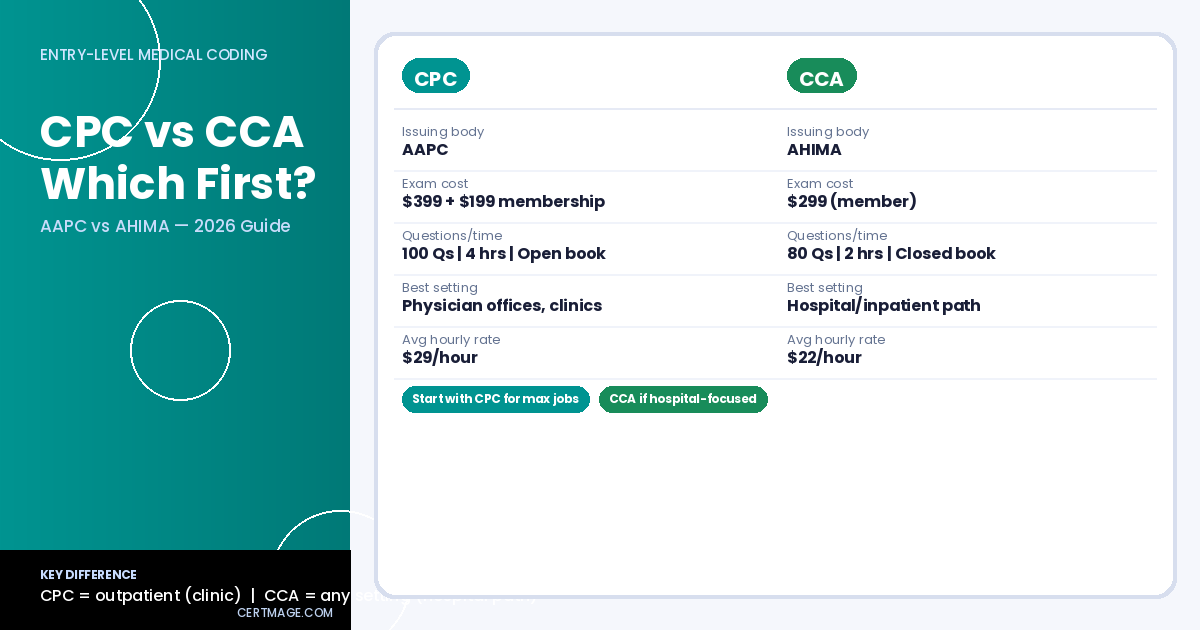
The CPC (Certified Professional Coder) from AAPC is the right first medical coding certification if you are targeting outpatient or physician-office coding roles – it is the most recognized entry-level coding credential in that setting, earns an average of $29 per hour, and opens the widest range of entry-level coding positions including remote work. The CCA (Certified Coding Associate) from AHIMA is the right first certification if you already know you want to work in a hospital or inpatient setting – it covers both outpatient and inpatient coding systems, costs $100 less than the CPC, and puts you on the AHIMA credential track that leads to the CCS (Certified Coding Specialist) for advanced hospital coding careers.
If you are not yet sure whether you want to work in a clinic or a hospital, start with the CPC. The outpatient job market is larger, the remote opportunities are more abundant, and the CPC’s broader recognition gives you more flexibility.
Who Should Read This Guide
This comparison is specifically for candidates who are at the beginning of their medical coding career or considering a career change into medical coding. If you already have 1-2 years of inpatient hospital coding experience, you may be past both of these credentials – consider going directly to the CCS. If you are an experienced outpatient coder looking to advance, see our CPC vs Other Medical Coding Certifications guide for the full path forward.
Side-by-Side Comparison
| Factor | CPC (Certified Professional Coder) | CCA (Certified Coding Associate) |
| Issuing body | AAPC (American Academy of Professional Coders) | AHIMA (American Health Information Management Association) |
| Level | Entry-level to associate | Entry-level |
| Cost | $399 (AAPC member) / $399 (non-member for exam) | $299 (AHIMA member) / $399 (non-member) |
| AAPC membership | Required to take exam – $199/year | N/A |
| AHIMA membership | N/A | Recommended – discounts available |
| Questions | 100 multiple choice | 80 multiple choice |
| Duration | 4 hours | 2 hours |
| Passing score | Not published (approximately 70%) | Not published |
| Open book? | Yes – AMA CPT manual and ICD-10-CM allowed | No – closed book |
| Experience requirement | None enforced; training course or experience recommended | None enforced; training strongly recommended |
| New credential name | CPC-A (Apprentice) until experience verified | CCA upon passing |
| Renewal | 36 CPE credits per 2-year cycle | 20 CEUs per 2-year cycle |
| Renewal cost | $55 (member) per 2-year cycle | $50 (AHIMA member) / $75 (non-member) |
| Average hourly rate | $29/hour | $22/hour |
| Average annual salary | $60,000-$75,000 (after experience) | $45,000-$62,000 |
| Primary setting | Outpatient, physician offices, clinics | Entry hospital settings, any healthcare setting |
| Remote work availability | Very high | Moderate |
| Leads to | CPC-P, specialty CPC credentials, CPMA (auditing) | CCA-P (physician), CCS (advanced inpatient) |
The Most Important Difference: AAPC vs AHIMA
CPC and CCA are not just different exams – they come from different organizations with different philosophies, credential tracks, and industry relationships.
AAPC (American Academy of Professional Coders) is the larger of the two organizations by membership. It focuses heavily on outpatient coding, physician-office billing, and revenue cycle. AAPC certifications dominate physician-office and ambulatory surgery center job postings. The AAPC also offers a robust set of specialty certifications (CPC-Oncology, CPC-Emergency Department, etc.) that allow coders to develop niche expertise.
AHIMA (American Health Information Management Association) has a broader scope that includes health information management, data governance, and clinical documentation improvement alongside coding. AHIMA credentials are more prevalent in hospital settings, health information management departments, and organizations that handle large volumes of health data. AHIMA’s credential track leads to the CCS and eventually to RHIT and RHIA for health information management leadership.
| Setting type | Which credential employers prefer |
| Physician offices and group practices | CPC strongly preferred |
| Ambulatory surgery centers | CPC strongly preferred |
| Outpatient hospital departments | CPC or CCA both accepted |
| Inpatient hospital coding | CCA as entry, CCS preferred for experienced |
| Health information management departments | AHIMA credentials (CCA path) preferred |
| Insurance and payer organizations | CPC or CCA both recognized |
| Remote coding positions | CPC preferred due to higher recognition |
| Medical billing companies | CPC strongly preferred |
What the CPC Tests
The CPC exam is the most comprehensive entry-level coding exam in the industry. At 100 questions over 4 hours, it is also the longest – requiring genuine familiarity with ICD-10-CM diagnosis coding, CPT procedure coding, HCPCS Level II codes, and the guidelines that govern how they are used together.
The exam is open book. You may bring the AMA CPT manual and ICD-10-CM codebook. However, open-book does not mean easy. The exam is structured so that candidates who have not internalized the structure of both codebooks will not be able to look up answers quickly enough to finish in time. Preparation requires knowing where to look, not just what the books contain.
| Exam content area | What it covers |
| ICD-10-CM | Diagnosis coding rules, guidelines, sequencing |
| CPT Surgery sections | Integumentary, musculoskeletal, respiratory, cardiovascular, digestive, GU, nervous system, eye |
| CPT E&M (Evaluation and Management) | Office visits, hospital visits, consultations, new vs established patients |
| CPT Radiology | Imaging procedures and interpretation codes |
| CPT Pathology/Laboratory | Lab panels, surgical pathology, microbiology |
| HCPCS Level II | Supplies, DME, drugs, ambulance services |
| Medical terminology and anatomy | Body system knowledge to support coding decisions |
| Compliance and regulatory | HIPAA, CMS, Medicare billing rules |
The CPC-A (Apprentice) designation is granted on passing. The “A” is removed once the candidate documents 2 years of coding experience or completes 80 hours of approved coding education with a passing grade – whichever comes first. Most employers treat CPC-A and CPC equivalently for hiring purposes; some job postings specifically mention both.
What the CCA Tests
The CCA exam covers both inpatient and outpatient coding at a foundational level, making it genuinely versatile for candidates who are not yet sure which setting they want to work in. At 80 questions in 2 hours, it is more concise than the CPC and focuses on coding competency rather than breadth across every CPT section.
The exam is closed book. Unlike the CPC, no reference materials are permitted during the CCA exam. This means you must memorize coding guidelines, major categories, and sequencing rules rather than being able to look them up.
| Exam content area | What it covers |
| ICD-10-CM | Diagnosis coding (outpatient) |
| ICD-10-PCS | Procedure coding (inpatient – this is unique to CCA among entry credentials) |
| CPT and HCPCS | Outpatient procedure coding |
| Health data and information management | Basic HIM concepts, data quality, patient record management |
| Healthcare compliance | HIPAA, fraud and abuse basics, coding compliance |
| Reimbursement methodologies | DRGs, APCs, fee schedules at an awareness level |
The presence of ICD-10-PCS (the inpatient procedure coding system used for hospital stays) is the most distinctive aspect of CCA content. CPC does not test ICD-10-PCS at all because CPC is focused on outpatient physician coding. If you want to work in inpatient hospital coding, CCA’s inclusion of PCS coding gives it a meaningful content advantage as an entry point.
Salary and Career Path Comparison
The salary gap between CPC and CCA reflects both the larger outpatient job market and the higher per-hour rates in physician-office settings.
| Career stage | CPC path | CCA path |
| Entry-level | CPC-A, $40,000-$55,000 | CCA, $38,000-$52,000 |
| After 2-3 years | CPC, $55,000-$75,000 | CCA + experience, $48,000-$65,000 |
| Mid-career specialty | Specialty CPC (oncology, ED, etc.), $70,000-$90,000 | CCS, $65,000-$85,000 |
| Advanced | CPMA (auditing), $80,000-$110,000 | RHIT, $65,000-$85,000 |
| Leadership | Revenue Cycle Manager, Compliance Analyst | RHIA, Health Information Director, $80,000-$110,000 |
ZipRecruiter 2023 data shows CPC-A credential holders averaged $29/hour while CCA credential holders averaged $22/hour in comparable entry-level coding roles. The CPC pay premium holds consistently across geographic markets.
2026 Context: What Coders Need to Know This Year
ICD-10-CM FY2026 update (effective October 1, 2025 through September 30, 2026): 487 new diagnosis codes, 28 deletions, and 38 revisions. Major new code additions include:
- Non-pressure chronic ulcers: over 100 new codes adding specificity by site and severity
- Neurodevelopmental disorders: expanded codes for autism spectrum, ADHD subtypes, speech disorders
- Infectious diseases: enhanced COVID-19 sequencing guidance, new codes for Demodex mite infestation
- Cancer: new genetic susceptibility codes, expanded breast cancer classifications
ICD-10-CM FY2027 update (effective October 1, 2026): CMS has already announced the next update cycle. Coders who take their exam close to October 1, 2026 should verify which fiscal year’s ICD-10-CM their exam is based on.
CPT 2026 (effective January 1, 2026): 288 new codes, 84 deletions, 46 revisions. Key additions:
- AI-augmented services: new CPT codes for AI-assisted radiology interpretation and documentation
- Remote patient monitoring: new codes for shorter monitoring periods (2-15 days)
- Proprietary lab analyses: over 75 new PLA codes for advanced diagnostic tests
- Radiology overhaul: comprehensive revision of lower extremity revascularization imaging codes
Both CPC and CCA exams use these current code sets. Preparation materials from 2024 or earlier will have outdated code examples that no longer exist or have changed structure.
Preparation Comparison
| Factor | CPC preparation | CCA preparation |
| Study format | Open book means learning where to find codes, not memorizing them | Closed book requires memorizing key guidelines and code structures |
| Typical prep time | 3-9 months depending on background | 3-6 months depending on background |
| Recommended training | AAPC’s online CPC training (80+ hours) | AHIMA’s approved coding education programs |
| Practice exams | Essential – timing is critical on 100Q/4hr format | Important – closed book format requires different prep approach |
| Anatomy requirement | High – must identify body systems and anatomical sites for CPT surgery coding | Moderate – basic anatomy sufficient |
| Coding software | AAPC’s Practicode offers hands-on coding practice that counts toward CPC-A upgrade | Optum360 encoder practice available |
FAQs
What is the difference between CPC and CCA?
CPC (from AAPC) is the most recognized outpatient coding credential, costs $399, requires 4 hours and 100 open-book questions, and earns an average $29/hour. CCA (from AHIMA) is the entry-level AHIMA credential, costs $299 (member), requires 2 hours and 80 closed-book questions, and earns an average $22/hour. CCA covers both outpatient and inpatient coding including ICD-10-PCS; CPC focuses on outpatient CPT and ICD-10-CM coding.
Which medical coding certification should I get first?
Start with CPC if you want to work in physician offices, outpatient clinics, or remote coding. Start with CCA if you know you want to work in hospital inpatient coding or want to pursue the AHIMA credential track toward CCS and RHIT.
Is the CPC harder than the CCA?
Yes, generally. The CPC is longer (100 questions, 4 hours vs 80 questions, 2 hours) and covers more CPT surgery sections in depth. However, the CCA is closed book while the CPC allows reference materials, which changes the preparation strategy significantly.
Can I take both CPC and CCA?
Yes. Some coders complete both to maximize their job market flexibility. The more common path is CPC first, then specializing within the AAPC track (specialty CPCs, CPMA) or bridging to the AHIMA track (CCS) after gaining experience.
How long does it take to prepare for CPC or CCA?
Most candidates with structured training complete CPC preparation in 3 to 9 months. CCA preparation typically takes 3 to 6 months. Starting with an 80+ hour coding course that covers anatomy, medical terminology, ICD-10-CM, and CPT is the minimum foundation for either exam.
What is a CPC-A?
CPC-A (Apprentice) is the designation awarded when you pass the CPC exam without yet meeting the 2-year experience requirement. The “A” is removed when you document 2 years of professional coding experience or complete 80 hours of approved coding education. Most employers hire CPC-A holders at the same entry-level positions as CPC holders.
What are the ICD-10-CM FY2026 changes I need to know?
The FY2026 ICD-10-CM update (effective October 1, 2025) added 487 new codes including major expansions for non-pressure chronic ulcers (100+ new codes), neurodevelopmental disorders, and infectious disease sequencing. Updated CPT 2026 (effective January 1, 2026) added 288 new codes including AI-assisted service codes and revised remote patient monitoring codes.
Is there a medical coding certification that requires no experience?
Both CPC and CCA have no enforced experience prerequisites. The CCA’s AHIMA education recommendation can be satisfied through a training program. The CPC requires AAPC membership ($199/year) and accepts training as an alternative to work experience for the initial application.
What comes after CPC or CCA?
After CPC: specialty certifications (CPC-Oncology, CPC-Cardiology), CPMA (coding auditor), COC (outpatient hospital coding). After CCA: CCS (advanced inpatient hospital coding, the primary AHIMA advanced credential), CCS-P (physician-based inpatient coding). For health information management leadership, see our RHIA vs RHIT guide.
Where can I practice for CPC or CCA exams?
CertMage provides practice questions for both certifications aligned to the current AAPC and AHIMA exam blueprints. See our healthcare certifications resource hub and practice question pages for both credentials.