Search for “best first medical coding certification” and you will keep landing on the same two names: the CPC from AAPC and the CCA from AHIMA. Both are entry points into medical coding, but they are built differently, priced very differently and tested under different rules. One is a four-hour open-book exam that costs roughly twice as much to attempt. The other is a two-hour exam at a test centre with a short list of rules that can cost you your fee before you answer a single question.
This guide compares them for someone starting out. It explains what each exam actually tests, what it costs, what experience you need, how the apprentice status on the CPC works, where each credential leads, and the one detail that trips up candidates in 2026: which code books you are allowed to bring.
What is the difference between CPC and CCA?
The CPC (Certified Professional Coder) is AAPC’s core professional coding credential, and the CCA (Certified Coding Associate) is AHIMA’s entry-level coding credential. They come from two separate organizations that built two separate career ladders. AAPC’s ladder is strongly associated with physician-practice and outpatient coding. AHIMA’s ladder runs through health information management and is strongly associated with hospital settings, with the CCA as its entry rung and the CCS above it. Employer preference varies by region and by employer, so treat those associations as general patterns, not rules.
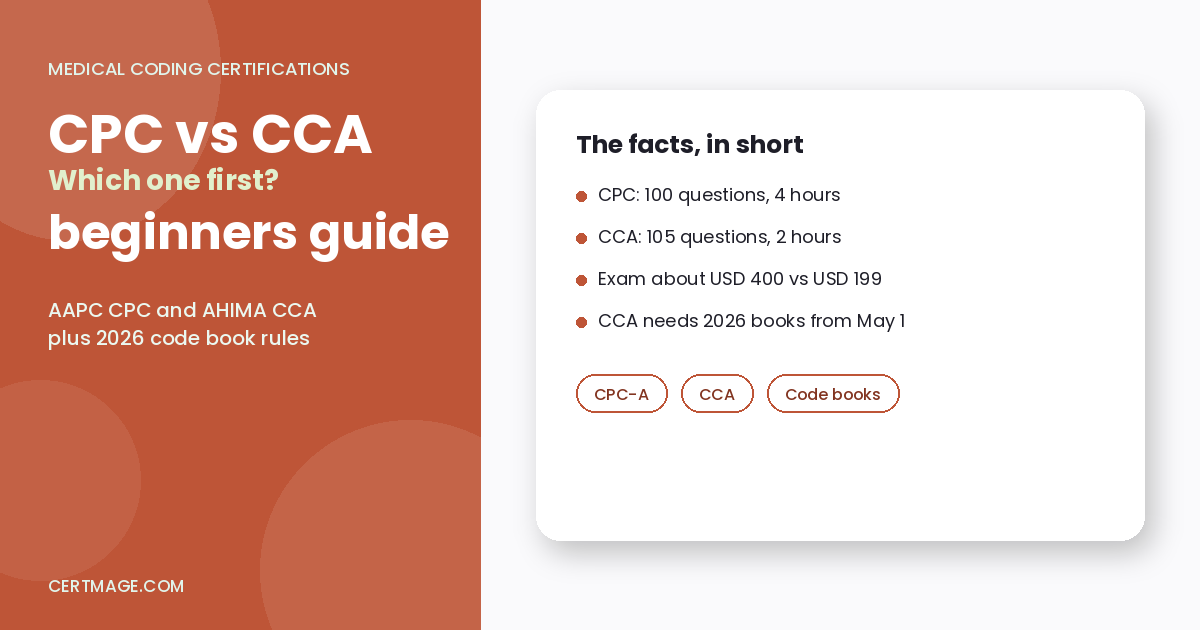
In practical terms, the CPC is the longer and more coding-focused exam. It has 100 multiple-choice questions over four hours, it is open book, and it assumes you already understand medical terminology, anatomy and pathophysiology. The CCA is shorter, with 105 questions (90 scored and 15 unscored pretest items) over two hours, and it is broader. It tests clinical classification, reimbursement, health records, compliance, information technology and privacy, with coding as the centre of that wider health information foundation.
| CPC (AAPC) | CCA (AHIMA) | |
| Questions | 100 multiple-choice | 105 (90 scored, 15 pretest) |
| Time | 4 hours | 2 hours |
| Passing score | 70% (70 correct) | Scaled score of 300 |
| Where you test | Testing centre or live remote proctor at home | Pearson VUE testing centre |
| Navigation | You can skip and flag questions | You cannot go back or flag questions |
| Exam fee | USD 399 for one attempt or USD 499 for two (exam page), or “starting at USD 425” (certification page) | USD 199 members, USD 299 non-members |
| Membership | AAPC membership required to schedule | None required |
| Eligibility | Background knowledge assumed | High school diploma required |
| After passing | CPC-A (apprentice) until 2 years of experience are verified | Full CCA |
| Next step | CPC specialty credentials | CCS, with 1 year of coding experience |
Which is better for beginners, CPC or CCA?
Neither is better for everyone, but the CCA is the gentler first step and the CPC is the more widely recognised credential for outpatient and physician-office coding. The CCA costs far less, requires no experience and has a shorter exam, which makes it a lower-risk starting point if you are unsure about the career or have a tight budget. The CPC costs more to attempt and usually involves paid training, but it is the credential most associated with the outpatient work that many beginners want.
A useful way to decide is to look at where you want to work. If your goal is a physician practice or clinic, the CPC fits and the investment is easier to justify. If your goal is hospital-side coding or health information work, or if you want a credential you can earn quickly and cheaply while you build experience, the CCA makes sense and naturally leads to the CCS. The most reliable way to settle it for your own market is to open ten job postings for the role you want and note which credential they name. Our guides on AAPC vs AHIMA and CPC vs CCS cover the wider comparison between the two bodies.
Which code books can you bring in 2026?
For the CCA, AHIMA’s page says exams delivered on or after May 1, 2026 require the 2026 code books, and candidates without the correct books cannot test and forfeit their fees. AHIMA’s candidate guide adds that handwritten notations are allowed, but your books must not contain coding rules or guidelines copied from other references such as Coding Clinic or CPT Assistant, and books with Post-it notes, loose materials or handmade tabs are not allowed. AHIMA’s own preparation text still refers to 2024 code sets in places, so do not rely on a single page and check the current exam preparation requirements before you buy anything.
The CPC is more flexible but still has rules. AAPC’s exam FAQ says you need the AMA CPT Professional Edition (the required publisher), plus ICD-10-CM and HCPCS Level II from any publisher. Current-year books are recommended. The preceding year’s books are permitted but, in AAPC’s words, put you at a disadvantage, and AAPC’s exam page adds that you may bring the preceding year, the current year or a mix, but only one copy of each book, printed or as an eBook through the exam platform. You may highlight, underline, add brief handwritten notes tied to everyday coding and use tabs that carry only words or numbers. You may not add supplemental reference pages, copy exam or practice questions into the books, or white out or print over pages. A proctor checks your materials before you begin.
The practical lesson is the same for both exams. Buy books for the year in which you will actually sit the exam, not the year you start studying, and practise with that same edition, because codes and page locations shift between editions. If your test date falls near a year-end or mid-year code change, confirm the required edition on the AAPC or AHIMA site before you order.
What does the CPC exam test?
AAPC’s CPC and CPB exam page gives a question-by-question breakdown of the 100 questions, and the percentages are approximate because they reflect question counts. The largest share is CPT procedure coding. Six questions each come from the 10000 series (integumentary), the 20000 series (musculoskeletal), the 30000 series (respiratory, cardiovascular, hemic and lymphatic), the 40000 series (digestive), the 50000 series (urinary, reproductive and endocrine) and the 60000 series (nervous system). Six questions each also cover radiology, pathology and laboratory, medicine, and evaluation and management, with four on anesthesia.
The rest is spread thinly across the supporting knowledge: seven questions on coding guidelines, five on ICD-10-CM, three on HCPCS Level II, four each on medical terminology and anatomy, three on compliance and regulatory topics, and ten case questions worth one question each. Two things stand out. More than half of the paper is CPT coding across body systems, so you need to be fast and accurate in the CPT book. And only a small number of questions test terminology, anatomy and compliance directly, which is why AAPC expects that background before you start rather than teaching it on the day. If you do not pass, AAPC gives you sub-scores for areas at 65% or below to guide your retake.
What does the CCA exam test?
AHIMA’s content outline lists six domains with weight ranges. Clinical Classification Systems is the largest at 30 to 34%, followed by Reimbursement Methodologies at 21 to 25%, Health Records and Data Content at 13 to 17%, and Compliance at 12 to 16%. Information Technologies and Confidentiality and Privacy each carry 6 to 10%.
That mix says a lot about the credential. The CCA candidate needs real coding ability, but also an understanding of how reimbursement works, how health records are structured, and what compliance and privacy require. It reads like a broad health information foundation with coding at the centre, which suits people heading towards hospital or health information roles. The exam is also unforgiving in format, because you cannot go back to earlier questions or flag them for review, so you have to answer each question once and move on.
How much experience do you need, and what is CPC-A?
For the CCA, you need a high school diploma. AHIMA recommends, but does not require, one of six months of coding experience, completion of an AHIMA-approved program, or other coding training that covers anatomy and physiology, medical terminology and basic ICD and CPT coding. So a true beginner can sit it after training and be a full CCA holder the day the result arrives.
The CPC works differently. There is no degree requirement, but AAPC’s steps say you must be an AAPC member before you can schedule the exam, and its training assumes working knowledge of medical terminology, anatomy and pathophysiology, either as three courses or as the combined Foundations in Medicine course, with exemptions if your education or work history already gave you that knowledge. You prepare, join, schedule and pass, and you then receive the CPC-A credential, where the “A” means apprentice.
You keep the apprentice status until you complete a two-year experience requirement and submit proof. AAPC accepts two years of on-the-job coding verified by two letters, one on company letterhead from an employer and the other from a colleague or previous employer. It also lets an 80-hour coding preparation course count as one year, and its CPC-A Practicode programme (three modules of 200 cases each) count as one year, and these can be combined to cover the full two years or paired with one year of verified on-the-job experience. This matters because passing the CPC does not instantly remove the “A”, and some employers care about the distinction. The CCA has no apprentice stage, which is part of its appeal for people with no experience at all.
How much do the CPC and CCA cost?
The CCA is the cheaper exam by a clear margin. AHIMA charges USD 199 for members and USD 299 for non-members, and retakes cost the same as the exam. The extras are small but worth knowing: a USD 30 penalty to reschedule within 14 days of the exam, a USD 75 processing fee on refunds, and eligibility extensions of USD 50, USD 100 or USD 150 for 30, 60 or 90 days.
For the CPC, AAPC’s pages show two figures. The CPC and CPB exam page lists USD 399 for one attempt or USD 499 for two attempts, while the certification page says the exam starts at USD 425. Prices change and the pages may reflect different dates, so confirm the figure at checkout. Registration must be at least three weeks before your exam date. AAPC’s prep courses start at USD 2,799 for self-paced or virtual instructor-led options, and while training is optional, many beginners use it. You also need an AAPC membership to schedule the exam and to maintain the credential, plus 36 continuing education units every two years, which AAPC says are often available at low or no cost. I could not find the membership price on the pages I read, so check AAPC. Either way, budget for the correct-year code books, which are a real cost for both exams.
What happens on exam day?
For the CPC, you have four hours in one sitting and can skip and flag questions. At a testing centre you arrive at least 30 minutes early, and phones and smartwatches are not allowed in the room. If you choose the remote option, you need a computer that meets AAPC’s requirements, a reliable internet connection, an external webcam (built-in webcams are not permitted) and a quiet private space that the proctor reviews before you start. A basic calculator is built into the testing platform, and physical calculators are not allowed. Results usually arrive in your AAPC account within 7 to 10 business days, though they can take longer in busy periods. Retake rights depend on your voucher, since a single-attempt voucher includes one attempt and a two-attempt bundle includes two. A no-show forfeits the attempt, and a USD 25 fee applies to testing-centre changes made between 9 days and 48 hours before the exam.
For the CCA, you test at a Pearson VUE centre with two hours on the clock. You must bring two IDs, a primary photo ID with signature and a secondary ID with signature, and the names on both must exactly match your authorisation letter, or you forfeit your fee. Rescheduling or cancelling is free up to 15 business days before the exam, your eligibility window is 120 days from the authorisation letter, and a no-show or arriving more than 15 minutes late forfeits the fee. You receive a score report at the test centre right after you finish. If you do not pass, you wait 30 days and submit a new application with the full fee.
Where does the CCA lead? The CCS step
If you start with the CCA, the next AHIMA rung is the CCS. According to AHIMA, the CCS has 107 questions (97 scored and 10 unscored) over four hours at a Pearson VUE centre, and unlike the CCA it lets you move between questions and flag them. The exam costs USD 299 for members and USD 399 for non-members, with a 30-day wait before a retake. Its domains are Coding Knowledge and Skills, Coding Documentation, Provider Queries, Regulatory Compliance and Information Technologies.
AHIMA recommends, but does not require, several routes to it, including a CCA plus one year of coding experience, two years of related coding experience, or another coding credential plus one year of experience. It describes the CCS as a natural progression for people who have coded inpatient and outpatient records or hold a CCA, so the CCA works as a lower-cost entry point. The CCS also needs the 2026 code books for exams on or after May 1, 2026. If you lean towards billing instead of coding, AAPC’s separate CPB exam has 135 questions over four hours and is weighted towards case analysis (about 25%), insurance types (about 21%), and reimbursement and collections and claims and billing (about 14% each).
What does a CPC or CCA holder earn?
I could not find a source that separates what CPC holders earn from what CCA holders earn, and quoting one number would suggest precision that does not exist. Our existing posts cover the wider picture in medical coding salary and which coding certification pays the highest salary. For a first credential, the useful points are that pay depends more on specialty, experience, setting and location than on which entry credential you hold, that moving up usually means adding a specialty or the next credential rather than repeating an entry one, and that apprentice status can affect early offers, so it is worth asking employers how they treat CPC-A and CCA holders.
How should you prepare?
Allow roughly ten weeks for either exam, and longer if you have no background in terminology or anatomy. For the CPC, spend the first two weeks on terminology, anatomy and learning to navigate your books, then work through ICD-10-CM guidelines, then the CPT sections and modifiers, then HCPCS Level II and compliance. Finish with timed question sets using your tabbed books, and sit at least one full 100-question mock under four-hour conditions. For the CCA, start with terminology, anatomy and health records basics, then move through clinical classification, reimbursement, compliance, privacy and information technologies, and finish with timed sets in which you do not go back, plus a full 105-question mock in two hours. Our AAPC CPC exam page has practice material.
The most common mistakes are buying the wrong year of books, copying coding guidelines into books where that is not allowed, practising with unlimited time and navigation for an exam that does not offer it, forgetting the upkeep rules, choosing purely on price, and arriving with ID that does not match. On upkeep, AAPC requires annual membership and 36 CEUs every two years, and AHIMA runs a two-year cycle with CEUs, which our guide to medical coding certification renewal compares in detail.
FAQS
Is CPC or CCA better for beginners?
Neither is better for everyone. The CCA costs far less, needs no experience and has a shorter exam, so it is a gentler first step. The CPC is the more widely recognised credential for outpatient and physician-office coding, but it costs more to attempt.
Is the CPC harder than the CCA?
Many candidates find the CPC more demanding because it is a 4-hour exam focused on real coding across CPT, ICD-10-CM and HCPCS. The CCA is shorter at 2 hours but covers broader health information topics and does not let you go back to earlier questions. I could not find an official pass rate for either exam on the pages I read, so be careful with figures quoted elsewhere.
How much does the CPC exam cost?
AAPC’s pages show USD 399 for one attempt and USD 499 for two on the exam page, and “starting at USD 425” on the certification page, so confirm at checkout. Training courses start at USD 2,799, and you also need code books and an AAPC membership, which is required to schedule the exam.
How much does the CCA exam cost?
AHIMA lists USD 199 for members and USD 299 for non-members. Retakes cost the same as the exam.
How many questions are on the CPC and CCA exams?
The CPC has 100 multiple-choice questions in 4 hours. The CCA has 105 questions in 2 hours, of which 90 are scored and 15 are unscored pretest items.
What is the passing score for the CPC and CCA?
The CPC requires 70%, which is 70 correct answers. The CCA passing score is 300 on a scaled score.
Is the CPC or CCA exam open book?
Both allow code books. The CPC is open book with CPT, ICD-10-CM and HCPCS Level II, tabs and brief handwritten notes. The CCA requires the correct code books for the test year, and AHIMA’s rules on notes and tabs are strict.
Which code books do I need for the CCA in 2026?
AHIMA says exams delivered on or after May 1, 2026 require the 2026 code books. Candidates without the correct books cannot test and forfeit their fees. Check AHIMA’s CCA page for the current requirement before you buy.
Can I take the CPC or CCA exam without experience?
Yes for both. The CCA requires a high school diploma and recommends training. For the CPC you need an AAPC membership and the background knowledge, and new coders who pass hold apprentice (CPC-A) status until they verify experience.
What is CPC-A?
It is apprentice status for people who pass the CPC without the required experience. You keep the “A” until you verify two years of experience, and AAPC lets an 80-hour coding course or its Practicode programme each count as one year, or two letters verify on-the-job coding.
Can I take the CPC or CCA online from home?
The CPC can be taken online with a live remote proctor, with an external webcam and a private space, or at a testing centre. The CCA page says the exam is taken at a Pearson VUE testing centre.
Do I need an AAPC membership to take the CPC?
Yes. AAPC’s steps say you must be a member before you can schedule the exam, and you need to keep your membership current to maintain the credential. The CCA has no equivalent membership rule, but AHIMA members pay less for the exam (USD 199 against USD 299).
Should I take CPC or CCS instead of CCA?
If you want inpatient hospital coding, the CCS is AHIMA’s higher credential. It has 107 questions over four hours, and AHIMA recommends routes such as a CCA plus one year of coding experience. Read our CPC vs CCS guide and our comparison of CPC with other medical coding certifications.
The bottom line
Choose the CPC if you are aiming at physician-office and outpatient coding and can fund the larger investment. Choose the CCA if you want the lower-cost, no-experience-needed entry point from AHIMA. Whichever you pick, lock in the correct year of code books for your test date, because that detail can end an exam attempt before it starts. If you are still mapping the wider field, start with our beginner guide to medical billing and coding and our overview of the top AHIMA certifications, and confirm fees and rules on the AAPC and AHIMA sites before you register.