
AAPC certification practice
Free CPC Practice Test
10 free CPC exam-style questions for Certified Professional Coder (CPC) exam, with answers, explanations and source references.
Full set: 353 questionsThe CPC exam is AAPC's Certified Professional Coder exam for medical coders. AAPC notes that preparation calls for solid knowledge of medical terminology, anatomy and pathophysiology. The exam is open book, with 100 multiple-choice questions, including 10 case-based questions, taken in one four-hour sitting, and 70% is needed to pass. New passers without experience hold CPC-A apprentice status until they meet the two-year experience requirement.
AAPC publishes a question count for each area. The 10 cases form the largest single block, followed by coding guidelines at 7 questions. The CPT 10000 to 60000 series, radiology, pathology and laboratory, medicine and E/M carry 6 questions each, ICD-10-CM has 5, medical terminology, anatomy and anesthesia have 4 each, and compliance and HCPCS Level II have 3 each. Since the AMA CPT Professional Edition, ICD-10-CM and HCPCS Level II code books are allowed, practise finding codes and applying guidelines efficiently.
Work through these free practice questions with your code books at hand. Check each answer and read every explanation to see which guideline or code range applies. Keep track of the areas where you miss questions, revisit them, and then retest.
About the exam
CPC exam at a glance
Key facts for the Certified Professional Coder (CPC) exam exam, taken from the official exam page.
| Exam code | CPC |
|---|---|
| Number of questions | 100 |
| Time allowed | 240 minutes |
| Passing score | 70% |
| Question types | Multiple choice, including 10 case-based questions; open book (AMA CPT Professional Edition, ICD-10-CM and HCPCS Level II code books allowed) |
| Exam price | $425 for one attempt, $499 for two attempts (student pricing $400 / $475) |
| Delivery | Online at home with a live remote proctor, or at a testing center; one sitting |
| Prerequisites | No formal exam prerequisite stated. AAPC says training requires high-level knowledge of medical terminology, anatomy and pathophysiology. New passers without experience hold CPC-A (apprentice) status until meeting the 2-year experience requirement. |
| Validity and renewal | Maintain AAPC annual membership and earn 36 CEUs every two years |
Source: official CPC exam page. Verified . Prices and policies can change, so confirm with the provider before booking.
Exam objectives
What the CPC exam covers
The CPC exam is organized into 18 official domains. Weight shows the share of the exam each domain represents, so spend your study time in proportion.
- Medical terminology 4 questions
- Anatomy 4 questions
- Compliance and regulatory 3 questions
- Coding guidelines 7 questions
- ICD-10-CM 5 questions
- HCPCS Level II 3 questions
- CPT 10000 series codes 6 questions
- 20000 series codes 6 questions
- 30000 series codes 6 questions
- 40000 series codes 6 questions
- 50000 series codes 6 questions
- 60000 series codes 6 questions
- Radiology codes 6 questions
- Pathology and laboratory codes 6 questions
- Medicine 6 questions
- E/M 6 questions
- Anesthesia 4 questions
- Cases 10 cases, 1 question each
Domains and weights from the official CPC exam outline.
Quick answers
CPC exam FAQ
How many questions are on the CPC exam?
The CPC exam has 100 questions and gives you 240 minutes to finish. Question types include multiple choice, including 10 case-based questions; open book (AMA CPT Professional Edition, ICD-10-CM and HCPCS Level II code books allowed).
What is the passing score for CPC?
You need 70% to pass the Certified Professional Coder (CPC) exam exam.
How much does the CPC exam cost?
The CPC exam costs $425 for one attempt, $499 for two attempts (student pricing $400 / $475). Check the official exam page for the price in your country.
How long is the CPC certification valid?
Maintain AAPC annual membership and earn 36 CEUs every two years.
Study resources
CPC study guides and comparisons
Go deeper than the practice questions: certification comparisons, study plans, and career context for CPC.
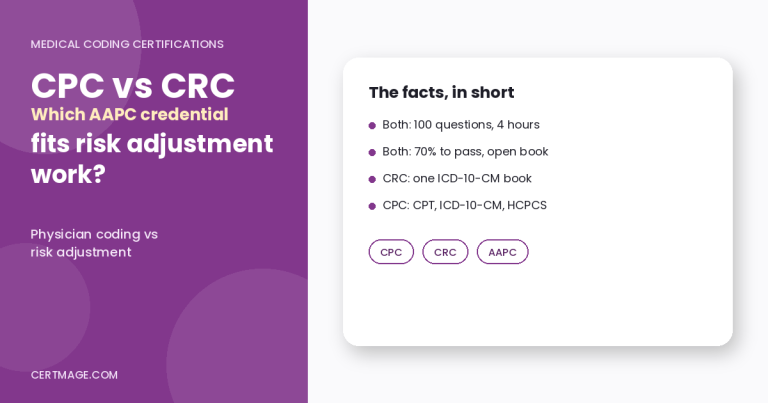 IT Certification Comparisons · 13 min read
CPC vs CRC: Which AAPC Coding Certification Fits Risk Adjustment Work?
Read the guide
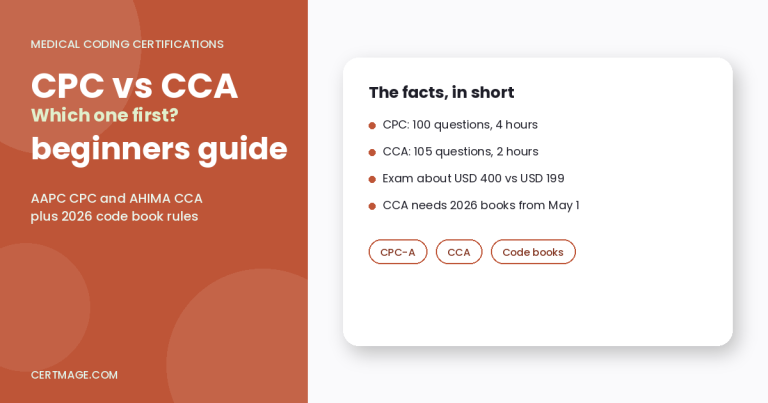 Healthcare & Medical Certifications · 15 min read
CPC vs CCA: Which Medical Coding Certification Should Beginners Take First? (Codebook Rules for 2026)
Read the guide
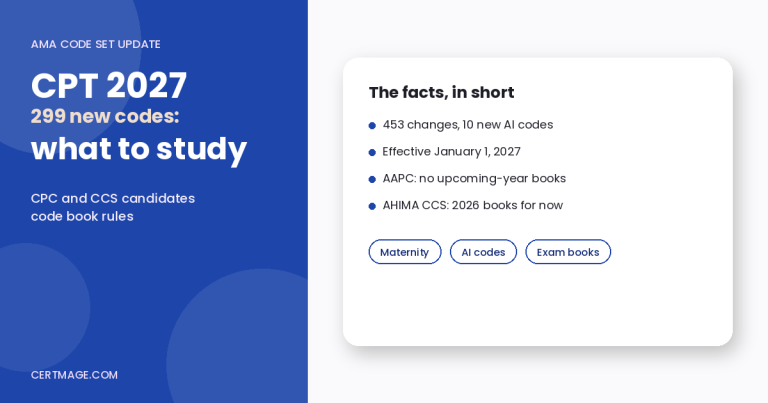 Healthcare & Medical Certifications · 11 min read
CPT 2027 Code Set: 299 New Codes, 10 New AI Codes, and What CPC and CCS Candidates Should Study
Read the guide
Source context
How this practice set is maintained
Maintained by the CertMage content team, this page loads questions from the exam dataset connected to its preparation resource. When an answer includes a supporting reference, it is shown with that answer so you can review the underlying vendor documentation.
Certification objectives, interfaces, and vendor services can change. Verify important details against the provider's current exam guide and documentation before your exam.
Reviewed by Ryan Nakamura CCNP, CCNA 200-301, VCP-DCV, LPIC-3, OCA