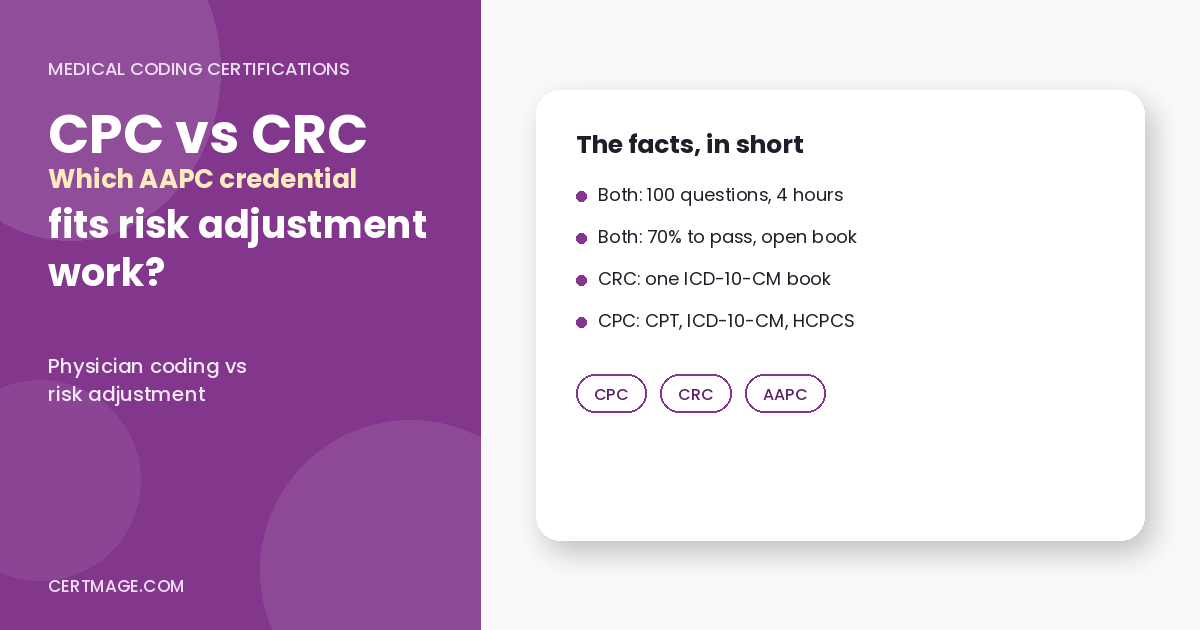
TL;DR: Choose the CRC (Certified Risk Adjustment Coder) if you want to work in risk adjustment: reviewing charts and coding diagnoses so that health plans and provider organizations capture patient risk accurately for Medicare Advantage, ACA and similar payment models. Choose the CPC (Certified Professional Coder) if you want the broader credential for physician and outpatient coding, with CPT procedure coding at its center. Both are AAPC exams with 100 multiple-choice questions, four hours, open-book rules and a 70% passing score. The difference is content. The CPC tests CPT, ICD-10-CM and HCPCS Level II across body systems and needs three code books. The CRC is weighted toward diagnosis coding, risk adjustment models, documentation and compliance, and AAPC’s CRC exam page lists a single ICD-10-CM code book. AAPC’s pages list both exams as starting at USD 425, with USD 499 for a two-attempt bundle on the CRC page. If you are new to coding and want the widest set of jobs, the CPC is usually the safer first credential. If your target job title says “risk adjustment,” the CRC is the direct match, and many coders eventually hold both.
Key Takeaways
- Different focus. The CPC covers professional-fee coding across CPT, ICD-10-CM and HCPCS Level II. The CRC covers diagnosis coding for risk adjustment, including HCCs, risk adjustment models, documentation improvement and compliance.
- Same exam shape. Both are 100 multiple-choice questions in 4 hours, passing at 70% (70 correct answers).
- Different code books. CPC: AMA CPT Professional Edition plus ICD-10-CM and HCPCS Level II. CRC: one current-year ICD-10-CM book, per AAPC’s CRC exam page.
- Training is cheaper for the CRC. AAPC lists CRC prep courses starting at USD 1,495. CPC courses started at USD 2,799 on the AAPC pages we reviewed for our earlier CPC guides.
- Apprentice status is a CPC detail. AAPC’s apprentice pages describe CPC-A, which you hold until you verify two years of coding experience. The pages we reviewed do not mention an apprentice designation for the CRC.
- Upkeep is similar. AAPC lists 36 continuing education units every two years and an active annual AAPC membership to maintain the CRC. The CPC uses the same 36-unit model.
- Neither replaces the other. They answer different job needs, and holding both is common among coders who work across settings.
Quick Facts
| CPC | CRC | |
| Issuer | AAPC | AAPC |
| Full name | Certified Professional Coder | Certified Risk Adjustment Coder |
| Focus | Physician and outpatient coding: CPT, ICD-10-CM, HCPCS Level II | Risk adjustment: diagnosis coding, HCCs, models, documentation, compliance |
| Questions | 100 multiple choice | 100 multiple choice |
| Time | 4 hours | 4 hours |
| Passing score | 70% (70 correct) | 70% (70 correct) |
| Open book | Yes, with approved code books and AAPC rules | Yes, with one approved ICD-10-CM code book and AAPC rules |
| Code books | AMA CPT Professional Edition, ICD-10-CM, HCPCS Level II | ICD-10-CM (current year, any publisher) |
| Exam price (AAPC pages) | Starting at USD 425 on the certification page. An earlier CPC exam page showed USD 399 for one attempt and USD 499 for two | USD 425 for one attempt, USD 499 for two |
| Training (starting price) | USD 2,799 on pages reviewed for our CPC guides | USD 1,495 |
| Apprentice status | CPC-A until two years of coding experience are verified | Not described on the AAPC pages we reviewed |
| Maintenance | AAPC membership plus 36 CEUs every two years | AAPC membership plus 36 CEUs every two years |
| Delivery | Testing center or online with live remote proctor | Testing center or online with live remote proctor |
Figures come from AAPC’s pages and our earlier CPC guide, checked in November 2026. AAPC pages show different starting prices on different pages, so confirm the exact price, bundle and membership cost at checkout.
What Is the CPC?
The CPC is AAPC’s flagship credential for professional-fee coding, meaning coding for services delivered by physicians and other providers in offices, clinics and outpatient settings. It is the best-known coding credential in the AAPC family and a common first certification for new coders.
Key facts:
- Exam: 100 multiple-choice questions, 4 hours, 70% to pass. You can skip and flag questions.
- Content: More than half of the exam is CPT coding across body systems. The rest covers ICD-10-CM, HCPCS Level II, guidelines, medical terminology, anatomy, compliance and case questions.
- Books: AMA CPT Professional Edition, plus ICD-10-CM and HCPCS Level II from any publisher.
- After passing: If you do not already have two years of coding experience, you receive CPC-A (apprentice) until you verify that experience.
- Compare it with other options: See our CPC vs CCA guide and our CPC vs CCS guide.
What Is the CRC?
The CRC is AAPC’s credential for risk adjustment coding. Risk adjustment is the process of capturing a patient population’s health conditions accurately so that payment models can account for how sick or complex a population is. Coders in this area review medical records and code diagnoses, with a strong focus on documentation that supports each condition.
Key facts:
- Exam: 100 multiple-choice questions, 4 hours, 70% to pass, taken at a testing center or at home with a live remote proctor.
- Domains described by AAPC: core risk adjustment knowledge (including ICD-10-CM coding for chronic and complex conditions, HCCs, and Medicare Advantage and ACA payment systems), documentation and compliance, chronic and complex conditions (such as diabetes, COPD, cancer, cardiovascular and renal disease), and auditing and data accuracy (including chart reviews and risk score capture).
- Recommended background: A high-level understanding of medical terminology, anatomy and pathophysiology, plus proper application of ICD-10-CM codes for risk adjustment.
- Who it targets: AAPC lists new entrants, experienced uncertified coders, certified coders, and healthcare professionals working with payers or value-based care organizations.
- Experience requirement: AAPC’s CRC page states no specific years of experience.
- Official page: AAPC’s Certified Risk Adjustment Coder page, linked at the end of this guide, has the current details.
What Does the Exam Actually Test?
CRC question breakdown (per AAPC’s CRC exam page)
| Topic | Questions |
| Diagnosis coding | 30 |
| Compliance | 15 |
| Risk adjustment models | 15 |
| Documentation improvement | 12 |
| Purpose and use of risk adjustment models | 10 |
| Cases (10 cases) | 10 |
| Pathophysiology, medical terminology and anatomy | 5 |
| Quality of care | 3 |
CPC question breakdown (summarized from our CPC guide)
| Topic | Approximate questions |
| CPT procedure coding across body systems (integumentary, musculoskeletal, respiratory/cardiovascular, digestive, urinary/reproductive/endocrine, nervous system) | 36 |
| Radiology, pathology and laboratory, medicine, and evaluation and management | 24 |
| Anesthesia | 4 |
| Coding guidelines | 7 |
| ICD-10-CM | 5 |
| HCPCS Level II | 3 |
| Medical terminology and anatomy | 8 |
| Compliance and regulatory | 3 |
| Case questions | 10 |
What the breakdowns tell you:
- The CRC is a diagnosis-and-documentation exam. Diagnosis coding is the largest block at 30 questions, and compliance, models and documentation improvement together add another 52.
- The CPC is a procedure-coding exam. CPT across body systems is the largest block, and you need to be quick and accurate in the CPT book.
- Models matter on the CRC. Between “risk adjustment models” and “purpose and use of risk adjustment models,” 25 questions test how the payment models work.
- Both include cases. Ten case questions in each exam test applied coding, not memorization.
Exam Rules and Code Books
| CPC | CRC | |
| Books allowed | AMA CPT Professional Edition, ICD-10-CM, HCPCS Level II | One approved ICD-10-CM code book, current year, any publisher |
| Format | Print or eBook | Print or eBook with search function |
| Notes | Brief handwritten notes tied to everyday coding, tabs with words or numbers only | Handwritten notes only if related to daily coding activities |
| Prohibited | Copying exam or practice questions into books, whiting out or printing over pages, supplemental reference pages | Study or exam questions in books, altering or printing over pages |
| Calculator | Built into the testing platform | Online calculator in the platform, no physical calculators |
| Results | Typically 7 to 10 business days | Within 7 to 10 business days in your My AAPC account |
Because code sets change every year, buy the version AAPC’s approved-code-books page lists for your exam date. Our ICD-10-CM FY2027 updates guide explains the October 1, 2026 update and how it affects exam season.
Requirements: Experience, Membership and Apprentice Status
- CPC: No degree requirement. AAPC’s earlier steps require an AAPC membership to schedule the exam and assume working knowledge of medical terminology, anatomy and pathophysiology. Pass without two years of coding experience and you hold CPC-A.
- Removing the “A” from CPC-A: AAPC accepts two years of verified on-the-job coding, or one year of verified coding plus either Practicode or an 80-hour coding course, or Practicode plus the 80-hour course. Practicode requires at least 600 cases at 70% or higher. Experience letters must be on company letterhead, signed, dated and submitted as a non-editable PDF, and applications are usually processed in 2 to 4 weeks.
- CRC: AAPC’s CRC page states no experience requirement and lists new entrants among eligible groups. The AAPC apprentice pages we reviewed describe CPC-A only and do not mention a CRC apprentice designation. Confirm with AAPC what designation you receive if you pass without experience.
- Membership for the CRC: AAPC’s CRC page says an active annual AAPC membership is required to maintain the credential. The CRC exam page we reviewed did not say whether membership is required to take the exam, so confirm at checkout.
Cost: CPC vs CRC
| Item | CPC | CRC |
| Exam | Starting at USD 425 (an earlier exam page showed USD 399 for one attempt, USD 499 for two) | USD 425 for one attempt, USD 499 for two |
| Training (starting price) | USD 2,799 | USD 1,495 |
| Code books | CPT (AMA), ICD-10-CM, HCPCS Level II | ICD-10-CM |
| Membership | Required to schedule (per AAPC steps) and to maintain | Required to maintain |
| Maintenance | 36 CEUs every two years | 36 CEUs every two years |
Points to note:
- The CRC needs fewer books, which lowers the code book budget.
- AAPC’s price pages differ. Confirm the current price, any bundle and the membership fee at checkout. We could not find the membership price on the pages we reviewed.
- Training is optional. Many beginners use it, but a course is not a requirement on the pages we reviewed.
- The two-attempt bundle costs USD 499 on the CRC page. That is a modest increase over the single attempt, so consider it if you want a safety net.
For how renewal works across AAPC and other bodies, see our medical coding certification renewal guide.
Which Fits Which Job?
| Job or goal | Better fit | Why |
| Risk adjustment coder or HCC coder at a health plan | CRC | Built for chart review and diagnosis capture |
| Auditor or quality reviewer in risk adjustment | CRC | Auditing and data accuracy are core domains |
| Physician practice or clinic coder | CPC | CPT, ICD-10-CM and HCPCS for professional claims |
| First coding credential with the widest job range | CPC | The more widely recognized entry credential for outpatient coding |
| Remote coder in a payer or value-based care setting | CRC, often with CPC | Risk adjustment roles often appear in these settings. See our remote medical coding jobs guide |
| Coder who wants billing as well as coding | CPC, then consider CPB | See our CPB vs CPC guide |
| Coder moving into compliance or audit | CRC or CPMA, depending on focus | See our CIRCC vs CPMA guide |
| Coder with a CPC who wants risk adjustment work | Add CRC | Builds on diagnosis coding knowledge |
Decision Framework
Choose the CPC first if:
- You are new to medical coding and want the broadest foundation.
- You want physician practice, clinic or outpatient jobs.
- You want a credential that covers procedures as well as diagnoses.
- Job postings in your area ask for CPC most often.
Choose the CRC first if:
- Your target job title includes risk adjustment, HCC coding or similar.
- You are already working in or near a health plan, payer or value-based care organization.
- You want a shorter, ICD-10-CM-focused path with fewer books and lower starting training cost.
- You are comfortable with medical terminology and anatomy, since the exam assumes a high-level understanding.
Take both if:
- You want to work across outpatient and risk adjustment settings.
- You already hold one and want to broaden your options.
Start with something else if:
- You prefer hospital or facility coding, where other credentials may fit better. See our CPC vs other medical coding certifications guide.
How Hard Are the Exams?
AAPC’s pages we reviewed do not list pass rates, so treat any rate you see online as unofficial.
- CPC difficulty comes from volume and speed. A 100-question, 4-hour exam with CPT across body systems rewards candidates who know how to navigate the books.
- CRC difficulty comes from the documentation and model knowledge. You need to know how conditions map to risk categories and how documentation supports a diagnosis, on top of accurate ICD-10-CM coding.
- Your background matters. Nurses and clinicians often find CRC content familiar. Billing and front office staff may find CPC procedure coding closer to their work.
Salary and Career Value
AAPC’s pages did not give a salary figure for either credential, and we could not find a source that isolates CRC holders from CPC holders. Pay depends on specialty, setting, location and experience. See our medical coding salary guide for the wider picture, and review job postings in your market to see which credential employers ask for.
Study Plan Ideas
These are suggestions, not AAPC requirements. Adjust for your background.
CRC (about 8 to 10 weeks)
- Weeks 1 to 2: Medical terminology, anatomy and pathophysiology basics. Learn the ICD-10-CM book layout and guidelines.
- Weeks 3 to 4: Diagnosis coding for chronic and complex conditions, such as diabetes, COPD, cancer, cardiovascular and renal disease.
- Weeks 5 to 6: Risk adjustment models, HCC concepts, Medicare Advantage and ACA payment systems.
- Weeks 7 to 8: Documentation improvement, compliance and auditing.
- Weeks 9 to 10: Case practice and at least one full timed mock with 100 questions in 4 hours, using your tabbed book.
CPC (about 10 weeks)
- Weeks 1 to 2: Terminology, anatomy and book navigation.
- Weeks 3 to 4: ICD-10-CM guidelines and coding.
- Weeks 5 to 8: CPT sections and modifiers across body systems, plus evaluation and management.
- Week 9: HCPCS Level II and compliance.
- Week 10: Timed practice sets and a full 100-question mock.
Common Mistakes to Avoid
- Choosing the CRC because it sounds specialized, without checking whether jobs in your area ask for it.
- Choosing the CPC for a risk adjustment job and then finding the role expects HCC knowledge.
- Buying the wrong year of code books. Check AAPC’s approved-code-books page for your exam date.
- Writing in books in ways the rules prohibit. Only permitted notes and tabs are allowed.
- Practicing with unlimited time. Both exams are 4 hours for 100 questions, so practice at exam pace.
- Forgetting upkeep. Both credentials need an active AAPC membership and 36 CEUs every two years.
- Assuming the apprentice rules are the same for both. The pages we reviewed describe CPC-A only, so confirm what applies to your credential.
FAQS
Which is better, CPC or CRC?
Neither is better overall. The CPC fits physician and outpatient coding, and the CRC fits risk adjustment work. Choose by the job you want.
Can I get both the CPC and the CRC?
Yes. Many coders hold both. Neither is a prerequisite for the other.
How many questions are on the CPC and CRC exams?
Both have 100 multiple-choice questions and allow 4 hours.
What is the passing score for the CPC and CRC?
70% on both, which means at least 70 correct answers out of 100.
How much does the CRC exam cost?
AAPC’s CRC exam page lists USD 425 for one attempt and USD 499 for two attempts. Confirm the price at checkout.
How much does the CPC exam cost?
AAPC’s certification page lists the exam as starting at USD 425, and an earlier exam page showed USD 399 for one attempt and USD 499 for two. The pages differ, so confirm at checkout.
Which code books do I need for the CRC?
AAPC’s CRC exam page lists one approved ICD-10-CM code book, current year, from any publisher, in print or eBook form.
Which code books do I need for the CPC?
The AMA CPT Professional Edition, plus ICD-10-CM and HCPCS Level II from any publisher. Check AAPC’s approved-code-books page for the right year.
Is the CRC exam open book?
Yes, within AAPC’s rules. You may use the approved code book with permitted notes, and you may not add exam or practice questions or alter pages.
Do I need experience to take the CRC?
AAPC’s CRC page states no specific years of experience and lists new entrants among eligible groups. It recommends a high-level understanding of medical terminology, anatomy and pathophysiology.
What is CPC-A and does the CRC have one?
CPC-A is the apprentice designation for people who pass the CPC without two years of coding experience. The AAPC pages we reviewed describe it for the CPC only, so confirm with AAPC whether anything similar applies to the CRC.
How do I keep the CRC or CPC active?
Keep an active AAPC membership and earn 36 CEUs every two years, per AAPC.
Should a beginner take the CPC or the CRC first?
If you want the widest set of entry jobs, the CPC is usually the safer first credential. If you are targeting a risk adjustment role specifically, or already work with a payer, the CRC is the direct match.
Final Thoughts
The choice comes down to the work. If you want to code physician and outpatient services across CPT, ICD-10-CM and HCPCS, choose the CPC. If you want to work in risk adjustment, reviewing charts and capturing diagnoses for payment models, choose the CRC. Check job postings in your area, confirm current prices, books and membership rules at checkout, and review AAPC’s official CRC certification page before you register, since exam details and fees can change.