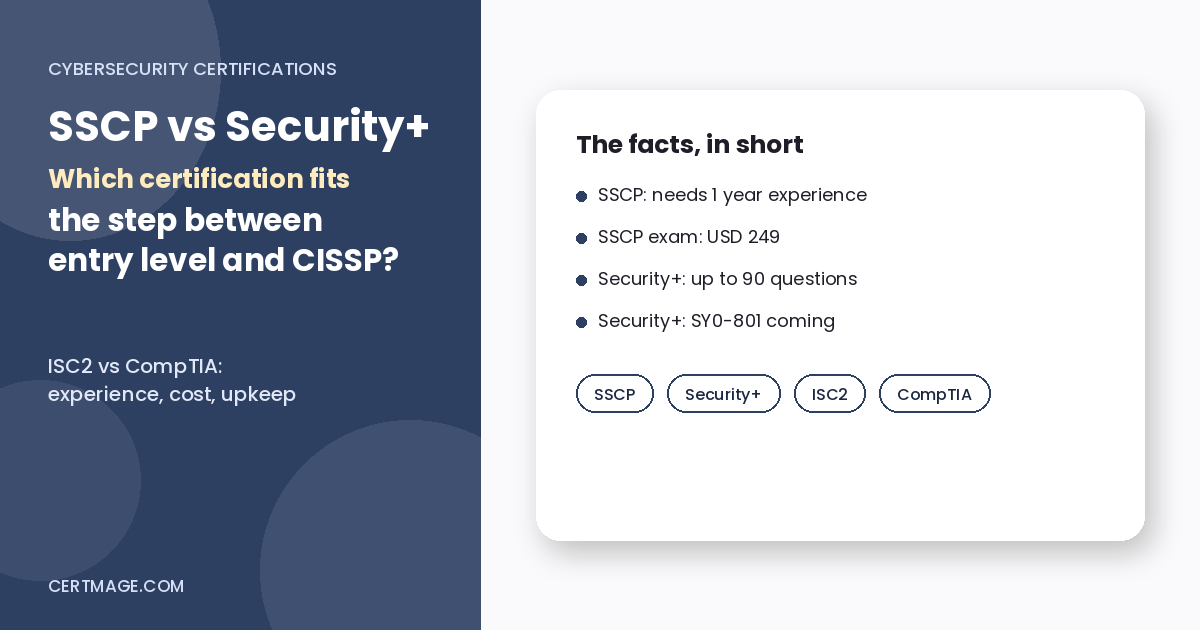
TL;DR: Take CompTIA Security+ if you are new to security, have no work history in it yet, or want the credential of most entry-level postings. Take ISC2 SSCP if you already work hands-on with security controls (access, monitoring, incident response, cryptography, networks and systems) and want an operations-focused credential that sits one step below CISSP in ISC2’s ladder. ISC2’s own page describes Security+ as demonstrating conceptual understanding and SSCP as demonstrating hands-on execution, and says they complement each other. Five facts decide most cases: SSCP needs one year of relevant experience (or you pass first and become an Associate of ISC2 with two years to earn it), Security+ has no formal prerequisite, SSCP is cheaper to pass but costs more to keep (about USD 249 plus USD 135 a year, against a one-time Security+ fee and a renewal that can be free), both credentials are on ISC2’s current list of qualifying credentials that can waive one year of CISSP experience, and Security+ is moving from SY0-701 to SY0-801, which affects when you should book.
Key Takeaways
- Security+ is the broader, no-gate starting point. CompTIA recommends about two years of hands-on experience, but it is a recommendation, not a requirement.
- SSCP is the operational, experience-gated option. One year of cumulative experience (a qualifying degree can count toward it), or the Associate pathway.
- Upkeep differs. Security+ renews on a three-year cycle through 50 continuing education units. SSCP requires 60 CPE credits every three years plus an annual fee.
- Scores cannot be compared. SSCP passes at 700 out of 1,000 and Security+ at 750 on a 100 to 900 scale. These are scaled scores, not percentages.
- Format differs. SSCP is computerized adaptive (CAT), with 100 to 125 items in 2 hours. Security+ has up to 90 questions in 90 minutes, mixing multiple-choice and performance-based items.
- Both help with CISSP. ISC2’s April 2026 revision of its CISSP experience-waiver list names both SSCP and Security+ as qualifying credentials for a one-year waiver (one waiver only, not combined with a degree waiver).
- Plan around the Security+ version change. SY0-701 retired in English on June 11, 2027, and SY0-801 is listed for November 17, 2026.
Quick Facts
| Item | ISC2 SSCP | CompTIA Security+ |
| Positioning | Hands-on, operational security administration | Foundational, broad security knowledge |
| Current version | Outline effective October 1, 2025 | SY0-701 now. SY0-801 listed for November 17, 2026 |
| Questions and time | 100 to 125 items, 2 hours (per the outline) | Up to 90 questions, 90 minutes |
| Question styles | Multiple choice and advanced item types | Multiple choice and performance-based |
| Exam type | Computerized adaptive testing (English, Japanese, Spanish) | Fixed-length exam |
| Passing score | 700 out of 1,000 | 750 on a 100 to 900 scale |
| Languages | English, Japanese, Spanish | SY0-701 in several languages. SY0-801 lists English |
| Exam price | USD 249 (ISC2 pricing page) | USD 404 retail as of January 2025 per CompTIA. SY0-801 price not published |
| Experience | 1 year cumulative, or Associate pathway (2 years to earn it) | None required. Two years of hands-on experience recommended |
| Domains | 7, weights 9% to 16% | 5, weights 12% to 28% (701) |
| Keeping it active | USD 135 per year plus 60 CPE credits per 3 years | 50 CEUs per 3 years. USD 150 per cycle if renewed by uploading CEUs, with fee-free routes |
| DoD 8140 | ISC2 says approved | CompTIA lists it among eight approved CompTIA certifications |
| Where to confirm | ISC2 SSCP pages | CompTIA Security+ pages |
The 60-Second Decision
| If this describes you… | Start with |
| No security work yet, and you want the most commonly named entry credential | Security+ |
| One or more years in security operations, administration or a SOC | SSCP |
| No experience but you want an ISC2 credential now | SSCP as an Associate of ISC2 (pass now, earn the experience within two years) |
| Aiming for CISSP within a few years | Either one, because both can waive one year of CISSP experience (only one waiver) |
| Targeting defense or government work | Check the exact job requirement, then pick the credential it names |
| Not sure | Security+, then add SSCP once you have the experience |
What Is the SSCP?
The Systems Security Certified Practitioner (SSCP) is ISC2’s certification for people who implement, monitor and administer an organization’s security controls. ISC2’s overview says it is for military and DoD cybersecurity professionals, career advancers heading toward team-lead or senior operational roles, and Security+ holders who want experience-based validation. It states that SSCP is ANAB accredited under ISO/IEC 17024 and approved under the U.S. DoD 8140.03 manual, qualifying for intermediate operational work roles and for advanced roles among technical support specialists.
SSCP domains and weights
ISC2’s current outline (effective October 1, 2025) lists seven domains with average weights:
| Domain | Weight |
| 1. Security Concepts and Practices | 16% |
| 2. Access Controls | 15% |
| 3. Risk Identification, Monitoring and Analysis | 15% |
| 4. Incident Response and Recovery | 14% |
| 5. Cryptography | 9% |
| 6. Network and Communications Security | 16% |
| 7. Systems and Application Security | 15% |
The weights are fairly even, so there is no single domain you can skip. Cryptography is the smallest at 9%, but it is the only domain with its own name, and many candidates underestimate it.
SSCP exam format
Per the outline, the SSCP exam has 100 to 125 items, a two-hour limit, a passing score of 700 out of 1,000, and is delivered through Pearson VUE. ISC2 uses computerized adaptive testing for the SSCP in English, Japanese and Spanish. ISC2 describes CAT as re-estimating your ability after each answer based on item difficulty and your responses, using the same content outline as a fixed-form exam. Item types include multiple choice and what ISC2 calls advanced item types.
ISC2’s SSCP page also lists two purchase windows: an exam-only option with a 365-day window and one attempt, and an option with Peace of Mind Protection that has a 180-day window and two attempts. The page does not state the protection’s price, so check it at checkout.
SSCP fees and upkeep
ISC2’s overview lists the exam at USD 249 and the annual maintenance fee at USD 135, with 60 CPE credits every three years. Rescheduling fees are USD 50 and cancellation fees USD 100 on ISC2’s standard pricing page.
What Is Security+?
Security+ is CompTIA’s foundational security certification and one of the most widely named entry-level credentials. CompTIA’s pages list a maximum of 90 questions in 90 minutes, a mix of multiple-choice and performance-based items, and a passing score of 750 on a 100 to 900 scale. For SY0-701, CompTIA recommends Network+ plus two years in a security or systems administrator role. For SY0-801, it recommends a security administrator with two years of hands-on experience.
| Domain | SY0-701 | SY0-801 |
| General Security Concepts | 12% | 16% |
| Threats, Vulnerabilities and Mitigations (701) / Attacks (801) | 22% | 24% |
| Security Architecture | 18% | 19% |
| Security Operations | 28% | 27% |
| Security Program Management and Oversight | 20% | 14% |
Price: CompTIA’s article lists the SY0-701 retail price at USD 404 as of January 2025. A third-party source cited USD 425 in mid-2025, so prices may have changed. No SY0-801 price had been published on the pages we read.
Validity and renewal: CompTIA says Security+ is good for three years and requires 50 continuing education units to renew. Renewal routes include completing a CertMaster CE course, passing a recertification exam or a higher certification, or uploading qualifying activities. CompTIA’s fee page lists USD 150 per three-year period if you renew by uploading CEUs, and says renewing by passing the latest exam, earning a higher-level CompTIA certification, or completing CertMaster CE renews without CE fees. If you renew a higher CompTIA certification, lower ones renew without extra fees.
How Do SSCP and Security+ Compare Side by Side?
| Question | SSCP | Security+ |
| Main skill tested | Operating and administering security controls | Understanding security concepts and applying them in scenarios |
| Who can be certified immediately | People with 1 year of experience or a qualifying degree. Others become Associates | Anyone |
| Exam style | Adaptive, 100 to 125 items, 2 hours | Fixed, up to 90 items, 90 minutes |
| Hands-on style items | “Advanced item types” | Performance-based questions |
| Domain count | 7, fairly even weights | 5, uneven weights (Security Operations is the largest) |
| Exam price | USD 249 | About USD 404 (CompTIA, January 2025) |
| Ongoing cost | USD 135 per year | USD 150 per cycle if renewed with CEUs, or free routes |
| Ongoing education | 60 CPE credits per 3 years | 50 CEUs per 3 years |
| Vendor | ISC2 | CompTIA |
| Typical next step | CISSP once you reach the experience requirement | CySA+, PenTest+, SecurityX or SSCP, depending on your path |
Why You Cannot Compare 700/1,000 With 750/900
These pass marks are scaled scores, so they do not mean the same thing, and neither is a percentage of questions answered correctly. A pass mark of 750 on a 100 to 900 scale is not “harder” than 700 on a 0 to 1,000 scale, and 700 out of 1,000 is not “70%.” Each vendor sets its own scale and cut point through its own psychometric process. The practical lesson is to study for coverage and to practice under time pressure, not to chase a percentage.
How Do the Domains Overlap? (Our Approximate Map)
This map is our own reading, not an official crosswalk. Both exams cover the same general territory, but they organize it differently.
| SSCP domain | Closest Security+ territory | What differs |
| Security Concepts and Practices | General Security Concepts, Security Program Management | SSCP frames concepts as practices you apply on the job |
| Access Controls | Security Operations (identity and access), Security Architecture | SSCP gives access control its own domain at 15% |
| Risk Identification, Monitoring and Analysis | Threats and Vulnerabilities, Security Operations | SSCP emphasizes monitoring and analysis workflows |
| Incident Response and Recovery | Security Operations | Both cover response. SSCP treats it as a standalone domain at 14% |
| Cryptography | General Security Concepts, Security Architecture | SSCP gives it a dedicated domain (9%). Security+ spreads it out |
| Network and Communications Security | Security Architecture | SSCP’s network domain is the largest at 16% |
| Systems and Application Security | Security Architecture, Threats | SSCP covers endpoint, system and application hardening in one domain |
If you hold Security+, you already know much of the vocabulary. What SSCP adds is depth of practice, and the expectation that you have done the work.
What Is It Like to Take Each Exam?
| Topic | SSCP | Security+ |
| Length | 100 to 125 items in 2 hours | Up to 90 questions in 90 minutes |
| How difficulty adapts | Adaptive: question difficulty adjusts to your answers | Fixed: the same style of questions for everyone |
| Non-multiple-choice items | “Advanced item types” | Performance-based questions such as drag-and-drop or simulations |
| Pacing | Steady, because you cannot predict how many items you will see | Plan for performance-based items early or late, depending on your style |
| Delivery | Pearson VUE | Test center or online proctoring (confirm current options with CompTIA) |
| Practice advice | Cover all seven domains evenly | Practice performance-based items and the large Security Operations domain |
We did not confirm how either vendor handles skipping or reviewing questions, so read the candidate guidance on test day logistics before you book.
Who Can Take SSCP and When Do You Earn the Full Credential?
This is where SSCP differs most from Security+.
- One year of cumulative experience in one or more of the seven domains. Full-time work counts monthly (four weeks at 35 or more hours is one month). Part-time work of 20 to 34 hours a week counts, with 1,040 part-time hours equal to six months and 2,080 hours equal to twelve months. Paid and unpaid internships count with documentation on letterhead.
- A qualifying degree can count toward the requirement. ISC2’s outline says a related bachelor’s or master’s degree can count toward up to one year. Approved programs include cybersecurity programs and degrees such as Computer Science, Computer Engineering, Management Information Systems and IT. ISC2 updates the list.
- Associate of ISC2: if you pass without the experience, you become an Associate and have two years to earn the one year required.
- Endorsement: one training guide says you must complete the application and endorsement within nine months of passing and that an endorser must be an ISC2 member in good standing. It also lists a USD 50 yearly Associate fee. That source is not ISC2, so confirm all of this with ISC2.
Security+ has no experience gate, which is why it is more common as a first credential.
What Does Each Certification Cost Over Time?
SSCP is cheaper to earn but more expensive to hold. The following is our arithmetic from the official figures. It excludes training, retakes, endorsement or CPE activity costs, and any CertMaster CE course fee, and prices vary by country.
| Point in time | SSCP (USD 249 exam plus USD 135 per year) | Security+ (USD 404 exam, USD 150 at each 3-year renewal if paid by CEU upload) |
| Day one | 249 | 404 |
| End of year 1 | 384 | 404 |
| End of year 2 | 519 | 404 |
| End of year 3 | 654 | 554 (with the USD 150 renewal) |
| End of year 6 | 1,059 | 704 (with two USD 150 renewals) |
The Security+ column falls if you renew through a fee-free route, such as passing a higher CompTIA certification or completing CertMaster CE. The SSCP column assumes you pay the annual fee every year. The first annual fee may be due only after endorsement, according to one training guide, so your first year could be slightly cheaper than shown.
The takeaway is not that one is a better deal. SSCP’s lower exam price is offset by its annual fee by around the second year, while Security+’s higher upfront price comes with lighter upkeep.
Do Both Help With CISSP?
Yes, and this is a data point most comparisons miss. ISC2 revised its CISSP experience-waiver list on April 1, 2026. According to ISC2’s page, the CISSP requires five years of cumulative, full-time work experience in at least two of the eight CISSP domains. A qualifying credential can satisfy one year, and a qualifying degree can also reduce the requirement by up to one year, but only one waiver is allowed: you cannot combine a degree and a credential to reduce two years. The page lists both SSCP and CompTIA Security+ as qualifying credentials. Certified in Cybersecurity (CC) did not appear in the content we read.
In practice, either one can reduce the CISSP requirement from five years to four, but you only get that benefit once. If you are weighing the senior end of the ladder, see our overview of the CISSP, and confirm the current list on ISC2’s page because it was revised recently.
What About DoD and Government Work?
- SSCP: ISC2 states that SSCP is approved under DoD 8140.03, qualifying for intermediate operational work roles and advanced roles for technical support specialists.
- Security+: CompTIA’s December 2024 article lists Security+ among eight CompTIA certifications approved for DoDM 8140.03. It did not say which work roles or levels Security+ maps to.
Role mapping changes, and approval for one version does not necessarily carry to another, so check the DoD qualification matrix and your contract’s wording before you buy an exam.
Should You Take SY0-701 Now or Wait for SY0-801?
This depends on your timeline and your study materials.
| Situation | Our suggestion |
| You are already studying with SY0-701 materials and can test within a few months | Finish on SY0-701. CompTIA lists English retirement on June 11, 2027 |
| You are starting from zero | Check whether SY0-801 is live and whether materials exist for it, then study for the current version |
| You need the credential for a job offer soon | Test on whichever version you can book first |
| You hold an older Security+ | Check your expiry and renewal options before buying a new exam |
What changes in SY0-801: General Security Concepts rises from 12% to 16%, Threats rises from 22% to 24%, and Security Program Management and Oversight falls from 20% to 14%. For a detailed comparison, see our SY0-701 vs SY0-801 guide. We could not confirm that SY0-801 was live on the day we read CompTIA’s page, so check the status directly.
Which Certification Fits Which Career?
| Your situation | Likely first choice | Why |
| New to IT or security, no work history | Security+ | No experience gate and broad foundations. See our Network+ vs Security+ guide if you are also weighing networking |
| Very new and want the gentlest ISC2 start | ISC2 CC or Security+ | See our ISC2 CC vs Security+ guide |
| 1+ years in security operations or administration | SSCP | Matches your day-to-day work and builds toward ISC2’s higher credentials |
| Working toward CISSP | Security+, SSCP, or both, then CISSP | Either can waive one year of CISSP experience, but only one waiver applies |
| Government or defense contractor roles | The credential your job requirement names | Both are listed for 8140, so check role mapping |
| SOC analyst path | Security+, then CySA+ | CySA+ builds on Security+ for analysts |
| IT support or networking background | Security+ first | Easier to align with entry-level job postings |
| Sysadmin who already hardens systems and reviews logs | SSCP | You likely meet the experience requirement already |
Six quick scenarios
- Help desk technician with a year of experience: Security+ first. If your work includes access requests, patching and monitoring, SSCP may also fit, because that experience can count.
- Systems administrator with three years: SSCP is a strong fit because your daily tasks map to its domains. Security+ is easier to pass but may add less.
- Recent graduate with a relevant degree and no job: consider SSCP as an Associate, because a qualifying degree can count toward the experience requirement and you have two years to complete the rest. Security+ is the lower-effort alternative.
- Career changer from a non-IT field: Security+ first, then build experience. SSCP can follow once you have a year of qualifying work.
- Military or defense contractor: match the credential to your required work role.
- Security analyst heading toward CISSP: either credential helps, but remember only one waiver applies.
How Should You Decide? A Short Framework
- Do I have a year of security work? If not, Security+ is the cleaner start, or pass SSCP as an Associate and earn the experience.
- What do the postings I want ask for? Read ten and count the credentials named.
- Am I aiming for CISSP? Either credential can waive one year, but you can only use one waiver.
- Can I afford the upkeep? Compare SSCP’s annual fee and CPE requirement with your budget.
- When will I test? Decide whether you will test on SY0-701 (English retiring June 11, 2027) or SY0-801.
- Do I prefer adaptive or fixed exams? Some people prefer to see a fixed number of questions.
What Is the Career Value of Each?
We do not publish salary figures, and no certification guarantees a job. Security+ is widely named in entry-level security and IT postings, so it is a common first signal. SSCP signals hands-on operational experience in ISC2’s ecosystem and can lead toward CISSP and other ISC2 credentials. Employers still weigh practical skill, so a certification plus a home lab or a work project is stronger than either alone. For wider context, see our ranked guide to the best cybersecurity certifications and whether Security+ is worth it.
What Study Plan Ideas Fit Each Path?
These are our planning estimates, not official guidance.
| Path | Starting point | Suggested time | Focus |
| Security+ | New to security, some IT basics | 6 to 10 weeks | Concepts, threats, architecture, operations, performance-based practice |
| Security+ | Works in IT support | 4 to 6 weeks | Governance, risk and compliance gaps |
| SSCP | 1+ years in security operations | 6 to 10 weeks | All seven domains, extra time on areas outside your daily work |
| SSCP | Degree but little experience | 8 to 12 weeks | All domains, plus a plan to earn the experience as an Associate |
An 8-week SSCP plan (example)
- Week 1: Domain 1 and the outline. Read ISC2’s outline and list unfamiliar terms.
- Week 2: Domain 2 (access controls). Practice authentication, authorization and account lifecycle scenarios.
- Week 3: Domain 3 (risk, monitoring and analysis). Work through log review and vulnerability workflows.
- Week 4: Domain 4 (incident response and recovery). Walk through an incident lifecycle and recovery planning.
- Week 5: Domain 5 (cryptography). Cover symmetric and asymmetric concepts, hashing, certificates and key management.
- Week 6: Domain 6 (network and communications security). Review segmentation, protocols and secure design.
- Week 7: Domain 7 (systems and application security). Cover hardening, malware defenses and secure configuration.
- Week 8: Mixed timed practice across all seven domains and a review of weak areas.
A 6-week Security+ plan (example)
- Week 1: General security concepts and the exam objectives.
- Week 2: Threats, vulnerabilities and attacks.
- Week 3: Security architecture, including cloud and network design.
- Week 4: Security operations (the largest domain), including identity and access, monitoring and incident handling.
- Week 5: Program management and oversight, including risk, governance and compliance.
- Week 6: Performance-based practice and timed full-length tests.
Lab ideas that help either exam
Set up a small home lab: a Linux virtual machine you harden, a Windows machine whose event logs you review, a packet capture you analyze, a basic firewall configuration, and a simple log-collection setup. Writing down what you did and why is also useful interview material.
For a longer Security+ schedule, use our Security+ study guide. To see how ISC2 handles exam updates, read our guide to the ISC2 CC exam update.
What Are Common Mistakes?
- Assuming SSCP is a beginner exam. It has an experience requirement, even though you can pass first as an Associate.
- Comparing pass marks. 750 on a 100 to 900 scale and 700 out of 1,000 are not comparable.
- Ignoring the Security+ version change. Check which version you are testing and its retirement date.
- Budgeting only for the exam. SSCP adds an annual fee and CPE credits, and Security+ adds a renewal.
- Skipping performance-based practice on Security+. The format includes non-multiple-choice items.
- Using both for the same CISSP waiver. Only one one-year waiver applies.
- Treating DoD approval as universal. Check the exact work role requirement.
- Studying only the domains you like. SSCP’s weights are fairly even, so no domain is safe to skip.
- Using an old outline. SSCP’s outline took effect October 1, 2025, and Security+ is changing versions.
FAQS
Is SSCP harder than Security+?
SSCP assumes hands-on experience and uses an adaptive format, while Security+ is broader and has no experience gate. Neither vendor publishes pass rates, so “harder” depends on your background.
Do I need Security+ before SSCP?
No. ISC2 lists no Security+ prerequisite, though its page describes the two as complementary.
How much experience does SSCP require?
One year of cumulative work in one or more of the seven domains. A qualifying degree can count toward it, and you can also pass first and become an Associate of ISC2.
How many questions and how long is the SSCP?
ISC2’s outline lists 100 to 125 items in two hours, with a passing score of 700 out of 1,000.
How much do the exams cost?
ISC2 lists USD 249 for SSCP. CompTIA’s article listed USD 404 for SY0-701 as of January 2025. Confirm current prices.
How do I keep each certification active?
SSCP requires 60 CPE credits every three years and a USD 135 annual fee. Security+ requires 50 CEUs every three years, with fee-free renewal routes and USD 150 per cycle if you upload CEUs.
Do both help me qualify for CISSP?
ISC2’s April 2026 waiver list names both SSCP and Security+ as qualifying credentials for a one-year waiver, but only one waiver can be applied.
What is the Security+ passing score?
750 on a scale of 100 to 900.
Is SY0-701 still available?
CompTIA’s page lists English retirement on June 11, 2027, with SY0-801 listed for a November 17, 2026 launch. Confirm current availability before booking.
Is SSCP approved for DoD work?
ISC2 says SSCP is approved under DoD 8140.03 for specific work-role levels. CompTIA lists Security+ among approved certifications. Verify your exact role requirement.
Can I get SSCP without a degree?
Yes, if you have one year of qualifying experience or take the Associate pathway.
Which should I take first for a SOC job?
Most people start with Security+, then add a SOC-focused credential. Check the postings you want.
Is SSCP a stepping stone to CISSP?
It can be. ISC2 contrasts SSCP’s one-year, operations focus with CISSP’s five-year, leadership focus and says to choose based on your role.
Final Thoughts
Choose Security+ if you are starting or the postings you target name it. Choose SSCP if you already work with security controls and want an ISC2 credential that leads toward CISSP. If you are weighing both, plan around the experience gate, the ongoing SSCP costs, the single CISSP waiver, and the Security+ version change. Before you book, read ISC2’s SSCP overview, confirm the current exam format, and check CompTIA’s status for SY0-801.