Quick Answer: 89 percent of hiring managers will not consider a candidate without at least one cybersecurity certification, making certification a hard filter that operates before your resume reaches a human reviewer. The 14 certifications in this guide are ranked not by name recognition but by salary premium per dollar invested, career path alignment, and honest preparation realism. Before diving in, CertMage’s practice exam library covers every certification on this list with scenario-based question banks built around the current exam blueprints.
Why This Guide Is Different From Every Other Ranking
Most competitor roundups leave out the honest “who should skip it” section. Some certifications are prestigious but inefficient for specific career paths. This guide says so directly for every credential.
The rankings are built on five verified data points for each certification. Job demand is measured through CyberSeek job posting data and LinkedIn search frequency current as of Q1 2026. Salary premium reflects the average differential between certified and non-certified professionals in equivalent roles drawn from Glassdoor, ZipRecruiter, and BLS data. ROI is calculated as the salary premium divided by total first-year investment including exam and preparation costs. Preparation realism reflects community consensus from Reddit, TechExams.net, and verified completion data rather than provider marketing copy. The who should skip it section reflects honest career path analysis, not vendor positioning.
Certification stacking compounds salary advantages over time. Professionals holding CISSP plus cloud certifications often earn more than those with either credential alone. Strategic accumulation of complementary certifications rather than redundant ones maximizes lifetime earning potential while demonstrating breadth and depth of expertise.
The Cybersecurity Job Market in 2026: Why Certification Matters More Than Ever
The persistent workforce gap of 4.8 million unfilled positions globally creates intense competition for qualified talent. Employers increasingly rely on certifications to filter candidates and validate claimed expertise in a field where skills directly impact organizational security posture.
Typical progression starts with entry-level certifications supporting analyst or administrator roles at $50,000 to $75,000. Associate-level certifications enable mid-level positions at $75,000 to $110,000. Professional certifications open senior technical and leadership opportunities at $120,000 to $170,000. Executive certifications support director and CISO roles at $170,000 to $300,000 and above.
The certifications in this guide are organized into four tiers matching that salary progression. Tier 1 covers foundation and entry-level credentials. Tier 2 covers mid-level specialist credentials. Tier 3 covers advanced professional credentials. Tier 4 covers executive and specialist credentials.
Tier 1: Foundation and Entry-Level Certifications
1. CompTIA Security+ (SY0-701)
Provider: CompTIA Exam Cost: $404 (verified March 2026) Training Cost: $0 to $300 (free resources are viable; paid courses run $100 to $300) Difficulty: Beginner Recommended Prerequisites: CompTIA Network+ or two years of IT experience with a security focus Time to Prepare: Security+ takes 2 to 3 months of preparation for most candidates Exam Format: Maximum 90 questions, 90 minutes, passing score 750 out of 900 Renewal: Every 3 years via 50 CEUs
Salary Impact: Security+ enables entry into roles paying $85,000 to $105,000 in total compensation, with a $5,000 to $10,000 premium over uncertified candidates in the same role.
ROI Calculation: $5,000 to $10,000 annual premium on $404 exam cost equals 1,238 percent to 2,475 percent first-year ROI. Factoring in preparation costs of $200 the breakeven point is approximately three weeks of additional earnings.
Job Demand: Security+ is the world’s most popular cybersecurity certification with over 700,000 professionals certified. It is required by the US Department of Defense for DoD 8570/8140 compliance.
Who it is perfect for: Anyone entering cybersecurity from IT, help desk, networking, or a completely adjacent field. Security+ is the baseline that unlocks the first security role. Without it, most entry-level job applications are filtered out before human review. It is also required for DoD contractor positions, making it mandatory for a significant portion of the US cybersecurity job market.
Who should skip it: Nobody. Security+ is the universal starting point. The only exception is a candidate who already holds a more advanced certification that includes Security+ domain coverage, in which case the advanced certification makes Security+ redundant.
CertMage coverage: CertMage’s Security+ practice exams cover all five SY0-701 domains with updated scenario-based questions and complete answer explanations. Score 80 percent or higher consistently before you book your exam date.
2. CompTIA Network+ (N10-009)
Provider: CompTIA Exam Cost: $369 Difficulty: Beginner Time to Prepare: 2 to 3 months Renewal: Every 3 years via 30 CEUs
Salary Impact: Network+ enables roles at $70,000 to $90,000 as a network or systems administrator with security responsibilities. It is a stepping stone rather than a destination credential.
Who it is perfect for: Candidates with no networking background who plan to pursue Security+ within 6 to 12 months. Network+ provides the TCP/IP, routing, and switching foundation that Security+ assumes you already have.
Who should skip it: Candidates with two or more years of hands-on networking experience. The content is accessible through experience and the credential adds limited incremental salary signal beyond what hands-on networking history already demonstrates.
3. CCNA (200-301)
Provider: Cisco Exam Cost: $330 Training Cost: $200 to $500 for self-study resources Difficulty: Intermediate Time to Prepare: 2 to 4 months Renewal: Every 3 years
Salary Impact: CCNA-certified professionals earn an average annual salary of $102,496 in the US. Network Security Engineers with CCNA earn an average of $161,414 annually. Network Architects earn an average of $167,110.
ROI Calculation: A $20,000 to $30,000 entry premium on a $330 exam cost represents exceptional ROI for candidates targeting network security or infrastructure security roles.
Who it is perfect for: Candidates targeting network security engineer, network administrator, or infrastructure security roles at organizations running Cisco equipment, which is the majority of enterprise networks. CCNA is also a prerequisite for Cisco’s advanced security certifications including CCNP Security.
Who should skip it: Candidates targeting pure cybersecurity analyst, SOC, or governance roles where network configuration skills are not a daily requirement. CompTIA Network+ achieves the same foundational goal at a lower cost for non-Cisco-specific career paths.
Tier 2: Mid-Level Specialist Certifications
4. CompTIA CySA+ (CS0-003)
Provider: CompTIA Exam Cost: $404 Difficulty: Intermediate Recommended Prerequisites: Security+ and two years of experience in IT security roles Time to Prepare: 2 to 3 months for Security+-certified candidates Renewal: Every 3 years via 60 CEUs
Salary Impact: CySA+ focuses specifically on threat detection, analysis, and response, core competencies for SOC and analyst positions. This certification bridges entry-level Security+ and advanced credentials while validating practical skills employers seek. Roles requiring CySA+ average $100,000 to $125,000.
ROI Calculation: $15,000 to $20,000 salary step-up on $404 exam cost after moving from Security+ to CySA+ roles equals exceptional ROI for the second certification in a blue team career path.
Who it is perfect for: Security analysts, SOC analysts, and threat intelligence professionals who want to advance from entry-level Security+ roles to mid-level analyst positions. CySA+ is the most efficient path from Security+ to the analyst skill set that employers pay premium for.
Who should skip it: Candidates on an offensive security or penetration testing track. CEH provides better career alignment for offensive roles and covers more relevant content for that path.
CertMage coverage: CertMage’s CySA+ practice exams cover all four CS0-003 domains with scenario-based questions and complete answer explanations updated for the current blueprint.
5. Certified Ethical Hacker (CEH v13)
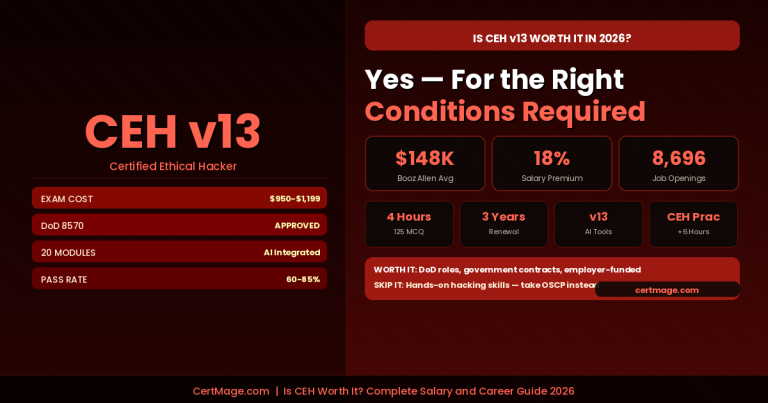
Provider: EC-Council Exam Cost: $1,199 for exam voucher plus $100 eligibility application fee if self-study Training Cost: $2,500 to $4,500 for official training with exam included Difficulty: Intermediate Recommended Prerequisites: Two years of information security experience Time to Prepare: 6 to 8 weeks with experience; 3 to 4 months without Renewal: Every 3 years via 120 ECE credits plus $80 annual membership DoD 8140 Approved: Yes
Salary Impact: One survey found CEH-enabled roles average $126,000 annually. The premium is highest for government contracting and DoD positions where CEH’s 8140 approval creates institutional demand.
ROI Calculation: $20,000 to $30,000 premium on $1,299 to $1,399 minimum investment for self-study path equals strong ROI, particularly for DoD contractor roles.
⚠️ 2026 CISSP Waiver Update: CEH was removed from the ISC2 approved CISSP experience waiver list effective April 1, 2026. If your roadmap involved using CEH to reduce the CISSP experience requirement from five years to four years, that pathway no longer exists.
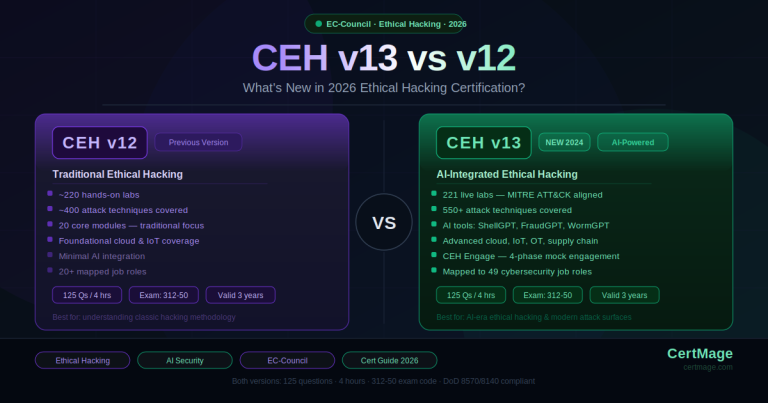
Who it is perfect for: Professionals targeting ethical hacking, penetration testing, or vulnerability assessment roles at organizations requiring DoD 8140 compliance including federal contractors, defense agencies, and government departments. CEH v13’s AI integration makes it the most current ethical hacking credential for professionals who need to demonstrate knowledge of AI-assisted attack techniques.
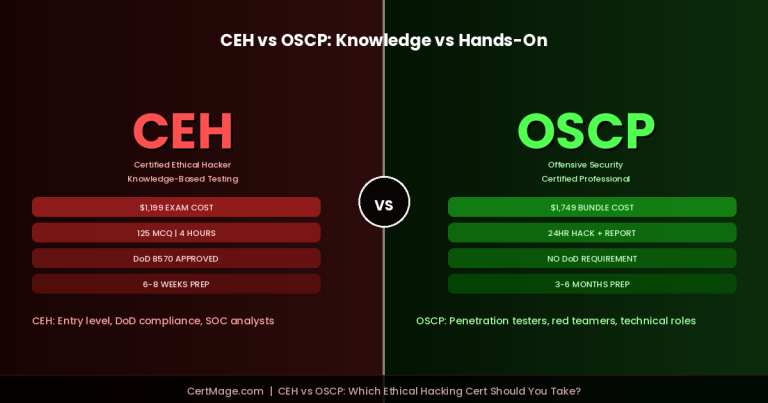
Who should skip it: Experienced penetration testers who already have hands-on skills and are ready for OSCP. CEH is a knowledge-based credential and employers in pure offensive security roles increasingly prefer OSCP’s hands-on validation over CEH’s multiple choice format. Technical hiring managers dig into practical skills and will value hands-on certifications like OSCP or GPEN over CEH for specialized pen test roles.
CertMage coverage: CertMage’s CEH v13 practice exams are built around the current 312-50 blueprint with complete scenario-based question banks across all 20 modules.
6. CompTIA PenTest+ (PT0-003)
Provider: CompTIA Exam Cost: $404 Difficulty: Intermediate Time to Prepare: 2 to 3 months Renewal: Every 3 years via 60 CEUs DoD 8140 Approved: Yes
Salary Impact: PenTest+ enabled roles average $116,000 annually.
Who it is perfect for: Candidates on the penetration testing career path who want a CompTIA-branded credential before committing to OSCP’s significantly higher cost and difficulty. PenTest+ is also DoD 8140 approved, making it useful for government contractors who need a compliance credential rather than a technical showcase.
Who should skip it: Candidates who can go directly to OSCP. In the penetration testing world, OSCP has become the de facto standard and PenTest+ is often perceived as a stepping stone rather than a destination. If budget allows and you have the technical foundation, OSCP is the higher-signal investment for offensive security careers.
Tier 3: Advanced Professional Certifications
7. OSCP (Offensive Security Certified Professional)
Provider: OffSec Cost: $1,699 for the standalone exam and $1,749 for the PEN-200 course bundle Difficulty: Advanced (hardest certification in this guide by practical challenge) Recommended Prerequisites: Solid networking fundamentals, Linux and Windows administration experience, basic scripting in Python or Bash, and significant hands-on hacking practice Time to Prepare: 4 to 6 months for candidates with IT backgrounds; up to 12 months from non-technical fields Renewal: OSCP does not expire. It is one of the few cybersecurity certifications with lifetime validity. Exam Format: 24-hour live exploitation exam against multiple target machines plus professional report writing
Salary Impact: OSCP is the strongest salary signal in offensive security. OSCP holders at the junior and mid levels consistently earn more than peers without it with a $10,000 to $20,000 premium. Cybersecurity job listings specifying the OSCP certification offer salaries averaging $117,600 to $151,000, the highest among all certifications in job posting salary data.
ROI Calculation: Target salary for OSCP plus one to two years of experience is $90,000 to $130,000. The $1,749 investment against a $20,000 premium represents exceptional ROI, and the lifetime validity means no renewal costs.
Who it is perfect for: Anyone serious about a penetration testing or offensive security career. OSCP is widely regarded as one of the most challenging and prestigious certifications in cybersecurity. It is a fully hands-on credential that tests candidates’ ability to think like an attacker and compromise real systems in a controlled environment. Employers in red team, penetration testing, bug bounty, and offensive security consulting roles treat OSCP as the minimum bar for serious candidates.
Who should skip it: Candidates who are not on an offensive security track. OSCP’s value is specific to roles requiring demonstrated exploitation capability. For blue team, governance, or cloud security roles, OSCP adds limited career signal relative to its significant preparation investment.
8. CISSP (Certified Information Systems Security Professional)
Provider: ISC2 Exam Cost: $749 Difficulty: Advanced Experience Required: Five years cumulative paid experience in two or more of the eight CBK domains (or four years with qualifying degree) Time to Prepare: 3 to 6 months with prior security experience; candidates without deep background may need 6 to 12 months Exam Format: CAT; 100 to 150 questions; 3 hours; passing score 700 out of 1,000 Renewal: Every 3 years; 120 CPE credits required
Salary Impact: CISSP holders earn a $25,000 to $35,000 annual premium over non-certified peers in equivalent roles. Average total compensation for CISSP-certified professionals is $120,000 to $160,000 and above. The $749 exam cost is recouped in under two weeks of the additional annual earnings.
CISSP is the most significant salary certification at the senior level and is a common requirement for security leadership roles. It has the highest correlation with six-figure salaries among all security certifications.
⚠️ 2026 CISSP Waiver Update: Effective April 1, 2026, ISC2 reduced its CISSP experience waiver list from approximately 50 certifications to 25. Significant certifications removed include CEH, CISA, CRISC, and OSCP. Certifications that survived and still qualify for the waiver include Security+, CISM, and CCSP.
Who it is perfect for: Security professionals with 4 to 6 years of experience targeting senior engineer, security architect, security manager, or CISO-track roles. CISSP is the most requested certification in US cybersecurity job postings according to CyberSeek, and it is one of the few credentials that signals both technical and governance competency.
Who should skip it: Practitioners in pure offensive security roles often find CISSP less relevant to their daily work than OSCP or GIAC offensive certifications, though CISSP remains valuable if you eventually move toward security management. Also skip it if you have not yet accumulated the required experience. Taking the exam without qualifying experience only earns the Associate of ISC2 designation, which has limited immediate career value.
CertMage coverage: CertMage’s CISSP practice exams cover all eight CBK domains with the scenario-based managerial thinking questions the CAT exam actually tests.
9. CompTIA CASP+ (SecurityX / CAS-005)
Provider: CompTIA Exam Cost: $494 Difficulty: Advanced Recommended Prerequisites: Ten years of IT experience with five in security (recommended) Time to Prepare: 3 to 4 months Renewal: Every 3 years via 75 CEUs DoD 8140 Approved: Yes for IAT Level III and IAM Level III
Salary Impact: CASP+ roles average $120,000 to $150,000 and the DoD approval creates institutional demand for government-aligned organizations.
Who it is perfect for: Senior technical practitioners who want to demonstrate deep security engineering capability without moving into management. CASP+ is intentionally positioned as the technical hands-on alternative to CISSP’s management orientation. Candidates who want to stay in technical roles at the highest level rather than transitioning to governance should consider CASP+ over CISSP.
Who should skip it: Candidates whose career goal is CISO, Security Director, or management-track roles. For those paths, CISSP’s governance and management coverage provides stronger signal than CASP+’s technical depth.
10. CCSP (Certified Cloud Security Professional)
Provider: ISC2 Exam Cost: $599 Difficulty: Advanced Experience Required: Five years total IT experience with three in security and one in cloud security Time to Prepare: 3 to 4 months Renewal: Every 3 years via 90 CPE credits
Salary Impact: AWS Security Specialty and CCSP both provide $10,000 to $20,000 salary premiums. Cloud security certifications carry salary premiums because cloud skills are in such high demand. CCSP holders pursuing cloud security roles earn $130,000 to $165,000.
Fast path for CISSP holders: Professionals holding CISSP can satisfy the CCSP experience requirement entirely through their CISSP certification, making CCSP a fast follow-on for CISSP holders targeting cloud roles.
Who it is perfect for: Security professionals transitioning into cloud security roles or those already working in cloud environments who need a vendor-neutral credential to complement AWS, Azure, or GCP-specific certifications.
Who should skip it: Professionals whose organizations are not significantly invested in cloud infrastructure. CCSP’s value is directly proportional to cloud adoption in your target roles.
Tier 4: Specialist and Executive Certifications
11. AWS Security Specialty (SCS-C02)
Provider: Amazon Web Services Exam Cost: $300 Difficulty: Advanced Recommended Prerequisites: AWS Solutions Architect Associate, five years of IT security experience, two years of AWS experience Time to Prepare: 3 to 4 months Renewal: Every 3 years
Salary Impact: AWS Security Specialty adds $18,000 to $25,000 at $300 cost, representing exceptional value for cloud-focused roles. Cloud certifications like AWS Security Specialty hit the high end at $159,000 in job listing salary data.
Who it is perfect for: Security engineers working in AWS environments or targeting AWS-specific security roles at cloud-first companies. The $300 exam cost makes it one of the highest ROI credentials in this guide in terms of salary premium per dollar invested.
Who should skip it: Professionals in organizations running primarily Azure or GCP infrastructure. Vendor-specific certifications are most valuable when aligned with the platform you actually work on.
12. CISM (Certified Information Security Manager)
Provider: ISACA Exam Cost: $760 for ISACA members, $895 for non-members Experience Required: Five years of IS management experience with three years in security management Difficulty: Advanced Time to Prepare: 3 to 4 months Renewal: Every 3 years via 120 CPE credits
Salary Impact: CISM holders pursuing director and CISO roles see $15,000 to $25,000 salary advantages. Professionals holding both CISM and CISSP average $155,000 to $185,000 in total compensation.
Who it is perfect for: Security managers and directors who want to validate management-focused expertise and signal readiness for CISO-track roles. CISM and CISSP are complementary: CISSP adds technical breadth while CISM adds governance and management focus.
Who should skip it: Technical practitioners with no interest in management roles. CISM’s value is specifically in its signal to executive and board-level audiences that the holder understands security as a business function.
13. GPEN / GWAPT (GIAC Certifications)
Provider: SANS Institute / GIAC Cost: SANS GIAC courses can run $7,000 and above for GPEN. The certification exam itself is $979. Difficulty: Advanced Time to Prepare: SANS courses run 5 to 6 days plus lab time
Salary Impact: GIAC certifications including GCIH, GCFA, and GCTI each provide $10,000 to $15,000 salary premiums. SANS/GIAC certifications are expensive and rigorous, and employers in specialized technical roles recognize that investment.
Who it is perfect for: Penetration testers and red team professionals who want depth beyond OSCP in specific domains. The OSCP plus GIAC GPEN or GWAPT combination is the penetration testing specialist stack. OSCP is the foundation; GIAC’s GPEN adds specific technical depth for consultancy or specialized red team roles.
Who should skip it: Anyone not able to justify $7,000 or more for a single credential. The SANS training cost is prohibitive for self-funded candidates. Employer-sponsored training makes GIAC credentials highly valuable. Self-funded candidates should typically exhaust OSCP, CISSP, and cloud certifications before considering GIAC given the cost difference.
14. CRISC (Certified in Risk and Information Systems Control)
Provider: ISACA Exam Cost: $760 for members, $895 for non-members Experience Required: Three years in IS risk management across two or more CRISC domains Difficulty: Advanced Renewal: Every 3 years via 120 CPE credits
Salary Impact: CRISC is among the highest-paying executive certifications. For technical professionals, CRISC and CISM consistently command top salaries averaging $155,000 to $170,000.
Who it is perfect for: GRC professionals, risk managers, and IT auditors whose primary focus is risk management and control frameworks. CRISC is the most respected risk management credential in enterprise environments.
Who should skip it: Technical practitioners not involved in risk governance. CRISC’s value is specific to GRC and risk management career paths.
The Best Certification Stacks for Specific Career Paths
Understanding individual certifications is useful. Understanding which combinations create the strongest career trajectory is more valuable.
Blue team to senior security engineering: Security+ to CySA+ to CISSP is the most complete blue team to senior security engineering path. Each credential builds on the last and validates progressively more advanced defensive operations capability. CertMage covers all three steps of this path with practice tests that let you measure readiness at each stage before moving to the next.
Penetration testing specialist: The penetration testing path starts with Security+, then moves to PenTest+ or CEH for DoD compliance needs, then to OSCP as the primary credential. Timeline to first pen test role is 12 to 24 months from zero with a target salary of $90,000 to $130,000 with OSCP plus one to two years of experience.
Cloud security: CISSP plus CCSP is the highest-paid combination in the current market, driven by cloud security demand. AWS Security Specialty adds a third layer for AWS-specific roles.
Security management and CISO track: CISM requires three years of management experience; CISSP requires five years in two or more domains. Target salary range is $140,000 to $200,000 and above at VP and CISO level.
Governance, risk, and compliance: CISA for auditing, CRISC for risk management, CISM for management. These three ISACA credentials together cover the full GRC function and support Director and Chief Risk Officer level roles.
The 2026 Certification ROI Table
| Certification | Exam Cost | Salary Premium | First-Year ROI | Expires |
| CompTIA Security+ | $404 | $5K–$10K | 1,238%–2,475% | 3 years |
| CompTIA CySA+ | $404 | $15K–$20K | 3,713%–4,950% | 3 years |
| CompTIA PenTest+ | $404 | $10K–$15K | 2,475%–3,713% | 3 years |
| CompTIA CASP+ | $494 | $15K–$20K | 3,036%–4,048% | 3 years |
| CCNA | $330 | $20K–$30K | 6,060%–9,090% | 3 years |
| CEH v13 | $1,299 | $20K–$30K | 1,539%–2,309% | 3 years |
| OSCP | $1,749 | $10K–$20K | 572%–1,143% | Never |
| CISSP | $749 | $25K–$35K | 3,337%–4,672% | 3 years |
| CCSP | $599 | $10K–$20K | 1,669%–3,338% | 3 years |
| AWS Security | $300 | $18K–$25K | 6,000%–8,333% | 3 years |
| CISM | $760 | $15K–$25K | 1,974%–3,289% | 3 years |
| GPEN | $7,000+ | $10K–$15K | 143%–214% | 4 years |
| CRISC | $760 | $15K–$25K | 1,974%–3,289% | 3 years |
The One Question That Determines Which Certification to Get First
Before choosing a certification, answer this question: what is the specific job title I want to have in twelve months?
If the answer is SOC Analyst, Security Analyst, or any entry-level security role: the answer is Security+. Start there without exception.
If the answer is Penetration Tester or Ethical Hacker: the answer is Security+ first, then PenTest+ or CEH, then OSCP within 18 to 24 months.
If the answer is Cloud Security Engineer: the answer is Security+ if you do not have it, then AWS Security Specialty or Azure Security Engineer aligned to your organization’s cloud platform.
If the answer is Senior Security Engineer or Security Architect: the answer is CISSP if you have the experience, with CySA+ as the bridge if you do not yet have five years.
If the answer is Security Manager, Director, or CISO: the answer is CISSP and CISM together, with CRISC added for GRC-heavy organizations.
For practice exams covering every certification on this list, CertMage provides updated question banks with complete answer explanations built around the current exam blueprints. Score 80 percent or higher consistently on CertMage practice tests before booking any exam on this list and your first-attempt pass rate will be dramatically higher than the industry average.
Frequently Asked Questions
Which cybersecurity certification is best for beginners?
Security+ provides a $5,000 to $10,000 premium over uncertified candidates and enables entry into the first security role. It is the universal starting point and should be every beginner’s first credential. CertMage’s Security+ practice tests are the most efficient way to confirm you are ready before you book.
Which cybersecurity certification pays the most?
Cybersecurity job listings specifying the OSCP certification offer salaries averaging $117,600 to $151,000, the highest among all certifications in job posting salary data. For absolute salary level rather than job listing data, executive certifications like CISM, CRISC, and CISSP support CISO-level roles paying $170,000 to $300,000 and above.
How many cybersecurity certifications should I have?
Certification stacking compounds salary advantages over time. Strategic accumulation of complementary certifications rather than redundant ones maximizes lifetime earning potential. Most senior practitioners hold three to five certifications at different levels. Two certifications that directly serve your target career path outperform five certifications spread across unrelated domains.
Do cybersecurity certifications expire?
Most do. CompTIA certifications renew every three years via CEUs. ISC2 credentials renew every three years with 90 to 120 CPE credits plus an annual membership fee. ISACA credentials renew every three years with 120 CPE credits and annual maintenance. OSCP does not expire and is one of the few certifications with lifetime validity.
Is CEH still worth it after the CISSP waiver removal?
Yes, with qualification. CEH remains DoD 8140 approved and continues to be required or preferred by federal contractors, defense agencies, and enterprise security teams. What changed is the CISSP sequencing strategy. The previous approach of doing CEH specifically to reduce the CISSP experience requirement no longer works. CEH remains valuable as a standalone ethical hacking credential on its own merits, particularly in government-aligned roles.