If you are considering the Certified Ethical Hacker (CEH) certification in 2026, one of the first questions you will face is this: should you still bother understanding CEH v12, or go straight to v13? And if you already hold a v12 credential, is upgrading worth it?
This guide gives you a complete, research-backed comparison of CEH v13 vs v12 — covering every meaningful difference in syllabus, labs, exam format, AI integration, career value, and salary potential — so you can make the right call for your cybersecurity career in 2026.
What Is CEH v13 and When Was It Released?
CEH v13 — officially called the Certified Ethical Hacker Version 13 — is the latest version of EC-Council’s globally recognized ethical hacking certification. It was launched on September 23, 2024, operating on Exam Blueprint v5.0 effective April 2024, and has been the active version throughout 2026 and into 2026.
EC-Council describes CEH v13 as the world’s first AI-powered ethical hacking certification — a significant claim that reflects just how fundamentally different this version is from its predecessor. Rather than simply updating tool lists or refreshing module content, v13 integrates artificial intelligence throughout the entire learning framework, from reconnaissance and scanning through to exploitation, persistence, and post-engagement analysis.
CEH v13 is built around a 4-phase learning framework that it shares with v12 — Learn, Certify, Engage, and Complete — but every phase has been substantially upgraded to reflect the AI-driven threat landscape that security professionals face in 2026.
What Is CEH v12 and Is It Still Valid?
CEH v12 was EC-Council’s previous major version, widely studied and obtained by thousands of cybersecurity professionals. It covered 20 core modules across the five phases of ethical hacking — Reconnaissance, Vulnerability Scanning, Gaining Access, Maintaining Access, and Clearing Tracks — and was respected for its breadth and practical lab coverage.
CEH v12 focused primarily on traditional ethical hacking techniques: network scanning, enumeration, web application attacks, malware analysis, social engineering, cryptography, and foundational cloud and IoT security. Its iLabs platform provided hands-on practice, and it offered a practical exam option alongside the standard knowledge-based assessment.
If you hold a CEH v12 credential, it remains valid for three years from your certification date. However, as v13 becomes the market standard and employer expectations shift toward AI-integrated security skills, the professional value of holding only a v12 credential will diminish over time.
CEH v13 vs v12: What Are the Key Differences?
This is the core question most candidates need answered. Here is a comprehensive breakdown across every dimension that matters.
1. AI Integration — The Biggest Change by Far
CEH v12: Minimal emphasis on artificial intelligence. The curriculum focused on traditional hacking methodologies with no structured AI component. AI tools and AI-specific attack vectors were not part of the core curriculum.
CEH v13: AI is woven into every phase of the ethical hacking lifecycle. This is not a single added module — it is a fundamental redesign. CEH v13 teaches candidates to use AI tools including ShellGPT, FraudGPT, and WormGPT for tasks like automated reconnaissance, AI-assisted vulnerability scanning, predictive breach analysis, and automated exploitation. It also teaches candidates how to defend against AI-powered attacks — including AI-generated malware, deepfake-based social engineering, prompt injection attacks, and model poisoning.
The v13 framework includes an AI Proficiency Testing component for candidates pursuing the advanced CEH Master designation, making AI competency a formally assessed part of the credential pathway.
This shift is not cosmetic. It reflects the reality that both attackers and defenders are now deploying AI at scale — and that ethical hackers who cannot work with and against AI-powered threats are increasingly underprepared for real-world engagements.
2. Hands-On Labs — Massively Expanded
CEH v12: Offered strong hands-on coverage through the iLabs platform, with approximately 220 labs covering core penetration testing scenarios. The labs were tool-focused and simulation-based, covering individual attack techniques in controlled environments.
CEH v13: Expands the lab environment significantly, with 221 live labs aligned to the MITRE ATT&CK framework and over 550 attack techniques covered across 20 modules — compared to approximately 400 in v12. The v13 labs include AI-based scenarios such as AI-driven malware analysis, automated exploitation simulations, and AI-assisted threat detection exercises.
Beyond individual labs, v13 introduces CEH Engage — a revolutionary 4-phase simulated ethical hacking engagement. This places candidates inside a mock organization scenario where they execute a complete security engagement from initial reconnaissance through to post-engagement reporting. It is the closest simulation to a real-world penetration testing engagement available in any certification program.
V13 also adds monthly CTF (Capture the Flag) competitions with year-long access to 12 different challenges, providing continuous skill reinforcement and competitive benchmarking against peers globally.
3. Curriculum and Module Updates
Both CEH v12 and CEH v13 are structured around 20 core modules. The module count has not changed, but the content within those modules has been substantially modernized in v13.
What CEH v12 covered well:
- Footprinting and reconnaissance using traditional OSINT tools
- Network scanning and enumeration using Nmap, Nessus, and similar tools
- System hacking, privilege escalation, and maintaining access
- Web application attacks including SQL injection and XSS
- Social engineering techniques
- Foundational cloud security and basic IoT concepts
- Cryptography and steganography fundamentals
- Malware analysis and reverse engineering basics
What CEH v13 adds or significantly deepens:
- AI-powered cyberattack techniques — automated phishing, deepfake fraud, AI-generated malware
- Advanced cloud security — multi-cloud platforms (AWS, Azure, GCP), container security, Kubernetes vulnerabilities, serverless attack surfaces, and cloud misconfiguration exploitation
- Expanded IoT and OT/SCADA security — operational technology exploitation, medical device security, edge computing vulnerabilities
- Post-quantum cryptography awareness — preparing for the shift away from classical encryption algorithms
- Zero Trust architecture concepts — understanding and bypassing modern zero trust implementations
- Advanced ransomware attack strategies — including Ransomware-as-a-Service (RaaS) models and double-extortion techniques
- Supply chain attack vectors — a growing threat category that v12 barely touched
- Programming concepts integration — understanding code in the context of vulnerability discovery and exploit development
The overall effect is that v13 graduates are prepared for attack surfaces and threat models that simply did not exist at the scale v12 was designed for. Modern enterprise environments — running across multi-cloud, containerized, AI-assisted, and IoT-connected infrastructure — require the expanded coverage v13 provides.
4. Exam Format Comparison
| Feature | CEH v12 | CEH v13 |
| Exam Code | 312-50 | 312-50 |
| Number of Questions | 125 | 125 |
| Exam Duration | 4 hours | 4 hours |
| Passing Score | 60–85% (varies by form) | 60–85% (varies by form) |
| Practical Exam | Optional (CEH Practical) | Optional (enhanced with AI scenarios) |
| CEH Master | Available | Available (adds AI Proficiency Testing) |
| Certification Validity | 3 years | 3 years (some sources indicate 5 years for v13) |
| Renewal | EC-Council ECE credits | EC-Council ECE credits |
The core written exam format is largely consistent between versions. The most meaningful exam-level change in v13 is the enhancement of the CEH Practical exam — a 6-hour hands-on assessment conducted in a live cyber range environment with real attack scenarios — and the introduction of CEH Master for candidates who pass both the written exam and the Practical with distinction, now including AI Proficiency Testing as a formal assessment component.
5. New Tools Covered in CEH v13
CEH v12 trained candidates on the industry’s established toolkit: Nmap, Metasploit, Wireshark, Burp Suite, John the Ripper, Hydra, Sqlmap, and similar tools that have been staples of penetration testing for years.
CEH v13 retains all of these while adding a significantly updated toolset aligned to modern attack techniques:
- ShellGPT — AI-assisted command generation for penetration testing tasks
- FraudGPT — understanding and defending against AI-generated fraud campaigns
- WormGPT — AI-powered malware generation awareness and defense
- AI-assisted reconnaissance tools — automated OSINT and target profiling
- Container security tools — Docker and Kubernetes vulnerability assessment tools
- Cloud misconfiguration scanners — for AWS, Azure, and GCP environments
- Advanced ransomware simulation tools — for understanding modern RaaS attack chains
- Updated versions of core tools reflecting current capabilities
This expanded toolset reflects the reality that an ethical hacker in 2026 operates in an environment where attackers have access to AI-powered capabilities — and defenders must understand those same tools to counter them effectively.
6. Career Mapping and Job Role Alignment
CEH v12 prepared candidates for roughly 20+ defined cybersecurity job roles, covering the core penetration testing and ethical hacking spectrum.
CEH v13 expands this dramatically — the certification is now formally mapped to 49 cybersecurity job roles, reflecting both the breadth of the updated curriculum and the growing specialization of the cybersecurity industry. New role alignments include AI-based penetration tester, cloud security engineer, machine learning security expert, DevSecOps specialist, and OT/ICS security analyst — roles that barely existed in mainstream hiring when v12 was developed.
This expanded role mapping is not just a marketing figure. It represents EC-Council’s recognition that cybersecurity has fragmented into dozens of specializations, and that a modern ethical hacking certification needs to provide a foundation broad enough to support diverse career trajectories.
CEH v13 vs v12: Head-to-Head Summary
| Category | CEH v12 | CEH v13 |
| AI Integration | Minimal — not in core curriculum | Central — AI throughout all 5 phases |
| Hands-On Labs | ~220 labs, tool-focused | 221 live labs, MITRE ATT&CK aligned |
| Attack Techniques | ~400 techniques covered | 550+ techniques covered |
| Cloud Security | Foundational coverage | Advanced — multi-cloud, containers, K8s |
| IoT/OT Security | Basic concepts | Expanded — medical devices, SCADA, edge |
| New Tools | Traditional toolkit | AI tools added (ShellGPT, FraudGPT, etc.) |
| Exam Format | 125 Qs / 4 hrs | 125 Qs / 4 hrs (consistent) |
| Practical Exam | Optional CEH Practical | Enhanced with AI scenarios |
| CEH Master | Available | Available + AI Proficiency Testing |
| Job Role Mapping | 20+ roles | 49 roles |
| Ransomware Coverage | Foundational | Advanced — RaaS, double extortion |
| Supply Chain Attacks | Limited | Dedicated coverage |
| Post-Quantum Crypto | Not covered | Awareness module included |
| Monthly CTFs | Not included | 12 monthly challenges, year-long access |
| CEH Engage | Not included | 4-phase mock engagement included |
Should You Upgrade from CEH v12 to v13?
If you currently hold CEH v12, the question of whether to upgrade is worth taking seriously. Here is a clear framework:
Upgrade to v13 if:
- Your v12 credential is approaching its renewal date — renewing under v13 standards keeps you current
- Your current or target role involves cloud environments, AI tools, or IoT/OT systems — v13 directly covers these
- You are targeting senior or specialized roles that require demonstrated knowledge of AI-driven threats
- You want access to the enhanced CEH Practical exam and CEH Master designation with AI Proficiency Testing
- Your employer or clients are asking for evidence of AI-security competency
You can wait if:
- Your v12 is recent and still has significant validity remaining
- Your current role is focused on traditional network penetration testing where AI tools are not yet deployed
- You are preparing for a different certification path in the near term (OSCP, PNPT, etc.) and plan to return to CEH later
The honest assessment is that for most professionals in active cybersecurity roles, the AI integration in v13 is not optional knowledge — it is becoming essential. The upgrade is worth it.
What Is the CEH v13 Exam Cost in 2026?
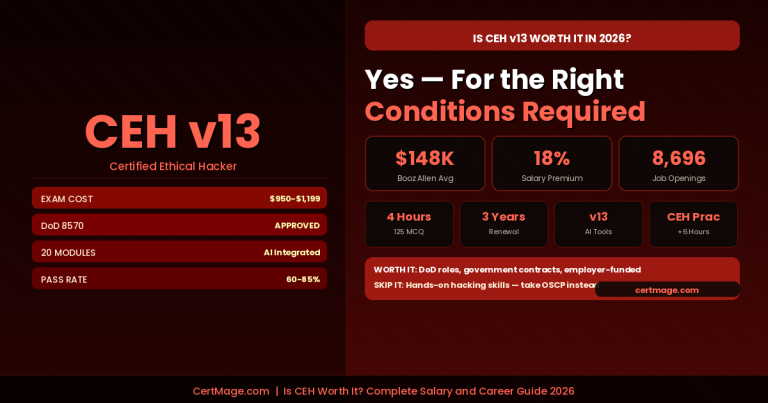
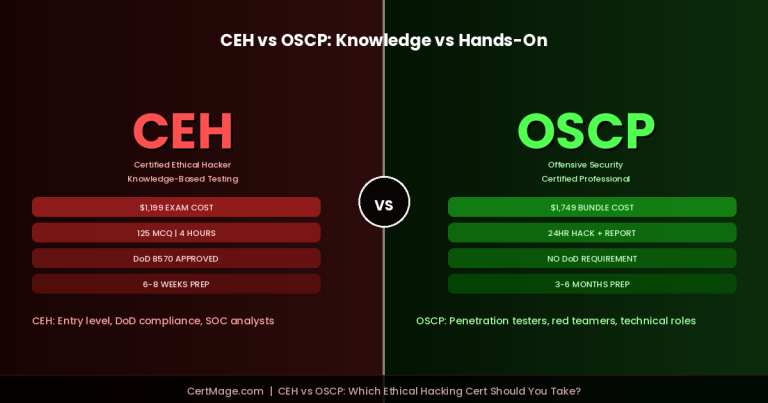
The CEH v13 exam voucher costs approximately $1,199 USD for the knowledge-based exam. The CEH Practical exam is an additional cost. EC-Council requires candidates to either complete official EC-Council training or demonstrate at least two years of information security work experience to be eligible for the exam.
Training costs vary significantly by provider and format — instructor-led classroom training, live online training, and self-paced options all carry different price points. It is worth comparing providers carefully, as the quality of lab access and course materials varies considerably.
How to Prepare for CEH v13 in 2026
Passing CEH v13 requires more structured preparation than v12 did, primarily because of the AI component and the expanded lab requirements. Here is what works:
Study the official EC-Council curriculum. EC-Council’s courseware is the authoritative source for exam content. Every exam question is drawn from the official modules — there are no shortcuts around the official material.
Prioritize lab practice above all else. CEH v13’s practical emphasis means that candidates who understand concepts but lack hands-on experience consistently underperform on exam day. Allocate more than half of your study time to lab work. If you cannot access the full EC-Council iLabs, supplement with platforms like TryHackMe, Hack The Box, and self-built virtual lab environments.
Master the AI modules specifically. This is where v13 candidates are most likely to be underprepared. Many candidates come from traditional IT security backgrounds and have limited exposure to AI security concepts. Spend dedicated time understanding how AI tools are used offensively, how AI-powered attacks work mechanically, and how defenders counter them.
Learn the MITRE ATT&CK framework. CEH v13 labs and exam questions are heavily aligned to MITRE ATT&CK. Understanding the framework — its tactics, techniques, and procedures structure — will help you contextualize exam questions and make faster, more accurate decisions under time pressure.
Use high-quality practice exams. Practice testing is the most reliable predictor of exam performance. Focus on practice exams that include detailed explanations for every answer — not just answer keys. Understanding the reasoning behind correct and incorrect answers builds the applied knowledge that scenario-based questions demand.
CertMage offers CEH v13-aligned practice questions, study guides, and exam preparation resources specifically designed for the updated v13 exam domains — including the AI and cloud security content that is most commonly tested and most commonly underprepared for by candidates in 2026.
What Jobs Can You Get With CEH v13 in 2026?
CEH v13’s mapping to 49 cybersecurity job roles reflects the broad career applicability of the credential. The most common and highest-paying roles for CEH v13 certified professionals in 2026 include:
- Penetration Tester / Ethical Hacker — $85,000 to $130,000 annually
- Vulnerability Assessment Analyst — $75,000 to $110,000 annually
- Red Team Engineer — $100,000 to $145,000 annually
- SOC Analyst (Tier 2/3) — $80,000 to $120,000 annually
- Cloud Security Engineer — $105,000 to $150,000 annually
- AI Security Specialist — $110,000 to $155,000 annually (emerging, high demand)
- Security Consultant — $90,000 to $140,000 annually
- OT/ICS Security Analyst — $95,000 to $135,000 annually
The AI Security Specialist role is worth highlighting — it barely existed as a defined role when v12 was current, and it is now one of the fastest-growing and highest-compensating specializations in the entire cybersecurity market. CEH v13’s AI integration makes it one of the few certifications that directly prepares candidates for this emerging field.
Frequently Asked Questions: CEH v13 vs v12
Is CEH v12 still accepted by employers in 2026?
CEH v12 is still a recognized credential and will remain valid until its expiry date. However, as v13 becomes the market standard and employers begin specifying AI security knowledge in job requirements, the competitive advantage of holding only v12 is diminishing. Most candidates entering the market fresh in 2026 should pursue v13 directly.
Can I take the CEH v13 exam without training?
EC-Council requires either completion of official EC-Council training or verification of at least two years of work experience in information security. Without one of these, you are not eligible to sit the exam regardless of your actual skill level.
How long does it take to prepare for CEH v13?
With a solid IT security background, most candidates require 8 to 12 weeks of dedicated preparation. Candidates newer to the field or with limited hands-on experience typically need 14 to 20 weeks. The AI modules specifically require additional time for candidates who have not previously worked with AI security tools.
Is CEH v13 harder than v12?
CEH v13 is broadly considered more challenging than v12, primarily due to the addition of AI security content and the expanded attack surface coverage. The core exam format (125 questions, 4 hours) remains similar, but the depth of knowledge required across newer domains — particularly AI attacks, multi-cloud security, and supply chain exploitation — is greater.
Does CEH v13 help with DoD 8570/8140 compliance?
Yes. CEH remains compliant with the U.S. Department of Defense Directive 8570/8140, making it a required or recognized credential for a broad range of U.S. government and defense contractor cybersecurity roles. This compliance was maintained through the v13 update.
What is the difference between CEH, CEH Practical, and CEH Master?
CEH is the standard knowledge-based exam (125 questions, 4 hours). CEH Practical is a separate 6-hour hands-on exam conducted in a live cyber range with real attack scenarios. CEH Master is the designation awarded to candidates who pass both the CEH written exam and the CEH Practical, with v13 adding an AI Proficiency Testing component to the Master pathway.
Final Verdict: CEH v13 vs v12 in 2026
CEH v13 is not just an incremental update. It is the most significant overhaul in the certification’s history — and the shift to AI-integrated ethical hacking makes it fundamentally more relevant to the 2026 threat landscape than v12 was.
For candidates deciding between studying v12 material versus pursuing v13 directly, the answer is straightforward: pursue v13. The AI integration, expanded cloud and IoT coverage, CEH Engage simulation, monthly CTF access, and 49-role career mapping all represent genuine, meaningful improvements that directly affect how valuable the credential is to employers and how prepared the holder is for actual ethical hacking work.
For v12 holders considering renewal or upgrade: the question is not whether v13 is better — it clearly is — but whether the timing makes sense for your current role and career trajectory. For most active security professionals, the answer is yes.
The cybersecurity landscape is not waiting. AI-powered attacks are already happening. Ethical hackers who are certified under a framework that accounts for this reality will be the ones organizations trust with their most critical security engagements.
Ready to start preparing for CEH v13? Visit CertMage.com for practice exams, study guides, and CEH v13-aligned preparation resources designed to help you pass on your first attempt.
Tags: CEH v13 vs v12, CEH v13 new features 2026, certified ethical hacker v13, CEH v13 exam guide, CEH v12 upgrade, EC-Council CEH 2026, CEH v13 AI integration, ethical hacking certification 2026, CEH v13 syllabus, CEH v13 salary, CEH v13 vs v12 comparison, CEH Master certification, C