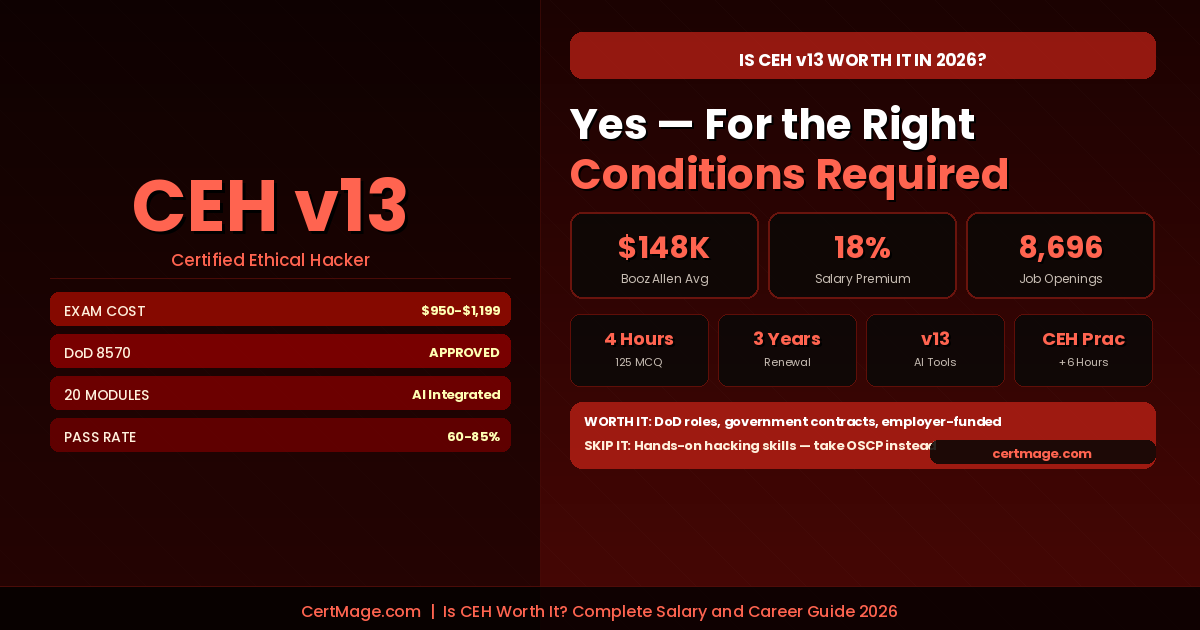
Is CEH worth it? CEH in 2026 is worth it under specific conditions — primarily if you are in or targeting compliance-heavy, government, or large enterprise environments where brand recognition and DoD 8570 compliance matter. It is not worth it if you are paying out of pocket purely to learn hands-on hacking skills, because the multiple choice format does not validate practical exploitation ability. The honest answer depends entirely on why you want it and where you are in your career.
If you are applying for a government contract job and you have the CEH, your resume gets past the automated filter. If you do not, it goes in the trash. The ROI here is infinite — no cert, no job.
CEH Fast Facts
| Detail | Information |
| Full name | Certified Ethical Hacker v13 |
| Issuing body | EC-Council |
| Exam code | 312-50 |
| Exam cost | $950 to $1,199 USD depending on region |
| Exam duration | 4 hours |
| Number of questions | 125 multiple choice |
| Passing score | 60 to 85 percent depending on exam form |
| Experience required | 2 years in information security recommended |
| No experience path | Complete official EC-Council training |
| DoD 8570 approved | Yes — multiple categories |
| Renewal | 120 ECE credits every 3 years |
| Optional Practical exam | CEH Practical — 6 hours, live lab environment |
| Current version | CEH v13 — first AI-integrated ethical hacking cert |
| NICE Framework | Endorsed by NICE National Initiative for Cybersecurity Education |
Is CEH Worth It for Career Starters?
CEH is a resume certification. That is not an insult — that is its primary function. It proves you have a baseline understanding of security concepts and tools and it gets you past HR firewalls.
For career starters, CEH is worth it in these specific situations. If every job posting in your target market lists CEH as required or preferred, the certification is not optional — it is the admission ticket. If you are targeting government contracting or defense sector roles where DoD 8570 compliance is mandatory, CEH opens those positions in a way that no purely hands-on certification does.
It is not worth it for complete beginners with no IT foundation. If you are just starting out in IT, focus on foundational certifications first. Do not spend $1,300 on the exam until you know you are ready. Security+ provides a better ROI as your first cybersecurity credential and costs $404 versus $950 to $1,199 for CEH.
CEH Salary in 2026: Real Numbers
CEH Salary by Experience Level
An entry-level Certified Ethical Hacker with less than 1 year of experience can expect to earn an average total compensation of $78,614. An early career Certified Ethical Hacker with 1 to 4 years of experience earns an average total compensation of $100,416.
| Experience Level | Average US Salary |
| Entry level (0 to 1 year) | $78,000 to $90,000 |
| Early career (1 to 4 years) | $90,000 to $120,000 |
| Mid career (4 to 8 years) | $110,000 to $145,000 |
| Senior level (8 plus years) | $130,000 to $165,000 |
CEH Salary by Job Role
Information security manager positions represent the highest-paying tier, with salaries ranging from $90,000 to $175,000 annually. Penetration tester roles pay an average compensation ranging from $65,000 to $158,000 depending on experience and specialization. Cybersecurity Engineer positions blend defensive and offensive capabilities, typically paying between $73,000 and $155,000.
| Role | Average US Salary |
| Security Analyst | $80,000 to $110,000 |
| Ethical Hacker | $90,000 to $125,000 |
| Penetration Tester | $90,000 to $158,000 |
| Cybersecurity Engineer | $95,000 to $155,000 |
| Information Security Manager | $100,000 to $175,000 |
| Senior Ethical Hacker | $130,000 to $165,000 |
CEH Salary by Top Employer
CEH certified professionals earn the following average salaries at major employers: Lockheed Martin $116,154, Booz Allen Hamilton $148,603, Raytheon $130,000, SAIC $122,084, Department of Homeland Security $110,000, Google $100,000.
The salary premium: CEH delivers an 18 percent average salary premium over non-certified security professionals. According to PayScale, CEH certified professionals can see salary increases of up to 20 to 30 percent after earning their certification. In some cases professionals report that the certification helped them land higher-paying jobs or promotions, allowing them to recover their investment in a matter of months.
CEH ROI: The Complete Cost vs Return
Full Cost Breakdown
| Cost Item | Amount |
| CEH exam only (self-study path) | $950 to $1,199 |
| Official EC-Council training (iLearn) | $999 additional |
| Official classroom training | $2,000 to $3,500 additional |
| Third-party practice exams | $50 to $150 |
| Total self-study path | $1,000 to $1,350 |
| Total with official training | $2,000 to $4,700 |
| CEH Practical exam (optional) | $550 additional |
ROI Calculation
| Return Item | Amount |
| Average annual salary increase | $15,000 to $30,000 |
| DoD contractor role premium | $20,000 to $40,000 |
| Time to break even (self-study path) | 3 to 8 weeks of increased earnings |
| 3-year cumulative benefit | $45,000 to $90,000 additional earnings |
For that money, OSCP at $1,749 including lab access is widely considered a better investment for serious penetration testers. The CEH ROI is strongest when DoD compliance or enterprise HR filtering makes it a requirement rather than a choice.
The Honest Criticism of CEH — And Why It Still Matters
This section most blogs skip. You deserve the complete picture.
The Valid Criticisms
The biggest criticism of the CEH is that it does not actually teach you how to hack. The standard CEH is a 4-hour 125-question multiple choice exam. It tests your knowledge of tools, methodologies, and concepts. You need to know the exact Nmap flags for an XMAS scan but you do not actually have to run the scan. You need to know what a SQL injection looks like but you do not have to exploit a database.
Covering 20 modules means covering each one relatively superficially. Certifications like OSCP are far more demanding technically and reflect genuine hands-on exploitation ability — something CEH’s format cannot validate.
These criticisms are valid. In penetration testing practitioner communities, CEH is frequently dismissed as a vocabulary test that anyone can pass with sufficient memorization. Senior penetration testers rarely list CEH as a meaningful signal of practical ability.
Why CEH Still Matters Despite the Criticisms
Recruiters who do not know the difference between cross-site scripting and a crosswalk use the CEH as a keyword filter. They search LinkedIn for CEH because the hiring manager asked for someone who knows about ethical hacking. It is arguably the most recognized security certification name outside of the industry. Even non-technical managers know what it sounds like.
In 2026, as organizations confront ransomware attacks, data breaches, and network vulnerabilities, certifications like CEH offer a competitive edge in the talent market.
The job market data does not lie. On October 19, 2024, there were 8,696 job openings for ethical hackers listed on LinkedIn alone. When you consider all job platforms and openings throughout the year this number is likely much higher.
What Does CEH v13 Cover?
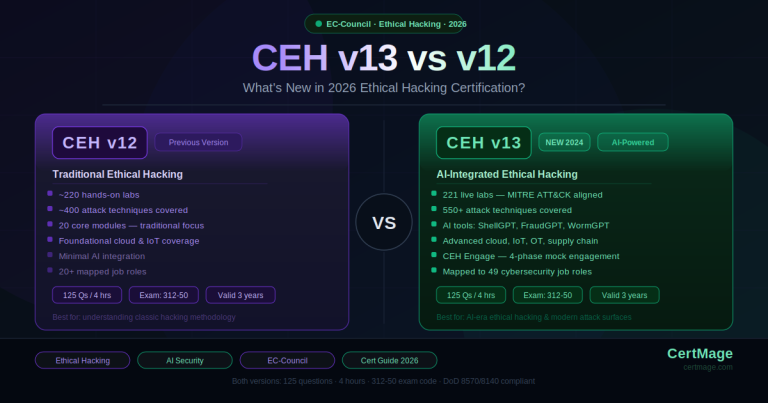
CEH v13 is EC-Council’s first AI-powered ethical hacking certification. It covers 20 modules and 550 plus attack techniques, with AI-assisted hacking and defense tools integrated throughout.
CEH v13 Exam Domains
| Module Area | Key Topics |
| Reconnaissance | Footprinting, OSINT, DNS enumeration, competitive intelligence |
| Scanning and enumeration | Network scanning, OS fingerprinting, banner grabbing, vulnerability identification |
| System hacking | Password cracking, privilege escalation, maintaining access, clearing tracks |
| Malware and threats | Trojans, ransomware, rootkits, fileless malware, AI-powered malware |
| Social engineering | Phishing, vishing, spear phishing, impersonation, insider threats |
| Web application attacks | SQL injection, XSS, CSRF, OWASP Top 10, API security |
| Network attacks | Sniffing, session hijacking, DoS, ARP poisoning |
| Cloud security | AWS, Azure, GCP misconfigurations, container security |
| IoT and OT security | SCADA, ICS, embedded device vulnerabilities |
| AI-powered attacks | ShellGPT, FraudGPT, WormGPT, AI-assisted reconnaissance |
What CEH v13 adds over CEH v12: AI integration is woven throughout every module. CEH v13 explicitly covers how attackers use AI tools for reconnaissance automation, phishing generation, and exploit development — and how defenders detect and counter AI-powered attacks. This update makes CEH v13 significantly more relevant to the 2026 threat landscape than any previous version.
CEH vs OSCP: Which Is the Better Investment?
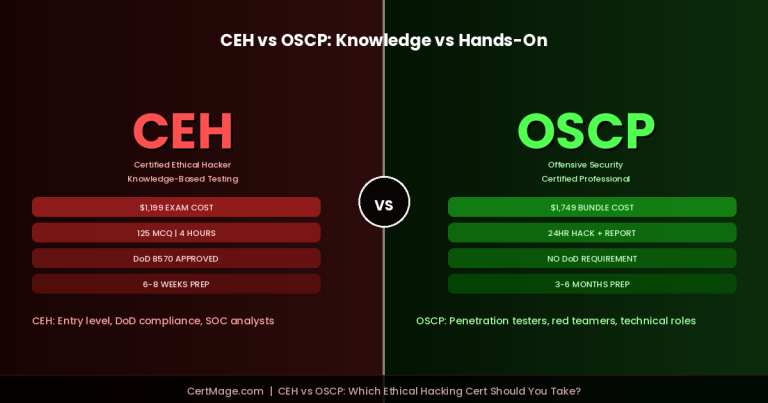
This is the most important comparison for candidates choosing between the two certifications. For the complete detailed breakdown, our CEH vs OSCP guide covers every dimension. Here is the summary:
| Factor | CEH | OSCP |
| Cost | $950 to $1,199 exam only | $1,749 Course and Cert Bundle |
| Exam format | 125 multiple choice questions | 24-hour practical exploitation |
| DoD 8570 compliant | Yes | No |
| HR keyword recognition | Very high | Lower but growing |
| Technical hiring manager respect | Moderate | Very high |
| Actual hacking skills tested | No | Yes |
| Best for | Government, compliance, enterprise | Penetration testing firms, red teams |
| Salary premium | 18 to 20 percent | 20 to 25 percent in technical roles |
If you do pursue CEH, add the Practical component. The combination addresses the certification’s main weakness and produces a credential respected both by HR departments and technically sophisticated hiring managers.
CEH Job Market in 2026
The cybersecurity skills gap keeps widening with millions of positions unfilled globally. Organizations struggle to find qualified professionals who can conduct thorough security assessments, creating exceptional opportunities for those with proper credentials.
Industries Hiring CEH Certified Professionals
| Industry | Why They Hire | Salary Premium |
| Government and defense | DoD 8570 mandatory requirement | Highest nationally |
| Financial services | Regulatory compliance, penetration testing | Strong |
| Healthcare | HIPAA security assessments | Moderate to strong |
| Technology | Red team and vulnerability programs | Strong |
| Consulting | Client security assessments | Strong |
| Critical infrastructure | Energy, utilities, ICS security | Strong |
Top Employers Actively Hiring CEH Professionals
Government contractors like Lockheed Martin, Raytheon, and General Dynamics provide stable employment with excellent benefits packages. Security clearances you gain often translate to higher earning potential. Consulting firms such as Deloitte, PwC, and KPMG offer rapid career progression and exposure to diverse client environments.
The remote work advantage: Remote work has fundamentally changed geographic considerations. Many organizations now hire ethical hackers regardless of location focusing on skills and credentials rather than proximity. This shift lets you access top-tier salaries while living in lower-cost areas.
When CEH Is Worth It
You should take the CEH if you need it for a DoD requirement, your employer is paying for it, or you are trying to transition into security and notice every job in your area requires it. It is also a good stepping stone if you eventually want to tackle the CEH vs CISSP decision later in your career.
CEH is clearly worth it in these specific situations:
You are targeting government or defense contractor roles. If you are applying for a government contract job and you have the CEH, your resume gets past the automated filter. The ROI here is infinite — no cert, no job.
Your employer is paying for it. When the cost is covered by professional development budget, CEH becomes a no-brainer. The credential opens doors and the financial risk is eliminated.
You are transitioning into cybersecurity from IT. CEH provides the structured offensive security framework that makes you credible to security hiring managers. It signals intentional career direction in a way that general IT certifications do not.
You need DoD 8570 compliance at a lower experience threshold than CISSP. CEH satisfies DoD requirements significantly earlier in your career than the 5-year experience requirement of CISSP. For early-career professionals in the defense sector, CEH is often the most efficient DoD compliance path.
You want to add the CEH Practical for genuine credibility. CEH makes strong sense for security professionals targeting government and DoD roles where 8570 compliance is required, corporate security analysts who need to demonstrate offensive awareness, professionals building toward more advanced offensive certifications who want a structured foundation, and candidates in enterprise environments where HR filters on recognizable certification names.
When CEH Is Not Worth It
Skip the CEH if you are paying out of pocket and want to learn practical hacking, or if you already have the CISSP. At that point, the CEH adds very little value to your resume.
You want genuine hands-on penetration testing skills. The CEH written exam does not prove you can exploit anything. If your goal is real offensive security capability, OSCP at $1,749 provides hands-on validation that CEH’s multiple choice format cannot replicate.
You are an experienced penetration tester. CEH makes less sense for experienced penetration testers who want to demonstrate real-world skills or candidates on tight budgets where the cost-to-value ratio is difficult to justify.
You already hold Security+ and CISSP. Adding CEH between these two credentials provides minimal additional career value. The money and time are better invested in a higher-level or more specialized credential.
You are on a tight budget without employer support. At $950 to $1,199 for the exam alone, CEH is expensive relative to its practical skills validation. Security+ at $404 or OSCP at $1,749 with lab access both provide stronger value per dollar for candidates without employer funding.
What Comes After CEH?
| Career Goal | Next Certification After CEH |
| Hands-on penetration testing | OSCP — validates actual exploitation skills |
| Security management track | CISSP — after 5 years experience |
| Advanced offensive security | GPEN, GXPN, or OSEP |
| Security analytics | CySA+ or GCIA |
| Web application testing | GWAPT or BSCP |
| Cloud penetration testing | AWS Security Specialty or CCSP |
CertMage covers the complete cybersecurity certification path including all major credentials in our Best Cybersecurity Certifications 2026 guide. For the full comparison of CEH against its most common alternative for hands-on hacking validation, our CEH vs OSCP guide covers every difference in detail.
How to Prepare for CEH v13
Step 1: Verify you meet the experience requirement. EC-Council requires 2 years of information security experience or completion of an approved training program before taking the exam. If you lack the experience, enroll in the official EC-Council iLearn or instructor-led course to satisfy the eligibility requirement.
Step 2: Study all 20 modules systematically. CEH is a breadth exam. Every module appears in the exam with roughly equal weighting. Candidates who concentrate heavily on interesting modules like system hacking while skimming others like IoT security consistently encounter unexpected exam gaps. Study all 20 modules with equal discipline.
Step 3: Memorize tool names, flags, and use cases specifically. CEH questions frequently ask which specific tool accomplishes a specific task, what command-line flags are used for specific scan types, and which protocol is involved in specific attack scenarios. Memorize the primary tools in each module and their specific use cases.
Step 4: Practice with 500 plus scenario-based questions before booking. CEH scenario questions test whether you can apply methodology and tool knowledge to real attack situations rather than simply recalling definitions. CertMage’s CEH v13 practice exams cover all 20 modules with current scenario-based questions and complete answer explanations aligned to the 312-50v13 blueprint.
Step 5: Consider the CEH Practical for technical credibility. The CEH Practical exam adds a 6-hour hands-on component that validates real offensive security skills in a live lab environment. Technical hiring managers who are skeptical of the written CEH respect the Practical significantly more. If you are targeting roles where the hiring manager is a practitioner rather than an HR professional, the Practical component is worth the additional investment.
Frequently Asked Questions: Is CEH Worth It?
Is CEH worth it in 2026?
Yes under specific conditions. CEH is worth it for government and defense contractor roles requiring DoD 8570 compliance, employer-funded professional development, security professionals transitioning from IT who need brand-recognized credentials, and candidates building toward advanced offensive certifications. It is not worth it for paying out of pocket to learn practical hacking skills.
How much does CEH pay in 2026?
CEH holders earn $78,000 to $90,000 at entry level, $90,000 to $120,000 with 1 to 4 years of experience, and $130,000 to $165,000 at senior level in the US. Government contractors like Booz Allen Hamilton pay CEH professionals an average of $148,603.
How much does CEH cost?
The CEH exam costs $950 to $1,199 depending on region. Official EC-Council training adds $999 to $3,500. Third-party practice exams add $50 to $150. Total self-study path costs $1,000 to $1,350. The optional CEH Practical exam costs approximately $550 additional.
Is CEH harder than Security+?
Yes. CEH is harder than Security+ in terms of both content breadth and cost. Security+ costs $404 and takes 8 to 12 weeks to prepare for. CEH covers 20 offensive security modules and costs $950 to $1,199. Security+ is the recommended first cybersecurity certification before attempting CEH.
Does CEH teach you how to hack?
The written CEH multiple choice exam tests knowledge of hacking tools and methodologies but does not require you to actually exploit any systems. The optional CEH Practical exam does require hands-on exploitation in a live lab environment. If practical hacking skills are your primary goal, OSCP provides more genuine hands-on validation.
Is CEH recognized by DoD?
Yes. CEH is DoD 8570/8140 approved for multiple position categories. It is one of the most commonly required certifications for government contractor and defense sector roles that require validated offensive security knowledge.
How long does CEH preparation take?
Most candidates need 6 to 8 weeks of focused part-time study covering all 20 modules. Candidates with existing security knowledge can prepare in 4 to 6 weeks. Complete beginners should allow 10 to 14 weeks and should complete Security+ or equivalent preparation before attempting CEH.
Is CEH better than OSCP?
Neither is objectively better. CEH provides broader DoD compliance and HR recognition across government and enterprise environments. OSCP provides superior technical credibility with penetration testing practitioners and hiring managers who are themselves security professionals. For the complete comparison, our CEH vs OSCP guide covers every dimension.
What is CEH v13 and what is new?
CEH v13 is the current version of the Certified Ethical Hacker certification. It is the first version to integrate AI throughout all 20 modules, covering AI-powered attack tools like ShellGPT, FraudGPT, and WormGPT alongside traditional ethical hacking methodology. The v13 update makes the certification significantly more relevant to the 2026 threat landscape than previous versions.
Can you get CEH without experience?
Yes through the official training path. Candidates without 2 years of information security experience can satisfy the eligibility requirement by completing an approved EC-Council training course. Self-study candidates without qualifying experience are not eligible to sit the exam directly.