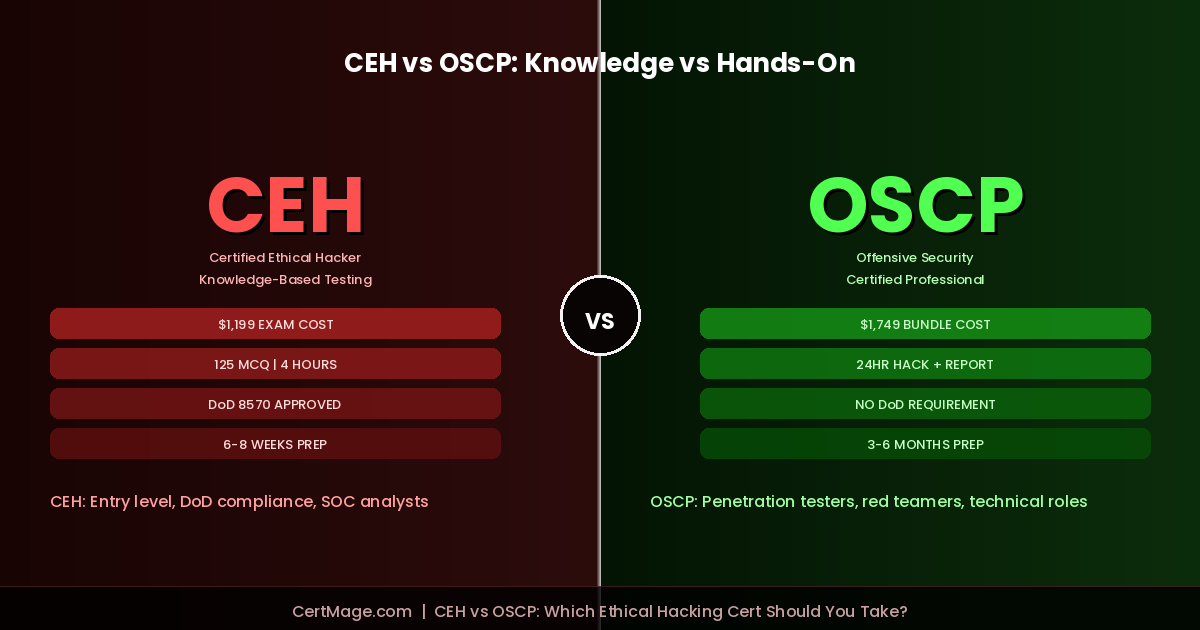
CEH vs OSCP — take CEH first if you are new to security, need DoD 8570 compliance, or work in government and compliance-focused environments. Take OSCP if you have 1 to 2 years of IT experience, want to become a penetration tester or red teamer, and need to prove hands-on skills to technical hiring managers. The CEH vs OSCP debate comes down to one fundamental split: knowledge-based testing versus performance-based testing. CEH measures what you know about ethical hacking. OSCP measures whether you can actually do it.
Both certifications validate offensive security knowledge. They take completely opposite approaches to proving it.
CEH vs OSCP: Key Differences at a Glance
| Factor | CEH v13 | OSCP |
| Full name | Certified Ethical Hacker | Offensive Security Certified Professional |
| Issuing body | EC-Council | Offensive Security (OffSec) |
| Exam format | 125 multiple choice questions | 24-hour practical — compromise live machines |
| Exam duration | 4 hours | 23 hours 45 minutes hacking plus 24 hours reporting |
| Cost | $1,199 (self-paced with exam) | $1,749 (Course and Cert Bundle — recommended) |
| Passing score | 70 percent | 70 out of 100 points |
| Hands-on labs in exam | Optional CEH Practical (6 hours, separate cost) | Yes — mandatory, no multiple choice |
| Preparation time | 60 to 120 hours over 6 to 8 weeks | 300 to 500 hours over 3 to 6 months |
| Pass rate | 60 to 85 percent | 15 to 20 percent without adequate prep, 60 to 70 percent with proper preparation |
| Expiration | 3 years via ECE credits | OSCP does not expire — lifetime validity |
| DoD 8570 approved | Yes | No |
| Modules covered | 20 modules, 550 plus attack techniques | Penetration testing methodology, AD, web, exploit dev |
| AI integration | Yes — CEH v13 is EC-Council’s first AI-powered cert | Not formally — practical methodology focus |
| Active Directory testing | Covered conceptually | Core exam component — 40 percent of exam points |
| Average salary | $90,000 to $125,000 | $95,000 to $140,000 |
| Best for | Beginners, compliance roles, government, SOC analysts | Penetration testers, red teamers, offensive security specialists |
What Is the Main Difference Between CEH and OSCP?
The main difference between CEH and OSCP is that CEH is knowledge-based testing and OSCP is performance-based testing. CEH asks you 125 multiple choice questions about hacking tools, methodologies, and attack categories over 4 hours. OSCP puts you in a live network with real machines and gives you 23 hours and 45 minutes to compromise them, then 24 hours to write a professional penetration testing report.
CEH is the shield — an entry-to-intermediate certification that teaches you the vocabulary of hacking, focusing on tools, compliance, and theory, and the golden ticket for getting past HR filters especially for government jobs. OSCP is the sword — an advanced hands-on certification that forces you to be a hacker, focusing on manual exploitation, scripting, and persistence, and the badge of honor that proves to technical hiring managers you can actually do the job.
What Does CEH Cover?
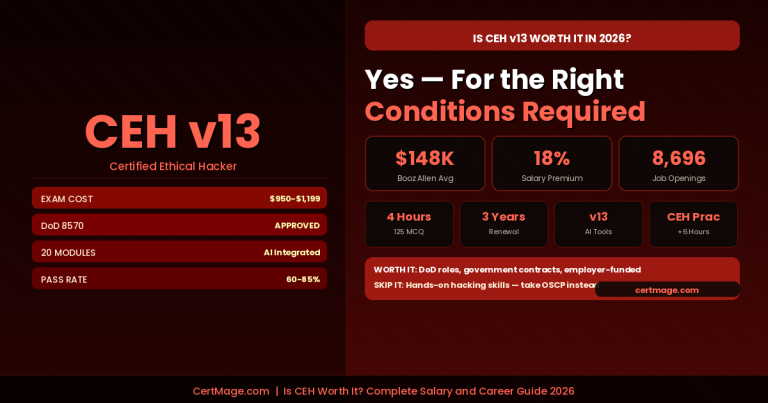
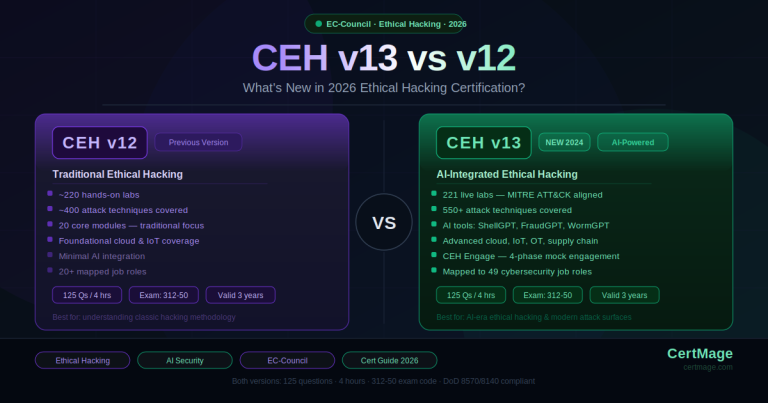
CEH v13 is EC-Council’s flagship ethical hacking certification covering 20 modules and 550 plus attack techniques. It teaches you the five phases of ethical hacking — reconnaissance, scanning, gaining access, maintaining access, and covering tracks — along with the tools and methodologies attackers use.
CEH v13 Exam Domains
| Module Category | What You Learn |
| Footprinting and reconnaissance | OSINT techniques, DNS enumeration, social engineering reconnaissance |
| Scanning networks | Port scanning, OS fingerprinting, network mapping |
| Enumeration | NetBIOS, SNMP, LDAP, NTP, SMTP enumeration |
| Vulnerability analysis | Vulnerability scanning tools, CVE databases, risk scoring |
| System hacking | Password cracking, privilege escalation, covering tracks |
| Malware threats | Trojans, viruses, ransomware, rootkits, fileless malware |
| Social engineering | Phishing, vishing, impersonation, insider threats |
| Web application hacking | SQL injection, XSS, CSRF, OWASP Top 10, API security |
| Cloud security | AWS, Azure, GCP misconfigurations, container security |
| AI-powered attacks | AI-assisted reconnaissance, deepfakes, AI-generated phishing |
CEH v13 2026 updates: CEH v13 integrates AI throughout the entire learning framework. Tools like ShellGPT for AI-assisted command generation, FraudGPT for AI-generated fraud awareness, and WormGPT for AI-powered malware understanding are explicitly covered. The AI integration makes CEH v13 more relevant to the 2026 threat landscape than any previous version. CertMage’s CEH v13 practice exams cover all 20 modules with scenario-based questions aligned to the current blueprint.
What Does OSCP Cover?
OSCP is OffSec’s performance-based penetration testing certification. It is delivered through the PEN-200 (Penetration Testing with Kali Linux) course which includes 90 days of lab access to intentionally vulnerable machines. The exam itself is a 24-hour attack followed by a 24-hour professional report.
OSCP Exam Structure
| Component | Detail |
| Standalone machines | 3 machines worth 20 points each (60 points total) |
| Active Directory set | 1 AD environment worth 40 points total |
| Total points available | 100 |
| Passing score | 70 points minimum |
| Report requirement | Professional penetration testing report submitted within 24 hours |
| Proctoring | Webcam and screen sharing throughout |
OSCP Technical Content
| Area | What You Must Be Able to Do |
| Network enumeration | Identify services, open ports, and potential attack vectors |
| Privilege escalation | Windows and Linux local privilege escalation techniques |
| Active Directory attacks | Kerberoasting, Pass-the-Hash, Golden Ticket, lateral movement |
| Web application attacks | SQL injection, command injection, file inclusion, XXE |
| Password and hash cracking | Online and offline cracking techniques |
| Port forwarding and pivoting | Tunneling through compromised systems to reach internal networks |
| Buffer overflow | Basic stack-based buffer overflow exploitation |
| Client-side attacks | Phishing, malicious documents, browser exploitation |
| Methodology and reporting | Professional documentation of all findings and exploitation steps |
The Try Harder philosophy: OSCP’s training philosophy is built around “Try Harder” — you learn through frustration, research, and persistence rather than following step-by-step tutorials. This philosophy centers on learning through frustration, research, and persistence. OffSec recommends solid Linux and networking fundamentals plus basic scripting ability in Python or Bash before enrolling — without this foundation, the initial learning curve becomes extremely steep.
CEH vs OSCP: Difficulty Comparison
CEH requires 60 to 120 hours of preparation, a 4 to 6 hour exam, and has a 60 to 85 percent pass rate. OSCP requires 300 to 500 hours minimum preparation, a 24-hour practical exam plus a 24-hour report, and first-time failure is common.
| Factor | CEH | OSCP |
| Type of difficulty | Breadth of knowledge across 20 modules | Depth of practical exploitation under pressure |
| Preparation time | 6 to 8 weeks part-time | 3 to 6 months with 20 plus hours per week |
| Hardest part | Memorizing tool names and methodology details across 20 domains | Active Directory attack chains under time pressure |
| Can you pass by memorizing? | Yes — CEH is primarily knowledge-based | No — you must actually compromise machines |
| First attempt failure rate | Low to moderate | High — first-time failure is common and expected |
| Mental demand | Sustained study and recall | 48 hours of continuous pressure, troubleshooting, and reporting |
The honest truth about OSCP difficulty: Most candidates who fail their first OSCP attempt do so because of one of three reasons: insufficient Active Directory practice (AD is 40 percent of the exam), not writing practice reports for every machine they compromise during lab time, or enrolling before they can consistently root medium-difficulty boxes on Hack The Box or Proving Grounds.
CEH vs OSCP: Job Market and Employer Perception
This is where the comparison gets nuanced — and where most blog posts give you the wrong answer.
Searching US-based opportunities across three popular job boards found that CEH was included in job descriptions 1.5 to 3 times more often than OSCP in raw listing count.
But raw listing count does not tell the complete story.
Quality matters — jobs asking for OSCP are generally more technical and offer faster career progression into senior engineering roles.
| Factor | CEH | OSCP |
| Raw job listing volume | Higher — 1.5 to 3x more listings | Lower overall volume |
| Job quality | Broad range including compliance and analyst roles | Primarily senior technical and offensive roles |
| DoD 8570/8140 compliance | Yes — required for many government positions | No |
| Technical hiring manager perception | Mixed — some see it as entry-level | Very positive — respected as proof of real skills |
| HR filter value | Very high | High in technical teams |
| Dedicated pen test firm requirement | Acceptable but OSCP preferred | Near-universal requirement |
| Red team roles | Rarely listed as requirement | Frequently listed as requirement |
The employer split: If you are applying to government contractors, defense agencies, and large enterprises where HR filters by DoD compliance requirements, CEH gets you in the door. If you are applying to dedicated penetration testing firms, red teams, and technical security teams where hiring managers review resumes personally, OSCP commands significantly more respect. Dedicated penetration testing firms almost universally require OSCP or equivalent practical certifications.
CEH vs OSCP Salary in 2026
Penetration testing roles in 2026 command average salaries of $95,000 to $140,000, with certified professionals earning 15 to 25 percent more than their non-certified peers.
Salary by Role and Certification
| Role | CEH Salary | OSCP Salary |
| Security Analyst | $80,000 to $110,000 | Less common path |
| Ethical Hacker | $90,000 to $120,000 | $95,000 to $130,000 |
| Penetration Tester | $90,000 to $125,000 | $100,000 to $140,000 |
| Red Team Operator | $110,000 to $145,000 | $120,000 to $165,000 |
| Security Consultant | $95,000 to $130,000 | $105,000 to $145,000 |
| Senior Pen Tester | $120,000 to $155,000 | $130,000 to $170,000 |
| IT Security Consultant (DoD) | $100,000 to $140,000 | Not DoD required |
The salary reality: OSCP holders in dedicated penetration testing roles typically earn $5,000 to $15,000 more than CEH holders in equivalent roles. However CEH holders have access to a broader range of security positions including analyst, compliance, and SOC roles where OSCP is irrelevant. The ceiling is higher for OSCP. The floor is more accessible with CEH.
Who Should Take CEH?
Take CEH if:
You are new to cybersecurity and need a recognized entry point. CEH provides a structured framework for understanding the full ethical hacking landscape before specializing. The 20-module curriculum covers everything from reconnaissance through cloud security in a way that builds genuine foundational knowledge. Start here if you have fewer than 2 years of IT security experience.
You need DoD 8570/8140 compliance. Government contractors, defense agencies, and federal security positions frequently require DoD-approved certifications. CEH meets DoD 8570/8140 requirements for certain positions. OSCP does not. If you are targeting federal or defense sector roles, CEH may be non-negotiable.
You work in a SOC, compliance, or blue team role. Understanding how attackers think makes you a better defender. CEH provides the attacker methodology knowledge that improves threat detection, incident response, and security policy without requiring the deep offensive skills that OSCP demands. For blue team professionals, CEH is more immediately applicable than OSCP.
Your budget and timeline do not support OSCP preparation. CEH requires 6 to 8 weeks of preparation and costs $1,199. OSCP requires 3 to 6 months of intense preparation and costs $1,749 minimum. If you need a recognized credential within the next 2 months, CEH is your realistic option.
Do not take CEH if you are an experienced penetration tester seeking technical credibility with offensive security hiring managers — CEH will not impress them. The credential is well known for being obtainable through memorization without hands-on skills.
Who Should Take OSCP?
Take OSCP if:
You want to become a penetration tester or red teamer. You cannot be a credible penetration tester in 2026 without hands-on skills. OSCP is the credential that proves you have them. Dedicated penetration testing firms nearly universally require it. Without OSCP or equivalent practical experience, your resume is filtered before human review in most offensive security hiring processes.
You have 1 to 2 years of IT or security experience and are ready for the challenge. OSCP is not an entry-level certification. Candidates who attempt it without solid Linux fundamentals, networking knowledge, and basic scripting skills waste their lab time and fail. But for candidates who are ready, it is the most career-defining credential in offensive security.
You want lifetime validity with no renewal fees. OSCP does not expire. You earn it once and it stays on your transcript permanently. CEH requires renewal every 3 years with ECE credits and fees. The lifetime validity of OSCP makes it increasingly valuable over a career.
You want instant credibility with technical hiring managers. OSCP commands instant respect from technical peers. When a hiring manager who is themselves a penetration tester sees OSCP on a resume, it signals something CEH cannot — that you have actually done the work under real pressure.
Do not take OSCP if you have fewer than 12 months of IT experience, cannot commit 20 plus hours per week during your lab period, or need DoD compliance for a government role.
Can You Take Both CEH and OSCP?
Yes — and the most strategic path for many professionals is to take both in sequence.
Many successful professionals follow this path: Year 1 — CEH or Security+ for foundations. Year 2 — hands-on practice on TryHackMe, HackTheBox, Proving Grounds. Year 3 — OSCP to validate practical skills. Year 4 plus — specialized certifications like OSWE, OSEP, or CRTP. This path gives you HR-friendly credentials early, time to build technical skills, and lower risk of OSCP failure.
Taking CEH first gives you the structured framework and DoD compliance credential. Building hands-on skills during the gap between CEH and OSCP gives you the practical ability to pass OSCP. This sequence is more efficient and less expensive than attempting OSCP without the foundational knowledge CEH provides.
How to Prepare for CEH v13
Step 1: Study the official EC-Council CEH v13 blueprint. All 20 modules are publicly listed with topic breakdowns. Build your study plan around the blueprint. Do not study blindly.
Step 2: Use a comprehensive study guide. Matt Walker’s CEH guide is widely recommended as the best third-party resource. Combine it with official EC-Council materials and hands-on labs in iLabs.
Step 3: Take 500 plus practice questions before booking. CEH is a knowledge-based exam. Practice questions identify gaps in your tool and methodology knowledge before exam day. CertMage’s CEH v13 practice exams are built around the current 312-50 blueprint with complete scenario-based question banks across all 20 modules.
Step 4: Aim for 85 percent or higher on practice exams consistently. Passing CEH requires 70 percent but aiming for 85 percent in practice builds the confidence buffer you need under exam pressure.
How to Prepare for OSCP
Step 1: Build your foundation before enrolling in PEN-200. Complete TryHackMe’s Jr Penetration Tester path and root at least 20 to 30 easy and medium machines on Hack The Box before spending $1,749 on PEN-200. Enrolling without this foundation wastes your lab time.
Step 2: Master Active Directory attack chains specifically. AD attacks account for 40 percent of the OSCP exam. Kerberoasting, Pass-the-Hash, Golden Ticket attacks, and lateral movement through AD environments must become second nature. Build a home AD lab and practice these techniques repeatedly.
Step 3: Write a professional report for every machine you compromise. Reporting is a mandatory and graded component of OSCP. Candidates who do not practice report writing during their lab time consistently struggle with the 24-hour reporting window under exam pressure.
Step 4: Do not attempt the exam until you can root medium HTB boxes consistently. If you cannot consistently compromise medium-difficulty Hack The Box machines, you are not ready for the OSCP exam. Use this as your readiness benchmark before booking.
Step 5: Use current practice materials. CertMage’s OSCP preparation materials include practice questions and resources aligned to the current PEN-200 blueprint.
Decision Framework: CEH vs OSCP
| Your Situation | Take This |
| New to cybersecurity with less than 2 years experience | CEH first |
| Need DoD 8570 compliance | CEH — OSCP does not qualify |
| Work in SOC, blue team, or compliance | CEH |
| Want to become a penetration tester | OSCP — no substitute |
| Target government or defense contractor roles | CEH |
| Target dedicated pen test firms or red teams | OSCP |
| Budget under $1,500 and timeline under 3 months | CEH |
| Have 1 to 2 years IT experience and can commit 20 plus hours weekly | OSCP |
| Want a credential that never expires | OSCP |
| Want the broadest possible job listing access | CEH |
| Want the highest technical credibility | OSCP |
| Starting a career in ethical hacking from scratch | CEH then OSCP in sequence |
Frequently Asked Questions: CEH vs OSCP
What is the main difference between CEH and OSCP?
CEH is a knowledge-based certification testing theoretical understanding of ethical hacking through 125 multiple choice questions. OSCP is a performance-based certification requiring you to compromise live machines in a 24-hour practical exam. CEH tests what you know. OSCP tests what you can do.
Which is harder — CEH or OSCP?
OSCP is significantly harder. CEH requires 6 to 8 weeks of study and has a 60 to 85 percent pass rate. OSCP requires 300 to 500 hours of preparation and has a first-time pass rate of 15 to 20 percent for underprepared candidates, rising to 60 to 70 percent with proper preparation. First-time failure on OSCP is common and expected.
Which pays more — CEH or OSCP?
OSCP holders in dedicated penetration testing roles typically earn $5,000 to $15,000 more than CEH holders in equivalent roles. Penetration testers with OSCP average $100,000 to $140,000. CEH holders in broader security roles average $90,000 to $125,000.
Does CEH satisfy DoD 8570 requirements?
Yes. CEH meets DoD 8570/8140 requirements for certain government and military positions. OSCP does not meet DoD 8570 requirements. For government and defense contractor roles requiring DoD compliance, CEH is the appropriate choice.
Does OSCP expire?
No. OSCP has lifetime validity and never expires. You earn it once and it stays on your transcript permanently. CEH requires renewal every 3 years through ECE credits and fees.
How much does CEH cost?
CEH v13 costs approximately $1,199 for the self-paced iLearn package including the exam. Official instructor-led training costs $3,499 to $4,500. The optional CEH Practical exam is an additional cost on top of the written exam.
How much does OSCP cost?
The OSCP Course and Cert Bundle costs $1,749 and includes 90 days of PEN-200 lab access and one exam attempt. The standalone exam with two attempts costs $1,699. Retakes cost $249 per attempt.
Should I take CEH before OSCP?
For most candidates, yes. CEH provides the structured ethical hacking framework and foundational tool knowledge that makes OSCP lab time more productive. Candidates who go directly to OSCP without CEH or equivalent foundational knowledge typically waste their lab time on basics and fail their first exam attempt.
Which certification do penetration testing employers prefer?
Dedicated penetration testing firms nearly universally prefer OSCP. Government, defense, and compliance-focused employers frequently require or prefer CEH due to DoD 8570 requirements. Large enterprise security teams are split — CEH for compliance-adjacent roles, OSCP for offensive security roles.
Can I get both CEH and OSCP?
Yes — and the recommended sequence is CEH first for foundations, then 6 to 12 months of hands-on lab practice, then OSCP to validate practical skills. This path maximizes your employability across both compliance-focused and technical offensive security markets.