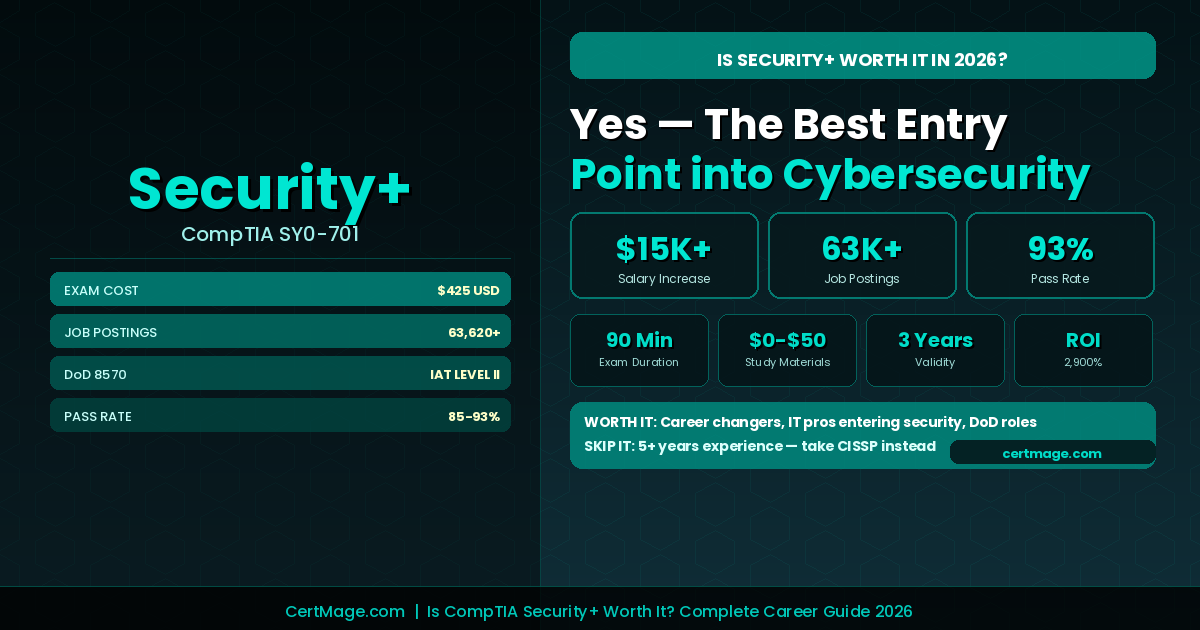
Is CompTIA Security+ worth it? Yes — Security+ is worth it in 2026 for anyone trying to enter cybersecurity or transition from general IT into a security role. A $425 to $700 investment delivers $15,000 plus in annual salary increases, pays for itself within two weeks of a new position, and opens doors to 63,620 plus job postings. The only professionals who should skip it are those with 5 or more years of hands-on security experience who should target CISSP instead, and complete beginners with no IT foundation who should start with A+ or Network+ first.
Security+ is not the most prestigious cybersecurity certification. It is the most useful one for most people at the most important stage of their career.
Security+ Fast Facts
| Detail | Information |
| Full name | CompTIA Security+ SY0-701 |
| Issuing body | CompTIA |
| Exam cost | $425 USD |
| Exam duration | 90 minutes |
| Number of questions | Maximum 90 questions |
| Question types | Multiple choice and performance-based questions |
| Passing score | 750 out of 900 |
| Prerequisites | None formally required |
| Recommended experience | 2 years of IT experience with security focus |
| Study time | 40 to 80 hours depending on IT background |
| Expiration | 3 years — renewal via CEUs or passing a higher CompTIA cert |
| DoD approved | Yes — DoD 8570/8140 IAT Level II |
| Current version | SY0-701 |
| Retirement date | May 2027 — study now while materials are plentiful |
Is Security+ Worth It for Career Changers?
Yes — Security+ is especially worth it for career changers moving from general IT into cybersecurity. Security+ is the most requested entry-level cybersecurity certification in job postings. If you are trying to get your foot in the door, this is probably the door.
An IT support technician earning $45,000 who earns Security+ and transitions into a security analyst role can expect $65,000 to $75,000 — a $20,000 plus increase in year one.
The career change math works because Security+ does two things simultaneously. It proves you understand the security fundamentals that general IT experience does not formally validate. And it gets your resume past the automated filtering systems that block non-certified candidates from ever reaching a human reviewer.
Security+ Salary in 2026: Real Numbers
Security+ Salary by Experience Level
| Experience Level | Realistic US Salary Range |
| Entry level with no prior security experience | $55,000 to $70,000 |
| 1 to 2 years experience plus Security+ | $65,000 to $85,000 |
| 2 to 4 years experience plus Security+ | $80,000 to $100,000 |
| 4 plus years plus Security+ and advanced certs | $95,000 to $130,000 |
| DoD contractor with clearance plus Security+ | $85,000 to $110,000 |
Security+ Salary by Job Role
| Role | Average US Salary |
| SOC Analyst Tier 1 | $55,000 to $75,000 |
| IT Security Administrator | $65,000 to $85,000 |
| Systems Administrator (security focus) | $70,000 to $90,000 |
| Security Analyst | $75,000 to $100,000 |
| Information Security Analyst | $80,000 to $105,000 |
| Network Security Specialist | $78,000 to $100,000 |
| Cybersecurity Specialist (DoD) | $75,000 to $110,000 |
| Security Engineer (with additional certs) | $95,000 to $130,000 |
Security+ Salary by Location
| Location | Salary Premium |
| Washington D.C. metro | Highest nationally — federal and DoD contractor demand |
| San Francisco and Bay Area | 20 to 30 percent above national average |
| New York City | 15 to 25 percent above national average |
| Seattle | 15 to 20 percent above national average |
| Remote roles | National average regardless of your location |
| Lower cost of living areas | Base salary with strong benefits packages |
The DoD salary premium: Defense contractors including Booz Allen, Leidos, SAIC, CACI, and Raytheon pay a billing rate premium for certified staff — that premium flows to salary. Entry-level DoD SOC analysts frequently earn $70,000 to $85,000 versus $55,000 to $65,000 in equivalent commercial roles. Active clearance combined with Security+ pushes starting salaries to $85,000 to $110,000 for Tier 1 roles.
Security+ ROI: The Complete Calculation
The total investment ranges from $425 for the exam only with free study materials to $700 for most candidates using quality study guides and practice tests.
Full Cost Breakdown
| Cost Item | Amount |
| Exam voucher (SY0-701) | $425 |
| Study guide (optional) | $0 to $50 |
| Video course (optional) | $0 to $100 |
| Practice exams | $0 to $100 |
| Retake insurance (optional) | $100 |
| Total budget path | $425 to $500 |
| Total standard path | $500 to $700 |
| Total with bootcamp | $700 to $2,500 |
ROI Calculation
| Return Item | Amount |
| Average annual salary increase | $8,000 to $20,000 |
| DoD contractor salary increase | $15,000 to $30,000 |
| Time to break even (standard path) | 2 to 4 weeks of increased earnings |
| 3-year cumulative benefit | $24,000 to $60,000 additional earnings |
| First-year ROI (standard path) | Approximately 2,900 percent |
Quick napkin math: most people invest somewhere between $500 and $1,500 total. If Security+ helps you land a job paying $15,000 more than what you are making now — totally realistic for career changers — you break even in the first month.
What Does Security+ Cover?
Security+ SY0-701 covers five domains. Understanding the domain weights helps you allocate your study time efficiently.
Security+ SY0-701 Exam Domains
| Domain | Weight | What You Learn |
| General Security Concepts | 12% | Basic cryptography, authentication, authorization, security controls, zero trust concepts |
| Threats, Vulnerabilities and Mitigations | 22% | Malware types, attack vectors, social engineering, vulnerability scanning, threat intelligence |
| Security Architecture | 18% | Cloud security, network infrastructure, secure network design, virtualization, SASE, ZTNA |
| Security Operations | 28% | Incident response, digital forensics, log monitoring, identity management, endpoint security |
| Security Program Management and Oversight | 20% | Risk management, compliance frameworks, data privacy, third-party risk, security governance |
The heaviest domain is Security Operations at 28 percent. This covers incident response, monitoring, and day-to-day security tasks — exactly what SOC analyst and security analyst roles require. Give it disproportionate study time.
Performance-based questions are where most candidates lose points. These are not multiple choice. You configure a firewall rule, analyze a log file, spot vulnerabilities in a network diagram, or match controls to compliance requirements. Candidates who study only multiple choice questions without practicing PBQ-style scenarios consistently underperform on exam day.
Security+ Job Market in 2026
Security+ opens doors to 63,620 plus job postings with 750,000 plus unfilled positions in the broader cybersecurity market.
Industries Hiring Security+ Certified Professionals
| Industry | Why They Hire | Salary Premium |
| Government and defense | DoD 8570 mandatory requirement | Highest nationally |
| Healthcare | HIPAA compliance, patient data security | Strong |
| Financial services | PCI-DSS, SOX compliance | Strong |
| Technology | Security operations, cloud security | Competitive |
| Retail and e-commerce | PCI compliance, fraud prevention | Moderate |
| Education | Network security, data protection | Moderate |
| Consulting | Client security assessments | Strong |
The DoD mandate is the single strongest demand driver: The DoD 8570/8140 mandate requires Security+ for all cybersecurity personnel with privileged access to DoD information systems — contractors and government employees alike. Defense contractors list Security+ as required, not preferred. This creates sustained, recession-resistant demand that does not fluctuate with private sector hiring cycles.
Is Security+ Hard?
Community data suggests 85 to 93 percent of well-prepared candidates pass. CompTIA does not publish official pass rates. The most common failure pattern is skipping practice exams and underestimating performance-based questions.
| Factor | Reality |
| Difficulty level | Entry to intermediate |
| Pass rate (well-prepared candidates) | 85 to 93 percent |
| Hardest question type | Performance-based questions (PBQs) |
| Most commonly failed area | Security Operations and incident response scenarios |
| Study time with IT background | 40 to 80 hours over 4 to 8 weeks |
| Study time without IT background | 80 to 150 hours over 8 to 15 weeks |
| Can you pass without hands-on experience | Yes but PBQs are harder without practical context |
Security+ is accessible but not trivial. The difference between candidates who pass on their first attempt and those who need a retake almost always comes down to one thing: whether they practiced performance-based question formats before exam day.
When Security+ Is Worth It
Security+ delivers strong ROI in these specific situations:
You are transitioning from general IT into cybersecurity. Help desk, network admin, sysadmin, and desktop support professionals who want to pivot into security analyst or SOC roles consistently find Security+ is the bridge that makes hiring managers take them seriously. Someone with five years of sysadmin work who earns Security+ suddenly gets interviews for security analyst positions they could not even apply to before.
You are entering cybersecurity with no prior experience. Security+ gives you a verified credential that gets your resume past ATS filters for entry-level security roles. Without it, your application often disappears regardless of what you actually know.
You need or want government or defense contractor work. Every person with privileged access to DoD networks must hold an approved cert or cannot be assigned. Defense contractors list Security+ as required, not preferred. If government or defense work is anywhere in your career plans, Security+ is non-negotiable.
You want the strongest possible certification foundation. Security+ is the starting point for CompTIA’s entire cybersecurity path — CySA+, PenTest+, SecurityX, and CASP+ all build on it. It also provides a foundation for CISSP once you accumulate the required experience. Starting your cybersecurity journey without Security+ is like building a house without a foundation.
When Security+ Is Not Worth It
If you have 5 or more years of hands-on security experience and no DoD requirement, CISSP, CISM, or an advanced technical certification like OSCP or AWS Security will do more for your career than Security+. Hiring managers for senior roles view Security+ as a junior credential — it is not a differentiator at that level.
Skip Security+ and go directly to CISSP if you have 4 or more years of security experience and are targeting senior engineer, architect, or management roles. Security+ would be a step backward in career positioning.
Skip Security+ if your IT foundation is not yet built. Security+ opens doors but does not create IT foundation. If you have no prior tech experience, you will struggle significantly with the exam and with the jobs it unlocks. A+ and Network+ first, then Security+.
Skip Security+ if your career is in development or data science. Security+ is irrelevant to software development and data science hiring pipelines. The certification validates security knowledge that those roles do not require or evaluate.
What Comes After Security+?
Security+ is the starting block, not the finish line. Here is the complete next-step map based on your target role:
| Career Goal | Next Certification After Security+ | Average Salary With Next Cert |
| SOC analyst or threat detection | CySA+ (CompTIA Cybersecurity Analyst) | $90,000 to $115,000 |
| Penetration tester or red teamer | PenTest+ then OSCP | $100,000 to $140,000 |
| Cloud security specialist | AWS Security Specialty or SC-500 | $110,000 to $150,000 |
| Security management or CISO path | CISSP (after 5 years experience) | $120,000 to $175,000 |
| GRC and compliance | CISM or CISA (after experience) | $110,000 to $155,000 |
| AI security specialization | CompTIA SecAI+ (launched February 2026) | $110,000 to $145,000 |
CertMage covers the complete cybersecurity certification path including advanced credentials in our Best Cybersecurity Certifications 2026 guide. For the comparison of Security+ vs CySA+ — the most common next step — our Security+ vs CySA+ guide covers every difference.
Security+ vs Other Entry-Level Security Certifications
| Factor | Security+ | CEH | SSCP | GFACT |
| Cost | $425 | $1,199 | $249 | $299 |
| Level | Entry to intermediate | Intermediate | Entry | Foundational |
| DoD approved | Yes — IAT Level II | Yes | Yes — IAT Level I | No |
| Vendor neutral | Yes | Yes | Yes | Yes |
| Pass rate | 85 to 93 percent prepared | 60 to 85 percent | Similar | Similar |
| Job posting volume | Highest of any entry-level security cert | High | Lower | Lower |
| Best for | Most professionals entering cybersecurity | Ethical hacking focus | ISC2 ecosystem entry | Absolute beginners |
Security+ has the highest job posting volume of any entry-level security certification and the strongest combination of cost, accessibility, and employer recognition. For most professionals entering cybersecurity, it is the right starting point.
How to Prepare for Security+ in 2026
Step 1: Assess your IT foundation before studying. Security+ assumes you understand networking fundamentals, basic operating systems, and entry-level IT infrastructure. If you cannot explain the difference between TCP and UDP, what DHCP does, or how DNS works, spend 2 to 4 weeks on Network+ fundamentals first. Attempting Security+ without this foundation leads to failure and wasted $425.
Step 2: Use the official CompTIA Security+ SY0-701 study guide. The CompTIA official study guide covers every exam objective at the right depth. Read it completely before attempting any practice exams. Mike Chapple and David Seidl’s official CompTIA guide is widely considered the best single resource.
Step 3: Practice performance-based questions specifically. PBQs appear at the start of the Security+ exam. Most candidates who fail do so because they are unprepared for PBQ-format questions. Practice configuring firewalls, analyzing log files, reading network diagrams, and matching security controls to scenarios — not just multiple choice recall.
Step 4: Take practice exams until you score above 80 percent consistently. Practice exams identify gaps before exam day. Aim for 80 percent or higher on multiple full practice tests before booking your real exam. CertMage’s Security+ practice exams cover all five SY0-701 domains with scenario-based questions and complete answer explanations. Score 80 percent or higher consistently on CertMage practice tests before booking.
Step 5: Book your exam 4 to 6 weeks from when you start studying. Candidates with a concrete exam date study more efficiently than those with no deadline. Set your date, build a study schedule around it, and commit. With an IT background, 4 to 6 weeks of focused daily study is sufficient. Without IT background, budget 8 to 12 weeks.
Security+ Renewal: What You Need to Know
Security+ is valid for 3 years. To renew you need to earn 50 CompTIA Continuing Education (CE) units and pay the $50 renewal fee. Alternatively passing a higher-level CompTIA certification like CySA+ automatically renews Security+ for another 3 years — making the renewal cascade one of the most efficient features of the CompTIA certification system.
The May 2027 retirement note: SY0-701 retires in May 2027, which actually increases its urgency — earn it now while study materials are plentiful and community support is strong. Candidates who earn Security+ now have a 3-year credential that will remain valid well into 2030 depending on when they pass.
Frequently Asked Questions: Is Security+ Worth It?
Is CompTIA Security+ worth it in 2026?
Yes. Security+ delivers $15,000 plus annual salary increases on a $425 to $700 investment, opens 63,620 plus job postings, is required for DoD government positions, and is the most universally recognized entry-level cybersecurity credential. It is not worth it for professionals with 5 or more years of security experience who should pursue CISSP instead.
How much does Security+ pay in 2026?
Security+ holders earn $65,000 to $95,000 on average in the US. Entry-level roles start at $55,000 to $70,000. DoD contractor roles with active security clearance pay $85,000 to $110,000. Experienced security professionals with additional certifications earn $95,000 to $130,000 or more.
How much does Security+ cost?
The Security+ exam costs $425 USD. Total investment including study materials ranges from $425 for self-study using free resources to $700 for most candidates using quality study guides and practice tests.
How hard is Security+?
Security+ is accessible but not trivial. Community data suggests 85 to 93 percent of well-prepared candidates pass on their first attempt. The most common failure pattern is underestimating performance-based questions — candidates who study only multiple choice questions are significantly less prepared than those who practice PBQ formats.
Does Security+ expire?
Yes. Security+ is valid for 3 years and requires 50 CE units and a $50 renewal fee. Passing a higher-level CompTIA certification automatically renews Security+ for another 3 years without separate renewal action.
Is Security+ enough to get a cybersecurity job?
Yes — for entry-level roles. SOC Analyst Tier 1, IT Security Administrator, and Help Desk with a security focus are all realistic targets with Security+ alone. You will be a stronger candidate with a home lab, a TryHackMe or Hack The Box profile, or a few months of internship experience alongside the cert. Security+ alone will not get you senior roles.
Do I need A+ before Security+?
Not formally — CompTIA does not require A+ before Security+. But Security+ assumes foundational IT knowledge. Candidates with no IT background who attempt Security+ without A+ or Network+ equivalent knowledge fail at significantly higher rates. If you are completely new to IT, A+ and Network+ first will make Security+ significantly more approachable.
What jobs can I get with Security+ in 2026?
Security+ qualifies you for SOC Analyst, IT Security Administrator, Security Analyst, Network Security Specialist, Systems Administrator with security responsibilities, and DoD/government cybersecurity roles. These positions pay $65,000 to $100,000 depending on experience, location, and clearance level.
Is Security+ recognized globally?
Yes. Security+ is a globally recognized vendor-neutral certification respected by employers in North America, Europe, the Middle East, Asia, and Australia. It is particularly valued in the US due to DoD compliance requirements but carries strong recognition in enterprise hiring globally.
What comes after Security+?
The most common next steps are CySA+ for security analyst roles, PenTest+ for offensive security paths, and eventually CISSP for senior leadership roles after 5 years of experience. CompTIA’s full security path goes Security+, CySA+, SecurityX or CASP+. Our Best Cybersecurity Certifications guide covers the complete progression.
Is Security+ better than CEH?
For most people entering cybersecurity, Security+ is the better first certification. It costs $425 versus CEH’s $1,199, has broader employer recognition, covers more foundational ground, and requires less specialized background. CEH is more valuable for professionals specifically targeting ethical hacking and government roles requiring that specific credential. For the full comparison, see our CEH vs OSCP guide.