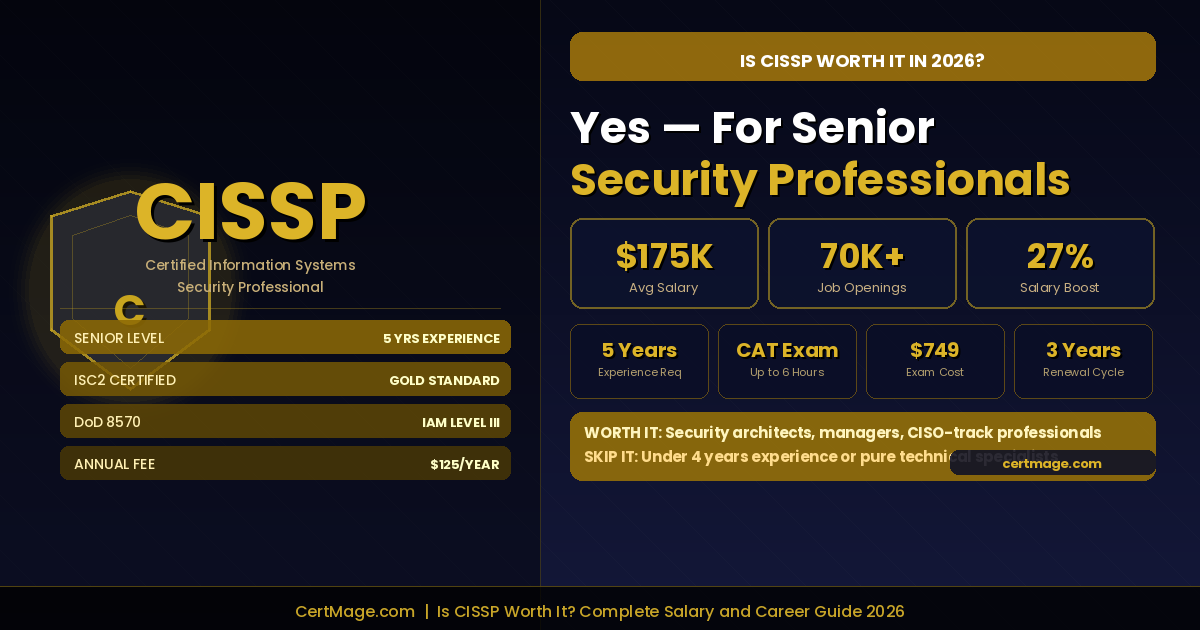
Is CISSP worth it? Yes — CISSP is worth it for mid-career cybersecurity professionals with 4 or more years of experience who are targeting senior engineer, security architect, security manager, or CISO-track roles. There are 70,082 US job listings explicitly requesting CISSP in 2026, average salaries reach $120,000 to $140,000, and the credential delivers salary increases of $25,000 to $40,000 within the first year for professionals in the right career stage. CISSP is not worth it for complete beginners, pure technical specialists with no interest in management, or candidates who have not yet met the five-year experience requirement.
This is not a certification you collect. It is a credential you earn when you are ready to step into security leadership.
CISSP Fast Facts
| Detail | Information |
| Full name | Certified Information Systems Security Professional |
| Issuing body | ISC2 (International Information System Security Certification Consortium) |
| Exam cost | $749 USD |
| Exam duration | Up to 6 hours (CAT format — most finish in 3 to 4 hours) |
| Number of questions | 100 to 150 (adaptive testing) |
| Passing score | 700 out of 1000 scaled |
| Experience required | 5 years paid full-time in at least 2 of 8 domains |
| No experience yet | Associate of ISC2 path available — earn credential, then fulfill experience within 6 years |
| Annual maintenance fee | $125 per year |
| CPE credits required | 120 credits every 3 years |
| Total 3-year cost | Approximately $2,000 to $7,000 including study materials |
| Expiration | Every 3 years — renewal via CPE credits and annual fee |
| DoD approved | Yes — DoD 8570/8140 IAM Level III and IASAE Level I and II |
Is CISSP Worth It for Mid-Career Professionals?
Yes — CISSP is most worth it for mid-career cybersecurity professionals with 5 or more years of hands-on security experience who want to move into senior engineer, security architect, or management roles. CISSP is basically a prerequisite for security management roles — try finding a CISO job posting that does not list it. For professionals at this stage, the ROI is massive — often a $25,000 to $40,000 salary increase within the first year.
CISSP is not about learning new technical skills. It is about proving you can think strategically about security at an enterprise level. The credential signals to employers that you understand risk at the business level — not just the technical level — and that distinction is exactly what moves you from senior individual contributor into security leadership.
CISSP Salary in 2026: The Real Numbers
CISSP Salary by Experience Level
| Experience Level | Average US Salary |
| Entry level with Associate of ISC2 | $75,000 to $95,000 |
| Mid level (3 to 5 years plus CISSP) | $110,000 to $140,000 |
| Senior level (5 to 10 years plus CISSP) | $140,000 to $175,000 |
| Director of Security | $155,000 to $190,000 |
| CISO (large enterprise) | $180,000 to $300,000 plus |
CISSP Salary by Job Role
| Role | Average US Salary |
| Information Security Analyst (CISSP) | $100,000 to $130,000 |
| Security Engineer (CISSP) | $115,000 to $145,000 |
| Security Architect | $135,000 to $175,000 |
| Information Security Manager | $130,000 to $165,000 |
| Director of Security | $155,000 to $195,000 |
| Chief Information Security Officer | $180,000 to $300,000 plus |
| IT Director | $140,000 to $185,000 |
| Security Consultant (CISSP) | $120,000 to $160,000 |
CISSP Salary by Industry
| Industry | Salary Range |
| Financial services | $135,000 to $200,000 |
| Healthcare | $115,000 to $165,000 |
| Government and defense | $110,000 to $160,000 |
| Technology | $130,000 to $185,000 |
| Consulting | $120,000 to $175,000 |
| Retail and e-commerce | $110,000 to $155,000 |
The salary amplifier effect: CISSP amplifies existing experience. It does not replace it. A junior security analyst with CISSP might see a $10,000 bump. A senior engineer with 8 years of experience might see $40,000 or more. The certification acts as a multiplier on your existing value — the bigger the base, the bigger the boost.
CISSP ROI: The Complete Cost vs Return Calculation
What CISSP Actually Costs
| Cost Item | Amount |
| Exam fee | $749 |
| Study materials (self-study) | $100 to $300 |
| Study materials (bootcamp) | $1,500 to $4,000 |
| ISC2 annual maintenance fee | $125 per year |
| CPE credits over 3 years | $0 to $500 |
| Total minimum (self-study) | $974 to $1,574 |
| Total with bootcamp | $2,374 to $5,374 |
ROI Calculation
| Return Item | Amount |
| Average annual salary increase | $25,000 to $40,000 |
| Time to break even (minimum investment) | 2 to 4 weeks of increased earnings |
| Time to break even (with bootcamp) | 1 to 2 months of increased earnings |
| 5-year cumulative additional earnings | $125,000 to $200,000 |
| 10-year maintenance cost | Approximately $1,250 in annual fees |
CISSP assures the strongest return on investment when you use it to move into senior security, architecture, or management roles rather than treating it as a beginner credential.
CISSP Experience Requirements: What You Must Know
This is the most misunderstood aspect of CISSP and the most common planning mistake candidates make.
The requirement: You must have a minimum of 5 years of cumulative, paid, full-time professional experience in at least 2 of the 8 CISSP domains before you can become fully certified.
The 8 CISSP Domains
| Domain | What It Covers |
| Security and Risk Management | CIA triad, governance, compliance, ethics, risk management |
| Asset Security | Data classification, ownership, privacy, retention, data security controls |
| Security Architecture and Engineering | Secure design principles, cryptography, security models, physical security |
| Communication and Network Security | Network protocols, secure network components, transmission security |
| Identity and Access Management | Identity management, authentication, authorization, access control |
| Security Assessment and Testing | Assessment strategies, security testing, audit logs, penetration testing |
| Security Operations | Incident management, investigations, disaster recovery, BCP |
| Software Development Security | SDLC, application security controls, acquired software security |
The Associate of ISC2 path: If you have not yet met the 5-year experience requirement, you can still take the CISSP exam. Passing earns you Associate of ISC2 status, which gives you 6 years to accumulate the required work experience and convert to full CISSP. This is a legitimate path for candidates who are 2 to 3 years into their security career and want to study now.
The 2026 waiver update: Effective April 1, 2026, ISC2 reduced its CISSP experience waiver list from approximately 50 certifications to 25. Significant certifications removed include CEH, CISA, CRISC, and OSCP. Certifications that survived and still qualify for the waiver include Security+, CISM, and CCSP. If you were planning to use CEH or OSCP to reduce your experience requirement, that path closed in April 2026.
What Does the CISSP Exam Actually Test?
CISSP uses Computerized Adaptive Testing (CAT). The exam adapts to your performance — questions get harder when you answer correctly and easier when you do not. This means every candidate’s exam is different.
| Factor | Detail |
| Format | CAT — adaptive testing |
| Duration | Up to 6 hours maximum |
| Questions | 100 to 150 questions |
| Question types | Multiple choice and advanced innovative questions |
| Passing score | 700 out of 1000 scaled |
| Immediate result | Pass or fail indicated at end |
| Most heavily tested domain | Security and Risk Management (15 to 19% of exam) |
| Pass rate | Approximately 49 to 55% for first-time candidates globally |
The mile wide and inch deep warning: CISSP is famously described as a mile wide and an inch deep. It does not test deep technical implementation skills. It tests whether you understand security concepts at the management and governance level — not how to configure a firewall but why a specific firewall architecture is the right choice for a given risk scenario. Candidates who approach CISSP as a technical exam consistently underperform compared to candidates who think like a manager.
CISSP Job Market in 2026
In 2026 there are 70,082 US job listings explicitly requesting CISSP certification. The US Bureau of Labor Statistics projects employment for information security specialists to grow by 29 percent until 2034 — much faster than average for all occupations.
Industries With Highest CISSP Demand
| Industry | Why CISSP Is Required |
| Financial services | Regulatory compliance (SOX, PCI-DSS), risk management |
| Government and defense | DoD 8570/8140 mandatory requirement for IAM Level III |
| Healthcare | HIPAA security officer roles, patient data protection |
| Consulting | Client-facing security leadership credibility |
| Technology | Enterprise security architecture, cloud security governance |
| Critical infrastructure | Energy, utilities, and operational technology security |
The DoD advantage: CISSP meets DoD 8570/8140 requirements for IAM Level III and IASAE Level I and II positions. For government contractors, defense agencies, and federal security roles, holding CISSP is not a nice-to-have — it is literally required by policy. This creates a sustained floor of demand that does not fluctuate with hiring cycles the way private sector demand does.
When CISSP Is Worth It
CISSP delivers strong ROI in these specific situations:
You have 4 to 6 years of security experience and want to move up. This is the sweet spot. You already have the experience requirement, you understand security concepts from real work, and you are at the career stage where credentials unlock management and architecture roles.
You are targeting CISO, Security Director, or Security Architect roles. These positions almost universally require CISSP. Without it, your resume is filtered before human review in most enterprise hiring processes.
You need DoD compliance. Government contractors and federal security professionals often have no choice — CISSP is a policy requirement for their role classification.
You are transitioning from IT management or risk management into dedicated security leadership. CISSP’s broad eight-domain coverage fills knowledge gaps across security disciplines and signals to employers that you have done the work to understand security holistically.
Your employer will pay for it. Many organizations pay for CISSP exam and materials through professional development budgets. If your employer covers the cost, the personal ROI calculation becomes extremely favorable at any career stage.
When CISSP Is Not Worth It
You are in the first 2 years of your security career. CISSP is not an entry-level credential. Studying for it without hands-on security experience means memorizing concepts you have never applied. The credential is designed to validate experience you already have — not teach you security from scratch. Start with CompTIA Security+ as your foundation. CertMage’s Security+ practice exams cover all five SY0-701 domains with current question banks.
You are a pure technical specialist with no interest in management. If you are happy in a deeply technical role and have no interest in management or strategy, CISSP probably is not worth your time. It will not make you better at penetration testing or incident response. OSCP, GPEN, or GREM are stronger investments for pure offensive or technical defensive specialists.
You want a quick pay bump in your current role. CISSP produces salary increases by unlocking new roles — not by adding to your current title. If your goal is a raise without changing jobs, CISSP may disappoint. The salary increase comes from transitioning into a role that requires the credential.
You have not yet met the five-year experience requirement and have no plan for the Associate path. Passing the exam without a clear timeline for fulfilling the experience requirement means maintaining Associate of ISC2 status with fees but no full certification value.
CISSP vs Other Cybersecurity Certifications
| Factor | CISSP | CISM | CEH | Security+ |
| Best for | Security leadership and management | Security management and governance | Ethical hacking knowledge | Entry-level cybersecurity |
| Level | Senior | Senior | Intermediate | Entry |
| Experience required | 5 years in 2 domains | 3 years in security management | 2 years recommended | None |
| Exam cost | $749 | $599 | $1,199 | $404 |
| Average US salary | $120,000 to $175,000 | $115,000 to $165,000 | $90,000 to $130,000 | $75,000 to $110,000 |
| DoD approved | Yes | Yes | Yes | Yes |
| Technical depth | Broad and strategic | Management-focused | Technical hacking focus | Broad foundational |
| Best next after | Security+ or CySA+ | CISSP or after security management experience | Security+ or CySA+ | Starting point |
CertMage has a detailed CISSP vs CISM comparison covering which management credential is right for your specific role in our CISSP vs CISM guide.
How to Prepare for CISSP in 2026
Step 1: Verify your experience before studying. Confirm you have 5 years of paid full-time work experience in at least 2 of the 8 CISSP domains. If you are short, assess whether the Associate of ISC2 path makes sense for your timeline. Studying for CISSP without meeting the experience requirement is inefficient because the exam tests applied judgment that comes from experience, not just knowledge.
Step 2: Think like a manager throughout your preparation. The single most important mindset shift for CISSP is moving from “how do I configure this?” to “what is the right security decision given these business constraints?” Every exam question should be answered from the perspective of a senior security manager making risk-informed decisions — not a technical specialist solving implementation problems.
Step 3: Use the official ISC2 CISSP Study Guide as your foundation. The official ISC2 guide written by Mike Chapple and David Seidl covers all eight domains at the right level of depth. Read it completely before attempting any practice exams. Understanding why answers are correct or incorrect is more valuable than memorizing correct answers.
Step 4: Study all eight domains — even the ones that feel unfamiliar. Most candidates have strong knowledge in two or three domains from their work experience. CISSP requires competency across all eight. Identify your weakest domains early and allocate extra study time there. The Security and Risk Management domain alone accounts for 15 to 19 percent of the exam.
Step 5: Take practice exams until you consistently score above 70 percent. Practice exams build the pattern recognition needed for the CAT format. Use scenario-based practice questions that mirror the managerial judgment style of real CISSP questions. CertMage’s ISC2 CISSP practice exams include over 2,000 questions across all eight domains with complete answer explanations — the largest question bank available for CISSP preparation.
Step 6: Budget 3 to 6 months of part-time preparation. Most candidates need 3 to 6 months of consistent study at 1 to 2 hours per day. Candidates with experience across multiple domains may be ready in 10 to 12 weeks. Rushing the preparation is the most common reason candidates fail their first attempt.
CISSP Salary Outside the United States
| Country or Region | Average CISSP Salary |
| United Kingdom | £85,000 to £130,000 |
| Australia | AUD $150,000 to $180,000 |
| Canada | CAD $120,000 to $160,000 |
| Singapore | SGD $130,000 to $170,000 |
| Germany | EUR $90,000 to $130,000 |
| India (Tier 1 cities) | INR 3,000,000 to 6,000,000 |
| UAE | AED $220,000 to $350,000 |
In markets with smaller security talent pools, CISSP carries disproportionate weight. In Sydney and Melbourne, senior security roles with CISSP regularly hit $200,000 AUD plus.
Frequently Asked Questions: Is CISSP Worth It?
Is CISSP worth it in 2026?
Yes — for mid-career professionals with 4 or more years of security experience targeting senior, management, or architect roles. CISSP delivers $25,000 to $40,000 salary increases within the first year and is required or preferred in 70,000 plus US job postings. It is not worth it for beginners or pure technical specialists with no management goals.
How much does CISSP pay in 2026?
CISSP holders earn $120,000 to $140,000 on average in the US. Senior roles including Security Architect, Director of Security, and CISO pay $155,000 to $300,000 plus depending on organization size and location.
How much does CISSP cost?
The CISSP exam costs $749 USD plus $125 per year in annual maintenance fees. Total investment including study materials ranges from $974 for self-study to $5,000 or more with instructor-led bootcamp training.
How hard is the CISSP exam?
CISSP is genuinely difficult. The pass rate is approximately 49 to 55 percent for first-time candidates globally. The exam uses computerized adaptive testing with 100 to 150 questions over up to 6 hours. The hardest part is the managerial thinking required — answering from a risk management perspective rather than a technical implementation perspective.
How many years of experience do you need for CISSP?
You need 5 years of paid full-time work experience in at least 2 of the 8 CISSP domains. If you do not yet have 5 years, you can take the exam and earn Associate of ISC2 status, then fulfill the experience requirement within 6 years.
Can beginners take CISSP?
Technically yes — you can take the exam without experience and earn Associate of ISC2 status. But the exam tests applied security judgment from experience, not memorized knowledge. Most beginners without hands-on security experience fail and waste $749. Start with Security+ first.
Does CISSP expire?
Yes. CISSP requires renewal every 3 years through 120 CPE credits and an annual maintenance fee of $125 per year. Failing to complete renewal results in losing the certification.
Is CISSP worth it for someone already earning $130,000?
It depends on your career goal. If you want to move into CISO or Security Director roles paying $180,000 to $300,000 plus, CISSP is a clear accelerator. If you are happy in your current senior technical role, the ROI diminishes unless your employer requires it for promotion.
How does CISSP compare to CISM?
Both target senior security professionals. CISSP is broader and more technically deep across all eight security domains. CISM focuses specifically on security management and governance. Many senior professionals hold both. For a detailed comparison, see CertMage’s CISSP vs CISM guide.
What changed with the CISSP experience waiver in April 2026?
ISC2 reduced the CISSP experience waiver list from approximately 50 certifications to 25 effective April 1, 2026. CEH, CISA, CRISC, and OSCP were removed from the waiver list. Security+, CISM, and CCSP still qualify. If you were planning to use a removed certification to reduce your experience requirement, you now need to fulfill the full 5-year requirement.
Which is better for getting hired — CISSP or Security+?
They target completely different career stages. Security+ is the most widely required entry-level cybersecurity credential. CISSP is the most widely required senior-level cybersecurity credential. Most cybersecurity professionals should eventually hold both — Security+ first, then CISSP 5 or more years later.