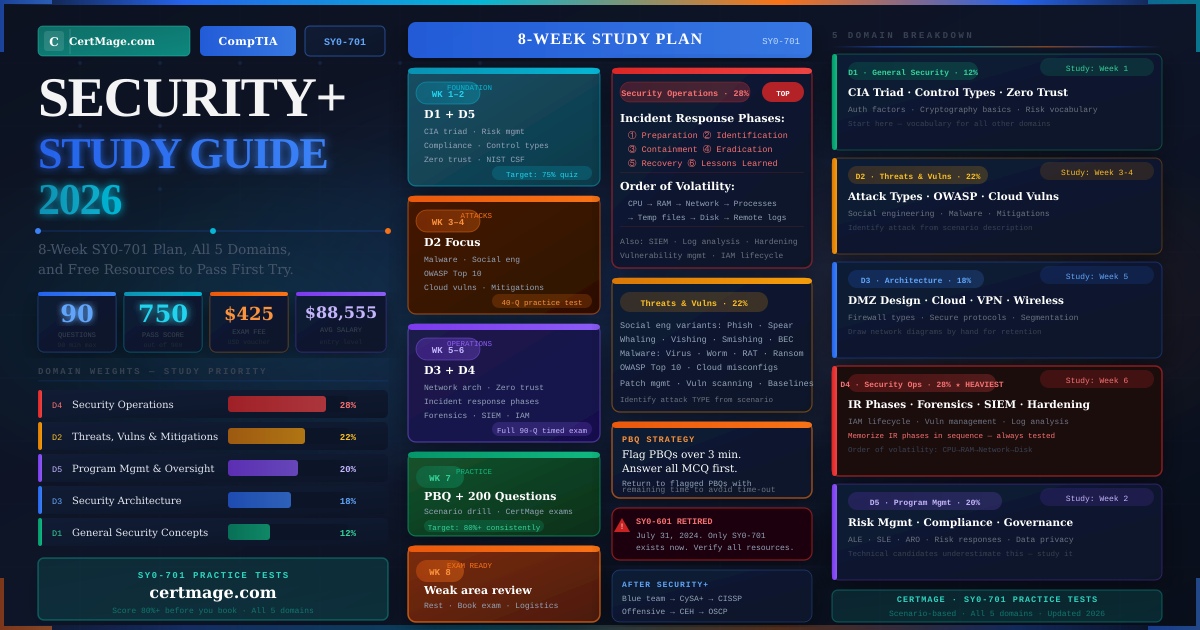
Quick Answer: The SY0-701 Security+ exam contains a maximum of 90 questions and you have 90 minutes to finish them. You need a score of 750 on a scale of 100 to 900 to pass. Candidates with networking experience typically need 4 to 8 weeks of focused preparation. Those entering from adjacent fields should plan for 8 to 12 weeks. This guide gives you a complete 8-week study plan built around the five domain weights, every free and paid resource worth using, a domain-by-domain breakdown of exactly what to study, and the performance-based question strategy that separates first-time passes from retakes. When you are ready to test your readiness before booking, CertMage’s Security+ practice tests are updated for the current SY0-701 blueprint and built around the scenario-based format the exam actually uses.
Why SY0-701 Is the Most Important Cybersecurity Exam You Can Take in 2026
With more than 700,000 professionals having earned the certification, Security+ stands as the world’s most popular cybersecurity credential.
There are only 83 cybersecurity workers for every 100 US cybersecurity jobs, indicating significant opportunities for newcomers to the field. Security+ is the credential that gets you in the door.
Security+ is DoD 8570 compliant. If you want to work for the government or defense contractors, Security+ is often a baseline requirement. Not just preferred. Required.
The average total compensation for a professional starting their cybersecurity journey with a SY0-701 is approximately $88,555. PayScale market data indicates Security+ professionals earn between $54,000 and $137,000, with experienced professionals reaching the higher compensation ranges.
The official Security+ voucher is about $425 USD. Even at entry-level compensation in the upper $70,000s to mid $80,000s nationally, the voucher cost is a tiny fraction of first-year earnings. That is the ROI calculation. A $425 investment against an $88,000 average starting salary is one of the strongest returns of any professional certification available.
SY0-701 Exam Format: Know This Before You Study a Single Page
SY0-701 is the current Security+ exam, launched on November 7, 2023. It includes multiple-choice and performance-based questions that test your ability to apply core security concepts. You will get a maximum of 90 questions and have 90 minutes to finish them. To pass, you need to get a score of 750 on a scale of 100 to 900.
Security+ is considered moderately difficult. It is more challenging than entry-level certifications like A+ but more accessible than advanced certifications like CySA+ or CASP+. With proper preparation, typically 2 to 4 months of dedicated study, most candidates pass on their first attempt.
What Changed From SY0-601 to SY0-701
SY0-701 cuts about 36 percent of the objectives from SY0-601, letting you focus on what is important. The domains got a shake-up too. Governance, Risk, and Compliance became Program Management and Oversight and now weighs in at 20 percent. Security Operations jumps to 28 percent, matching what teams deal with day to day.
CompTIA streamlined the exam from six domains to five, putting more emphasis on practical security operations and less on cryptography theory. The exam reflects how cybersecurity actually works in 2026, with cloud security, zero trust architecture, and security automation now front and center.
CompTIA updates Security+ every three years to maintain relevance with evolving cybersecurity challenges. The SY0-701 version launched in November 2023, introducing substantial modifications: streamlined from 35 to 28 objectives for enhanced focus, consolidated into five domains replacing fragmented topic areas, updated 20 percent of content reflecting the current threat landscape, and increased emphasis on hands-on skills and real-world application.
If you have any study materials referencing SY0-601, put them aside. SY0-601 retired on July 31, 2024. If you are starting your Security+ journey in 2026, SY0-701 is your only target. Do not waste time with any study material that references SY0-601.
Performance-Based Questions: The Part Most Candidates Underestimate
Performance-based questions require you to complete a task in a simulated environment rather than selecting a multiple-choice answer. You might be asked to configure a firewall rule, analyze a network diagram and identify the vulnerability, match security controls to scenarios, or interpret log output to identify an attack.
PBQs are intimidating, so many candidates focus entirely on multiple-choice prep. Big mistake. Practice with PBQ simulations so the format is familiar on exam day.
PBQs appear at the beginning of the exam. The most common mistake is spending too much time on a difficult PBQ and running out of time for multiple-choice questions. The correct strategy is to flag any PBQ that will take more than three minutes, move through all multiple-choice questions first, then return to flagged PBQs with remaining time.
The 5 SY0-701 Domains: What You Are Actually Tested On
There are five domains: General Security Concepts at 12 percent, Threats, Vulnerabilities, and Mitigations at 22 percent, Security Architecture at 18 percent, Security Operations at 28 percent, and Security Program Management and Oversight at 20 percent.
Study time allocation should follow domain weight. If you study equally across all five domains, you are under-preparing for Security Operations and over-preparing for General Security Concepts. The correct approach is to spend the most time on the highest-weighted domains first.
Domain 1: General Security Concepts (12%)
This domain covers the CIA triad and security goals, control types including preventive, detective, and corrective, cryptography basics, identity concepts, network fundamentals, and risk terminology.
This is the vocabulary and framework domain. Everything you learn in Domains 2 through 5 builds on the concepts introduced here. Do not rush through it, but do not over-invest in it either at 12 percent.
CIA Triad is the foundation of everything. Confidentiality means preventing unauthorized disclosure of information. Integrity means ensuring data has not been altered without authorization. Availability means ensuring authorized users can access systems and data when needed. Every security control on the exam maps to one or more of these three properties.
Control Types are tested heavily in scenario questions. Technical controls are implemented through technology including firewalls, encryption, and access control lists. Managerial controls are administrative policies including security policies, risk assessments, and training programs. Operational controls are day-to-day procedures including change management and incident response. Physical controls protect the physical environment including locks, cameras, and guards.
Within those categories, controls are also classified by function. Preventive controls stop attacks before they occur. Detective controls identify attacks as they happen or after. Corrective controls restore systems after an attack. Deterrent controls discourage attacks. Compensating controls provide alternative protection when primary controls cannot be implemented.
Cryptography fundamentals at the level tested include symmetric versus asymmetric encryption, common algorithms including AES, RSA, and ECC, hashing algorithms including SHA-256 and MD5, digital signatures, and certificate-based authentication. You are not expected to implement these, but you must know which algorithm applies to which use case.
Zero Trust Architecture is new to SY0-701 and worth dedicated study time. Zero trust assumes no user, device, or network segment is trusted by default. Every access request must be verified regardless of whether it originates inside or outside the network perimeter. Key zero trust concepts include microsegmentation, continuous verification, least-privilege access, and multi-factor authentication as a default rather than an exception.
Priority study topics for Domain 1: Authentication factors covering something you know, something you have, and something you are. The difference between identification, authentication, authorization, and accounting. Security control categories and functions. CIA triad application to real scenarios. Zero trust principles and where they apply.
Domain 2: Threats, Vulnerabilities, and Mitigations (22%)
This domain covers malware types, phishing and social engineering, application and cloud vulnerabilities, misconfigurations, patching, secure baselines, and defense-in-depth strategies.
At 22 percent this is the second heaviest domain on the exam. It tests whether you can identify attack types from scenario descriptions, select the correct mitigation for a given threat, and recognize vulnerability indicators from log output or network diagrams.
Malware Classification requires you to distinguish between types based on behavior. Viruses attach to legitimate files and spread when those files are executed. Worms spread across networks without user interaction. Trojans disguise themselves as legitimate software. Ransomware encrypts files and demands payment. Spyware collects user data without consent. Keyloggers record keystrokes. Rootkits provide privileged system access while hiding from detection. Botnets coordinate infected devices for collective attacks. Fileless malware operates entirely in memory without writing to disk.
Social Engineering Attacks are scenario-heavy on the exam. Phishing sends fraudulent emails to large numbers of targets. Spear phishing targets specific individuals with personalized content. Whaling targets senior executives. Vishing uses phone calls. Smishing uses SMS messages. Pretexting creates a fabricated scenario to manipulate the target. Baiting leaves infected physical media where targets will find it. Tailgating physically follows an authorized person through a secure entry point. Business email compromise impersonates executives to authorize fraudulent transactions.
Application Vulnerabilities tested include the OWASP Top 10 categories. SQL injection inserts malicious database commands into input fields. Cross-site scripting injects malicious scripts into web pages viewed by other users. Cross-site request forgery tricks authenticated users into submitting unauthorized requests. Insecure direct object references expose internal object references. Security misconfigurations leave default credentials or unnecessary services enabled. Broken access control allows users to act outside their intended permissions. Cryptographic failures expose sensitive data through weak encryption.
Cloud Vulnerabilities are expanded significantly in SY0-701 compared to previous versions. Misconfigured S3 buckets exposing data publicly. Over-privileged IAM roles violating least privilege. Insecure APIs exposing cloud services. Shared responsibility model violations where the customer assumes the cloud provider handles security the provider expects the customer to manage.
Mitigation Strategies tested include patch management processes, vulnerability scanning frequency and scope, secure baseline configurations, defense-in-depth layering, network segmentation to contain breaches, and incident response playbook implementation.
Priority study topics for Domain 2: Identifying attack types from scenario descriptions. Matching mitigations to specific threat types. OWASP Top 10 application vulnerabilities. Phishing variant identification. Malware behavior classification.
Domain 3: Security Architecture (18%)
This domain covers implementing secure network designs, applying zero trust concepts to protect hybrid infrastructures, and supporting security operations in an enterprise environment.
Security Architecture tests whether you can design and evaluate security controls at the infrastructure level. Questions present network diagrams, cloud architectures, or hybrid environments and ask you to identify what is missing, what is misconfigured, or what control best addresses the described risk.
Network Security Zones are fundamental. The demilitarized zone (DMZ) sits between the internet and the internal network, hosting public-facing services. The internal network hosts private resources. The screened subnet variation places a firewall on both sides of the DMZ. Understanding why specific servers belong in specific zones is tested through scenario questions.
Firewall Types and Functions tested include packet-filtering firewalls that inspect headers only, stateful inspection firewalls that track connection state, next-generation firewalls that include application awareness and deep packet inspection, and web application firewalls that filter HTTP traffic. Understanding which firewall type addresses which threat is the exam-relevant skill.
Secure Network Protocols require you to know why certain protocols are preferred over others. SSH over Telnet because SSH encrypts the session. HTTPS over HTTP because HTTPS uses TLS encryption. SFTP over FTP because SFTP encrypts file transfers. SNMPv3 over SNMPv1/v2 because SNMPv3 supports authentication and encryption. LDAPS over LDAP because LDAPS encrypts directory traffic.
Virtualization and Cloud Architecture is heavily weighted in this domain. Understanding infrastructure as a service, platform as a service, and software as a service security responsibilities. Hypervisor types and virtual machine escape attacks. Container security including Docker and Kubernetes attack surfaces. Serverless architecture security considerations.
Zero Trust Implementation applies the concepts from Domain 1 to specific architectural decisions. Identity-aware proxies that verify identity for every request. Microsegmentation that limits lateral movement. Software-defined perimeters that hide network resources from unauthorized users. Continuous authentication that re-verifies users throughout sessions rather than only at login.
Priority study topics for Domain 3: DMZ design and placement of specific server types. Network segmentation and VLAN configuration. Cloud shared responsibility model. VPN types including site-to-site and remote access. Wireless security standards including WPA2 and WPA3.
Domain 4: Security Operations (28%)
Security Operations is the single largest domain on SY0-701 at 28 percent. It covers incident response, evidence handling, secure configurations, monitoring, and responding to threats in operational environments.
This domain represents more than a quarter of everything you will be tested on. It is weighted this heavily because security operations is where most entry-level security professionals spend most of their time. Candidates who treat this domain as equally important to the others are under-preparing.
Incident Response Process follows a defined sequence that the exam tests precisely. The phases are preparation, identification, containment, eradication, recovery, and lessons learned. Exam questions will describe a scenario at a specific phase and ask what should happen next, or ask which phase a described action belongs to.
Preparation means having plans, tools, and trained personnel ready before an incident occurs. Identification means detecting and verifying that an incident has occurred. Containment means limiting the damage and preventing spread. Eradication means removing the threat from the environment. Recovery means restoring affected systems to normal operation. Lessons learned means reviewing the incident to improve future response.
Digital Forensics is tested through the order of volatility. Volatile evidence must be collected before non-volatile evidence because it disappears when the system loses power. Collection order is: CPU registers and cache, RAM contents, network connections and routing tables, running processes, temporary file system contents, disk contents, and remote logging data. Questions will describe a forensic scenario and ask which evidence should be collected first.
Log Analysis and SIEM questions ask you to identify attack indicators from log output. Common patterns tested include failed authentication attempts indicating brute force, traffic spikes to known malicious IP addresses, unexpected outbound connections on unusual ports suggesting command-and-control communication, and access to sensitive data outside normal working hours.
Security Hardening covers operating system, network device, and application hardening techniques. Disabling unnecessary services reduces attack surface. Removing default credentials eliminates known vulnerabilities. Applying security baselines standardizes configurations across an environment. Group Policy Objects in Windows environments enforce security settings at scale.
Vulnerability Management covers the lifecycle from discovery through remediation. Vulnerability scanning identifies weaknesses. CVSS scoring prioritizes remediation effort. Patch management processes deliver fixes. Penetration testing validates that vulnerabilities are actually exploitable. Continuous monitoring detects new vulnerabilities as they emerge.
Identity and Access Management Operations covers how access is provisioned, maintained, and revoked. Provisioning processes grant access when users join. Periodic access reviews verify that access remains appropriate. Deprovisioning removes access when users leave. Privileged access management controls administrative credentials. Multi-factor authentication adds authentication factors beyond passwords.
Priority study topics for Domain 4: Incident response phases in order and what happens at each. Digital forensics order of volatility. SIEM alert interpretation from log data. Hardening techniques for specific operating systems. Vulnerability scanning versus penetration testing differences. Identity lifecycle management.
Domain 5: Security Program Management and Oversight (20%)
Governance, Risk, and Compliance became Program Management and Oversight in SY0-701 and now weighs in at 20 percent.
This domain tests governance-level thinking rather than technical implementation. Candidates with purely technical backgrounds often find this domain the most challenging because the questions require understanding of policy, risk quantification, and compliance frameworks rather than technical controls.
Risk Management Concepts require you to distinguish between four risk responses. Risk avoidance eliminates the activity that creates the risk. Risk transference shifts the risk to a third party through insurance or contracts. Risk mitigation reduces the probability or impact of the risk. Risk acceptance acknowledges the risk and takes no action because the cost of mitigation exceeds the benefit.
Quantitative risk analysis uses numbers. Single loss expectancy is the monetary loss from a single incident. Annual rate of occurrence is how many times per year the incident is expected. Annual loss expectancy is the product of those two figures and represents the expected annual cost of the risk. Qualitative risk analysis uses descriptive scales like high, medium, and low rather than dollar amounts.
Compliance Frameworks tested include NIST Cybersecurity Framework with its five functions of identify, protect, detect, respond, and recover. ISO 27001 as the international standard for information security management systems. SOC 2 Type I and Type II reports that assess service organization controls. PCI DSS requirements for organizations that process payment card data. HIPAA requirements for healthcare data protection. GDPR requirements for EU personal data processing.
Security Policies that the exam tests include acceptable use policies, data classification policies, change management policies, incident response policies, business continuity policies, and disaster recovery plans. Understanding what each policy governs and how violations are handled is the exam-relevant knowledge.
Third-Party Risk Management covers vendor assessment processes, supply chain security, and the security implications of outsourcing. Questions may ask about right-to-audit clauses, vendor questionnaires, or software bill of materials requirements.
Data Privacy Concepts include personally identifiable information, protected health information, data sovereignty requirements, data minimization principles, and the right to erasure. Questions connect these concepts to the compliance frameworks that govern them.
Priority study topics for Domain 5: Four risk response strategies with examples. Quantitative risk formulas including ALE, SLE, and ARO. NIST CSF five functions. Data classification levels and handling requirements. Business continuity versus disaster recovery differences.
The 8-Week Security+ Study Plan
This plan is built around the SY0-701 domain weights, not equal time distribution. The heaviest domains get the most time. The plan assumes one to two hours of study per day on weekdays and three to four hours on weekends for a total of roughly 80 to 90 hours of preparation.
Weeks 1 and 2: Foundation and Framework
Begin with Domain 1 (General Security Concepts) and Domain 5 (Security Program Management). These two domains together provide the conceptual framework that every other domain builds on. Understanding control types, risk management vocabulary, and compliance frameworks before studying attack techniques and operational procedures makes the later material far more coherent.
Your goal in weeks one and two is exposure to terminology and concepts that you will reinforce later. Professor Messer’s free SY0-701 course provides complete coverage in digestible segments.
Dedicate week 1 to Domain 1. Cover CIA triad, control categories and functions, authentication factors, cryptography concepts, and zero trust. Use Professor Messer’s Domain 1 videos as your primary content. Take notes on every acronym and write one example sentence for each control type.
Dedicate week 2 to Domain 5. Cover risk management quantitative formulas, risk response strategies, NIST CSF, major compliance frameworks, and data classification. These concepts feel abstract until you write practice questions for yourself. For each risk response strategy, write a scenario where it applies.
End of week 2 milestone: Take a 20-question practice quiz covering only Domains 1 and 5. Target 75 percent. If you score below 65 percent, spend three additional days reviewing weak areas before proceeding.
Weeks 3 and 4: The Attack Landscape
Domain 2 (Threats, Vulnerabilities, and Mitigations) at 22 percent is the second-highest weighted domain and requires the most memorization. Spend these two weeks building a comprehensive mental map of attack types, malware behaviors, and mitigations.
Week 3 covers attack types. Social engineering variants, malware classification, network attacks including ARP spoofing and DNS poisoning, and application vulnerabilities. For social engineering, create a one-page reference that names each variant, describes the mechanism, and states the mitigation.
Week 4 covers vulnerabilities and mitigations. OWASP Top 10, cloud-specific vulnerabilities, misconfiguration patterns, and vulnerability management processes. Practice identifying vulnerabilities from scenario descriptions. The exam will give you a situation and ask what type of vulnerability is present, not what the vulnerability is called.
End of week 4 milestone: Take a 40-question practice quiz covering Domains 1, 2, and 5. Target 75 percent. Review every incorrect answer and identify whether the mistake was a vocabulary error, a conceptual misunderstanding, or a scenario-reading error. Different types of mistakes require different remediation.
Weeks 5 and 6: Architecture and Operations
Domain 3 (Security Architecture) at 18 percent and Domain 4 (Security Operations) at 28 percent together represent 46 percent of the exam. These are the most scenario-intensive domains and the ones that most directly reflect real-world security work.
Week 5 covers Domain 3. Network security zones and DMZ design, secure protocol selection, cloud architecture security, virtualization security, and wireless security. Draw network diagrams by hand for common topologies and identify where each security control belongs.
Week 6 is dedicated entirely to Domain 4 because of its 28 percent weight. Cover incident response phases, digital forensics order of volatility, log analysis, SIEM interpretation, identity lifecycle management, and hardening techniques. For incident response, memorize the phases in sequence and write one concrete action for each phase.
End of week 6 milestone: Take a full 90-question timed practice exam covering all five domains. Target 75 percent. The distinction between partially correct and fully correct answers determines exam success. Review every incorrect answer. Note which domain and sub-topic each missed question covers.
Week 7: Performance-Based Questions and Scenario Drilling
Stop reading new content. This week is entirely practice-focused.
Complete 200 additional practice questions with a specific focus on scenario-based questions that require multi-step reasoning. For every incorrect answer, write a brief explanation of why the correct answer is right and why each incorrect answer is wrong in your own words.
Practice PBQ scenarios specifically. Work through firewall rule analysis, log interpretation, network diagram review, and security control selection tasks. The CompTIA CertMaster Labs provide browser-based PBQ environments. Configure access control lists, analyze log entries, and identify vulnerabilities in network diagrams.
By the end of week 7, you should be scoring 80 percent or higher consistently on full practice exams. CertMage’s SY0-701 exam dumps are built to match the current exam format with scenario-based questions across all five domains and full explanations for every answer. Scoring 80 percent consistently on CertMage before booking your exam date is the benchmark most successful first-attempt candidates reach.
Well-prepared candidates achieve 70 to 80 percent first-attempt pass rates by dedicating 8 to 12 weeks to structured study. Candidates who score below 75 percent on practice exams before their exam date have a significantly higher retake rate.
Week 8: Weak Area Elimination and Exam Readiness
Identify your three weakest sub-topics from your week 7 practice test performance. Spend two days on each, going back to source material and then re-testing specifically on those areas.
Technical people often gloss over risk management and compliance content. These soft topics make up 20 percent of the exam. Do not lose easy points because you skipped the boring chapters.
Three days before your exam, stop studying new material. Review your notes, particularly your control-type reference sheet and the incident response phase sequence.
The night before, review exam logistics only. Confirm your test center location and arrival time, or verify your remote proctoring setup including camera, microphone, and a cleared desk. Scheduling your exam creates urgency, which can be motivating. Book your exam date at the start of week 8 if you have not already.
Every Free Resource Worth Using
Professor Messer’s SY0-701 Course is the gold standard for free Security+ preparation. His course covers every exam objective in organized video segments, each under 15 minutes. It is completely free on his website with no registration required. Start here for every domain.
CompTIA’s Official Exam Objectives document is available free from CompTIA’s website. Print it and use it as a study checklist. Every topic that appears on the exam is listed here. If a topic is in your study materials but not in the objectives document, deprioritize it. If a topic is in the objectives but you cannot confidently explain it, study it more.
Jason Dion’s Practice Exams on Udemy are available for $15 to $25 during frequent sales. They simulate actual exam conditions with timed full-length tests and include strong PBQ examples that the free resources often lack.
TryHackMe and Hack The Box provide free browser-based lab environments for hands-on practice. The specific rooms that align with SY0-701 objectives include network security fundamentals, incident response basics, and log analysis challenges.
NIST Publications are available free at nist.gov. The NIST Cybersecurity Framework document is essential reading for Domain 5. The SP 800-61 Computer Security Incident Handling Guide provides the authoritative reference for incident response phases tested in Domain 4.
Common Mistakes That Cause Retakes
Reading about security is not the same as doing security. You can understand firewall concepts perfectly but still struggle to configure one under exam pressure. Hands-on practice with actual tools is non-negotiable.
Studying SY0-601 material is the single most damaging mistake. With 36 percent of objectives changed and five domains instead of six, SY0-601 materials actively misprepare you. Verify that every resource you use explicitly targets SY0-701.
Ignoring domain weights produces imbalanced preparation. Candidates who spend equal time on all five domains allocate too little time to Security Operations (28%) and too much to General Security Concepts (12%). Follow the domain weight ratios in your time allocation.
Ignoring domain weights, leaving PBQs for last with no time, using brain dumps, and skipping exam policies are the primary causes of exam failure.
Memorizing answers instead of understanding scenarios. The SY0-701 examination emphasizes scenario-based problem-solving and practical application, requiring more than theoretical knowledge alone. If your practice is multiple choice memorization, you will struggle with the scenario questions that represent the majority of the exam.
Not taking full timed practice exams before the real exam. Knowing the material and performing under time pressure are different skills. A 90-question exam in 90 minutes is approximately one minute per question. Candidates who have never practiced under this time constraint frequently find themselves running out of time on the real exam.
Security+ Salary by Role in 2026
The SY0-701 certification unlocks the door to many foundational and in-demand positions including Cybersecurity Analyst earning $85,000, SOC Analyst earning $78,000, IT Security Specialist earning $90,000, Systems Administrator earning $80,000, and IT Auditor earning $82,000.
SOC Analyst national average is $85,900 with many postings in the $70,000 to $100,000 range. Shift differentials and clearances can raise pay significantly.
Government contractors and defense industry professionals find Security+ particularly valuable due to its DoD 8140 compliance, making it mandatory for many federal roles. Government sector Security+ professionals earn 15 to 20 percent more than private sector counterparts according to PayScale data.
The US Bureau of Labor Statistics projects information security analyst jobs to grow 29 percent from 2024 to 2034, much faster than average. Getting Security+ certified now means entering a field that will continue growing throughout your career.
After Security+: Your Certification Path
Security+ is the foundation, not the destination. The credential positions you for the next step depending on your target role.
For blue team and SOC careers: Security+ to CySA+ to CISSP. Plan progression to CySA+, CISSP, or specialized certifications based on career goals. CySA+ deepens threat analysis and behavioral analytics skills. CISSP validates senior security management capability.
For cloud security careers: Security+ to AWS Security Specialty or Azure Security Engineer Associate. Cloud security roles are among the fastest-growing and highest-compensating in the field.
For government and defense contracting careers: Security+ satisfies DoD 8140 baseline requirements. The next logical step for government roles is CySA+ for IAT Level II or CASP+ for IAT Level III positions.
For offensive security careers: Security+ to CEH to OSCP. Security+ proves foundational knowledge. CEH demonstrates ethical hacking methodology. OSCP proves hands-on exploitation capability.
For practice tests built specifically for Security+ and every certification step that follows, CertMage covers the full CompTIA certification path from Security+ through CySA+, CASP+, and beyond with exam-format practice that matches the current blueprint.
Frequently Asked Questions
How long does it take to study for Security+ SY0-701?
Candidates with networking experience and IT background typically need 4 to 8 weeks of focused preparation. Those entering from adjacent fields or with limited technical experience should plan for 8 to 12 weeks.
What is the Security+ passing score?
You need to get a score of 750 on a scale of 100 to 900 to pass.
How many questions is the Security+ exam?
You will get a maximum of 90 questions and have 90 minutes to finish them.
How much does Security+ cost?
The official Security+ voucher is about $425 USD.
Is Security+ worth it in 2026?
The ROI on the Security+ is one of its biggest selling points. In the United States, the exam costs around $425. When you compare that one-time investment to a potential starting salary of over $70,000, a significant jump from a typical help desk role, the value is undeniable.
Does Security+ expire?
Yes, CompTIA Security+ expires every three years. There are various renewal options, including taking more advanced tests and accruing continuing education units.
What is the best free resource for Security+ study?
Professor Messer’s free SY0-701 video course is the most complete free resource available. Combined with CompTIA’s official exam objectives document and CertMage’s practice tests to verify readiness, these three resources cover everything needed to pass.
Can a beginner pass Security+?
Security+ establishes no formal prerequisites for certification, making it truly entry-level. Security+ appeals to diverse professionals seeking cybersecurity careers. CompTIA recommends Network+ and two years of IT experience, but these are recommendations not requirements.