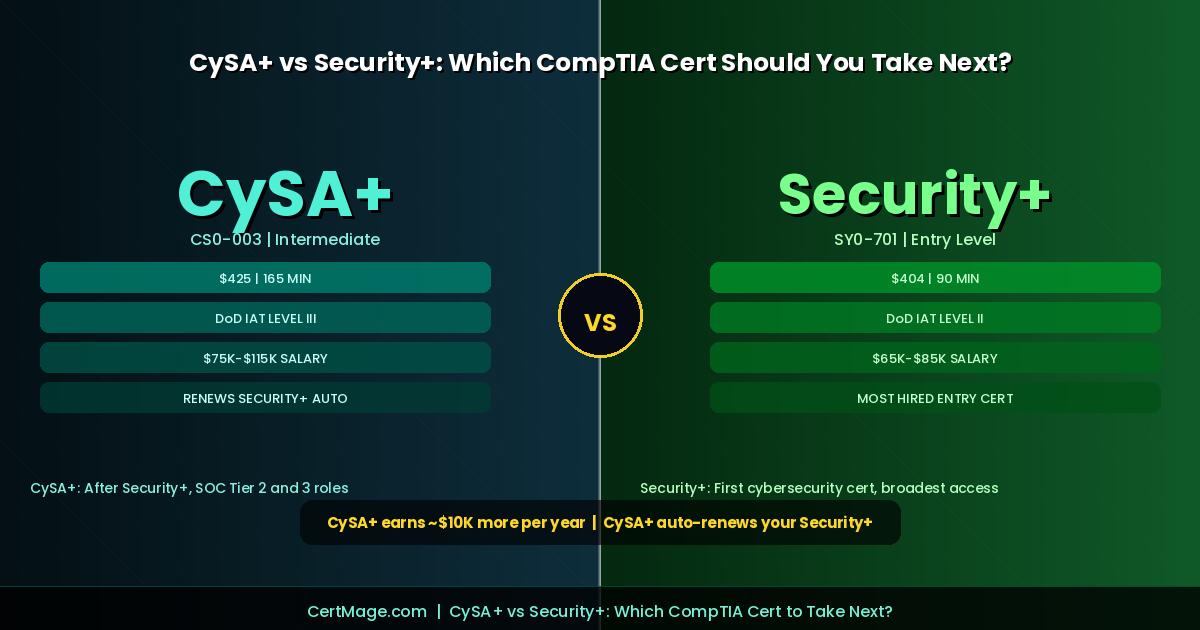
CySA+ vs Security+ — take Security+ first if you are entering cybersecurity or have fewer than 2 years of hands-on security experience. Take CySA+ next if you already hold Security+ and want to specialize in threat detection, behavioral analytics, and SOC analyst roles. Security+ is your entry point into cybersecurity. CySA+ is your next step up once you are already in it.
These two certifications are not competing options at the same career stage. Security+ proves you know cybersecurity concepts. CySA+ proves you can apply them in real security operations under pressure.
CySA+ vs Security+: Key Differences at a Glance
| Factor | CompTIA Security+ | CompTIA CySA+ |
| Exam code | SY0-701 | CS0-003 |
| Level | Entry level | Intermediate |
| Exam cost | $404 USD | $425 USD |
| Exam duration | 90 minutes | 165 minutes |
| Maximum questions | 90 | 85 |
| Passing score | 750 out of 900 | 750 out of 900 |
| Question types | Multiple choice and PBQs | Multiple choice and PBQs |
| Prerequisites | None | None formally — Security+ and 3 to 4 years recommended |
| Study time | 6 to 12 weeks | 6 to 10 weeks with Security+ and experience |
| DoD 8570 approved | Yes — IAT Level II | Yes — IAT Level III |
| Renewal | 3 years via 50 CEUs | 3 years via 60 CEUs — also renews Security+ automatically |
| Focus | Broad foundational cybersecurity knowledge | Specialized threat detection, analysis, and incident response |
| Average entry salary | $65,000 to $85,000 | $75,000 to $115,000 |
| Best for | Career starters, career changers, DoD compliance | SOC analysts, threat hunters, incident responders |
| Stackable cert | CNSP (with Network+) | CSAP (CompTIA Security Analytics Professional) |
What Is the Main Difference Between CySA+ and Security+?
Security+ gives you broad knowledge across cybersecurity domains making you versatile for various entry-level roles. CySA+ dives deep into threat analysis and incident response preparing you for specialized analyst positions in Security Operations Centers.
The simplest way to understand the difference is this. Security+ builds your foundation while CySA+ helps you apply that knowledge in real-world security operations. Security+ tells employers you know what it takes to assess an organization’s security, implement solutions, and respond to incidents conceptually. CySA+ tells employers you can do those things analytically under operational pressure in a live SOC environment with real tools and real data.
Security+ is the vocabulary test of cybersecurity. CySA+ is the performance test.
What Does Security+ Cover?
Security+ (SY0-701) covers five broad domains representing foundational cybersecurity knowledge. It is designed to validate that you understand the conceptual landscape of cybersecurity before you specialize in any particular area.
Security+ Exam Domains
| Domain | Weight | What You Learn |
| General security concepts | 12% | Security controls, authentication types, cryptography basics, PKI, security frameworks, zero trust |
| Threats, vulnerabilities and mitigations | 22% | Malware types, social engineering, attack vectors, vulnerability scanning, threat intelligence concepts |
| Security architecture | 18% | Cloud security, network infrastructure security, secure network design, SASE, segmentation |
| Security operations | 28% | Incident response procedures, digital forensics basics, log monitoring, identity management, SIEM concepts |
| Security program management and oversight | 20% | Risk management frameworks, compliance, data privacy, third-party risk, governance |
Security+ is broad by design. The goal is to establish a baseline across all security domains rather than depth in any one area. Security operations is the heaviest domain at 28 percent and the most directly applicable to entry-level SOC roles.
Who Security+ is for: Anyone entering cybersecurity for the first time, IT professionals transitioning into security roles, candidates who need DoD 8570 IAT Level II compliance, and professionals building the foundation for more specialized credentials including CySA+.
What Does CySA+ Cover?
CySA+ (CS0-003) is an intermediate certification that assumes Security+ level knowledge and focuses entirely on the applied analytical skills used in security operations centers, threat hunting teams, and incident response roles.
CySA+ Exam Domains
| Domain | Weight | What You Do |
| Security operations | 33% | Analyze log data from SIEM tools, interpret network traffic, triage alerts, apply threat intelligence, support security monitoring processes |
| Vulnerability management | 30% | Conduct vulnerability scans, analyze scan results, prioritize remediation, track vulnerability lifecycle, assess risk in organizational context |
| Incident response management | 20% | Apply incident response procedures, analyze attack indicators, preserve digital evidence, coordinate response activities, produce incident reports |
| Reporting and communication | 17% | Communicate findings to technical and non-technical stakeholders, create vulnerability assessment reports, provide remediation recommendations |
Security operations at 33 percent is the exam’s heaviest and most distinctive domain. This is where candidates who have not worked in a real SOC environment struggle most. Questions present real log data, real SIEM alerts, real attack indicators, and require you to analyze and respond correctly under time pressure. Candidates who have only studied theory without practical tool experience consistently underperform in this domain.
The critical tools you must know for CySA+: Wireshark for packet analysis, Splunk or equivalent SIEM for log analysis, Nessus or OpenVAS for vulnerability scanning, and threat intelligence platforms including MITRE ATT&CK framework. These appear in performance-based questions that require hands-on tool recognition.
Who CySA+ is for: Security analysts targeting Tier 2 and Tier 3 SOC roles, threat hunters, vulnerability management specialists, incident responders, and professionals who need DoD 8570 IAT Level III compliance for senior government positions.
CySA+ vs Security+: Difficulty Comparison
CySA+ is intentionally harder. It requires you to analyze attack scenarios, interpret logs, and apply incident response procedures — not just define terms. CompTIA positions CySA+ as an intermediate certification requiring Security+ knowledge plus real-world experience.
| Factor | Security+ | CySA+ |
| Type of difficulty | Breadth across 5 domains, conceptual understanding | Applied analysis under pressure, scenario-heavy questions |
| Hardest aspect | Governance and compliance domain — least intuitive for technical candidates | Log analysis and SIEM interpretation without prior SOC experience |
| Study time with relevant background | 6 to 12 weeks from scratch | 6 to 10 weeks after Security+ plus experience |
| Study time without background | 10 to 16 weeks | 10 to 16 weeks — higher failure risk |
| Exam duration | 90 minutes | 165 minutes — nearly double |
| Pass rate | 85 to 93 percent prepared candidates | Lower — scenario-heavy format is harder to prepare for through study alone |
| Common failure reason | Underestimating governance domain and PBQs | Insufficient hands-on SIEM and log analysis practice |
| Most valuable preparation | Practice exams and governance study | Real SOC tool experience and log analysis practice |
Warning: CySA+ exam questions assume Security+ level knowledge. If you do not know the difference between symmetric and asymmetric encryption, what a SIEM is, or how the incident response lifecycle works, you will struggle regardless of how much hands-on experience you have. Most professionals spend 1 to 3 years in a security role between Security+ and CySA+. That experience gap matters — the CySA+ exam is scenario-heavy and rewards real-world exposure far more than memorization.
CySA+ vs Security+: Salary Comparison
CySA+ certified professionals earn approximately $10,000 more per year on average than Security+ holders in equivalent markets. This reflects the intermediate level of the certification and the more senior roles it qualifies for.
Security+ Salary by Role
| Role | Average US Salary |
| SOC Analyst Tier 1 | $55,000 to $75,000 |
| IT Security Administrator | $65,000 to $85,000 |
| Information Security Analyst (entry) | $70,000 to $90,000 |
| Network Security Specialist | $72,000 to $92,000 |
| DoD Cybersecurity Contractor | $80,000 to $105,000 |
CySA+ Salary by Role
| Role | Average US Salary |
| SOC Analyst Tier 2 | $75,000 to $95,000 |
| SOC Analyst Tier 3 | $90,000 to $115,000 |
| Threat Intelligence Analyst | $85,000 to $110,000 |
| Incident Response Analyst | $88,000 to $115,000 |
| Vulnerability Management Specialist | $85,000 to $115,000 |
| Threat Hunter | $95,000 to $130,000 |
Salary by DoD Level
| Certification | DoD 8570 Level | Government Salary Range |
| Security+ | IAT Level II | $75,000 to $100,000 |
| CySA+ | IAT Level III | $90,000 to $120,000 |
CySA+ covers IAT Level III. For senior government roles, CySA+ is the stronger credential. This DoD level difference directly explains a portion of the salary gap between the two certifications in defense and government contracting environments.
The Stackable Certification Advantage
One of the most underutilized advantages of CySA+ is its stackable credential benefits within the CompTIA ecosystem.
CySA+ renews Security+ automatically. When you pass CySA+, your active Security+ is automatically renewed for another 3 years without a separate renewal action. This means maintaining both certifications active requires only renewing CySA+ every 3 years.
CySA+ plus CASP+ earns CSAP. CompTIA Security Analytics Professional (CSAP) is the stackable credential earned by holding active CySA+ and CASP+ simultaneously. CSAP demonstrates advanced security analytics competency for senior analyst and lead roles.
CySA+ plus Security+ plus Network+ earns CSIS. CompTIA Secure Infrastructure Specialist (CSIS) — the most widely recognized CompTIA stackable credential — requires all three active simultaneously.
For the complete picture of every CompTIA stackable certification combination and which combinations unlock which credentials, our Best Cybersecurity Certifications 2026 guide covers every path.
Should You Take CySA+ Before Security+?
Technically yes — CySA+ has no mandatory prerequisites. But candidates without Security+ knowledge typically take significantly longer to prepare and have lower first-attempt pass rates. Security+ first is the efficient path.
Most employers still list Security+ as a baseline requirement or preference even for analyst roles where CySA+ is more directly relevant. Having CySA+ without Security+ creates a gap on your resume that hiring managers notice.
For the vast majority of candidates, the answer is Security+ first, CySA+ within 12 to 18 months. The two certifications build directly on each other — Security+ gives you the vocabulary, CySA+ gives you the application.
The exception: if you have 3 or more years of genuine SOC experience, strong SIEM proficiency, and a practical background in vulnerability management and incident response, you can take CySA+ directly without Security+ as a genuine shortcut. The exam will feel more natural because of your operational background.
Who Should Take Security+ First?
Take Security+ first if:
You are entering cybersecurity from any background. Security+ is the most widely held entry-level cybersecurity certification globally and the most universally listed as required or preferred for entry-level security roles. Starting without it means missing the baseline credential that hiring managers use as a filter.
You have fewer than 2 years of hands-on security experience. The CySA+ exam rewards operational SOC experience that most candidates with fewer than 2 years simply have not built yet. Security+ is the credential for your current career stage.
You need DoD IAT Level II compliance quickly. Security+ satisfies this requirement faster than any other path. CySA+ satisfies IAT Level III but adds preparation time and cost that may not be justified if IAT Level II is your immediate goal.
You want to maximize your employability across all security roles. Security+ opens doors in SOC analysis, IT security administration, compliance, risk management, and network security roles simultaneously. CySA+ is more specialized and primarily opens SOC and analyst roles.
For the complete worth-it analysis of Security+ including salary data, ROI calculation, and preparation guide, our Is Security+ Worth It guide covers every detail.
Who Should Take CySA+ Next?
Take CySA+ if:
You already hold Security+ and have 1 or more years of security operations experience. This is the primary target audience for CySA+. Professionals who have validated their foundational knowledge with Security+ and gained real SOC experience are in the ideal position to tackle CySA+ and see immediate salary and career impact.
You are targeting Tier 2 or Tier 3 SOC roles. CySA+ is increasingly mentioned in job listings for Level 2 or Level 3 SOC roles especially where real-time threat analysis is crucial. Senior SOC analyst positions at enterprise organizations frequently list CySA+ as required or strongly preferred.
You work in vulnerability management or incident response. CySA+’s vulnerability management and incident response management domains at 30 and 20 percent respectively validate the skills that vulnerability management specialists and IR analysts use daily. If these are your primary responsibilities, CySA+ is the most direct credential for your role.
You need DoD IAT Level III compliance. For senior government and defense contractor positions requiring IAT Level III, CySA+ is the most efficient path from Security+ to the next DoD compliance level.
You want to pursue CASP+ or CISSP eventually. CySA+ provides the intermediate analytical depth that makes CASP+ preparation more approachable and the operational security context that strengthens CISSP application even before you meet its 5-year experience requirement.
The CompTIA Security Certification Path in 2026
Understanding exactly where Security+ and CySA+ fit in the full CompTIA security journey helps you plan your 3 to 5 year career roadmap.
| Stage | Certification | Time | Cost | Target Salary |
| Entry | Security+ (SY0-701) | 6 to 12 weeks | $404 | $65,000 to $90,000 |
| Intermediate | CySA+ (CS0-003) | 6 to 10 weeks after Security+ | $425 | $75,000 to $115,000 |
| Advanced | CASP+ | 10 to 14 weeks | $509 | $100,000 to $145,000 |
| Expert | CISSP (after 5 years experience) | 3 to 6 months | $749 | $120,000 to $175,000 |
Both certifications remain in high demand in 2026. Security+ offers broader entry-level access across industries including finance, healthcare, and education. CySA+ accelerates career progression once you have foundational experience.
How to Prepare for Security+
Step 1: Master the governance and compliance domain specifically. Security Program Management and Oversight at 20 percent of the exam is where most technically-minded candidates lose points. Risk management frameworks including NIST and ISO 27001, regulatory compliance requirements including HIPAA and PCI-DSS, and third-party risk management require dedicated study time beyond technical security topics.
Step 2: Practice performance-based questions explicitly. PBQs appear at the start of the Security+ exam. Candidates who study only multiple choice consistently underperform on PBQ scenarios requiring you to configure firewalls, identify vulnerabilities in network diagrams, or choose the right control for a given threat. Practice these formats deliberately.
Step 3: Use current practice materials. CertMage’s Security+ practice exams cover all five SY0-701 domains with scenario-based questions aligned to the current 2026 blueprint.
How to Prepare for CySA+
Step 1: Get hands-on with SIEM tools before studying exam content. Candidates who fail CySA+ most commonly lack hands-on SIEM experience. Install Splunk free edition or Security Onion. Practice ingesting logs from different sources, creating correlation rules, and investigating alerts. Understand what common attack patterns look like in real log data before you ever open a study guide.
Step 2: Practice log analysis daily from week one. Know the difference between common Windows Event IDs such as 4625 (failed logon) and 4720 (user account created) without looking them up. Practice parsing web server access logs, firewall logs, and DNS query logs for indicators of compromise. The CySA+ exam presents real log samples and asks you to identify what happened.
Step 3: Master vulnerability management concepts at operational depth. CVSS scoring, CVSS v3 metrics, vulnerability scanner output interpretation, and remediation prioritization based on business context all appear in the vulnerability management domain. Practice reading Nessus or OpenVAS output and making realistic remediation priority decisions.
Step 4: Study the MITRE ATT&CK framework explicitly. ATT&CK is referenced throughout CySA+ scenario questions. Know the major tactic categories, understand how techniques map to tactics, and practice identifying which ATT&CK techniques correspond to attack behaviors described in exam scenarios.
Step 5: Use current practice materials. CertMage’s CySA+ practice exams cover all four CS0-003 domains with current scenario-based questions and complete answer explanations.
Decision Framework: CySA+ vs Security+
| Your Situation | Take This |
| New to cybersecurity, no prior experience | Security+ |
| 0 to 2 years IT or security experience | Security+ |
| Already hold Security+, working in SOC | CySA+ |
| Target role is Tier 1 SOC analyst | Security+ |
| Target role is Tier 2 or Tier 3 SOC analyst | CySA+ |
| Need DoD IAT Level II immediately | Security+ |
| Need DoD IAT Level III for senior government role | CySA+ |
| Want automatic Security+ renewal | CySA+ |
| 3 plus years SOC experience, no certs yet | CySA+ directly is possible |
| Building toward CASP+ or CISSP | CySA+ is the intermediate step |
| Want maximum entry-level job openings | Security+ |
| Want maximum analyst role salary | CySA+ |
| Budget is primary concern | Security+ costs $21 less and opens doors faster |
| Want both eventually | Security+ first, CySA+ within 12 to 18 months |
Frequently Asked Questions: CySA+ vs Security+
What is the difference between CySA+ and Security+?
Security+ validates broad foundational cybersecurity knowledge across five domains for entry-level professionals. CySA+ validates intermediate applied skills in threat detection, behavioral analytics, vulnerability management, and incident response for professionals already working in security operations. Security+ is the entry point. CySA+ is the next step up.
Which is harder — CySA+ or Security+?
CySA+ is harder. It has a longer exam at 165 minutes versus 90 minutes, is scenario-heavy requiring applied analytical thinking rather than conceptual recall, and assumes Security+ level foundational knowledge plus operational experience. CompTIA recommends 3 to 4 years of hands-on experience before CySA+.
Should you take Security+ before CySA+?
Yes for most candidates. Security+ first is the efficient path because CySA+ assumes Security+ knowledge throughout. Candidates without Security+ foundation typically take significantly longer to prepare and have lower first-attempt pass rates. The recommended sequence is Security+ first then CySA+ within 12 to 18 months.
Which pays more — Security+ or CySA+?
CySA+ pays approximately $10,000 more per year on average. Security+ entry-level roles pay $65,000 to $85,000. CySA+ intermediate roles pay $75,000 to $115,000. The gap reflects the higher experience requirements and more specialized analytical skills CySA+ validates.
Does CySA+ renew Security+?
Yes. Passing CySA+ automatically renews your active Security+ for another 3 years without a separate renewal action. This makes maintaining both certifications active a single renewal cycle rather than two separate processes.
How much does CySA+ cost?
CySA+ exam costs $425 USD. Security+ costs $404 USD. Both require renewal every 3 years — Security+ needs 50 CEUs and CySA+ needs 60 CEUs.
Can I take CySA+ without Security+?
Yes. CySA+ has no mandatory prerequisites. However candidates without Security+ knowledge or equivalent experience consistently struggle more with CySA+ content that assumes foundational cybersecurity understanding. Taking Security+ first is strongly recommended for most candidates.
What jobs does CySA+ qualify you for?
CySA+ qualifies you for SOC Analyst Tier 2 and Tier 3, Threat Intelligence Analyst, Incident Response Analyst, Vulnerability Management Specialist, and Threat Hunter roles paying $75,000 to $130,000 in the US.
Is CySA+ worth it after Security+?
Yes. CySA+ is the natural and most productive next step after Security+ for professionals working in or targeting security operations roles. The salary increase of approximately $10,000 per year on a $425 exam investment delivers strong ROI within weeks of landing a higher-level role.
What comes after CySA+?
Common next steps after CySA+ include CASP+ for advanced security architecture, CISSP after 5 years of experience for security leadership, or specialized certifications including AWS Security Specialty or SC-500 for cloud security. CertMage covers every step of the cybersecurity certification path in our Is CEH Worth It guide and our Best Cybersecurity Certifications 2026 guide.