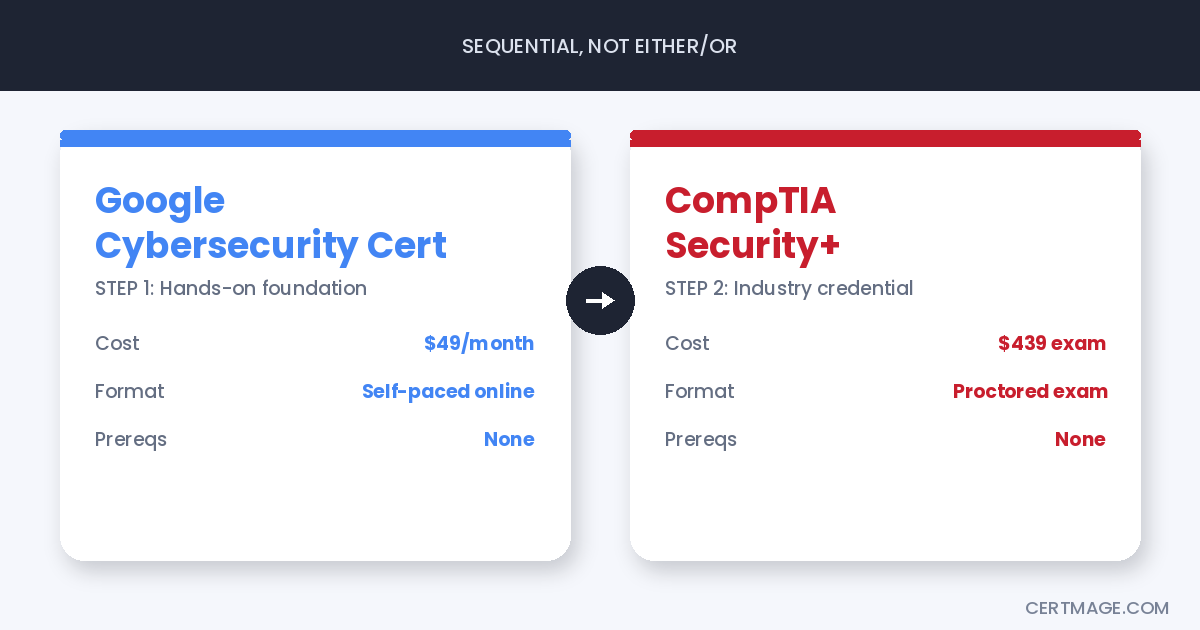
Google’s Cybersecurity Certificate and CompTIA Security+ are not competing options, Google’s own certificate is explicitly built to prepare you for the Security+ exam, and Coursera awards a dual credential when you complete both, which makes the real question not which one to choose, but which order to take them in.
The direct answer: Start with the Google Cybersecurity Certificate if you have no prior IT or security background, since it teaches hands-on skills with real tools, Python, Linux, SQL, and SIEM platforms, at a low monthly cost with no prerequisites. Follow it with CompTIA Security+ to earn the industry-recognized, DoD 8140-compliant credential that employers and government contracts actually require by name. Doing both costs roughly $586 to $733 total and takes most learners 4 to 9 months combined. Official details live on Coursera’s Google Cybersecurity Certificate page and CompTIA’s Security+ certification page.
Google Cybersecurity Certificate vs Security+ at a Glance
| Detail | Google Cybersecurity Certificate | CompTIA Security+ |
| Format | Self-paced online courses, 8 to 9 modules | Single proctored exam, SY0-701 |
| Cost | $49 per month on Coursera, 7-day free trial | $439 exam voucher |
| Typical time to complete | 3 to 6 months at 7 to 10 hours per week | 4 to 10 weeks of study, then a 90-minute exam |
| Prerequisites | None | None |
| Industry recognition | Growing, backed by Google’s employer network | Established, DoD 8140 IAT II compliant, widely named in job postings |
| Credential type | Professional Certificate, not an accredited degree | Vendor-neutral certification |
| Renewal | None required | Every 3 years, $150 via Continuing Education |
| Designed relationship | Explicitly built to prepare you for Security+ | Accepts and benefits from Google certificate preparation |
Important: Coursera states directly that completing the Google Cybersecurity Certificate helps prepare you for the Security+ exam, and completing both earns you a dual credential. This is not marketing spin, the two programs share substantial content overlap in network security, threat detection, and risk fundamentals, which is exactly why treating this as an either/or decision wastes the natural synergy between them.
What the Google Cybersecurity Certificate Actually Teaches
| Area | What You Learn |
| Cybersecurity foundations | Core concepts, risks, threats, and vulnerabilities, and how to mitigate them |
| Hands-on tools | Python, Linux, and SQL, used throughout the program rather than taught in isolation |
| Network security and SIEM | Protecting networks, devices, and data using Security Information and Event Management tools |
| Incident detection and response | Real-world scenario practice, including portfolio-ready projects |
| AI-assisted job search tools | Resume building, interview practice, and career planning support added to the current curriculum |
Key point: The program’s emphasis on practical, tool-based learning is its core differentiator from Security+. You finish having actually used Python, Linux, and SQL in simulated scenarios, not just studied definitions of what they are. This is valuable specifically because it builds the applied muscle memory that a single proctored exam cannot test directly.
What CompTIA Security+ Actually Validates
| Area | What You Demonstrate |
| General security concepts | Threats, vulnerabilities, and mitigation techniques at an industry-standard depth |
| Architecture and design | Secure network and system architecture principles |
| Implementation | Deploying and configuring security controls in realistic scenarios |
| Operations and incident response | Day-to-day security operations and formal incident response procedures |
| Governance, risk, and compliance | Program-level security governance and regulatory considerations |
Note: Security+ is scenario-heavy and vendor-neutral, meaning it tests your judgment across generic security principles rather than any single company’s specific toolset. This is precisely why it satisfies DoD 8140 requirements and appears by name in far more job postings than Google’s certificate does on its own, employers and government contracts can rely on a consistent, third-party-verified standard behind the credential.
The Real Cost of Doing Both
Required Costs
| Item | Cost |
| Google Cybersecurity Certificate, 3 months at $49/month | $147 |
| Google Cybersecurity Certificate, 6 months at $49/month | $294 |
| CompTIA Security+ exam voucher | $439 |
Realistic Total Budget by Path
| Path | Total Cost |
| Google certificate only | $147 to $294 |
| Security+ only, self-study | $439 to $700, including materials |
| Both, sequential, fast pace | $586 to $733 |
| Both, sequential, standard pace with a Security+ retake buffer | $700 to $1,150 |
The honest total: Doing both costs meaningfully less than most 4-year degree alternatives while delivering both practical, tool-based skill and the industry-recognized credential employers screen for by name. This combination consistently produces one of the strongest cost-to-outcome ratios of any entry point into cybersecurity.
Who Should Start With the Google Certificate, and Who Should Start With Security+
Complete beginners with no IT background at all. The Google certificate’s no-prerequisite, hands-on structure builds foundational comfort with security tools before you face Security+’s more exam-focused, scenario-heavy format.
Career changers who want a low monthly cost before committing to a proctored exam fee. At $49 per month with a free trial, the Google certificate lets you test your genuine interest in cybersecurity before spending $439 on a Security+ voucher.
IT professionals are already comfortable with networking or systems administration. If you already hold CompTIA A+ or Network+, or have hands-on IT experience, you can likely skip directly to Security+ preparation without needing the Google certificate’s foundational ramp-up. If you are still weighing whether the Google certificate adds value on top of that existing background, see our Is Google Cybersecurity Certificate Worth It review for the full standalone breakdown.
Anyone targeting a specific employer or government contract that names Security+ explicitly. Skip straight to Security+ preparation, since the Google certificate’s practical value will not substitute for a named credential requirement in a job posting or contract specification.
Common Mistakes When Choosing Between These Two
Treating this as a strict either/or decision. Coursera and Google built the certificate specifically to lead into Security+, and completing only one leaves real value on the table that the other credential would add.
Assuming the Google certificate alone satisfies DoD 8140 or similar formal compliance requirements. It does not. Security+ carries that specific, named compliance recognition that Google’s certificate does not currently hold.
Skipping the Google certificate’s hands-on tool practice because Security+ is the more recognized credential. Employers increasingly want to see applied skill alongside the certification itself, and the Google program’s portfolio projects directly address that gap.
Underestimating how much content overlap exists between the two. Candidates who complete the Google certificate first and then treat Security+ prep as starting from zero waste time re-learning concepts the certificate already covered.
Assuming the $49 per month Coursera cost is fixed regardless of pace. Completing the program faster genuinely reduces total cost, while dragging it out across many months adds up quickly at $49 per month.
FAQS
Should I take the Google Cybersecurity Certificate or CompTIA Security+ first?
The Google certificate first, if you are a complete beginner, since it builds hands-on foundational skills at low cost before you commit to Security+’s $439 exam fee. If you already have IT experience, you can go directly to Security+.
Do I need both certifications, or is one enough?
Neither is strictly required, but completing both delivers the strongest combination of practical, tool-based skill and industry-recognized, DoD 8140-compliant credentialing. Many employers specifically value seeing both.
How much does it cost to do both?
Roughly $586 to $733 total for a fast, focused path, or $700 to $1,150 if you need additional study materials or a Security+ retake.
Does the Google Cybersecurity Certificate actually prepare you for Security+?
Yes. Coursera states directly that the program is designed to prepare candidates for the Security+ exam, and completing both earns a dual credential recognition.
Is the Google Cybersecurity Certificate respected by employers on its own?
It carries real, growing recognition, backed by Google’s employer network of 150 or more partner companies, but it does not yet carry the same formal, named recognition that Security+ has built over years as an established industry standard.
How long does it take to complete both?
Typically 3 to 6 months for the Google certificate at 7 to 10 hours per week, plus 4 to 10 weeks of additional Security+-specific study, for a combined timeline of roughly 4 to 9 months depending on your pace and prior background.
Can I skip the Google certificate if I already have IT experience?
Yes. If you already hold CompTIA A+, Network+, or equivalent hands-on IT experience, you can generally move directly into Security+ preparation without needing the Google certificate’s foundational ramp-up.
Does the Google certificate expire or require renewal?
No. It is a one-time completed credential with no renewal requirement, unlike Security+, which requires renewal every 3 years through 50 Continuing Education Units or a $150 fee.
Is Security+ required for government or DoD-related cybersecurity jobs?
Often yes, specifically. Security+ satisfies DoD 8140 IAT Level II requirements, a formal compliance recognition the Google certificate does not currently carry on its own.
What jobs can I get with the Google Cybersecurity Certificate plus Security+?
Entry-level roles including cybersecurity analyst, SOC analyst, and security operations roles, with the combination of practical skill and named industry credential strengthening candidacy for both private-sector and government-adjacent positions compared to holding either credential alone.