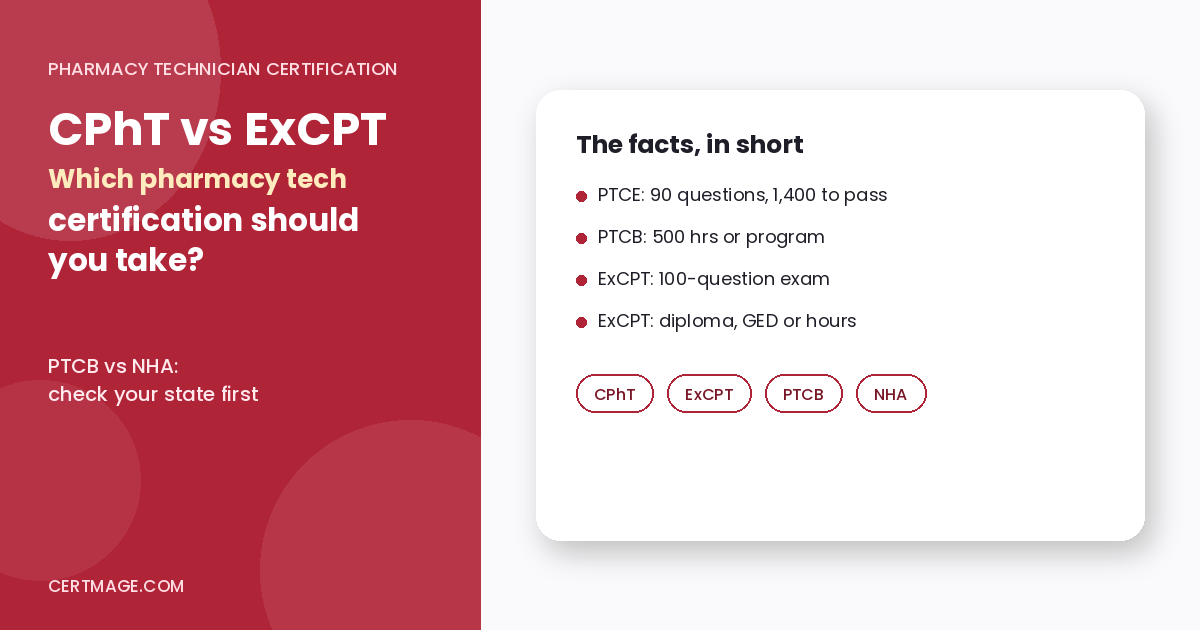
TL;DR: Both exams lead to a “CPhT” title, both are for pharmacy technicians, and both list the same exam fee in the sources we checked (about USD 129). The real difference is who issues them and who accepts them. The PTCB CPhT (taken through the PTCE) is the more widely referenced credential in job postings and has a visible advanced path. The NHA ExCPT is a 100-scored-question exam with a simpler, more flexible eligibility route (diploma or GED plus a training program or work hours). If you do not yet know where you will work, check your state board of pharmacy and the job postings you actually want before you pay. If your state and employer accept either, the choice often comes down to eligibility fit, exam style and how you prefer to study.
Key Takeaways
- Same job, two issuers. The PTCB issues the CPhT through the Pharmacy Technician Certification Exam (PTCE). The National Healthcareer Association (NHA) issues the ExCPT.
- Eligibility differs. The PTCB route needs either a PTCB-recognized training program or at least 500 hours of equivalent work experience. The NHA lists three options built around a diploma or GED, a training program or 1,200 supervised hours.
- Exam style differs. The PTCE is 90 questions (80 scored). One prep source reports the ExCPT as 120 questions (100 scored), while NHA’s own page mentions the 100-question exam.
- Content weighting differs. The PTCB outline weights medications and patient safety heavily. The ExCPT puts the largest block on the dispensing process.
- Renewal looks similar. Both renew every two years. NHA lists 20 hours of continuing education including 1 hour of pharmacy law and 1 hour of patient safety. Third-party sources list the same for the PTCB.
- Acceptance is the deciding check. State boards and employers decide what they recognize. Always confirm before paying.
Quick Facts
| Item | PTCB CPhT (PTCE) | NHA ExCPT |
| Issued by | Pharmacy Technician Certification Board (PTCB) | National Healthcareer Association (NHA) |
| Credential title | Certified Pharmacy Technician (CPhT) | Certified Pharmacy Technician (CPhT) through ExCPT |
| Exam questions | 90 (80 scored, 10 unscored) | 100 per NHA’s page. A prep source reports 120 total with 20 unscored |
| Time | About 2 hours including tutorial and survey (1 hour 50 minutes exam time) | A prep source reports 2 hours 10 minutes |
| Passing score | 1,400 on a 1,000 to 1,600 scale | A prep source reports 390 on a 200 to 500 scale |
| Eligibility | Recognized training program (or within 60 days of finishing) or 500+ hours of work experience | Diploma or GED (or due within 12 months), or a training program in the last 5 years, or diploma or GED plus 1 year with 1,200+ supervised hours in the last 3 years |
| Exam fee | USD 129 per the PTCB page | USD 129 per a prep source. NHA’s page does not list the amount |
| Delivery | Check the PTCB handbook | PSI testing center or live remote proctoring |
| Renewal cycle | Every 2 years | Every 2 years |
| Renewal fee | USD 49 per the PTCB page (a third-party source lists USD 55) | Required, amount not listed on NHA’s page |
| Accreditation | PTCB says the CPhT is NCCA-accredited | NHA says all its exams are NCCA-accredited |
Confirm every row on the issuer’s page before you register.
What Is the PTCB CPhT?
The PTCB’s CPhT is the credential earned by passing the Pharmacy Technician Certification Exam. To apply, the PTCB requires that you live in the US or its territories, complete one of two eligibility pathways, disclose any criminal and state board of pharmacy actions, follow PTCB policies and pass the exam.
Pathway 1 is completing a PTCB-recognized education or training program (or being within 60 days of finishing one). A pharmacy degree can also substitute for the training program. Pathway 2 is equivalent work experience as a pharmacy technician, at least 500 hours, completed at the time you apply.
One prep source says the PTCB also offers additional pharmacy-related certificates and an advanced credential, which can matter if you plan to move toward specialty or lead roles. See the PTCB’s official CPhT program page for current rules, and our PTCB exam page for practice material.
What Is the NHA ExCPT?
The ExCPT is the pharmacy technician exam from the National Healthcareer Association, a provider of allied-health certifications. NHA lists three ways to become eligible:
- A high school diploma or GED, or being scheduled to earn one within 12 months.
- Completing a pharmacy technician training or education program within the last 5 years.
- A diploma or GED plus 1 year of work experience, with at least 1,200 hours of supervised pharmacy-related work in the last 3 years.
The exam is delivered through PSI at a testing center or with live remote proctoring. NHA states that all its exams are NCCA-accredited. For many career changers, the ExCPT’s diploma-or-GED entry point is the practical draw, since you can sit for it without first completing a formal program, depending on which option you qualify under.
How Do the Exams Compare?
The two exams test the same job, but they slice the content differently.
| Content area | PTCE (PTCB outline) | ExCPT (per a prep source) |
| Medications / drugs and drug therapy | 40% | 13% |
| Patient safety and quality assurance | 26.25% | 14% |
| Order entry and processing / dispensing process | 21.25% | 43% |
| Federal requirements / laws | 12.5% | 15% |
| Role, responsibilities and general duties | Not a separate domain | 15% |
The PTCB weights are from its published content outline. The ExCPT weights come from a third-party prep source, and NHA says its free ExCPT test plan lists the official breakdown, so check that document. Outlines are updated from time to time, and older guides may show different PTCE percentages.
What this means in practice:
- PTCE: if you are strong on drug names, classes and safety checks, the weighting works in your favor. If medications are your weak spot, you will feel it, since they carry the biggest share.
- ExCPT: the dispensing process carries the biggest share, so day-to-day workflow knowledge (prescription processing, calculations, inventory, compounding basics) matters most.
How Do the Exam Formats Compare?
The PTCE is shorter. The ExCPT may be longer, depending on which source you trust.
- PTCE: 90 multiple-choice questions, of which 80 are scored and 10 are unscored and not identified. Plan for about 2 hours in total: a 5-minute tutorial, 1 hour 50 minutes of exam time and a 5-minute survey. The passing score is 1,400 on a scale of 1,000 to 1,600.
- ExCPT: NHA’s page says you will take the 100-question exam. One prep source reports 120 questions (100 scored, 20 unscored), 2 hours 10 minutes with no breaks, and a passing score of 390 on a 200 to 500 scale. We could not confirm these extra details from NHA’s page, so treat them as unverified and check NHA’s candidate handbook.
Scores on different scales cannot be compared with each other. A 1,400 on the PTCE and a 390 on the ExCPT are not directly equivalent.
What Are the Requirements for Each?
The ExCPT’s eligibility is built around education and hours. The PTCE’s is built around a recognized program or work experience.
| If you are… | PTCB CPhT | ExCPT |
| Finishing a recognized training program | Eligible (Pathway 1, within 60 days of completion) | Eligible (program in last 5 years) |
| Working in a pharmacy with 500 to 1,199 hours | Eligible (Pathway 2 needs 500 hours) | Probably not yet (needs 1,200 supervised hours) |
| Working in a pharmacy with 1,200+ hours | Eligible | Eligible with diploma or GED and 1 year, 1,200 hours in 3 years |
| A high school senior or recent graduate with no training | Not yet, per the pathways listed | May be eligible with a diploma or GED |
| Outside the US and its territories | Generally not, per the PTCB (military members and spouses are an exception) | Check NHA’s handbook |
If you are weighing both, read the pathway rules carefully. The 500-hour PTCB route and the 1,200-hour ExCPT route are not the same, and one of them may open for you earlier.
How Much Do They Cost?
The exam fee is the same in the sources we checked, so renewal, prep and acceptance matter more.
| Cost item | PTCB CPhT | ExCPT |
| Exam fee | USD 129 | USD 129 per a prep source (NHA’s page does not list it) |
| Renewal | USD 49 per the PTCB page. A third-party guide lists USD 55 | Required, amount not listed on NHA’s page. A prep source lists USD 55 |
| Reinstatement | USD 89 plus 1 extra pharmacy law CE hour, within 1 year of expiration, per the PTCB page | Allowed within 1 year of expiration per NHA, fee not listed |
| Training program | Varies widely by school | Varies widely by school |
| Prep materials | Optional | Optional (NHA says its prep products are not required to sit for an NCCA-accredited exam) |
The tuition for a training program usually costs far more than the exam itself, and neither exam fee includes it.
Which Is Harder?
We cannot rank difficulty fairly, and you should be careful with pass-rate numbers online.
One prep source reports PTCE pass rates of roughly 69 to 71 percent and ExCPT pass rates of roughly 62 to 64 percent over recent years. We could not confirm those from the PTCB or NHA, and pass rates depend on who takes the exam, so they are not a fair measure of difficulty. A higher or lower pass rate may simply reflect different candidate pools.
What we can say from the structure: the PTCE’s heavy medication weighting rewards memorizing drugs and safety rules, while the ExCPT’s dispensing weighting rewards workflow and calculation practice. Use the content outline for the exam you choose and take a timed practice test before you book.
Which Fits Which Situation?
| Your situation | Likely better fit | Why |
| Your state board or target employer names the PTCB | PTCB CPhT | Requirements win over preference |
| Your employer or state board names the ExCPT | ExCPT | Same reason |
| You have a diploma or GED, no training program and no work hours | ExCPT (if eligible) | The PTCB pathways do not list a diploma-only route |
| You completed a PTCB-recognized program | PTCB CPhT | The program fits Pathway 1 directly |
| You have 500 to 1,199 work hours | PTCB CPhT | You meet Pathway 2 sooner |
| You want an advanced or specialty pharmacy technician path | PTCB CPhT | The PTCB offers additional credentials |
| Pharmacy is a stepping stone to other allied-health work | ExCPT (consider) | NHA offers other allied-health exams |
| You are unsure where you will work | Check job postings first | Employers decide |
If you are also exploring other healthcare credentials, our CPC vs CRC guide, CPC vs CCA guide and CPC vs CCS guide cover the coding side, and RHIA vs CCS covers health information paths.
Decision Framework: Which Should You Take?
Work through these in order:
- Check your state board of pharmacy. Requirements vary by state, and some states set their own rules for technician registration or licensure. Confirm which exams count.
- Check three or four job postings in your area. If they name the CPhT or a specific issuer, follow that.
- Check your eligibility. Compare your training, diploma and work hours against each pathway.
- Ask your employer. Many pharmacies, especially chains and hospitals, have preferences and may reimburse the exam.
- Compare the content. Pull the content outline for each exam and ask which weighting fits your strengths.
- If everything is equal, choose by eligibility and study fit. There is no reason to pay for both unless a requirement says so.
Career Value
Certification is often a requirement or a strong preference for technicians, and some states require it. Beyond the first job, the PTCB’s advanced credential and additional certificates give a visible path toward specialty and lead roles. The NHA’s allied-health catalog may suit people who want to move across healthcare roles.
We do not quote salaries. Pay depends on the state, employer, setting and experience. Look at postings for your target role and note which credential employers name.
Study Plan Ideas
If you take the PTCE (about 4 to 8 weeks, our estimate):
- Weeks 1 to 3: medications (brand and generic names, classes, uses, interactions), since this carries the largest share.
- Weeks 4 to 5: patient safety and quality assurance (look-alike drugs, error prevention, high-alert medications).
- Week 6: order entry and processing, including calculations.
- Week 7: federal requirements and regulations.
- Week 8: timed practice tests.
If you take the ExCPT (about 4 to 8 weeks, our estimate):
- Weeks 1 to 4: the dispensing process, including prescription handling, calculations, inventory and compounding basics.
- Weeks 5 to 6: laws and regulations, plus role and responsibilities.
- Week 7: medication safety and drug therapy.
- Week 8: timed practice tests using NHA’s test plan as the checklist.
Common Mistakes to Avoid
- Choosing by reputation instead of requirements. Your state board and employer decide.
- Ignoring eligibility. Check that you qualify before you pay.
- Using old content outlines. Outlines change, so use the current one for each exam.
- Comparing scores across exams. The scales are different.
- Trusting pass-rate claims blindly. Pass rates are not a clean difficulty measure.
- Forgetting renewal. Both credentials renew every two years with continuing education.
- Skipping disclosure rules. The PTCB requires you to disclose criminal and state board actions, and other rules may apply to you.
FAQS
What is the difference between CPhT and ExCPT?
The CPhT is the PTCB’s credential (earned through the PTCE). The ExCPT is the NHA’s pharmacy technician exam. Both lead to a certified pharmacy technician title.
Is the PTCE or ExCPT easier?
We cannot say for certain. They weight content differently and use different score scales. Use each outline and a timed practice test to judge for yourself.
Which is more widely accepted?
Acceptance is set by state boards and employers. In the sources we checked, both were described as recognized, but check your state board and your target employers directly.
How many questions are on the PTCE?
90 multiple-choice questions, of which 80 are scored and 10 are unscored, per the PTCB.
What is the PTCB passing score?
1,400 on a scaled range of 1,000 to 1,600, per the PTCB.
How many questions are on the ExCPT?
NHA’s page says 100 questions. One prep source reports 120 total with 20 unscored.
How much does each exam cost?
The PTCB lists USD 129. A prep source lists USD 129 for the ExCPT, but NHA’s page did not show the amount.
Do I need to attend a training program?
Not always. The PTCB accepts either a recognized program or 500 hours of work experience. NHA lists diploma or GED, a training program or 1,200 supervised hours as separate options.
Do I need a high school diploma?
NHA lists a diploma or GED (or being scheduled to earn one within 12 months) as one eligibility option. The PTCB pages we reviewed did not list a diploma step, so check its handbook.
How often do I renew?
Both renew every two years. NHA lists 20 hours of CE including 1 hour of pharmacy law and 1 hour of patient safety. A third-party source lists the same for the PTCB.
Can I take both exams?
You can, but you generally only need one. Take both only if a state or employer requires it.
Are both exams NCCA-accredited?
The PTCB says its CPhT program is NCCA-accredited, and NHA says all of its exams are NCCA-accredited.
Which one should a beginner take?
Start with your state board and local job postings. If both are accepted, pick the one whose eligibility pathway you meet first.
Final Thoughts
The best pharmacy technician certification is the one your state board and your target employers accept, and that you are eligible to sit for now. The PTCB CPhT offers a visible advanced path and a work-hours route that opens at 500 hours. The ExCPT offers a diploma-or-GED entry point and a dispensing-focused exam. Verify requirements with your state board, compare job postings and use the PTCB’s CPhT program page and NHA’s test plan before you pay.