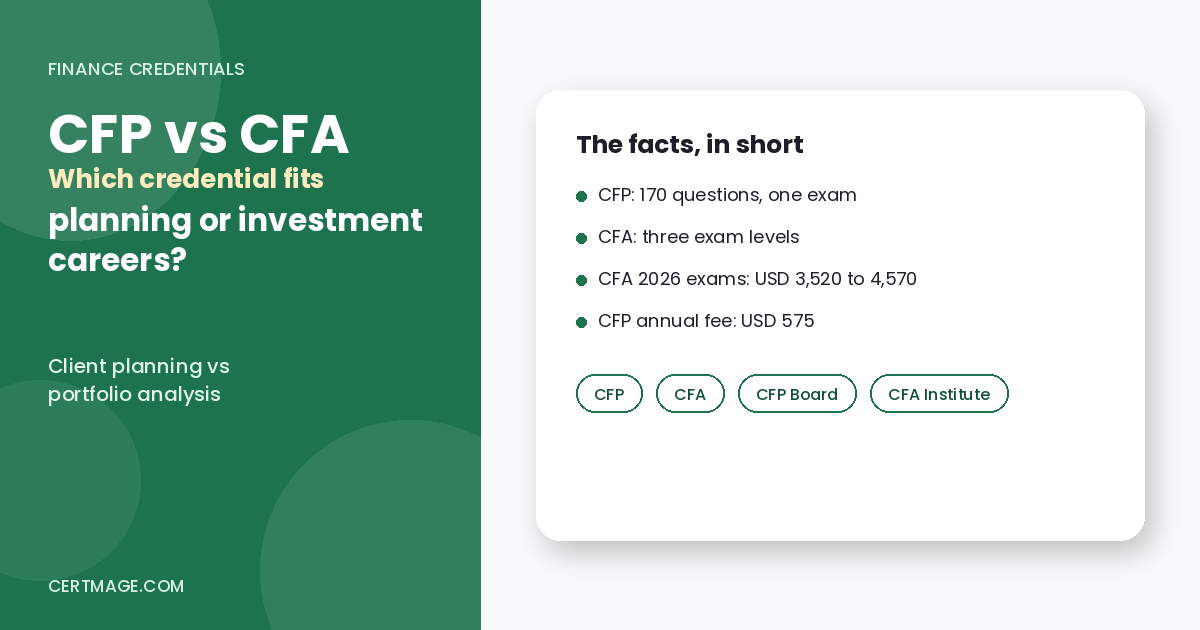
TL;DR: Choose the CFP (CERTIFIED FINANCIAL PLANNER, from CFP Board) if you want to advise individuals and families on retirement, taxes, insurance, estate planning and investments as a whole. Choose the CFA (Chartered Financial Analyst, from CFA Institute) if you want to analyze securities, manage portfolios, work in research or build an institutional investment career. The CFP is a single 170-question, two-session exam plus coursework, a bachelor’s degree, 6,000 hours of planning experience (or 4,000 through an apprenticeship pathway) and an ethics review. The CFA is three exams (Levels I, II and III), about 300 study hours per level, and 4,000 hours of relevant work experience over at least 36 months. The CFA’s exam fees for 2026 total USD 3,520 to 4,570 across three levels. The CFP’s exam is USD 825 to 1,025 per attempt, plus coursework and an annual certification fee of USD 575. Many people in wealth management hold both, so the real question is usually which one to take first.
Key Takeaways
- They certify different jobs. The CFP is built around holistic financial planning for clients. The CFA is built around investment analysis and portfolio management.
- The CFP exam is one exam. The CFA is three. The CFP has 170 multiple-choice questions over two 3-hour sessions. The CFA has three levels, each with its own format.
- Education paths differ. The CFP requires coursework through a CFP Board pathway before you sit the exam. The CFA does not require specific coursework but expects about 300 hours of study per level.
- Experience rules differ. CFP: 6,000 hours of planning experience or 4,000 hours through apprenticeship. CFA: 4,000 hours of relevant work over at least three years.
- Cost structure differs. CFA costs are mostly exam fees. CFP costs include coursework, the exam and an annual certification fee.
- You can hold both. CFA Institute and CFP Board each have their own rules, and holders of other credentials such as the CFA may qualify for an accelerated CFP education pathway.
- Pick by role. If clients are your job, start with the CFP. If securities and portfolios are your job, start with the CFA.
Quick Facts
| CFP | CFA | |
| Issuer | CFP Board | CFA Institute |
| Focus | Personal financial planning for clients | Investment analysis and portfolio management |
| Exam structure | 1 exam, 170 multiple-choice questions, two 3-hour sessions | 3 exams (Levels I, II and III) |
| Education | Coursework through a CFP Board pathway before the exam. Bachelor’s degree required, completed before or within 5 years after passing | Bachelor’s degree or equivalent, or professional work experience, or being a student within the timing rules, to enroll |
| Experience | 6,000 hours of financial planning experience, or 4,000 hours of apprenticeship experience | 4,000 hours of relevant work over at least 36 months |
| Study time | Coursework typically 12 to 18 months | About 300 hours per level, 3 to 4 years for all levels |
| Exam fee | USD 825 early, 925 standard, 1,025 late (per attempt) | 2026: Levels I and II USD 1,140 early or 1,490 standard. Level III USD 1,240 early or 1,590 standard |
| Annual certification fee | USD 575 (from October 1, 2025) | Check CFA Institute for membership dues |
| Attempts | Max 5 lifetime, max 3 in any 24 months | Max 6 attempts per level, max 2 per calendar year |
| Pass rate | Not stated in the CFP Board handbook | Level I: 43% (August 2025) |
Figures come from CFP Board’s candidate handbook and fee announcement, and from CFA Institute’s program, exam and press release pages, checked in November 2026. Fees, formats and curricula change, so confirm each figure with CFP Board and CFA Institute before you register.
What Is the CFP?
The CFP is the best-known planning credential in the United States. CFP professionals work with clients on retirement savings and income, risk management and insurance, investments, taxes, estate planning and the behavioral side of money. The certification process is often described as the “four Es”: education, examination, experience and ethics.
Key facts:
- Education: Complete coursework through a CFP Board pathway (a Registered Program, Transcript Review or the Accelerated Path). You can register for the exam before finishing, but you cannot sit it until CFP Board verifies your education. You also need a bachelor’s degree in any field, which you can complete up to five years after passing.
- Exam: 170 multiple-choice questions, computer-based, over two 3-hour sections with a 40-minute scheduled break between them. Offered in March, July and October in 8-day windows.
- Experience: 6,000 hours of professional financial planning experience, or 4,000 hours of apprenticeship experience that meets additional criteria. Experience can fall within 10 years before or 5 years after passing.
- Ethics: Sign the Ethics Declaration, agree to act as a fiduciary and pass a background check.
- Timeline: CFP Board’s page suggests a typical total of 18 to 24 months.
What Is the CFA?
The CFA charter is the investment profession’s best-known credential. It covers investment tools, valuation, portfolio management, ethics and professional standards, and it is earned through three increasingly applied exams.
Key facts:
- Three levels: Level I tests foundations with 180 multiple-choice questions in two sessions. Level II uses 22 item sets (88 multiple-choice questions) built on vignettes. Level III combines item sets and essay (constructed response) sets and lets you choose a pathway: Private Wealth, Private Markets or Portfolio Management, which accounts for 30 to 35% of the exam.
- Eligibility to enroll: A bachelor’s degree or equivalent, or professional work experience (4,000 hours acquired over at least three sequential years), or enrollment as an undergraduate within CFA Institute’s timing rules.
- Charter requirements: At least 4,000 hours of relevant work experience, over no fewer than 36 months, directly involving investment decision-making or work that informs it. You must also become a regular CFA Institute member and provide professional references.
- Study time: CFA Institute recommends 300 hours per level, and completing all three typically takes three to four years.
- Wealth route: If your goal is advisory work, the Level III Private Wealth pathway connects the CFA to planning-style work. See our FRM vs CFA guide for how the CFA compares with a risk credential.
Exam Content Side by Side
CFP exam domains (per the CFP Board handbook)
| Domain | Weight |
| A. Professional Conduct and Regulation | 8% |
| B. General Principles of Financial Planning | 15% |
| C. Risk Management and Insurance Planning | 11% |
| D. Investment Planning | 17% |
| E. Tax Planning | 14% |
| F. Retirement Savings and Income Planning | 18% |
| G. Estate Planning | 10% |
| H. Psychology of Financial Planning | 7% |
CFA Level I topic weights (2027 outline listed by CFA Institute)
| Topic | Weight |
| Ethical and Professional Standards | 10 to 15% |
| Quantitative Methods | 11 to 14% |
| Economics | 6 to 9% |
| Financial Statement Analysis | 11 to 14% |
| Corporate Finance | 6 to 9% |
| Equities | 11 to 14% |
| Fixed Income | 11 to 14% |
| Derivatives and Risk Management | 6 to 9% |
| Alternative Investments | 6 to 9% |
| Portfolio Construction | 8 to 12% |
CFA Institute lists both a 2026 outline and a 2027 outline. Check which one applies to your exam window, and read our CFA Level I 2027 curriculum changes guide for what moves.
What the content tells you:
- The CFP spreads across the client’s whole financial life. Investments are 17%, but retirement (18%), tax (14%), insurance (11%) and estate (10%) together carry far more.
- The CFA goes deep on investments. Equities, fixed income, derivatives, alternatives, portfolio construction, financial statement analysis and economics make up most of Level I.
- Ethics appears in both, but the CFA weights it more heavily at Level I and the CFP adds a fiduciary commitment and background check.
- Math is used differently. The CFA leans on quantitative methods and valuation. The CFP leans on applied calculations in retirement, tax and cash flow.
Exam Format Side by Side
| CFP | CFA Level I | CFA Level II | CFA Level III | |
| Questions | 170 multiple choice | 180 multiple choice | 88 multiple choice in 22 item sets | 11 item sets plus 11 essay sets |
| Time | 6 hours of testing in two 3-hour sections | Two sessions of about 135 minutes | 4 hours 24 minutes in two sessions | 4 hours 24 minutes in two sessions |
| Format notes | Computer-based, free movement within a subsection, no return to earlier subsections | Three answer choices, no penalty for wrong answers | Vignette-based, 20 of 22 sets scored | Vignette-based, pathway makes up 30 to 35% |
| Offered | March, July and October windows | See CFA Institute exam calendar | See CFA Institute exam calendar | See CFA Institute exam calendar |
Requirements: Education, Experience and Timelines
| CFP | CFA | |
| Degree | Bachelor’s in any field, finished before or within 5 years after passing | Bachelor’s or equivalent to enroll, or other routes above |
| Coursework | Required before the exam through a CFP Board pathway | None required, but plan about 300 hours of self-study per level |
| Experience | 6,000 hours of planning experience, or 4,000 hours via apprenticeship | 4,000 hours of relevant work over at least 36 months |
| Timing of experience | Within 10 years before or 5 years after passing | Counted toward charter eligibility, can be earned while studying |
| Ethics | Ethics Declaration, fiduciary commitment, background check | Membership application with professional references |
| Attempts | Lifetime max of 5. Max of 3 in any 24-month period | Max of 6 per level, max of 2 per calendar year |
Points to note:
- The CFP experience requirement is planning-specific. CFP Board describes it as experience that prepares you to provide personal financial planning to the public without supervision.
- CFA experience does not need to be investment-only, according to CFA Institute’s page for the enrollment requirement, but charter eligibility requires relevant investment decision-making work.
- Accelerated pathways exist for CFP. Third-party summaries say CFA and CPA holders may use an accelerated pathway that bypasses some coursework, with a capstone requirement. Confirm the details with CFP Board.
- Plan the CFA calendar early. Each level takes months of study, and the retake limits mean a failed attempt costs time.
Cost: CFP vs CFA
CFA exam fees for 2026 (USD)
| Level | Early | Standard |
| Level I | 1,140 | 1,490 |
| Level II | 1,140 | 1,490 |
| Level III | 1,240 | 1,590 |
| All three levels | 3,520 | 4,570 |
CFA Institute eliminated its one-time USD 350 enrollment fee, which dropped to USD 0 from April 29, 2025.
CFP costs (USD)
| Item | Amount |
| Exam, early registration | 825 |
| Exam, standard registration | 925 |
| Exam, late registration | 1,025 |
| Annual certification fee (from October 1, 2025) | 575 |
| Postponement fee | 500 |
| Coursework | Varies by provider. Not covered on the pages we reviewed |
What to take from the numbers:
- The CFA’s total is mostly exam fees, and failed attempts add the full fee again.
- The CFP’s total depends on coursework. The exam fee is lower, but coursework, applications and the annual fee add up.
- Register early for both. CFP Board and CFA Institute both charge more as deadlines pass.
- Membership and dues are extra. CFA charter holders pay CFA Institute dues, and CFP professionals pay the annual certification fee. Check each body’s current amounts.
- Study materials cost extra for both.
How Hard Are the Exams?
- CFA difficulty comes from volume and depth. CFA Institute reported a 43% pass rate for Level I in August 2025, with 26,192 candidates sitting. The same infographic lists an August 2025 pass rate of 50% for Level III. Plan on about 300 hours per level.
- CFP difficulty comes from breadth and integration. Scenario and case questions require combining tax, retirement, insurance, estate and investment knowledge. CFP Board’s handbook describes the exam as pass/fail and does not publish a numeric cut score or pass rate. A third-party summary reports overall pass rates of roughly two-thirds in recent windows, so treat that as unofficial.
- Background matters. Finance and economics graduates often find CFA material familiar. Planners and advisors often find CFP content close to their day-to-day work.
Which Fits Which Career?
| Role or goal | Better fit | Why |
| Financial planner or advisor serving individuals | CFP | Built around holistic client planning |
| Retirement planning or wealth advisor | CFP | Retirement and tax planning carry the most weight |
| Equity research analyst | CFA | Valuation and analysis focus |
| Portfolio manager | CFA | Portfolio management and investment decision-making |
| Institutional investment role (pension, endowment, asset manager) | CFA | Investment-focused credential |
| Private wealth manager with investment authority | Both, over time | CFA Level III Private Wealth pathway plus planning depth from the CFP |
| Risk analyst or risk manager | See our FRM vs CFA guide | Risk-focused credentials may fit better |
| Corporate finance or financial modeling | CFA or modeling credentials | See our FMVA certification guide and Is FMVA worth it |
Decision Framework
Choose the CFP first if:
- Your goal is to work directly with individuals, families or small business owners.
- You want planning across retirement, tax, insurance and estate.
- You are willing to complete coursework and the planning experience requirement.
- You want a fiduciary-oriented credential built around client advice.
Choose the CFA first if:
- Your goal is analysis, research or portfolio management.
- You are comfortable with a multi-year, three-exam path.
- You work or plan to work in an investment role that counts toward the 4,000-hour requirement.
- You want a credential recognized in institutional investing.
Take both if:
- You are in wealth management and want both planning depth and investment depth.
- You are early in your career and unsure. Start with the credential your current role supports, then add the other as your role grows.
Start with something else if:
- Your interest is accounting, audit or management accounting. See our CMA vs CPA guide and CPA vs CIA guide.
Salary and Career Value
Neither CFP Board nor CFA Institute publishes a salary figure on the pages we reviewed, and no single number isolates CFP or CFA holders. Pay varies a great deal by employer, region, role, client base and experience, and many advisor roles include variable compensation. Review current job postings in your market and note which credential appears most often for the role you want.
Study Plan Ideas
These are suggestions, not CFP Board or CFA Institute requirements.
CFP (about 18 to 24 months in total, per CFP Board’s typical timeline)
- Choose your education pathway and enroll in coursework.
- Plan your exam window. The exam is offered three times a year, and education must be verified before you sit.
- Focus on integration. Practice case questions that combine retirement, tax, insurance and estate topics.
- Track experience hours as you go, since you need to report them.
- Take the CFP Board practice exam included with registration, per the handbook.
CFA (about 300 hours per level)
- Start with Level I foundations. Ethics, quantitative methods, financial statement analysis and equities carry large weights.
- Spread study across months, not weeks. Many candidates start well before the exam window.
- Use timed practice. Level I is 180 questions in two sessions, about 90 seconds per question.
- Plan Level II and III early, because item sets and essay sets reward applied practice.
- Document your work experience toward the 4,000-hour requirement.
Common Mistakes to Avoid
- Choosing by prestige. Pick the credential that matches your job, not the one that sounds more advanced.
- Underestimating the CFA timeline. Three levels at about 300 hours each is a multi-year commitment.
- Ignoring the CFP’s coursework and experience requirements. The exam is one piece of certification.
- Missing deadlines. Late registration and postponements add cost for both credentials.
- Using an outdated curriculum. The CFA Level I outline changes for 2027, so confirm which outline your exam uses.
- Assuming the experience rules are the same. CFP and CFA define qualifying experience differently.
- Forgetting upkeep. CFP certification carries an annual fee and renewal requirements, and CFA charter holders have membership obligations.
FAQS
Which is better, CFP or CFA?
Neither is better overall. The CFP fits client-facing financial planning, and the CFA fits investment analysis and portfolio management. Pick by the job you want.
Can I get both the CFP and the CFA?
Yes. Many wealth management professionals hold both. They have separate requirements and separate issuers.
Is the CFP or CFA harder?
They are hard in different ways. The CFA has three exams with deep investment content, and CFA Institute reported a 43% Level I pass rate in August 2025. The CFP is one broad exam, and CFP Board does not publish a numeric pass rate in its handbook.
How many questions are on the CFP exam?
170 multiple-choice questions over two 3-hour sections, with a 40-minute scheduled break between them.
How is the CFA exam structured?
Three levels. Level I has 180 multiple-choice questions in two sessions. Level II has 22 item sets with 88 multiple-choice questions. Level III has 11 item sets and 11 essay sets, plus a pathway choice.
How much does the CFP exam cost?
CFP Board lists USD 825 for early registration, USD 925 for standard and USD 1,025 for late registration for the October 2026 window. There is also an annual certification fee of USD 575, and coursework is extra.
How much does the CFA exam cost?
For 2026 exams, Levels I and II are USD 1,140 early or USD 1,490 standard. Level III is USD 1,240 early or USD 1,590 standard. All three levels total USD 3,520 to 4,570. The one-time enrollment fee is USD 0 from April 29, 2025.
How much experience do I need for the CFP?
6,000 hours of professional financial planning experience, or 4,000 hours of apprenticeship experience. It must fall within 10 years before or 5 years after passing the exam.
How much experience do I need for the CFA charter?
At least 4,000 hours of relevant work experience over no fewer than 36 months, directly involving investment decision-making or work that informs it.
Do I need a degree for the CFP and the CFA?
The CFP requires a bachelor’s degree in any field, completed before passing or within 5 years after. The CFA requires a bachelor’s or equivalent to enroll, though CFA Institute also lists routes based on professional work experience or undergraduate enrollment.
How long does each take?
CFP Board describes a typical timeline of 18 to 24 months. The CFA typically takes three to four years across three levels at about 300 study hours each.
Which one should I take first?
Take the one that matches your current or target role. If you plan to advise clients, start with the CFP. If you plan to analyze securities or manage portfolios, start with the CFA.
Can a CFA holder skip part of the CFP education?
Third-party summaries say CFA and CPA holders may use an accelerated pathway that bypasses some coursework, with a capstone requirement. Confirm the details with CFP Board.
Final Thoughts
The choice comes down to who you serve and what you do all day. If it is clients, goals and plans, the CFP is the direct fit. If it is securities, valuation and portfolios, the CFA is. If you want both, sequence them around your current role and your timeline. Confirm fees, formats, experience rules and curriculum details with CFP Board and on CFA Institute’s official CFA Program page before you register, since prices, outlines and policies change.