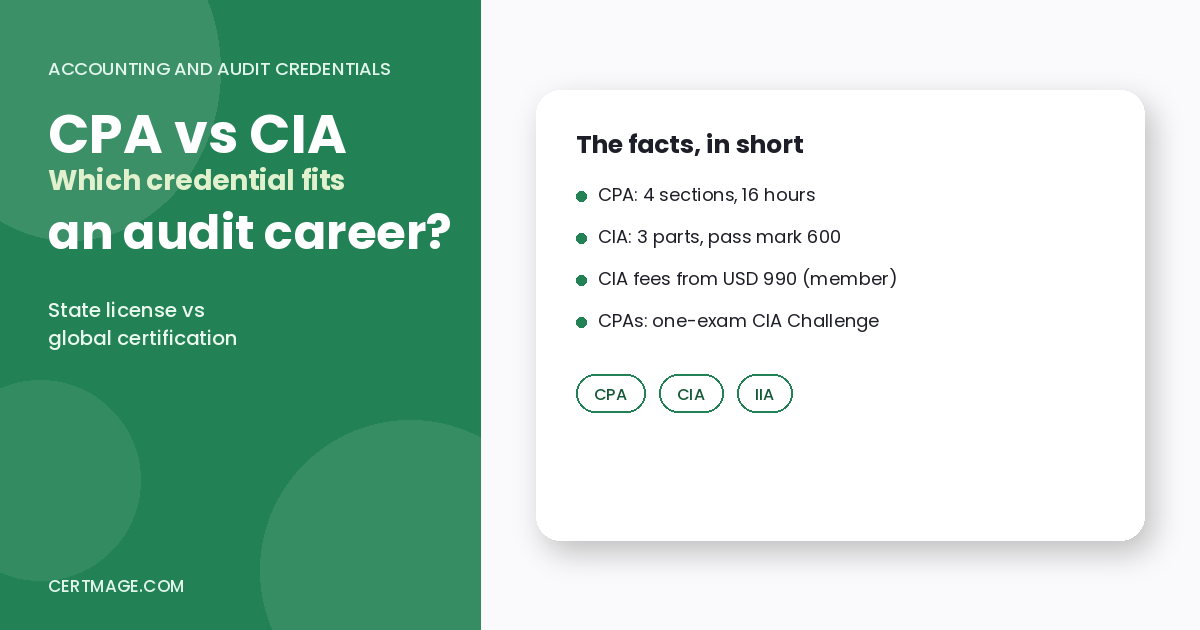
Short answer: Choose the CPA (Certified Public Accountant) if you want the broadest accounting license in the United States, with a path into external audit, tax, financial reporting and leadership roles that require licensure. Choose the CIA (Certified Internal Auditor) if your career is internal audit: evaluating governance, risk and controls inside an organization. The CPA is a state-licensed credential built from four four-hour exam sections (three Core and one Discipline), a 75 passing score and education and experience rules set by each state board. The CIA is an IIA global certification built from three exam parts, a 600 passing score on a 250 to 750 scale and a shorter experience requirement. If you already hold an active CPA, the IIA offers a single-exam CIA Challenge route, so the two are often combined, not chosen between.
Key takeaways
- CPA is a license. CIA is a certification. Your state Board of Accountancy grants the CPA license, while the Institute of Internal Auditors (IIA) grants the CIA.
- They answer different questions. The CPA proves accounting, audit and tax competence. The CIA proves internal audit competence aligned to the Global Internal Audit Standards.
- The CPA exam is longer. Four sections of four hours each is 16 hours of testing. The CIA is three parts, with 150, 120 and 120 minutes.
- Experience rules differ. The CIA needs one to two years of internal audit experience, depending on your degree, or five years without a degree. The CPA needs state-defined supervised experience, often one to two years.
- CPAs get a shortcut. Active CPAs and CAs can take the CIA Challenge Exam, a single 150-question exam, with no proof of experience required.
- Pricing for CIA changes soon. The IIA states that CIA pricing changes starting January 4, 2027, so check its current pricing page before you pay.
Quick Facts: CPA vs CIA
| Item | CPA | CIA |
| Full name | Certified Public Accountant | Certified Internal Auditor |
| Granted by | State or jurisdiction Board of Accountancy (exam set by AICPA, delivered through NASBA and testing providers) | The Institute of Internal Auditors (IIA) |
| Type | License to practice | Professional certification |
| Core focus | Accounting, external audit and attestation, tax, financial reporting | Internal audit: governance, risk and control assurance |
| Exam structure | 3 Core sections (AUD, FAR, REG) plus 1 Discipline section (BAR, ISC or TCP) | 3 parts: Internal Audit Fundamentals, Internal Audit Engagement, Internal Audit Function |
| Testing time | 4 hours per section, 16 hours total | Part 1: 150 minutes. Part 2: 120 minutes. Part 3: 120 minutes |
| Questions | Multiple choice plus task-based simulations | Part 1: 125. Part 2: 100. Part 3: 100 (multiple choice) |
| Passing score | 75 on a 0 to 99 scale per section | 600 on a 250 to 750 scale per part |
| Education | Set by your state, commonly 150 credit hours, with other pathways in some states | Bachelor’s degree or equivalent (other routes exist) |
| Experience | Set by your state, commonly 1 to 2 years supervised | 1 year with a master’s, 2 years with a bachelor’s, 5 years without a degree |
| Time to finish | At least 30 months to pass all sections in most jurisdictions | 3 years from program acceptance |
| Maintenance | State CPE rules | Annual CPE attestation, including 2 hours of ethics |
| Shortcut | Not applicable | CIA Challenge Exam for active CPAs and CAs |
Figures come from the AICPA, NASBA, and the IIA’s CIA pages, pricing page, candidate handbook and exam change documents, checked in November 2026. Requirements, fees and syllabi change, so confirm on the official pages before you apply.
What Is the Difference Between CPA and CIA?
The CPA is a state-issued license for accountants, centered on accounting, external audit and attestation, tax and financial reporting. The CIA is a global professional certification for internal auditors, centered on assessing risk management, control and governance processes inside an organization. In short, a CPA is licensed to practice public accounting, and a CIA is certified to practice internal auditing.
That difference shapes everything else: who sets the rules, how the exam is built, which jobs ask for each credential and how the two combine over a career.
What Is the CPA?
The CPA is the primary accounting license in the United States. Each jurisdiction’s Board of Accountancy sets education, experience and ethics requirements and decides who receives a license, while all candidates take the same Uniform CPA Examination.
Key facts:
- Exam structure: Three four-hour Core sections, Auditing and Attestation (AUD), Financial Accounting and Reporting (FAR) and Taxation and Regulation (REG), plus one four-hour Discipline section of your choice: Business Analysis and Reporting (BAR), Information Systems and Controls (ISC) or Tax Compliance and Planning (TCP).
- Total time: 16 hours of testing, with a standardized 15-minute break in each section that does not count against testing time.
- Scoring: 75 on a scale of 0 to 99 per section. The score is not a percentage, and it is not curved.
- Question mix: Each section blends multiple-choice questions and task-based simulations, weighted evenly for the Core and most Discipline sections. ISC is weighted 60% multiple choice and 40% simulations.
- Pass rates: The AICPA publishes pass rates quarterly. For Q1 to Q3 2026, the cumulative rates were about 50% for AUD, 44% for FAR, 66% for REG, 44% for BAR, 69% for ISC and 80% for TCP.
- Time window: Most jurisdictions allow at least 30 months to pass all sections, with the exact clock set by the state. Older material quoting 18 months is outdated in most places.
- Education and experience: Set by each Board of Accountancy. The traditional route is 150 credit hours, but some states have adopted other pathways. Experience is commonly one to two years under a licensed CPA.
What Is the CIA?
The CIA is the IIA’s flagship certification for internal auditors, and it is accepted globally. It tests your knowledge of internal audit fundamentals, how to perform an audit engagement and how to run the internal audit function, aligned to the Global Internal Audit Standards that became effective in January 2025.
Key facts:
- Exam structure: Three parts. Part 1 is Internal Audit Fundamentals (125 questions, 150 minutes), Part 2 is Internal Audit Engagement (100 questions, 120 minutes) and Part 3 is Internal Audit Function (100 questions, 120 minutes).
- Scoring: Scores are converted to a scale of 250 to 750, and a passing score is 600 or higher. There is no penalty for incorrect responses.
- Breaks: Breaks are not scheduled, and break time counts toward your overall time allotment.
- Experience: One year of internal audit experience with a master’s degree (or equivalent), two years with a bachelor’s degree (or equivalent), and five years without a degree.
- Program window: You have three years from acceptance into the program to complete all requirements, including experience.
- Languages: The IIA lists 14 languages, with Vietnamese becoming available on August 28, 2026. Some languages still use the 2019 syllabus, and Arabic moves to the 2025 syllabus on December 28, 2026.
Exam Content Side by Side
| CPA section | What it covers (at a high level) |
| AUD (Core) | Auditing and attestation |
| FAR (Core) | Financial accounting and reporting |
| REG (Core) | Taxation and regulation |
| BAR (Discipline) | Business analysis and reporting |
| ISC (Discipline) | Information systems and controls |
| TCP (Discipline) | Tax compliance and planning |
| CIA part | Domain weights (revised 2025 syllabus, per the IIA) |
| Part 1: Internal Audit Fundamentals | Section A 35%, Section B 20%, Section C 30%, Section D 15% |
| Part 2: Internal Audit Engagement | Section A 50%, Section B 40%, Section C 10% |
| Part 3: Internal Audit Function | Section A 25%, Section B 15%, Section C 15%, Section D 45% |
What the structure tells you:
- The CPA covers more subject areas. Auditing, financial reporting and tax are all tested in the Core, and your Discipline adds depth in analysis, systems or tax.
- The CIA goes deep on one profession. All three parts focus on how internal audit works, from the fundamentals to engagement planning and performance to managing the function.
- Part 3 is concentrated in one section. Section D carries 45% of Part 3, per the IIA’s change document, so read the Part 3 syllabus to see what it covers and plan your time around it.
- Older material may not match. The IIA revised the syllabi to align with the 2025 Global Internal Audit Standards, and the current exams replaced the previous ones starting no sooner than May 2025. Study from the current syllabus for your language.
Difficulty: Which Is Harder?
Neither body publishes a single “overall pass rate” for its credential in the pages reviewed, so treat any such number as unofficial. The CPA does publish section-level pass rates, which show the spread:
| CPA section | Cumulative pass rate (Q1 to Q3 2026) |
| AUD | 50.03% |
| FAR | 43.54% |
| REG | 66.32% |
| BAR | 43.88% |
| ISC | 68.56% |
| TCP | 79.75% |
The IIA’s pages reviewed did not list CIA pass rates. A practical comparison:
- CPA difficulty comes from volume and endurance. You study four sections over many months, sit 16 hours of testing, and manage a time window and state rules. FAR and BAR have the lowest pass rates.
- CIA difficulty comes from the standards and applied judgment. Many questions ask what an internal auditor should do under a given standard.
- Prior background matters. Accounting graduates often find the CPA content familiar, while professionals from operations, IT or risk sometimes find the CIA closer to their work.
Requirements: Education, Experience and Timelines
| CPA | CIA | |
| Education | Set by your state. The traditional route is 150 credit hours, and other pathways exist in some states | Bachelor’s or master’s degree (or equivalent), or no degree with five years of experience |
| Experience | Commonly 1 to 2 years supervised by a licensed CPA, set by your state | Master’s: 1 year. Bachelor’s: 2 years. No degree: 5 years |
| Exam timing | At least 30 months in most jurisdictions to pass all four sections | 3 years from program acceptance to finish all requirements |
| Sit exams before experience | Depends on the state | Yes, if you have a degree or an active IAP designation |
| Ethics | Some states require an ethics exam or course | Agree to the IIA’s Standards of Ethics and Professionalism, and complete 2 hours of ethics CPE yearly |
Points to note:
- CPA rules are local. Choose your jurisdiction first and read its Board of Accountancy page. Education pathways, fees and experience rules vary.
- CIA rules are global. The IIA sets a single framework, with the same experience tiers wherever you test.
- Sit-first flexibility. The IIA handbook says candidates with a degree or an active IAP designation can sit for the exams before meeting the experience requirement, but they will not be certified until the experience is met within the three-year program window.
- Plan the clock. The CIA’s three-year window and the CPA’s 30-month window are both real deadlines.
Cost: CPA vs CIA
CIA fees (member and non-member, in USD)
| Item | Member | Non-member |
| Application | 120 | 240 |
| Part 1 | 310 | 445 |
| Part 2 | 280 | 415 |
| Part 3 | 280 | 415 |
| Application plus all three parts | 990 | 1,515 |
| Challenge Exam application | 150 | 380 |
| Challenge Exam | 845 | 1,245 |
| Challenge route total | 995 | 1,625 |
| Annual renewal | 30 | 120 |
| Exam registration extension (75 days) | 100 | 100 |
| Program eligibility extension (12 months, once per program) | 275 | 275 |
| Reschedule or cancel (paid to Pearson VUE) | 75 | 75 |
The IIA states that pricing will change starting January 4, 2027. Check the IIA’s pricing page for the updated figures if you plan to register after that date. Prices outside North America may differ, and in some countries membership is required to apply.
CPA fees
CPA costs depend on the jurisdiction, so there is no single national price. The AICPA describes typical application fees of USD 20 to 150, with exam section fees on top. As one example, NASBA’s Ohio page lists USD 101 for the application, USD 96 for the education evaluation and USD 268.59 per section. Four sections at that jurisdiction come to USD 1,074.36 in section fees before application, evaluation and any retakes. Across the NASBA state pages reviewed, one pass at four sections came to roughly USD 1,266 to 1,358 including those fees. Add review courses, which are not included in these figures.
What the numbers suggest
- A first-time CIA candidate pays about USD 990 as a member for the application and three parts, before study materials, and about USD 1,515 as a non-member.
- A CPA pays more in exam fees if retakes are needed, because each section is a separate fee.
- For an active CPA, the Challenge route (USD 995 as a member) costs about the same as the three-part route (USD 990 as a member), but it replaces three exams with one 150-question exam and removes the experience proof. Confirm current prices after January 4, 2027.
The CIA Challenge Exam for CPAs
The IIA offers a one-exam route for qualified professionals, including active CPAs and CAs. Key facts from the IIA’s page:
- Who qualifies: Active CPA and CA holders, with a letter of good standing from your accounting body or current licensure.
- Format: One multiple-choice exam with 150 questions in a 180-minute session.
- Testing windows: February, June, September and November.
- Results: Within three weeks of your exam date, starting with the September 2026 window.
- Experience proof: Not required for the Challenge program.
- Extensions: None for the Challenge Exam.
- Fees: Application USD 150 for members and USD 380 for non-members. Exam USD 845 for members and USD 1,245 for non-members.
- Program window: The IIA says qualified accountants must pass the Challenge Exam within three years of applying.
For a full walkthrough, see our CIA Challenge Exam guide.
Keeping the Credential
CPA
State Boards of Accountancy set continuing professional education rules, so requirements vary by jurisdiction. Check your board for hours, reporting periods and ethics requirements.
CIA
- Annual attestation: CIAs self-attest each year that they meet renewal requirements, including CPE hours and two hours of ethics training, by December 31.
- Grace period: Missing the deadline places you in an inactive grace period status.
- Renewal fee: USD 30 for members and USD 120 for non-members, with grace renewal at USD 60 and USD 240. For North American members with active designations, annual renewal is included with membership, per the IIA.
- CPE hours: The pages reviewed point to the IIA’s CPE requirements page for the hour count, so confirm it there.
Salary and Job Outlook
Neither credential’s issuer publishes a salary, and no single number isolates CPA or CIA holders. For context, the U.S. Bureau of Labor Statistics reports a median annual wage of USD 83,680 for accountants and auditors in May 2025. That figure covers people with and without a CPA or CIA and includes internal auditors, so use it as a broad reference, not a promise. BLS also notes that accountants who file reports with the SEC must be licensed CPAs. Check job postings in your market for the credential employers ask for, which is the most reliable signal.
Which Fits Which Role?
| Role or goal | Better fit | Why |
| External auditor at a public accounting firm | CPA | Licensure is the standard route |
| Tax accountant or tax advisor | CPA | Tax is a core part of the exam |
| Corporate controller or financial reporting manager | CPA | Broad accounting and reporting depth |
| Internal auditor | CIA | Built around internal audit standards |
| Internal audit manager or chief audit executive track | CIA, often with CPA | Part 3 covers the Internal Audit Function |
| IT audit | CIA or CISA, depending on focus | See our CIA vs CISA guide |
| Fraud or financial crime investigator | CFE or CAMS, with CPA or CIA as support | See our CFE guide and CAMS vs CFE guide |
| Accountant moving into internal audit | CIA, possibly via the Challenge Exam | Cheaper and faster if you hold a CPA |
| Operations or risk professional moving into audit | CIA | No accounting license required, with a degree and experience rules |
CPA vs CIA: Which Should You Take? A Decision Framework
Take the CPA first if:
- You want a career in public accounting, tax or financial reporting.
- Your target jobs list the CPA as required or preferred.
- You are early in your career and have, or can complete, your state’s education requirement.
- You want the broadest accounting credential and the option to add the CIA through the Challenge route later.
Take the CIA first if:
- You already work in, or are moving into, internal audit.
- Your education is not accounting and you do not plan to pursue a CPA license.
- You want a global credential that is not tied to one state’s licensing board.
- You have one or two years of internal audit experience, or can earn it within the three-year program window.
Take both if:
- You want a career that mixes financial reporting depth with internal audit leadership. Earn the CPA, then use the Challenge Exam route to add the CIA with a single exam and no experience proof.
Consider other credentials if:
- Your focus is IT or technology audit. Our most rewarding IT auditing certifications ranking and CISA vs CRISC guide cover those paths.
- Your focus is finance and risk, not audit. Our FRM vs CFA guide compares those.
- Your focus is management accounting. See our CMA exam page.
Can You Hold Both CPA and CIA?
Yes. Many audit leaders hold both. The CPA covers accounting and external audit depth, and the CIA covers internal audit practice. The IIA built the Challenge Exam specifically for active CPAs and CAs, so the combination is the intended path for many accountants. Neither credential is a prerequisite for the other.
Does the CPA Count Toward the CIA?
Partly. The CPA does not exempt you from the CIA, but it gives you access to the Challenge Exam, which replaces the three-part exam with a single 150-question exam and removes the proof-of-experience requirement. The IIA’s handbook describes the standard route as three parts plus experience, so an active CPA saves both time and the experience step by using the Challenge route.
Should You Wait for the 2027 Price Change or the CPA Platform Change?
Two dates are worth checking before you commit:
- CIA pricing changes on January 4, 2027, according to the IIA. The updated prices are on a separate IIA page. Compare them with the current prices before you register.
- The CPA exam platform changes in July 2027. Our CPA exam platform change guide covers blackout dates and the score-release schedule so you can plan your testing windows.
If you are ready to test now, there is rarely a reason to wait. If you are a few months away, plan your registration around these dates.
A Practical Study Plan
These are suggestions, not requirements from the AICPA or the IIA. Adjust for your background.
For the CPA
- Choose your jurisdiction first. Read its Board of Accountancy page for education, experience, ethics and time-limit rules.
- Confirm your education eligibility through your state’s evaluation process before you pay for sections.
- Pick a Discipline section based on fit, not only pass rate. The AICPA advises against choosing only the section that seems easiest.
- Plan one section at a time inside your jurisdiction’s time window, and leave room for a retake.
- Practice simulations. Task-based simulations are half the score for most sections, and 40% for ISC.
For the CIA
- Confirm your eligibility tier (master’s, bachelor’s, no degree or active IAP) and your experience plan.
- Download the current syllabus for each part from the IIA, and confirm which version your language uses.
- Map each part to your experience. Check which part is closest to your daily work and plan extra time for the others.
- Study the Global Internal Audit Standards. The revised syllabi align with them.
- Time your registration. Each exam authorization window is 180 days or until your program expires, with a one-time 75-day extension.
Common Mistakes to Avoid
- Treating the CPA and CIA as the same kind of credential. One is a state license and the other is a global certification.
- Using the old CPA time limit. Most jurisdictions now give at least 30 months, not 18.
- Paying for the three-part CIA when you qualify for the Challenge route. Active CPAs and CAs can take one exam.
- Missing the CIA program window. You must finish all requirements within three years of acceptance, and the IIA offers a one-time 12-month program extension for USD 275.
- Studying an old CIA syllabus. The 2025 revision changed the part names and weights, and some languages are still moving over.
- Ignoring the pricing change. CIA pricing changes starting January 4, 2027.
- Assuming a CPA is required for every audit job. BLS says only some accountants must be licensed CPAs, for example those who file reports with the SEC.
- Choosing a CPA Discipline by pass rate alone. Fit with your career matters more.
- Skipping CPE planning. Both credentials require ongoing reporting.
FAQS
What is the difference between CPA and CIA?
The CPA is a state-issued license for accountants, focused on accounting, external audit, tax and financial reporting. The CIA is a global certification for internal auditors, focused on governance, risk and control assurance inside organizations.
Which is better, CPA or CIA?
Neither is better overall. The CPA fits public accounting, tax and financial reporting careers, and the CIA fits internal audit careers. Check which credential your target jobs ask for.
Can a CPA become a CIA?
Yes. The IIA’s CIA Challenge Exam is open to active CPAs and CAs. It is a single multiple-choice exam with 150 questions in 180 minutes, and proof of work experience is not required.
How many parts are in the CIA exam?
Three: Internal Audit Fundamentals (125 questions, 150 minutes), Internal Audit Engagement (100 questions, 120 minutes) and Internal Audit Function (100 questions, 120 minutes).
How many sections are in the CPA exam?
Four: three Core sections (AUD, FAR and REG) and one Discipline section of your choice (BAR, ISC or TCP). Each is four hours, for 16 hours of testing.
What is the passing score for the CPA and CIA?
The CPA requires 75 on a scale of 0 to 99 for each section. The CIA requires 600 on a scale of 250 to 750 for each part.
How much does the CIA cost?
For members, the application is USD 120, Part 1 is USD 310, and Parts 2 and 3 are USD 280 each, or USD 990 in total. Non-members pay USD 240, USD 445 and USD 415 each, or USD 1,515. The IIA states pricing changes starting January 4, 2027.
How much does the CPA exam cost?
It depends on your jurisdiction. As one example, NASBA’s Ohio page lists USD 268.59 per section plus application and evaluation fees. One pass at four sections came to roughly USD 1,266 to 1,358 across the NASBA state pages reviewed, before review courses.
How much experience do I need for the CIA?
One year of internal audit experience with a master’s degree, two years with a bachelor’s degree, or five years without a degree. You can sit the exams before meeting the experience requirement, but you must finish it within the three-year program window.
How long do I have to pass the CPA exam?
Most jurisdictions allow at least 30 months to pass all four sections, and some allow up to 36. The exact start of the clock is set by your state.
Do I need a CPA to be an internal auditor?
No. The CIA is the dedicated internal audit certification, and many internal auditors hold it without a CPA. Some employers prefer or ask for a CPA, so check job listings.
Is the CIA harder than the CPA?
They are hard in different ways. The CPA has four sections, 16 hours of testing and section pass rates from about 44% to 80%, while the CIA has three parts built around the Global Internal Audit Standards. The IIA’s pages reviewed did not list CIA pass rates.
Should I get both CPA and CIA?
Many audit leaders do. If you hold an active CPA, the Challenge Exam lets you add the CIA with one exam and no experience proof. Whether it is worth it depends on whether your role is internal audit, so check target job listings.
Final Thoughts
The CPA and CIA are built for different careers. The CPA is the broad accounting license, set by your state, with the longest path and the widest doors. The CIA is the internal audit certification, set by the IIA, with a shorter path and a sharper focus. Pick the one that matches the job you want, check your eligibility against each body’s rules, and keep the CIA Challenge Exam in mind if you already hold a CPA. Confirm current requirements and prices on the IIA’s CIA certification page and your state board’s CPA page before you apply, since fees, syllabi and rules change.