The CIA (Certified Internal Auditor) is the right certification if your career is in internal auditing – evaluating operational, financial, and compliance controls across the business as a whole. The CISA (Certified Information Systems Auditor) is the right certification if your career is in IT auditing or information systems governance – evaluating technology controls, cybersecurity frameworks, and IS risk management. Both are internationally recognized, both earn six-figure salaries, and both require multi-year experience. The one you need depends entirely on whether your audit work is people-and-process-focused or technology-focused.
Who Is This For?
Before comparing exams, costs, and domains, identify which professional describes your daily work or career target:
You need the CIA if you:
- Work in or want to work in an internal audit department evaluating business operations
- Conduct financial, operational, or compliance audits across business units
- Aspire to become a Chief Audit Executive or Head of Internal Audit
- Work in manufacturing, government, healthcare, or any sector where general audit skills matter
- Want a credential recognized across industries and not tied to technology specifically
You need the CISA if you:
- Work in or want to work in IT audit, information security audit, or IS governance
- Evaluate technology controls, cybersecurity implementations, and IS risk
- Work in banking, financial services, or technology-intensive environments
- Aspire to roles like IT Audit Manager, Information Security Auditor, or IS Compliance Officer
- Want the credential that opens CIO-track roles in technology governance
Side-by-Side: Key Facts
| Factor | CIA | CISA |
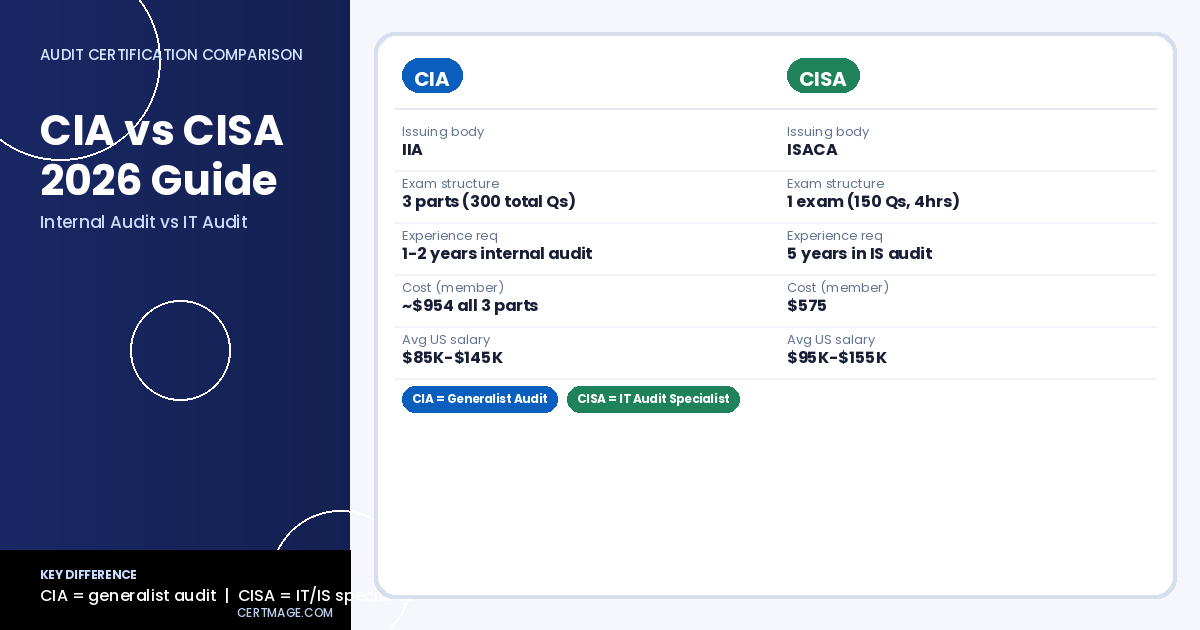
| Issuing body | Institute of Internal Auditors (IIA) | ISACA |
| Full name | Certified Internal Auditor | Certified Information Systems Auditor |
| Exam structure | 3 parts (taken separately) | 1 exam |
| Total questions | 300 (100 per part) | 150 |
| Total exam time | 6 hours (2 per part) | 4 hours |
| Passing score | 600 / 800 per part | 450 / 800 (scaled) |
| Exam cost (member) | $318 per part ($954 total) | $575 |
| Exam cost (non-member) | $378 per part ($1,134 total) | $760 |
| ACAMS membership required | Yes (IIA) – $295/year | Yes (ISACA) – $50/year + chapter fees |
| Total first-year investment | Approximately $2,000+ | Approximately $1,500+ |
| Work experience required | 1 year minimum (2 years without degree) | 5 years in IS audit, control, or security |
| Can you sit before experience? | Yes, then have 5 years post-exam to qualify | Yes, then have 5 years post-exam |
| Endorsement required | Yes – IIA member endorses your experience | No |
| Renewal | 40 CPE hours per year (80 per 2-year period) | 20 CPE hours per year (120 per 3-year period) |
| Annual fee | $50-$160 depending on IIA chapter | $45 (ISACA annual maintenance) |
| Average US salary | $85,000-$145,000 | $95,000-$155,000 |
| 2026 scoring change | Yes – results now take up to 3 weeks (no longer instant) | No change |
What the CIA Tests: Three-Part Breakdown
The CIA is the only globally recognized certification for internal auditors. It covers internal auditing in its broadest sense – not just financial auditing, but operational auditing, risk management evaluation, and governance assurance across every business function.
Part 1: Essentials of Internal Auditing (35% of CIA program)
This part establishes the theoretical and ethical foundation. It tests whether you understand the IIA’s International Professional Practices Framework (IPPF), the mandatory standards that govern every internal audit activity worldwide.
| Topic area | What it covers |
| Foundations of Internal Auditing | Purpose, authority, independence, objectivity, IPPF standards |
| Independence and Objectivity | Impairments to independence, managing conflicts of interest |
| Proficiency and Due Professional Care | Knowledge requirements, continuing professional development |
| Quality Assurance | Internal and external quality assessments, QA program requirements |
| Governance and Risk Management | Organizational governance, enterprise risk management, fraud risk |
| Internal Controls | Control frameworks (COSO), types of controls, control testing |
Part 2: Practice of Internal Auditing (25% of CIA program)
This part moves from theory to execution. It tests your ability to plan and conduct an actual audit engagement.
| Topic area | What it covers |
| Audit Engagement Planning | Risk assessment, audit objectives, scope, resource allocation |
| Performing Engagements | Evidence collection, sampling, documentation, analytical techniques |
| Communicating Results | Report writing, interim communications, management responses |
| Monitoring Outcomes | Follow-up procedures, resolution of management action plans |
| Quality Assurance in Engagements | Per-engagement quality considerations |
Part 3: Business Knowledge for Internal Auditing (40% of CIA program)
The heaviest part and the one that most distinguishes CIA from a purely technical audit qualification. It tests broader business acumen – finance, accounting, IT, and organizational behavior – because internal auditors must understand what they are auditing.
| Topic area | What it covers |
| Business Acumen | Organizational structures, strategy, industry analysis, stakeholder management |
| Information Technology | IT governance, cybersecurity fundamentals, data analytics for auditors |
| Financial Management | Financial statement analysis, budgeting, capital investment decisions |
| Quantitative Methods | Statistical sampling, data modeling, regression analysis for auditors |
Important April 2026 update: As of April 2026, CIA exam results are no longer instant. Candidates now wait up to three weeks for their official score by email. This changes how candidates should approach exam scheduling – plan accordingly and avoid booking follow-up part exams immediately after sitting a previous part.
What the CISA Tests: Five-Domain Breakdown
The CISA is the leading certification for IT auditors and information systems professionals evaluating technology controls. It assumes you already understand general business and auditing concepts, and goes deep on how technology, cybersecurity, and IS governance work in real organizations.
| Domain | Weight | What it covers |
| 1. Information System Auditing Process | 21% | Audit planning, evidence, sampling, reporting, follow-up |
| 2. Governance and Management of IT | 17% | IT strategy, frameworks (COBIT), IT investment, vendor management |
| 3. Information Systems Acquisition, Development and Implementation | 22% | SDLC controls, project governance, change management, testing |
| 4. Information Systems Operations and Business Resilience | 23% | IT service management, incident response, BCP/DR, hardware controls |
| 5. Protection of Information Assets | 17% | Access controls, cryptography, network security, data classification |
Domain 4 (IS Operations and Business Resilience) is the heaviest single domain at 23%. It covers everything that can go wrong in running a technology environment and what controls should exist to detect and recover from failures.
Unlike the CIA, CISA questions are heavily scenario-based from the beginning. You are almost never asked to define a concept – you are asked to identify the best control, the most appropriate audit procedure, or the most significant risk given a specific organizational scenario.
Experience Requirements: A Critical Difference
The experience gap between CIA and CISA is the most practically important difference for early-career audit professionals.
| Requirement | CIA | CISA |
| Minimum years of experience | 1 year (with bachelor’s degree) | 5 years of IS audit, control, or security |
| Experience waivers | 1 year for advanced degree, 2 years for certain volunteer roles | Waivers available: up to 3 years for relevant degrees or certification |
| Can you sit without experience? | Yes – then have 5 years post-exam to qualify | Yes – then have 5 years post-exam to certify |
| Experience domain requirements | Internal auditing or equivalent | Must be in IS audit, control, assurance, or security |
| How long to complete all 3 CIA parts | Recommended within 3 years of first part sitting | N/A (single exam) |
The practical consequence: CIA is accessible to candidates with just one year of work experience in an internal audit function. CISA requires five years specifically in IS audit or information security. This makes CIA the more accessible credential for early-career professionals, while CISA is better suited to mid-career IT professionals formalizing existing IS audit expertise.
Salary and Career Trajectories
Both certifications consistently deliver six-figure salaries, but the career paths diverge at the senior level.
| Role | CIA track | CISA track | US Salary |
| Entry audit (3-5 years) | Internal Auditor II, Senior Auditor | IT Auditor, IS Audit Analyst | $70,000-$95,000 |
| Mid-level (5-10 years) | Audit Manager, Internal Controls Manager | IT Audit Manager, IS Compliance Manager | $95,000-$130,000 |
| Senior (10+ years) | VP Internal Audit, Director of Audit | Director of IT Audit, IS Governance Lead | $130,000-$170,000 |
| Executive | Chief Audit Executive (CAE) | Chief Information Officer, VP IS Compliance | $150,000-$250,000+ |
CISA holders in technology-intensive industries (banking, financial services, healthcare, tech) frequently earn salaries at the top of the range because IT risk and cybersecurity governance has never been more valued by boards and regulators. CIA holders in large enterprises benefit from a clearer path to Chief Audit Executive – the senior-most internal audit role – because CIA is explicitly designed for that career trajectory.
Industries that heavily prefer each:
| Industry | CIA preference | CISA preference |
| Banking and financial services | High | Very high |
| Government and public sector | Very high | Moderate |
| Healthcare | High | Growing |
| Technology companies | Moderate | Very high |
| Manufacturing | High | Moderate |
| Consulting and advisory firms | Both valued equally | Both valued equally |
Can You Hold Both?
Many senior audit professionals hold both CIA and CISA. The combination signals complete audit capability: general operational and financial audit proficiency (CIA) plus specialist IT and IS audit depth (CISA). For Internal Audit departments that increasingly need teams covering both business-process audits and technology audits, professionals who hold both credentials are particularly valued in leadership roles.
The recommended sequence for dual certification: CIA first if you are early in your career with less than 5 years of total experience. CISA once you have accumulated the 5 years of IS-specific experience it requires. The CIA foundation in audit methodology also meaningfully supports CISA preparation, since CISA’s audit process domain (21% of the exam) covers familiar territory.
FAQs
What is the difference between CIA and CISA?
CIA (Certified Internal Auditor) validates general internal auditing skills across operational, financial, and compliance audits for any business function. CISA (Certified Information Systems Auditor) validates IT audit and information systems governance skills specifically. CIA is for generalist internal auditors. CISA is for IT auditors and IS governance specialists.
Which is harder, CIA or CISA?
CIA is generally considered more demanding overall because it requires passing three separate exams, covers broader content, and takes 12-18 months to complete all three parts. CISA is a single 4-hour exam but has a 5-year experience requirement. Candidates with IT backgrounds find CISA more intuitive. Candidates with business or accounting backgrounds find CIA more intuitive.
What changed with CIA exam results in April 2026?
From April 2026, CIA exam results are no longer instant. Candidates must wait up to three weeks for an official score notification by email. This affects how candidates plan their exam schedule, particularly if they want to pace their Part 1, 2, and 3 sitting dates around receiving results first.
Can I sit the CISA exam without 5 years of experience?
Yes. You can register for and sit the CISA exam before meeting the experience requirement. If you pass, you have 5 years from your exam date to complete the 5-year experience requirement and obtain your certification. Certain degrees and certifications can waive up to 3 years of the experience requirement.
Which pays more, CIA or CISA?
Both pay comparably at most career levels, averaging between $95,000 and $155,000 in the US mid-career. CISA holders in technology-intensive industries (banking, fintech, cybersecurity firms) often command a modest premium because of the demand for IS audit expertise in regulated sectors. CIA holders have a stronger path to Chief Audit Executive roles where total compensation frequently exceeds $200,000.
How long does it take to complete the CIA?
Most candidates complete all three CIA parts within 12 to 18 months. The IIA requires candidates to complete all three parts within 5 years of their first sitting. Each part takes 2 hours and consists of 100 questions. Candidates typically prepare 3-4 months per part.
What is the IIA’s IPPF?
The International Professional Practices Framework (IPPF) is the IIA’s comprehensive framework of guidance for the global internal audit profession. It includes Mandatory Guidance (Core Principles, Code of Ethics, Standards, and Implementation Guidance) and Recommended Guidance. Thorough knowledge of the IPPF is required to pass CIA Part 1.
Is CISA recognized by the DoD?
Yes. CISA is approved by the US Department of Defense under DoD 8570/8140 for the Technical Information Assurance category, making it a qualifying credential for many US government IT audit and information assurance roles.
Should I take the CIA or CISA if I work in healthcare?
Healthcare has demand for both. CISA is increasingly valuable as electronic health records, cybersecurity regulations (HIPAA), and healthcare IT governance become more central to audit functions. CIA is the standard for internal audit departments evaluating operational and compliance controls broadly. Healthcare organizations often want audit professionals with both skill sets. See our RHIA vs RHIT guide for related healthcare credential context.
Where do I prepare for CIA or CISA exams with CertMage?
CertMage provides updated practice questions for CIA Parts 1, 2, and 3 and CISA aligned to the current exam blueprints. Visit our IIA CIA exam questions and CISA exam questions pages for full preparation materials.