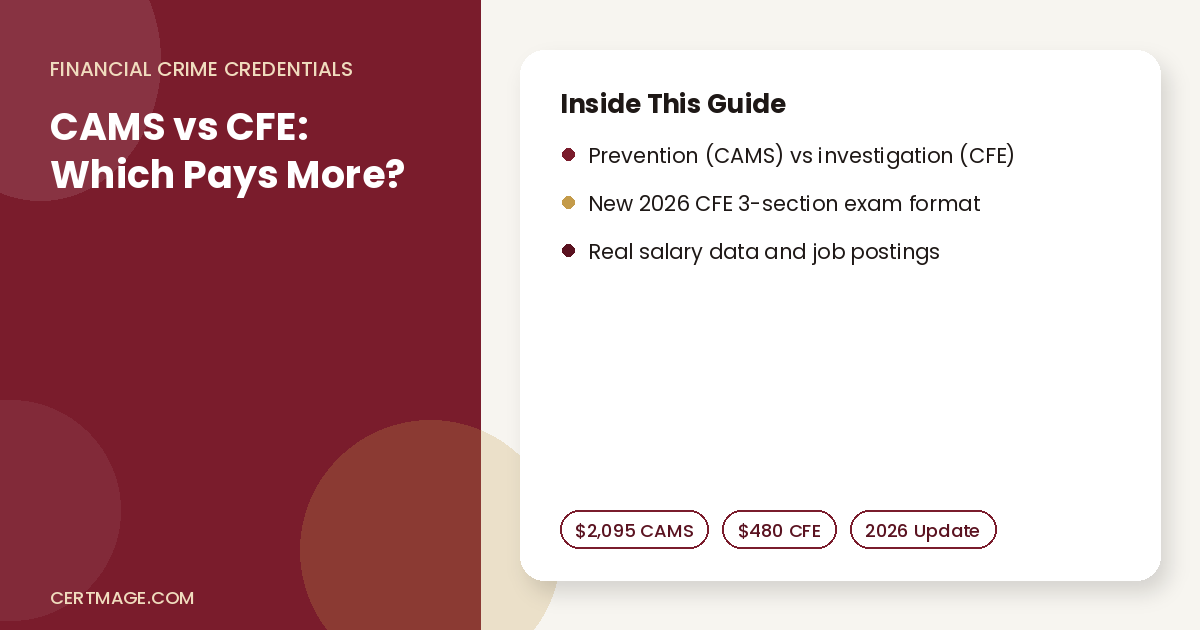
CAMS and CFE test 2 different moments in the same crime: CAMS certifies you to spot money laundering before or as it happens, inside a bank’s compliance function, while CFE certifies you to investigate fraud after it’s already occurred, often for a company, law firm, or law enforcement agency, and the certification that pays more depends entirely on which of those 2 moments your job actually sits in.
TL;DR
- CAMS (Certified Anti-Money Laundering Specialist, ACAMS) is a prevention and monitoring credential built for banking and financial-institution compliance roles
- CFE (Certified Fraud Examiner, ACFE) is an investigation credential built for post-incident fraud examination, often outside traditional banking
- ZipRecruiter’s September 2026 data shows CFE-titled roles averaging $147,203/year versus AML-CAMS-titled roles averaging $104,054/year, though the CFE figure comes from a narrower, smaller sample worth treating with caution
- CAMS costs roughly $2,095 upfront plus $295/year in mandatory ACAMS membership; CFE costs $480 to sit the exam but requires 2 years of fraud-related experience and 50 eligibility points before you can even apply
- The exams test different skills entirely: CAMS is a single 3.5-hour, 120-question exam on AML frameworks and red flags; CFE just moved to a new 3-section, 310-question format (as of June 2, 2026) requiring 75% in each section independently
- Real job postings show CAMS listed as required or preferred at banks specifically; CFE shows up across banking, corporate security, law enforcement, and consulting, a genuinely wider range of employers
The Core Distinction: Prevention vs Investigation
Before any cost or exam comparison matters, understand what each credential is actually built to prove.
| CAMS | CFE | |
| Issuing body | ACAMS | ACFE |
| Certifies | Ability to detect, monitor, and report money laundering activity | Ability to investigate, document, and testify about fraud after it occurs |
| Primary work setting | Bank and financial-institution compliance departments | Corporate security, internal audit, law enforcement, consulting, insurance |
| Timing relative to the crime | Before or during, real-time transaction monitoring | After, forensic investigation of what already happened |
| Legal/testimony component | Minimal | Significant, CFEs frequently prepare findings for litigation or prosecution |
| Regulatory focus | Bank Secrecy Act, FATF recommendations, sanctions regimes | Fraud schemes, financial crimes broadly, legal investigation procedure |
If your job title includes “compliance,” “BSA,” “sanctions,” or “transaction monitoring,” you’re in CAMS territory. If it includes “investigator,” “forensic,” “internal audit,” or “loss prevention,” CFE fits the actual work better. Plenty of professionals eventually hold both, covered later in this guide, but almost nobody needs both on day one. For the full standalone breakdown of each credential’s history, structure, and career path, see our complete CAMS guide and complete CFE guide.
Quick Facts: Side by Side
| Detail | CAMS | CFE |
| Number of questions | 120 | 310 across 3 sections |
| Duration | 3.5 hours | 6.5 hours total (150 + 150 + 90 minutes) |
| Passing requirement | Single overall score | 75% in each of 3 sections independently |
| Format change history | Stable | New 3-section format as of June 2, 2026, replacing the prior 4-section model |
| Prerequisites | None formal, though real-world AML experience is strongly assumed | 2 years fraud-related experience, 50 eligibility points, ACFE Associate Membership |
| First-time cost | Approximately $2,095 (private sector package) | $480 application fee |
| Ongoing membership | $295/year (private sector), mandatory | ACFE membership required, separate from exam fee |
| Renewal cycle | Every 3 years, tiered fee $200 to $300 | Annual CPE requirement through ACFE |
| Delivery | Pearson VUE, computer-based | Computer-based, closed book and closed notes |
What Changed in the CFE Exam, and Why It Matters Right Now
This is the single most important update anyone comparing these 2 credentials in 2026 needs to know, and a lot of comparison content online hasn’t caught up yet. On June 2, 2026, the CFE exam moved from its long-standing 4-section format to a restructured 3-section model based on ACFE’s 2024 Job Task Analysis.
| New Section | Questions | Duration | Heaviest Weighted Topics |
| Fraud Schemes and Financial Crimes | 120 | 150 minutes | Fraudulent disbursements (13%), procurement fraud (8%), money laundering (7%) |
| Fraud Investigations and Legal Issues | 120 | 150 minutes | Evidence collection (11%), interview techniques (9%), legal investigation issues (8%) |
| Fraud Prevention and Deterrence | 70 | 90 minutes | Fraud risk assessment (20%), prevention programs (16%), ethics (15%) |
Notice that money laundering now sits as a named, weighted topic inside CFE’s Fraud Schemes section at 7%, which is one of several signals that these 2 credentials increasingly overlap at the edges even though their core focus stays distinct. Candidates must score at least 75% in each section independently; a strong score in one section cannot offset a weak score in another, which is a meaningfully harder bar than CAMS’s single combined score.
CFE’s Eligibility Points System, Explained
Unlike CAMS, you cannot simply register and sit the CFE exam. ACFE requires 40 points to sit the exam and 50 points to actually earn certification, calculated as follows:
| Source | Points |
| Bachelor’s degree (any field, accredited institution) | 40 points |
| Without a degree: 2 years of fraud-related experience substitutes for each year of academic study | Varies |
| Professional experience in 1 of 8 approved fraud-related categories | Additional points, category-dependent |
| Mandatory minimum | At least 2 years of professional experience directly or indirectly related to fraud detection or deterrence |
You must also hold Associate Membership in ACFE before testing. CAMS has no comparable points system or mandatory pre-membership, which is the single biggest procedural difference between the 2 credentials and the reason CFE is functionally harder to start, even before you look at exam content.
Real Job Postings: What Employers Are Actually Asking For
CAMS, current listings, September 2026:
- Mission Bank’s Senior AML/CFT Analyst posting in Bakersfield, CA lists “CAMS certification” as a requirement, paying $78,000 to $93,000/year, tied directly to BSA/AML/CFT compliance program work
- Industrial and Commercial Bank of China’s AML Analyst posting in Manhattan lists “CAMS Certification preferred” for a temporary compliance role paying $30 to $40/hour
- A Jobtailor AML Analyst posting in New York lists CAMS as “preferred: CAMS or other relevant professional certification” for a role centered on reviewing suspicious transactions and preparing Suspicious Activity Reports
The pattern: CAMS shows up specifically and repeatedly at banks and financial institutions, almost always tied to BSA/AML compliance job functions, and it’s frequently listed as preferred rather than absolutely required, though the postings that do require it skew toward more senior compliance titles.
CFE-specific postings are harder to isolate the same way, since fraud examination work spans far more industries (insurance, corporate security, government, consulting, public accounting) and job titles rarely use “CFE required” as cleanly as banking postings use “CAMS required.” That breadth is itself a meaningful data point: CFE opens a wider range of employer types, while CAMS concentrates specifically in banking and financial-institution compliance.
Salary Comparison: The Honest Numbers
A disclosure before the numbers, because this comparison gets misquoted constantly. ZipRecruiter’s “Certified Fraud Examiner” salary data shows an unusually narrow range, $144,500 to $150,000 between the 25th and 75th percentile, which typically signals a smaller, more homogenous sample rather than a broad, representative one. Treat the CFE figure below as directionally accurate for experienced, credentialed fraud examiners specifically, not as a number every CFE holder should expect immediately.
| Metric | CAMS-tagged AML roles | CFE-titled roles | General AML Analyst (no certification specified) |
| Average annual salary | $104,054 | $147,203 | $65,589 |
| Reported range | $60,000 to $171,000 | $144,500 to $150,000 (narrow sample) | $52,500 to $74,500 |
| Source | ZipRecruiter, September 2026 | ZipRecruiter, July 2026 | ZipRecruiter, September 2026 |
Read this table carefully rather than picking the biggest number. The gap between “general AML Analyst” ($65,589) and “AML CAMS” ($104,054) is the actual certification premium worth paying attention to, roughly $38,000, since it compares the same job function with and without the credential. The CFE figure, by contrast, likely reflects a more senior, more specialized population of respondents rather than a clean entry-to-CFE salary jump, given how narrow its reported range is. Neither number should be read as “CFE pays $40,000 more than CAMS” in any direct, apples-to-apples sense.
Study Time and Pass Rates: What to Actually Expect
Neither ACAMS nor ACFE publishes official first-time pass rates, which is worth saying plainly before quoting any number. Community-sourced estimates put CAMS’s first-time pass rate around 60%, meaning roughly 4 in 10 candidates need a retake, but treat that as informed consensus rather than a verified statistic. ACFE does not publish a comparable figure at all for the new 3-section format, since it only launched June 2, 2026 and there hasn’t been time to accumulate a meaningful public dataset.
| CAMS | CFE | |
| Recommended study hours | Approximately 150 hours | Varies widely by existing fraud experience; no single published figure |
| Recommended timeline | 8 to 12 weeks at 1 to 4 hours daily | Depends heavily on how much of the 2-year experience requirement already overlaps with exam content |
| Most common failure point | Scenario-based, multi-select questions penalizing partial answers with zero credit | Failing to hit 75% independently in all 3 sections, a strong score in one section cannot offset a weak one |
| Content area most often under-prepared | Module 4: emerging technology (virtual assets, AI, RegTech) | Fraud Prevention and Deterrence, the newly-weighted section emphasizing risk assessment (20%) and ethics (15%) |
The practical implication for CAMS specifically: roughly 75 to 80% of the exam requires applied scenario judgment rather than fact recall, according to prep-industry consensus, which means memorizing AML definitions and red-flag lists alone is a common way otherwise well-prepared candidates fail. For CFE specifically: the independent 75%-per-section passing bar means you cannot treat weaker sections as acceptable trade-offs the way some certification exams allow; each of the 3 sections needs genuinely solid preparation on its own terms.
Do You Need Both?
Plenty of experienced financial-crime professionals eventually hold both credentials, and it’s a genuinely common career progression rather than an either-or decision for anyone in this field long-term.
Common path: start in a bank’s AML compliance function, earn CAMS to formalize BSA/AML expertise, then move into fraud investigation or a broader financial-crime role a few years later and add CFE once you’ve accumulated the required experience points. This order makes practical sense because CAMS has no experience prerequisite, letting you certify early, while CFE’s 2-year experience requirement and points system mean you likely need to be several years into a relevant career before you’re even eligible.
When holding both pays off specifically: senior compliance roles at large institutions increasingly blend AML monitoring with fraud investigation responsibilities, especially as regulators push banks toward more integrated financial-crime programs rather than siloed AML and fraud teams. If your target role or target employer explicitly combines these functions, both credentials genuinely complement each other rather than duplicating effort, since CAMS’s regulatory framework knowledge and CFE’s investigative methodology cover different, non-overlapping skill sets. This same both-credentials logic shows up elsewhere in financial-crime and audit careers too, our CIA vs CISA guide and CRISC vs CISM comparison cover similar sequencing decisions for audit and risk-management professionals.
Common Mistakes When Choosing Between Them
Assuming the higher-sounding average salary means the better career move. CFE’s reported $147,203 average looks decisive until you notice its unusually narrow 25th-to-75th-percentile range, a signal of a smaller, more senior-skewed sample rather than a typical entry outcome. Chasing that number without the underlying experience and eligibility points to actually qualify for CFE-track roles is a common and avoidable mistake.
Treating CAMS as a stepping stone to CFE by default. They’re genuinely different skill tracks, not sequential levels of the same skill. Plenty of successful AML compliance careers never touch CFE at all, and plenty of fraud investigators never need CAMS. Don’t earn one credential just because it seems like the “next step” without confirming your actual target roles require it.
Studying CFE materials published before June 2, 2026 without checking for the format update. The shift from 4 sections to 3, and the new independent 75%-per-section passing requirement, is recent enough that a meaningful amount of freely available prep content, including some competitor guides, still describes the retired format. Confirm any study resource explicitly addresses the current 3-section, 310-question structure before relying on it.
Underestimating CFE’s eligibility requirements until application time. The 50-point system and mandatory ACFE Associate Membership catch candidates off guard who assumed CFE worked like CAMS, register and test whenever ready. Check your eligibility months in advance, not the week you planned to register.
Ignoring CAMS’s recurring costs when budgeting. The $2,095 package fee is only the entry cost. Mandatory $295/year membership and a 3-year recertification fee mean CAMS’s true multi-year cost runs closer to $3,180 for a private-sector holder, a figure worth budgeting for upfront rather than discovering later.
Decision Checklist
- If your current or target role sits inside a bank’s compliance department and involves transaction monitoring, sanctions screening, or Suspicious Activity Report preparation, start with CAMS
- If your current or target role involves investigating fraud after it’s discovered, whether in corporate security, internal audit, law enforcement, or consulting, CFE fits the actual work better
- Check your eligibility for CFE honestly before committing time to it; the 50-point system and 2-year experience requirement mean you may not qualify yet, in which case CAMS’s lack of a formal prerequisite makes it the more immediately achievable credential
- Budget for CAMS’s ongoing $295/year membership and 3-year recertification cycle as a real, recurring cost, not just the $2,095 upfront package
- If you’re prepping for CFE right now, use only 2026-current study materials that reflect the new 3-section, 310-question format; anything describing the old 4-section model is now outdated as of June 2, 2026
- If you’re still weighing financial-crime and audit certifications more broadly before committing to either CAMS or CFE, our full audit and compliance certification roundup covers how these fit alongside other options in the field
FAQS
Is CAMS or CFE harder to get?
CFE is harder to start, since it requires 2 years of fraud-related experience and 50 eligibility points before you’re even allowed to apply, plus ACFE Associate Membership. Once you’re sitting the exam, CFE is also arguably harder to pass, since it requires 75% in each of 3 separately timed sections independently, while CAMS uses a single combined score across one 3.5-hour exam.
Which pays more, CAMS or CFE?
Reported figures show CFE-titled roles averaging higher ($147,203 versus $104,054 for AML-CAMS roles), but the CFE figure comes from a narrower sample and likely reflects more senior, more specialized respondents. The clearer, more reliable premium is CAMS’s roughly $38,000 lift over an uncertified AML Analyst role in the same function.
Can I get CFE without a college degree?
Yes. ACFE allows 2 years of fraud-related professional experience to substitute for each year of academic study that would otherwise count toward the 40 education points, meaning a non-degree path to eligibility exists, just a longer one.
Does CAMS require work experience?
No formal experience requirement exists for CAMS, unlike CFE. In practice, most successful candidates already work in AML, compliance, or a related banking function, since the exam assumes practical familiarity with real transaction-monitoring scenarios.
What changed in the CFE exam in 2026?
On June 2, 2026, ACFE replaced the historical 4-section exam with a restructured 3-section format (310 total questions across Fraud Schemes and Financial Crimes, Fraud Investigations and Legal Issues, and Fraud Prevention and Deterrence), based on ACFE’s 2024 Job Task Analysis. Candidates must score 75% in each section independently.
Is money laundering covered on the CFE exam?
Yes, as a specifically named, weighted topic (7%) inside the Fraud Schemes and Financial Crimes section, reflecting real overlap between fraud examination and AML work even though the 2 credentials serve different primary career tracks.
How much does CAMS cost in total over 3 years?
Approximately $3,180 for a prepared private-sector candidate factoring in the initial ~$2,095 package, $295/year membership across the 3-year cycle, and the recertification fee, which is tiered from $200 to $300 depending on when you apply.
Which certification is better for a career in banking specifically?
CAMS, without much ambiguity. It’s built specifically around Bank Secrecy Act compliance, FATF recommendations, and sanctions regimes that govern banking operations, and real job postings confirm banks ask for it by name far more consistently than they ask for CFE.
Which certification is better for a career in corporate investigations or law enforcement?
CFE. Its legal investigation, evidence collection, and interview technique content, plus the significant weight given to testimony-ready documentation, maps directly onto investigative and law-enforcement-adjacent work in a way CAMS’s compliance-monitoring focus does not.
Should I get CAMS first and CFE later, or the reverse?
CAMS first is the more common and more practical order for most candidates, since it has no experience prerequisite and lets you certify early in a compliance career. CFE typically comes later, once you’ve accumulated the 2 years of fraud-related experience and 50 points ACFE requires, often after a few years working in or adjacent to AML, audit, or investigative functions.