Certifying a single Epic analyst or trainer typically runs $500 to $10,000 per person depending on the module and training path, but that per-seat number is the smallest line on a hospital’s actual budget, since travel, lodging, lost productivity, and backfill staffing routinely cost more than the certification itself once you’re training a real cohort rather than one employee.
If you’re an individual candidate asking what Epic certification costs you personally, this isn’t that guide, our complete Epic certification guide covers exactly that. This piece is written for the other side of the table: HR directors, IT training managers, and CIOs who have to budget for certifying staff at organizational scale.
TL;DR
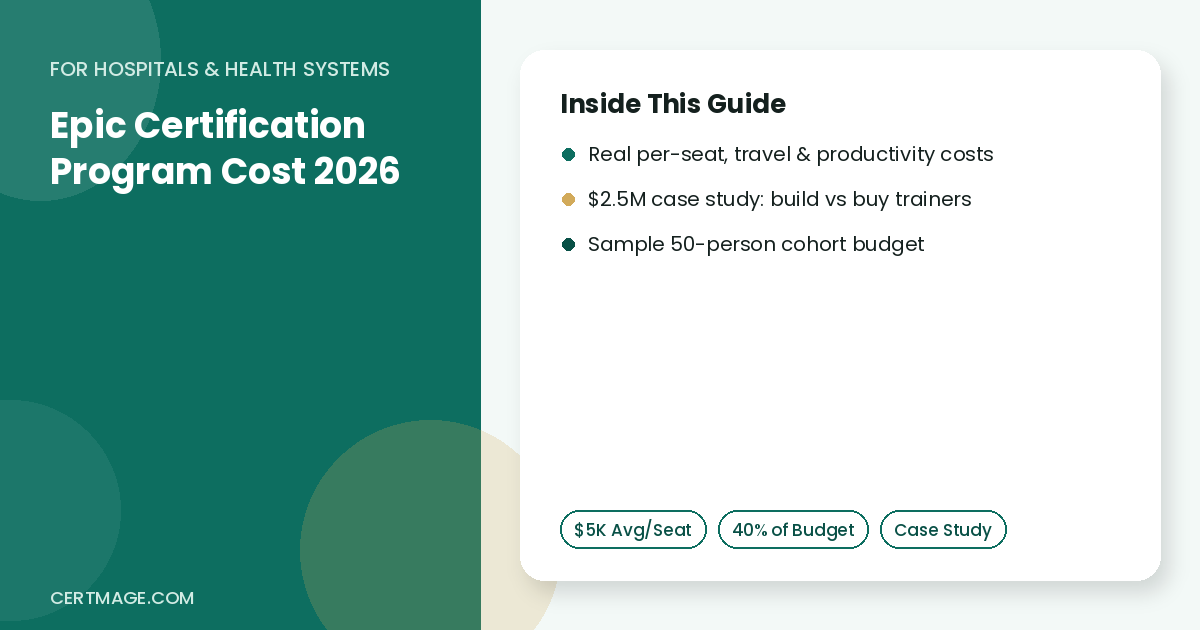
- Per-seat Epic certification training costs $500 to $10,000, averaging around $5,000, or $400/day and $250/half-day for shorter sessions
- That per-seat cost is usually the smallest line item; real organizational case studies show training-related costs (super-user training, staff programs, go-live support, lost productivity) reaching $600,000+ for a single specialty practice rollout
- One documented case study shows a health system saving $2.5 million and cutting training fees 40 to 50% by hiring locally-based contracted credentialed trainers instead of paying for travel-heavy internal certification
- Staff training and workflow redesign can consume roughly 40% of total Epic implementation cost in smaller settings
- The real decision most hospitals face isn’t “should we do this,” it’s build (certify internal staff) versus buy (hire pre-credentialed contract trainers), and the math tips differently depending on organization size and rollout timeline
The 5 Cost Lines That Actually Show Up on a Hospital’s Budget
Most public “Epic certification cost” content stops at the per-seat training fee. Here’s the fuller budget line-up hospitals actually plan against.
| Cost Line | What It Covers | Typical Range |
| Training/certification fee | Epic’s own training program fee per seat | $500 to $10,000 per person, averaging around $5,000 |
| Travel and lodging | Required in-person attendance at Epic’s Verona, WI campus for most certification tracks | Varies by home location; a recurring, often underbudgeted cost for multi-employee cohorts |
| Lost productivity | Staff time away from regular duties during training, which can run 15 hours to 6 months depending on the certification | Documented case: $175,000 for one specialty practice’s training-period productivity loss |
| Backfill staffing | Temporary or overtime coverage for employees who are away training | Rarely itemized publicly, but a real and recurring cost for any organization certifying frontline staff |
| Recredentialing and version-upgrade training | Epic certifications tied to a software version generally need renewal training with each major release | Ongoing, not a one-time cost; see our Epic certification renewal guide for the individual-credential side of this cycle |
What Real Organizations Have Actually Spent
A documented specialty practice rollout broke down its Epic training-related spending as follows: initial super-user training at $80,000, a broader staff training program at $150,000, go-live support at $200,000, and lost productivity during the training period at $175,000, a combined $605,000 in training-adjacent costs alone, separate from Epic’s software licensing and implementation fees.
For contrast, a Colorado family practice completed its entire Epic rollout, training included, in 4 months while staying under a $1 million total budget, showing how much variance exists based on organization size, rollout scope, and how efficiently training is structured.
The build-versus-buy case study worth studying closely: one health system, working with a staffing partner to source locally-based contract trainers instead of certifying and flying in staff, reported $2.5 million in total savings and a 40 to 50% reduction in training fees specifically from eliminating travel costs. The program credentialed 37 trainers through the contracted model, plus 12 backup credentialed trainers kept on standby to sustain training continuity through staff turnover, a detail worth noting since turnover risk is rarely factored into first-pass training budgets.
Build vs Buy: Training Internal Staff vs Hiring Contract Credentialed Trainers
This is the real decision most hospitals underestimate, and it comes down to a genuine cost tradeoff rather than an obvious answer either way.
| Train Internal Staff to Certification | Hire Contracted Credentialed Trainers | |
| Upfront cost per person | $500 to $10,000 plus travel/lodging | No individual certification cost; pay a contracted rate instead |
| Travel/lodging exposure | High, especially for organizations far from Verona, WI or regional training sites | Minimal to none if trainers are sourced locally |
| Long-term capability | Builds permanent in-house training capacity | Capacity leaves when the contract ends, unless trainers are later hired directly |
| Turnover risk | Lost investment if a newly certified employee leaves | Contractually mitigated; the documented case study above kept 12 backup trainers on standby specifically for this |
| Best fit | Large health systems planning multiple future rollouts or ongoing internal training need | Organizations running a single large implementation or facing a tight go-live timeline |
For reference, an Epic Credentialed Trainer’s average market pay sits around $52,554 per year ($25.27/hour), per ZipRecruiter’s current US data, useful context when comparing the fully-loaded cost of building an internal training function against a contracted alternative.
Cost by Certification Path
| Path | Typical Duration | Cost Range | Best Suited For |
| Short proficiency/badge-style training | 15 hours to a few days | $250 (half-day) to $400/day | Role-specific end-user proficiency, not full analyst certification |
| Standard module certification (Clinical, Revenue, etc.) | Several weeks | $500 to $5,000 | Analysts and trainers needing formal certification in a specific Epic module |
| Full analyst/consultant-track certification | Up to 6 months, including in-person Verona attendance | $5,000 to $10,000+ | Organizations building internal Epic build/support teams long-term |
Sample Budget: Certifying a 50-Person Go-Live Cohort
Real numbers help more than percentages here. Using the per-seat and case-study figures above, here’s what a mid-size hospital certifying 50 staff members across a mix of modules might realistically plan for.
| Line Item | Assumption | Estimated Cost |
| Per-seat training fees | 50 staff at an average $5,000 per seat | $250,000 |
| Travel and lodging | Estimated $1,500 to $3,000 per person for out-of-state Verona attendance, 40 of 50 requiring travel | $60,000 to $120,000 |
| Lost productivity | Scaled from the documented $175,000 specialty-practice figure for a smaller cohort, adjusted upward for 50 people | $200,000 to $350,000 |
| Backfill staffing | Temporary or overtime coverage during training windows | $50,000 to $100,000, highly dependent on role coverage needs |
| Contingency for turnover | Based on the documented 12-backup-trainer model for a 37-trainer cohort, roughly 30% buffer | Plan for 3 to 5 additional seats beyond the core 50 |
Total realistic range for this scenario: roughly $560,000 to $820,000, excluding Epic’s separate software licensing and implementation fees. That range sits close to the documented $605,000 specialty-practice figure cited earlier, which is a useful sanity check: if your own budget lands well below this range for a comparable cohort size, revisit whether travel, lost productivity, or backfill costs have been fully accounted for.
Does the Certification Path Change the Cost? Module-by-Module Variance
Not every Epic module costs the same to certify staff into, and cohort budgets should reflect that rather than applying one flat per-seat number across the board. Clinical documentation tracks, for instance, split into materially different training scopes depending on care setting; our Epic Ambulatory vs Epic Inpatient (ClinDoc) certification comparison breaks down how those 2 tracks differ in scope and training time, which directly affects which end of the $500 to $10,000 per-seat range a given cohort should expect to land in. Revenue cycle and Healthy Planet certifications carry their own distinct scopes as well, and treating “Epic certification” as one uniform cost ignores this real variance.
Why This Differs From an Individual’s Certification Cost
Everything in this guide assumes an employer is sponsoring and budgeting the certification, which is the far more common path. If you’re evaluating this from the other direction, as an individual trying to get Epic certified without an employer already sponsoring you, the cost structure and access path look completely different, and our guide on how to get Epic certified without already working in healthcare IT covers that path specifically, since Epic does not sell certification training directly to individuals the way many other credentialing bodies do.
Common Mistakes Hospitals Make When Budgeting This
Budgeting the per-seat training fee and stopping there. Travel, lodging, lost productivity, and backfill staffing routinely exceed the certification fee itself once you’re training more than a handful of people, and organizations that budget only the headline training cost consistently run over.
Not planning for turnover during a multi-month training pipeline. The $2.5 million case study above specifically built in 12 backup trainers precisely because losing a newly certified employee mid-rollout is a real, recurring risk, not an edge case.
Treating certification as a one-time cost rather than a recurring one. Epic certifications are generally tied to a software version, and major version upgrades typically require recredentialing, an ongoing budget line most first-time Epic customers don’t plan for until the first upgrade cycle arrives.
Defaulting to internal certification without running the build-versus-buy math. The documented 40 to 50% training-fee reduction from using locally-sourced contracted trainers instead of certifying and flying in staff is a large enough number that skipping this comparison can mean leaving real budget on the table.
Comparing Epic certification costs directly against a competing EHR’s training costs without adjusting for structure. Epic’s in-person, Verona-centered certification model has a fundamentally different cost shape than more remote-friendly competitors; our Epic vs Cerner (Oracle Health) certification comparison breaks down that structural difference in more depth.
Decision Checklist for Budgeting an Epic Certification Program
- Line-item travel, lodging, and lost productivity separately from the training fee itself; treating them as a rounding error is the single most common budgeting mistake
- Run the build-versus-buy comparison explicitly before committing to an internal-certification-only plan, especially for a single large rollout rather than ongoing internal capacity building
- Budget for turnover during the training pipeline, not just the training itself, particularly for multi-month analyst-track certifications
- Plan for recredentialing as a recurring line item tied to Epic’s version upgrade cycle, not a one-time expense
- If your organization needs certified staff quickly for a single go-live rather than long-term internal training capacity, the locally-sourced contracted trainer model has documented savings worth evaluating first
FAQS
How much does it cost a hospital to certify one employee in Epic?
Per-seat training typically runs $500 to $10,000 depending on the certification path, averaging around $5,000, before adding travel, lodging, and lost productivity costs, which are frequently larger than the training fee itself.
Why does Epic certification cost so much more for hospitals than the per-seat fee suggests?
Because most certification paths require in-person training at Epic’s Verona, WI campus or a regional site, adding travel and lodging on top of the base fee, and because employees are away from their regular duties during training, a cost hospitals experience as lost productivity even though it never appears on Epic’s own price list.
Is it cheaper to certify internal staff or hire already-certified contract trainers?
It depends on scope. A documented case study showed a health system saving $2.5 million and cutting training fees 40 to 50% by hiring locally-based contracted credentialed trainers instead of certifying and flying in internal staff. For organizations planning ongoing internal training capacity beyond a single rollout, building internal certification may still be the better long-term investment.
What percentage of a total Epic implementation budget goes toward training?
Staff training and workflow redesign can consume roughly 40% of total implementation cost in smaller healthcare settings, making it one of the largest cost categories in an Epic rollout, not a minor line item.
Does Epic certification expire, creating a recurring cost?
Yes. Certifications are generally tied to a specific software version, and major version upgrades typically require recredentialing, which hospitals should budget as an ongoing cost rather than a one-time expense. Our Epic certification renewal guide covers what triggers renewal at the individual level.
What does an Epic Credentialed Trainer cost to employ directly versus contract?
Directly employed Epic Credentialed Trainers earn an average of $52,554 per year in the US according to current market data. Contracted trainer rates vary by staffing arrangement and location, but the documented case study in this guide shows locally-sourced contracted trainers reducing overall training fees by 40 to 50% compared to a travel-heavy internal certification model.
How long does it take to certify a full training cohort?
Individual certification paths range from 15 hours for short proficiency training up to 6 months for full analyst or consultant-track certification. A full cohort’s timeline depends on how many staff need certifying simultaneously and whether the organization has capacity for parallel training tracks.
Should a small practice budget the same way a large health system does?
No. A documented Colorado family practice completed its entire Epic rollout, including training, in 4 months under a $1 million total budget, while a specialty practice’s training-related costs alone reached $605,000. Organization size, rollout scope, and timeline all materially change which cost lines dominate the budget.