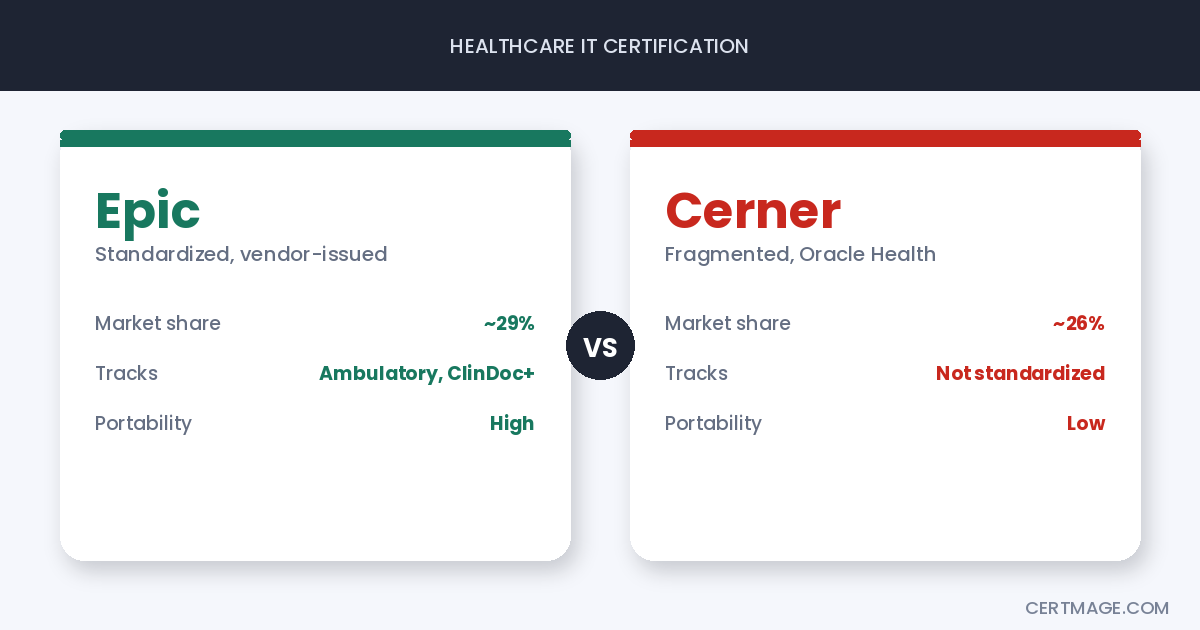
Epic runs a well-documented, vendor-issued certification system with named tracks like Ambulatory, ClinDoc, Willow, and Resolute, while Cerner, now Oracle Health, has no equally standardized professional credentialing program; understanding this asymmetry matters more than comparing exam content, because these two paths aren’t structured the same way.
The direct answer: If you want a portable, individually recognized credential you can carry between employers, Epic certification is the stronger, better-documented path. Cerner and Oracle Health credentialing is far more fragmented, some sources reference a Cerner Certified Professional designation with tracks in Millennium, PowerChart, and Cerner Command Language, but in practice most Cerner-trained professionals hold employer-issued or third-party training completion certificates rather than a single, widely recognized vendor credential. Epic and Cerner together hold roughly 55 percent of the US EHR market, Epic at approximately 29 percent and Cerner at approximately 26 percent, so both remain valuable specializations, they just aren’t credentialed the same way. Full details on the site’s existing coverage live in our Epic Certification guide.
Epic Certification vs Cerner Certification at a Glance
| Detail | Epic | Cerner (Oracle Health) |
| Issuing structure | Epic Systems Corporation, directly | Fragmented, no single standardized issuing body for individual professionals |
| Named tracks | Ambulatory, Inpatient/ClinDoc, Willow, Beacon, Resolute, Cadence, Prelude, and more | Millennium, PowerChart, and CCL referenced by some sources, not consistently documented |
| How you get certified | Typically employer-sponsored training, often at Epic’s Verona, Wisconsin campus | Employer-internal training, or third-party training vendor completion certificates |
| Portability | Generally recognized across Epic-using organizations | Highly variable, often tied to the specific employer or training provider |
| Access to training | Restricted, generally requires employer sponsorship or an Epic-using organization’s backing | More accessible through third-party training providers, though less standardized |
| Market share | Approximately 29 percent | Approximately 26 percent |
Important: This is not a symmetric comparison, and treating it as one is the most common mistake candidates make when researching this topic. Epic’s certification system is centralized and well-documented. Cerner’s is not, and Oracle’s 2022 acquisition of Cerner has not yet produced an equally standardized individual credentialing program to match what Epic has run for years.
How Epic Certification Actually Works
Epic certification is module-specific, meaning a professional certified in one track is not automatically certified in another, even within the same broad category.
| Track | Focus |
| Ambulatory | Documentation, scheduling, orders, and inbox management for outpatient clinical staff |
| Inpatient, ClinDoc | Admission, assessment, medication administration record, and nursing documentation for hospital-based teams |
| ADT, Prelude and Cadence | Patient registration, scheduling, and admission-discharge-transfer workflows for administrative staff |
| Willow | Pharmacy workflows, dispensing queues, and formulary management |
| Resolute | Hospital billing and professional billing for revenue cycle teams |
| Beacon | Oncology-specific clinical workflows |
Key point: Most Epic certification programs run 1 to 3 weeks in person at Epic’s Verona, Wisconsin headquarters, depending on the module and whether the candidate is new to Epic or transitioning from a prior version. This is a genuinely different model from most IT certifications, which are typically self-scheduled exams at a testing center. Epic training is structured, employer-sponsored, and location-specific.
How Cerner and Oracle Health Credentialing Actually Works
Note: Independently verifying a single, standardized Cerner or Oracle Health individual certification path is genuinely difficult, and that difficulty is itself the most important finding for anyone researching this topic. Some hiring and staffing sources reference a “Cerner Certified Professional” designation covering Millennium, PowerChart, and CCL, but real-world job postings and professional resumes more commonly reference specific “Cerner training certificates” tied to particular builds, documentation, orders, IView, EKM rules, issues management, rather than one consistent, widely recognized credential.
| What You’ll Actually Find | What It Means |
| Employer-issued training certificates | Tied to your specific employer’s implementation, generally not portable |
| Third-party training provider completion certificates | From vendors offering Cerner Millennium and PowerChart courses, not an official Oracle Health credential |
| Oracle Certified Professional, database-focused | A real Oracle credential, but focused on backend database administration and SQL, not clinical EHR competency |
| Oracle Health Certified Health IT Modules | Product certification for software meeting ONC federal health IT standards, not an individual professional credential at all |
Important: If your goal is to become “Cerner certified” the way you might become “Epic certified,” confirm exactly what credential a training provider is actually offering before paying for it. Several third-party Cerner training providers issue their own completion certificates that carry significantly less standardized recognition than Epic’s employer-sponsored, vendor-issued system.
What This Means for Your Career Decision
| If You Want | Choose |
| A well-documented, portable credential recognized across employers | Epic |
| To specialize in the platform used by roughly 29 percent of the US EHR market | Epic |
| Flexibility if a specific vendor’s product isn’t available at your current employer | Neither path guarantees full portability, but Epic’s system is more standardized |
| To work at an organization currently running Cerner or Oracle Health infrastructure | Cerner and Oracle Health-specific skills, gained through employer training regardless of formal certification status |
| The most structured path into healthcare IT analyst roles broadly | Epic, given its more established, better-documented training and certification pipeline |
Salary and Career Outcomes
| Role | Typical Salary Range |
| Epic-certified Analyst | $85,000 to $120,000 |
| Epic Application Coordinator | $95,000 to $135,000 |
| Cerner or Oracle Health Application Analyst | $80,000 to $115,000 |
| Healthcare IT roles requiring either platform | Comparable overall, driven more by role and organization than by which EHR platform |
The honest comparison: Salary outcomes between Epic and Cerner-focused roles are broadly comparable, since compensation tracks the role and organization more than the specific EHR platform. The real difference is career portability. An Epic certification travels with you to any Epic-using organization in a way that most Cerner or Oracle Health training does not, since there is no equivalent centralized, standardized credential to point to.
Who Should Pursue Epic, and Who Should Focus on Cerner or Oracle Health Skills
Healthcare IT professionals prioritizing career portability and a recognized credential. Epic’s centralized, employer-sponsored certification system delivers exactly this, and it remains the stronger choice if your goal is a credential you can point to across multiple future employers.
Professionals already working at, or specifically targeting, a Cerner or Oracle Health-using organization. Building deep platform expertise still carries real value, even without an equally standardized certification to show for it. Focus on accumulating hands-on build and configuration experience your employer can directly vouch for.
Clinical staff, nurses, and physicians whose organization uses either platform. Your training path is largely determined by what your employer runs, and neither Epic nor Cerner certification is typically pursued independently by clinical end users the way it is by analysts and IT professionals.
IT professionals early in a healthcare IT career with no current employer commitment. Epic’s more structured, better-documented path likely delivers a stronger long-term credential, though access typically requires either an Epic-using employer’s sponsorship or landing a role that includes Epic training as part of onboarding. For the complete Epic certification cost breakdown and track-by-track guidance, see our existing Epic Certification guide.
Common Mistakes When Researching This Comparison
Assuming Cerner or Oracle Health has an equally standardized certification system to Epic simply because Epic does. It does not, and treating the two as symmetric options leads candidates to overpay third-party training providers expecting Epic-level portability and recognition.
Paying for a third-party “Cerner certification” course without confirming exactly what credential it issues. Many issue their own completion certificates rather than an official Oracle Health credential, and the distinction matters significantly for how the credential will be perceived by future employers.
Assuming Epic certification is something you can pursue entirely independently. Most Epic training requires employer sponsorship or affiliation with an Epic-using organization, unlike many IT certifications that anyone can register for directly.
Confusing Oracle’s general technology certifications, like Oracle Certified Professional for databases, with Cerner or Oracle Health-specific clinical EHR credentials. They are separate programs testing entirely different skill sets.
Choosing a platform to specialize in based purely on which certification sounds more official, rather than which platform your target employers or region’s healthcare organizations actually run.
FAQS
Is there a real Cerner certification like Epic has?
Not to the same standardized degree. Some sources reference a Cerner Certified Professional designation, but in practice, most Cerner-trained professionals hold employer-issued or third-party training completion certificates rather than one consistent, widely recognized vendor credential.
How much does Epic certification cost?
Costs vary significantly by module and training format, in-person versus virtual, and are typically covered by an employer sponsoring the training rather than paid individually. See our full Epic Certification guide for a detailed cost breakdown.
Can I get Epic certified without working for an Epic-using organization?
Generally no. Most Epic certification programs require sponsorship from an Epic-using healthcare organization or direct employment involving Epic training, unlike many IT certifications open to independent registration.
What is the Cerner Certified Professional credential?
A designation referenced by some hiring and staffing sources, reportedly covering Cerner Millennium, PowerChart, and Cerner Command Language, though it is not as consistently documented or widely recognized as Epic’s certification tracks.
Which pays more, Epic or Cerner certified roles?
Salaries are broadly comparable between the two, since compensation tracks the specific role and organization more than which EHR platform you specialize in.
Is Epic or Cerner easier to get certified in?
Epic has a more defined, structured path, though it typically requires employer sponsorship. Cerner and Oracle Health credentialing is more accessible through third-party providers, but less standardized and less consistently recognized.
What is Oracle Certified Professional, and is it the same as Cerner certification?
No. Oracle Certified Professional is a general Oracle database and technology credential unrelated to clinical EHR competency. It should not be confused with Cerner or Oracle Health-specific training.
Does Oracle’s acquisition of Cerner mean a new standardized certification is coming?
As of publication, no equally standardized individual professional certification program has emerged from Oracle Health to match Epic’s system, though this could change as the integration continues.
Which EHR platform has more market share, Epic or Cerner?
Epic holds approximately 29 percent of the US EHR market, and Cerner, now Oracle Health, holds approximately 26 percent, together accounting for roughly 55 percent of the market.
Should I specialize in Epic or Cerner for a healthcare IT career?
Base the decision primarily on what your target employers or region’s healthcare organizations actually run, since both remain valuable specializations despite their very different credentialing landscapes.