TL;DR: The CBCS (NHA) and the CPC (AAPC) both open doors into healthcare revenue-cycle work, but they start you in different places. The CBCS is the billing-first entry credential: its 100-item exam spends 33% on billing and reimbursement and 20% on insurance and payer requirements, with coding at 32%. The CPC is the coding-first professional credential: a 100-question, 4-hour, open-book exam where you work through CPT, ICD-10-CM and HCPCS Level II across body systems and case studies, with a 70% pass mark. The CPC costs more up front (USD 425 for one attempt or USD 499 for two, plus required AAPC membership) and, after you pass, you hold CPC-A (apprentice) status until you show 2 years of experience credit. The CBCS exam fee is lower (third-party sources list about USD 117, which NHA does not publish on its FAQ), and NHA’s eligibility rules are built around a diploma or GED plus training or work hours. If you want the cheapest, fastest way to a recognized billing and coding credential, start with the CBCS. If your target is physician-practice coding and you can afford the extra cost and preparation, the CPC is the stronger long-term credential. Always check job postings in your area first.
Key Takeaways
- Different centers of gravity. The CBCS leans toward billing, reimbursement and payer rules. The CPC leans toward code assignment across CPT, ICD-10-CM and HCPCS Level II.
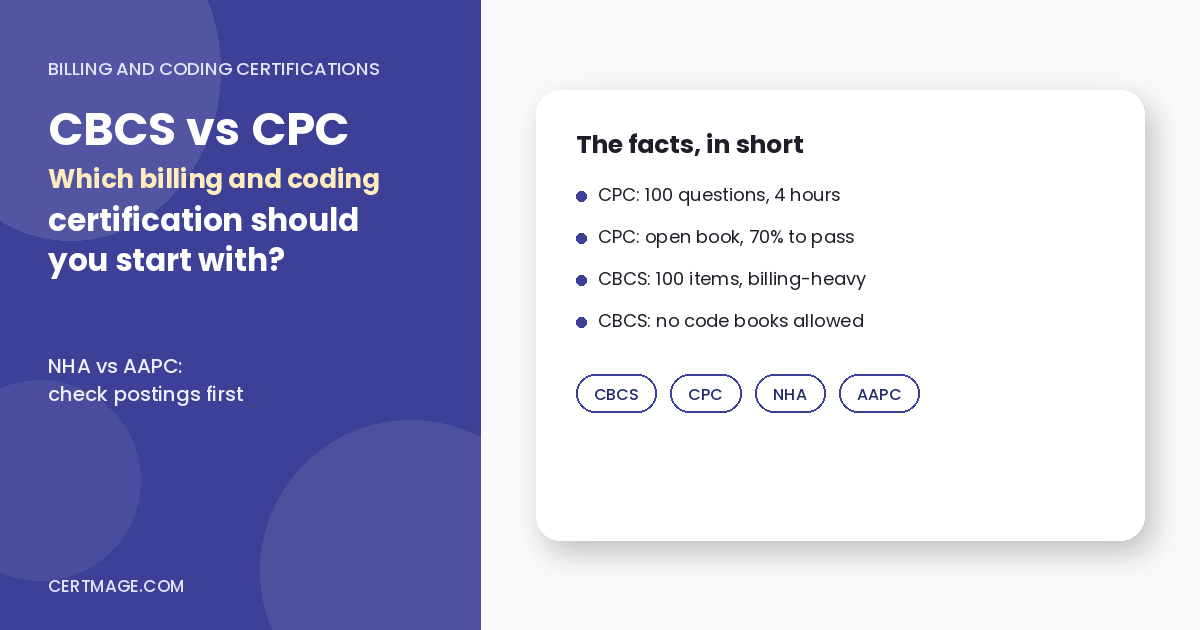
- Both exams have 100 questions or items. The formats differ a lot: the CPC is 4 hours and open book with code books allowed. NHA’s FAQ says coding manuals are not required or allowed for the CBCS since September 24, 2024, and relevant information appears with each question.
- The CPC has a 70% pass mark. AAPC states that 70 correct out of 100 passes. We did not find an official NHA passing score on the FAQ we reviewed.
- Cost is not close. AAPC lists USD 425 for one CPC attempt and USD 499 for two. NHA’s FAQ says to ask an NHA representative for CBCS pricing, and third-party sources list about USD 117.
- After the CPC you may hold an apprentice designation. AAPC says CPC-A status stays until you satisfy a 2-year experience requirement, which can be met through work experience, a coding course (80 hours counts as 1 year) or Practicode.
- Renewal differs. The CPC needs 36 CEUs every 2 years. The CBCS needs 10 CE hours every 2 years, per NHA’s FAQ.
- Employers decide. Many postings name the CPC, some accept the CBCS and some name neither. Check yours.
Quick Facts
| Item | CBCS (NHA) | CPC (AAPC) |
| Issued by | National Healthcareer Association (NHA) | AAPC |
| Full name | Certified Billing and Coding Specialist | Certified Professional Coder |
| Exam size | 100 items, per NHA’s FAQ | 100 multiple-choice questions |
| Time | Not listed on NHA’s FAQ. Third-party sources disagree, so confirm with NHA | 4 hours |
| Coding manuals | Not required or allowed since September 24, 2024. Needed information appears with each question | Open book: one copy each of CPT Professional Edition, ICD-10-CM and HCPCS Level II allowed |
| Passing score | Not listed on NHA’s FAQ. A third-party source lists 390 on a 200 to 500 scale | 70% (70 of 100) |
| Content | Revenue Cycle and Regulatory Compliance 15%, Insurance Eligibility and Other Payer Requirements 20%, Coding and Coding Guidelines 32%, Billing and Reimbursement 33% | Terminology, anatomy, compliance, guidelines, ICD-10-CM, HCPCS Level II, CPT by series, radiology, pathology and lab, medicine, E/M, anesthesia, and 10 case-study questions |
| Eligibility | Not on NHA’s FAQ. A third-party source lists a diploma or GED plus a training program in the last 5 years or 1 year of supervised work in the last 3 years | AAPC membership required to schedule. Anatomy, pathophysiology and medical terminology are prerequisites for new students, with exemptions for existing working knowledge |
| Exam fee | Not on NHA’s FAQ (ask NHA). A third-party source lists about USD 117 | USD 425 for one attempt, USD 499 for two |
| Delivery | PSI center or remote per third-party sources. Confirm with NHA | Testing center or at home with a live remote proctor (external webcam required) |
| After you pass | Credential awarded | CPC-A (apprentice) until a 2-year experience requirement is met |
| Renewal | 10 CE hours every 2 years | 36 CEUs every 2 years |
What Is the CBCS?
The CBCS is the NHA’s billing and coding credential. NHA’s FAQ describes an exam that covers applying code sets from CPT, HCPCS Level II and ICD-10-CM, within a larger frame of revenue cycle, payer requirements and reimbursement. The exam has four content areas:
| Content area | Items | Share |
| The Revenue Cycle and Regulatory Compliance | 15 | 15% |
| Insurance Eligibility and Other Payer Requirements | 20 | 20% |
| Coding and Coding Guidelines | 32 | 32% |
| Billing and Reimbursement | 33 | 33% |
Two details from NHA’s FAQ matter. First, NHA says the exam is reviewed annually, with questions removed or replaced when codes are deleted or guidelines become outdated, while the test plan does not change. Second, pharmacology content is not included.
What Is the CPC?
The CPC is AAPC’s flagship medical coding credential, geared toward outpatient and physician-practice coding. The exam is 100 multiple-choice questions in one 4-hour, proctored sitting. It is open book: you may bring one copy each of the AMA’s CPT Professional Edition, ICD-10-CM and HCPCS Level II, in print or as eBooks. You need at least 70 correct to pass, and if you do not pass, AAPC reports the categories where you scored 65% or less.
Where the CBCS spreads across the billing cycle, the CPC is concentrated on code assignment: 36 questions on the CPT 10000 to 60000 series (6 per series), plus 6 each on radiology, pathology and laboratory, medicine and E/M, 4 on anesthesia, 10 on case studies and smaller blocks on ICD-10-CM, HCPCS Level II, guidelines, compliance, anatomy and terminology. For official steps, see AAPC’s guide to getting CPC certified.
How Do the Exam Contents Compare?
The CBCS asks how a claim moves from visit to payment. The CPC asks which code is right and why.
| Skill area | CBCS | CPC |
| Insurance and payer rules | 20% (eligibility and payer requirements) | Minor, through compliance and guidelines |
| Claims, billing and reimbursement | 33% | Not a main focus |
| Revenue cycle and compliance | 15% | Compliance and regulatory (3 questions) |
| Code assignment | 32% (CPT, HCPCS Level II, ICD-10-CM) | Most of the exam (CPT by series, ICD-10-CM, HCPCS Level II) |
| Specialty-specific coding (radiology, pathology, anesthesia, E/M) | Not broken out | Dedicated question blocks |
| Medical terminology and anatomy | Not a listed area | 4 questions each |
| Case-study coding | Not listed | 10 questions |
What this means: if you like process, payers and claim follow-up, the CBCS lines up. If you like reading documentation and choosing precise codes, the CPC lines up. Many people find the CPC the harder of the two because it demands code-book fluency under time pressure.
How Do the Exam Formats Compare?
One lets you use your code books. The other, per NHA’s FAQ, does not.
- CPC: 100 multiple-choice questions, 4 hours, open book. AAPC provides an online calculator, and physical calculators are not allowed. Devices with an on/off switch are not allowed in the room. Delivery is at a testing center or at home with a live remote proctor, and at-home testing requires an external webcam.
- CBCS: 100 items. NHA’s FAQ says coding manuals are not required or allowed since September 24, 2024, and the information you need appears with each question. This makes the exam less dependent on manual lookup skill and more dependent on understanding rules and workflows. The FAQ we reviewed does not list the time limit or the passing score. Third-party guides disagree on the question count and time, so check NHA’s candidate handbook.
If you rely on strong navigation of code books, the CPC’s open-book format rewards that skill. If you prefer to know concepts without a book, the CBCS format fits that.
What Are the Requirements for Each?
The CPC adds a membership step and an apprentice period. The CBCS adds a training-or-hours rule.
CPC steps (AAPC):
- Prepare. AAPC says anatomy, pathophysiology and medical terminology are prerequisites for new students, with an exemption if you already have working knowledge from education or a job.
- Become a current AAPC member before you schedule.
- Pass the exam with 70% or higher.
- Remove the apprentice designation. After passing you hold CPC-A until you meet a 2-year experience requirement: two years of on-the-job coding (verified by letters), 80 contact hours of a coding preparation course (counts as 1 year), a CPC-A Practicode module (counts as 1 year), or a combination.
- Maintain: 36 CEUs every 2 years.
CBCS steps (NHA): NHA’s FAQ we reviewed did not list eligibility. A third-party source lists a high school diploma or GED plus either a billing and coding training program completed in the last 5 years or 1 year of supervised billing and coding work in the last 3 years, and a 6-month window to test after registering. Confirm on NHA’s site.
| If you are… | CBCS | CPC |
| New with no training and no experience | Check NHA’s eligibility first | Eligible to prepare, but plan for the prerequisites and AAPC membership |
| Finished a billing and coding program | Likely eligible per third-party eligibility | Eligible. Course hours may also count toward removing CPC-A |
| Working in a billing office | Likely eligible with 1 year of supervised work | Eligible. Work experience counts toward the 2-year requirement |
| Experienced coder | Possible, but the CPC may be the stronger fit | Eligible, often with direct registration for grandfathered physician-practice coders |
How Much Do They Cost?
The CPC costs more, mostly because of membership, books and the course.
| Cost item | CBCS | CPC |
| Exam | Ask NHA. A third-party source lists about USD 117 | USD 425 for one attempt or USD 499 for two |
| Membership | Not required, as far as the pages we reviewed show | AAPC membership required. The page we reviewed did not list the price |
| Code books | Not required for the exam. Useful for study | CPT Professional Edition, ICD-10-CM and HCPCS Level II needed for the open-book exam and study |
| Training course | Optional. Many choose a training program | AAPC lists a course. Prices were not on the page we reviewed |
| Retake | A new fee. A third-party source lists a 30-day wait after a failed attempt | A second attempt is included in the USD 499 option |
| Renewal | 10 CE hours every 2 years, with a fee that is not listed on NHA’s FAQ | 36 CEUs every 2 years, with membership fees |
We do not quote a single total because membership, course and book prices vary. Ask your employer whether they reimburse the exam, training or membership.
Which Is Harder?
The CPC is usually considered the more demanding exam, but we cannot rank them with official numbers.
The CPC needs fluency across code sets and specialties, case-study coding and time management over 4 hours. The CBCS is broader but shallower, and its focus on billing process suits people who have worked with claims. We do not quote pass rates, because we found no official figures.
If you are not sure, take a timed practice test for each style. If you score well on billing-process questions but struggle with code lookup, the CBCS may fit you better right now, and the CPC can come next.
Which Fits Which Career Path?
| Your goal | Better fit | Why |
| Medical billing or insurance follow-up | CBCS | The exam weights billing, reimbursement and payer rules |
| Physician-practice coding | CPC | The exam is built around outpatient code assignment |
| A low-cost first credential | CBCS | Lower listed exam fee and no membership noted |
| A credential most coding postings name | CPC (check postings) | Many coding roles name it. Verify yours |
| Hospital or inpatient coding | Neither as a first choice | See our CPC vs CCS guide and CPC vs CCA guide |
| Coding with a focus on risk adjustment | Neither as a first choice | See our CPC vs CRC guide |
| A broader view of all coding options | Read first | See our CPC vs other medical coding certifications guide |
| Health information management leadership | Neither as a first choice | See our RHIA vs CCS guide |
Decision Framework: Which Should You Start With?
- Check your target postings. Search ten jobs you want. If they name the CPC, plan for it. If they accept the CBCS, you have an easier entry.
- Decide billing or coding. Which daily work do you want: claims and payers, or code assignment?
- Check eligibility. Confirm NHA’s current CBCS rules and AAPC’s CPC prerequisites against your training and experience.
- Compare budgets. Include membership, books, course and retake costs for the CPC.
- Think about the apprentice period. If you pass the CPC with no experience, you will hold CPC-A until you meet the 2-year requirement. Plan how you will earn it.
- Consider doing both in order. Some people start with the CBCS, gain experience, then move to the CPC. This is common sense, not a rule, and not required.
- Plan renewal. CBCS needs 10 CE hours and the CPC needs 36 CEUs every 2 years.
Career Value
The CBCS signals billing and coding fundamentals. The CPC signals code-assignment skill that many coding employers look for. Neither guarantees a job, and entry-level coding roles often prefer experience. The CPC’s apprentice period shows how much weight AAPC puts on practice. The CBCS gives an earlier, cheaper credential to put on a resume while you build experience.
We do not quote salaries. Pay depends on region, employer, specialty and experience. Check current postings for your target role. Code sets also change every year, so keep an eye on updates, such as those in our CPT 2027 code set changes guide.
Study Plan Ideas
CBCS (about 6 to 10 weeks, our estimate):
- Weeks 1 to 2: the revenue cycle and regulatory compliance.
- Weeks 3 to 4: insurance eligibility and payer requirements.
- Weeks 5 to 7: coding and guidelines (CPT, HCPCS Level II, ICD-10-CM), without relying on books during practice.
- Weeks 8 to 9: billing and reimbursement, including claims and denials.
- Week 10: timed practice tests.
CPC (about 12 to 20 weeks, our estimate):
- Weeks 1 to 4: anatomy, terminology and pathophysiology, if you do not already know them.
- Weeks 5 to 8: guidelines, ICD-10-CM and HCPCS Level II.
- Weeks 9 to 14: CPT by series (E/M, anesthesia, surgery, radiology, pathology and laboratory, medicine).
- Weeks 15 to 16: case studies and compliance.
- Weeks 17 to 20: timed 100-question practice exams with your tabbed code books, so lookup speed is part of your practice.
Common Mistakes to Avoid
- Choosing by price alone. Check what your target employers name.
- Ignoring the apprentice period. CPC-A status continues until you meet AAPC’s 2-year experience requirement, so plan how you will earn it.
- Using old code books. Use current-year books for study and for the CPC exam.
- Bringing books to the CBCS. NHA’s FAQ says manuals are not required or allowed.
- Skipping membership steps. AAPC requires membership before you schedule.
- Not practicing under time. The CPC gives about 2.4 minutes per question.
- Forgetting renewal. CBCS needs 10 CE hours and the CPC needs 36 CEUs every 2 years.
FAQS
What is the difference between CBCS and CPC?
The CBCS is NHA’s billing and coding credential with a strong billing and payer focus. The CPC is AAPC’s coding credential with a focus on code assignment across CPT, ICD-10-CM and HCPCS Level II.
Which is better, CBCS or CPC?
It depends on your goal. Many coding postings name the CPC, while the CBCS is a lower-cost entry. Check postings for your area.
Is the CBCS easier than the CPC?
Many candidates find it so, since it is shallower on code assignment and has a different format. We found no official pass rates to confirm.
How many questions are on the CPC?
100 multiple-choice questions in 4 hours, with a 70% pass mark, per AAPC.
How many questions are on the CBCS?
NHA’s FAQ lists 100 items. Third-party sources disagree on the total, so confirm with NHA.
Is the CPC exam open book?
Yes. AAPC allows one copy each of CPT Professional Edition, ICD-10-CM and HCPCS Level II.
Can I use code books on the CBCS?
NHA’s FAQ says manuals are not required or allowed since September 24, 2024.
How much does each exam cost?
AAPC lists USD 425 for one CPC attempt and USD 499 for two. NHA’s FAQ says to ask for CBCS pricing, and a third-party source lists about USD 117.
Do I need AAPC membership for the CPC?
Yes. AAPC says you must be a current member before scheduling.
What is CPC-A?
It is AAPC’s apprentice status after you pass the CPC. You hold it until you meet a 2-year experience requirement through work, coursework or Practicode.
How often do I renew?
Both renew every 2 years. The CBCS needs 10 CE hours and the CPC needs 36 CEUs.
Can I take both?
Yes, and some people do the CBCS first. Most only need one to start.
Which should a beginner start with?
Start with your target job postings and your budget. If they accept it, the CBCS is a lower-cost entry. If they name the CPC, plan for it.
Final Thoughts
Start from where you want to work. If your path runs through claims, payers and the revenue cycle, the CBCS is a lower-cost, quicker way in. If your path runs through physician-practice coding and the exam skills of reading documentation and choosing codes, the CPC is the more demanding credential and the one many coding employers look for. Check postings, confirm current fees and rules with NHA and AAPC, and plan for renewal before you pay.