The direct answer first: The CPC is the most widely recognized medical coding certification for outpatient and physician-office settings and the safest first credential for most candidates entering the field. But “most recognized” does not mean “right for everyone.” The CCS pays more. The CCA costs less. The RHIA opens management doors. And the CPB is essential if billing is your actual job. This guide gives you the complete comparison across every major credential so you can choose the one that matches your career goals, not just the one that gets mentioned most often.
Why the Right Certification Decision Matters More Than Ever in 2026
Medical coding is one of the clearest non-degree pathways into a stable, well-paying healthcare career. The U.S. Bureau of Labor Statistics projects that employment for medical records specialists, including medical coders, will grow by 9% from 2023 to 2033, with about 15,000 job openings expected each year on average. The field is growing, the work can be done remotely, and the barrier to entry is a certification rather than a four-year degree.
But the certification landscape is genuinely confusing. Two competing organizations, AAPC and AHIMA, each offer multiple credentials at different levels, covering different settings, and are recognized differently by different employer types. Pick the wrong one for your situation, and you spend months preparing for a credential that does not match the jobs you want.
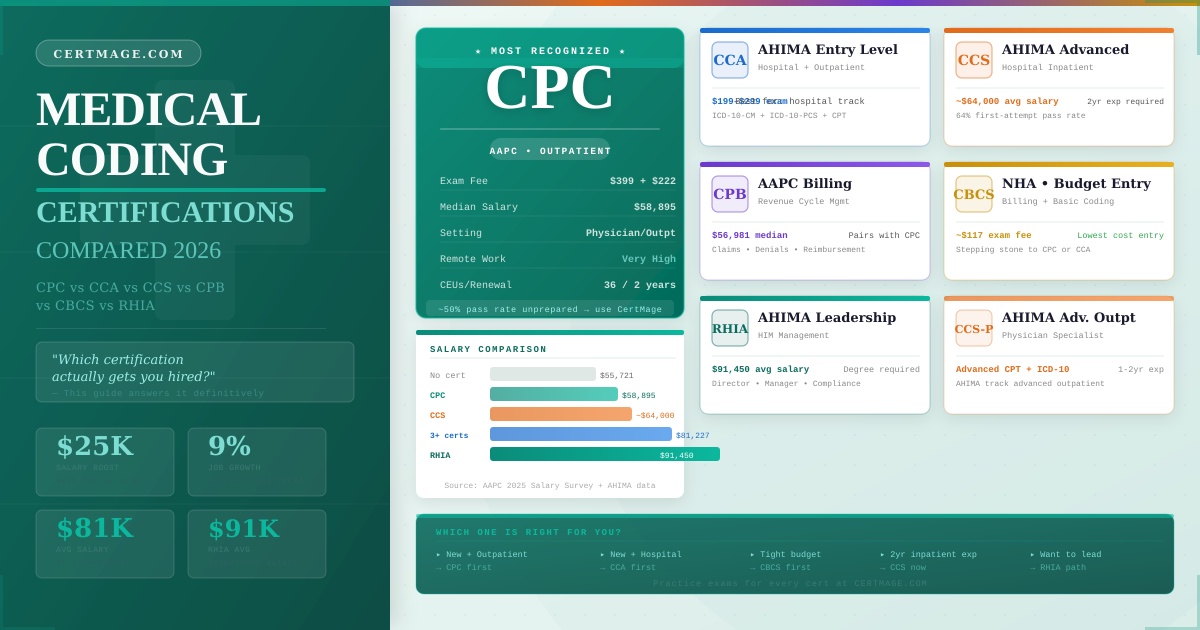
Certified professionals average $66,979 per year compared to $55,721 for those without certification. This gap grows wider with each additional credential earned. Holding three or more certifications correlates with an average salary of $81,227, according to the AAPC 2026 Salary Survey.
The financial case for certification is clear. The question is which certification, in which order, for which goal. That is what this guide answers. For scenario-based practice questions aligned to the current CPC exam blueprint, these high-quality medical coding practice resources help serious candidates build real exam readiness and confidence before test day.
The Medical Coding Certification Landscape: Who Issues What
Before comparing credentials, you need to understand the two main issuing bodies and what each one represents in the job market.
AAPC (American Academy of Professional Coders) was founded in 1988 and focuses primarily on physician-based and outpatient coding. The AAPC was founded to provide education and professional certification to physician-based medical coders. The organization’s certification is considered the gold standard and demonstrates a candidate’s ability to support cleaner claim submission, faster reimbursement, fewer denials, and better-run practices and facilities. AAPC credentials carry the strongest recognition in physician offices, outpatient clinics, ambulatory surgery centers, and revenue cycle management companies.
AHIMA (American Health Information Management Association) takes a broader health information management approach and is the dominant credentialing body for hospital-based coding, health information management, and leadership roles. AHIMA credentials carry particularly strong recognition in hospital systems, large health networks, and health information management departments.
Many coders maintain credentials from both organizations, and generally the more credentials you have, the better.
Here is the full credential map before we go deep on each one:
| Credential | Issuer | Level | Primary Setting | Cost |
| CPC | AAPC | Entry to Mid | Physician office, outpatient | $399 exam + $222 membership |
| CCA | AHIMA | Entry | Inpatient and outpatient | $199 to $299 |
| CBCS | NHA | Entry | Billing and coding | ~$117 |
| CCS | AHIMA | Advanced | Hospital inpatient | $299 to $399 |
| CPB | AAPC | Entry to Mid | Medical billing | $399 exam + $222 membership |
| CCS-P | AHIMA | Advanced | Physician outpatient | $299 to $399 |
| RHIT | AHIMA | Mid-Level | Health information management | Degree required |
| RHIA | AHIMA | Leadership | HIM management | Bachelor’s degree required |
The CPC: What It Is and Why It Dominates the Job Market
The CPC is AAPC’s flagship coding credential. It focuses on outpatient physician-office coding using CPT, ICD-10-CM, and HCPCS Level II. The CPC is recognized across virtually all outpatient settings. Candidates who pass without documented experience receive the CPC-A (Apprentice) designation. The median salary for CPC holders is $58,895 per year according to the AAPC 2026 Salary Survey.
PayScale reports an average base salary of $67,000 per year for professionals with the AAPC CPC certification as updated for 2026. According to AAPC’s own data, passing the CPC exam elevates a candidate’s earning potential by more than $25,000 above annual salaries for people without the CPC certification.
What the CPC Exam Covers
The Certified Professional Coder exam contains 100 multiple-choice questions, and test-takers are given 4 hours to complete it. The questions are split into 17 knowledge areas covering CPT series from 10,000 through 90,000, plus ICD-10-CM, HCPCS Level II, medical terminology, anatomy, and compliance. A passing score requires answering 70 questions correctly, which represents a 70% threshold.
The exam is open book. The CPC exam is open book, meaning you can bring official coding manuals including ICD-10, CPT, and HCPCS into the exam room. You are allowed handwritten notes pertaining to daily coding activities. But do not let the open-book format mislead you. The exam tests applied judgment across thousands of code options under intense time pressure. Candidates who go in without serious preparation fail at high rates. First-time pass rates hover around 50% for those without formal preparation.
CPC Cost in 2026
The CPC certification exam costs $399 for one attempt or $499 for two, plus $222 for mandatory AAPC membership dues payable before taking the exam. Students pay reduced rates of $375 for one attempt or $475 for two, plus the student AAPC membership fee of $157.
Total investment for most candidates: $621 for the exam plus membership, before study materials. Add $500 to $2,000 for quality study resources and practice materials depending on the program you choose.
The CPC-A Designation
If you pass the exam but have not yet completed two years of professional coding experience, you receive the CPC-A (Apprentice) designation. Many hospitals and RCM companies hire CPC-A candidates and help remove the apprentice status after one to two years. The CPC-A is a legitimate, employable credential that gets you in the door while your experience clock runs.
CPC Renewal Requirements
CPC certification must be renewed every two years with 36 Continuing Education Units (CEUs). Ongoing AAPC membership is also required to maintain the credential.
Who Should Get the CPC
The CPC is the right choice if you want to work in a physician office, outpatient clinic, ambulatory surgery center, or revenue cycle management company. It is the most employer-recognized entry-level coding credential in outpatient settings and the safest starting point for candidates who are not yet sure which direction their coding career will take.
Starting with CPC also opens doors to more advanced certifications later, such as the CCS. About 70% of professionals pursue certification to unlock better job opportunities and higher pay, according to AAPC.
The CCA: AHIMA’s Entry Point and the Hospital-Track Starter
The CCA is AHIMA’s entry-level coding credential covering both inpatient and outpatient coding, including ICD-10-PCS for hospital procedures. It is less expensive than the CPC and provides broader foundational knowledge. The CCA serves as a stepping stone to AHIMA’s advanced CCS certification.
The CCA’s dual coverage of inpatient and outpatient settings is its key differentiator from the CPC at entry level. If you know you want to work in hospital-based coding or eventually pursue the CCS, starting with the CCA rather than the CPC puts you on the right track from day one and saves you from learning outpatient-only content you will not need.
For beginners, CPC from AAPC is often recommended because it is more focused on outpatient coding and has a clearer entry path. CCA from AHIMA is better if you want to work in hospitals or pursue management roles later.
CCA Exam details: The exam covers ICD-10-CM, ICD-10-PCS, and CPT coding across inpatient and outpatient scenarios. It costs $199 for AHIMA members and $299 for non-members, making it the most affordable credentialing option among the major entry-level certifications.
Who should get the CCA: Candidates who want to work in hospital settings, those who plan to pursue the CCS later, and budget-conscious candidates who want a recognized entry-level credential at lower cost than the CPC.
The CBCS: The Billing-Focused Budget Option
The CBCS is an NHA certification. It is the most affordable entry-level option at approximately $117 for the exam. None of the five major certifications require a college degree, and the CCA and CBCS require only a high school diploma.
The CBCS covers billing workflows, claim submission basics, and coding fundamentals. It is primarily a billing credential rather than a pure coding credential, which makes it appropriate for candidates whose role will blend billing and coding rather than focusing exclusively on complex code assignment.
In NHA’s 2026 Industry Outlook, 61% of employers said they require certification for billing and coding specialists, and another 33% said they encourage it.
The CBCS is not a substitute for the CPC or CCA in roles that demand serious coding depth. It is the right starting point for candidates on a tight budget who need a credential quickly and plan to move up to the CPC or CCA within 12 to 18 months.
Who should get the CBCS: Budget-constrained candidates entering the billing side of the field, those who need a credential quickly to qualify for a specific entry-level role, and candidates who plan to use it as a stepping stone to the CPC or CCA.
The CCS: The Higher-Paying Hospital Coding Credential
The CCS, awarded by AHIMA, carries distinct benefits for professionals in healthcare IT. One of the standout advantages of CCS certification is the specialized knowledge it offers in inpatient coding. CCS-certified professionals are experts at translating complex medical records, especially those from hospital settings. This expertise extends to a broad range of medical scenarios including surgeries, intensive care treatments, and critical patient cases. CCS-certified coders often enjoy higher earning potential compared to their counterparts in general medical coding.
The median salary for a CCS holder is around $64,000, compared to approximately $48,500 for CPC holders. That salary premium reflects the CCS’s focus on complex inpatient hospital coding, which commands higher pay because it is genuinely harder and requires more experience to do well.
CCS Exam Details and Difficulty
The CCS exam consists of two sections totaling 115 to 140 questions, which must be completed within four hours. The first section features multiple-choice questions, while the second presents real-world medical scenarios covering inpatient, outpatient, and emergency department cases. To pass, you must score at least 300 on a 100 to 400-point scale.
The CCS exam is considered significantly more complex than the CPC exam, with just 64% of people earning a passing score on the first attempt. That lower first-attempt pass rate reflects both the exam’s difficulty and the fact that most CCS candidates come in with significant prior experience rather than fresh out of a training program.
CCS Prerequisites
To take the CCS certification exam, you must either have two years of experience or one year of experience combined with completed medical billing and coding courses or another coding credential. You can also take the CCS exam if you already have your certification as a CCS-P, RHIT, or RHIA.
This experience requirement is the critical difference between the CCS and entry-level credentials. The CCS is designed for working coders with real inpatient experience, not for candidates entering the field for the first time.
CCS Renewal Requirements
CCS certification requires biennial renewal with 20 CEUs and an annual self-assessment.
Who Should Get the CCS
The CCS is the right target credential for coders who have been working in inpatient or hospital settings for at least one to two years and want to formalize their expertise, increase their salary, and qualify for advanced roles in hospital coding, auditing, and clinical documentation improvement. It is not an entry-level credential.
If you have experience in medical coding and want to advance your career or increase your income, CCS certification may be better suited to help you achieve these goals.
The CPB: When Billing Is Your Actual Job
The CPB is AAPC’s billing-specific credential. It validates expertise in revenue cycle management, claims processing, denial management, and payer reimbursement. It pairs well with the CPC for professionals who handle both coding and billing. The median salary for CPB holders is $56,981 per year according to the AAPC 2026 Salary Survey.
The CPB is frequently overlooked in favor of the CPC, but it is the right primary credential for professionals whose work centers on billing, claims management, denial resolution, and payer relations rather than code assignment. In revenue cycle management departments, the CPB signals specific expertise that the CPC does not cover.
Many high-performing medical professionals hold both the CPC and the CPB, using the combination to demonstrate end-to-end revenue cycle competency from code assignment through claims payment. This combination is particularly valued in smaller practices where one person handles multiple functions.
Who should get the CPB: Professionals working primarily in medical billing, revenue cycle management, or claims processing roles, and CPC holders who want to add billing expertise to their credential profile.
The CCS-P: The Advanced Outpatient Specialist Credential
The CCS-P is AHIMA’s advanced credential for physician-based outpatient coding, making it the AHIMA equivalent of a senior CPC. It validates advanced competency in CPT, ICD-10-CM, and HCPCS coding in outpatient and physician settings.
The CCS and CCS-P exams are not considered entry-level coding exams. They are fill-in-the-blank and much more difficult to pass, which is why they are only recommended for coders who have a few years of on-the-job experience.
For coders who started with the CCA and want an advanced outpatient credential without pursuing the full hospital-focused CCS, the CCS-P offers a targeted advancement path. It is also recognized by AHIMA as sufficient to waive the experience requirement for the CCS exam, creating a flexible advancement track for AHIMA-track coders.
Who should get the CCS-P: Experienced outpatient coders on the AHIMA track, CCA holders ready for an advanced credential, and professionals in physician-based settings who want an advanced credential that signals depth in their specific environment.
The RHIT and RHIA: When You Want to Lead, Not Just Code
These credentials sit above the coding certifications and represent movement into health information management as a discipline rather than coding as a function.
RHIT (Registered Health Information Technician) requires an associate degree in health information technology from a CAHIIM-accredited program. It validates competency in health information management, data quality, privacy and security, and compliance, with some coding knowledge included. RHITs often work as coding supervisors, compliance specialists, and health information coordinators.
RHIA (Registered Health Information Administrator) requires a bachelor’s degree in health information management from a CAHIIM-accredited program. Job titles for RHIAs include Health Information Manager, Data Analyst, and Compliance Officer. RHIAs often interact with all levels of an organization and play a key role in making decisions based on patient data. The average salary for an RHIA is around $91,450, reflecting the high level of responsibility.
The RHIA is the credential that moves you from doing coding to managing the department that does coding. If your goal is healthcare administration, health information management leadership, or a director-level role, the RHIA is the path.
Who should get the RHIT or RHIA: Coders who have completed or are pursuing accredited health information management degree programs and want to move into management, compliance, or leadership roles beyond front-line coding.
Head-to-Head Comparison: The Complete Decision Matrix
| Factor | CPC | CCA | CBCS | CCS | CPB |
| Issuing Body | AAPC | AHIMA | NHA | AHIMA | AAPC |
| Level | Entry/Mid | Entry | Entry | Advanced | Entry/Mid |
| Exam Cost | $399 + $222 | $199-$299 | ~$117 | $299-$399 | $399 + $222 |
| Median Salary | $58,895 | N/A | N/A | ~$64,000 | $56,981 |
| Primary Setting | Outpatient/Physician | Inpatient + Outpatient | Billing/Coding | Hospital Inpatient | Billing/RCM |
| Experience Required | Recommended 2yr | Recommended 1yr | None | Required 2yr | Recommended |
| Pass Rate (1st attempt) | ~50% unprepared | Moderate | Moderate | 64% | Moderate |
| CEUs for Renewal | 36 every 2yr | 20 every 2yr | 10 every 2yr | 20 every 2yr | 36 every 2yr |
| Remote Work Potential | Very High | High | Moderate | High | Very High |
| Hospital Recognition | Moderate | Strong | Low | Very Strong | Low |
| Physician Office Recognition | Very Strong | Moderate | Low | Moderate | Strong |
| Best Next Step | CCS, CPB, specialty | CCS, CCS-P | CPC or CCA | RHIT, specialty | CPC |
Salary Comparison: What Each Credential Actually Pays
Non-certified medical billing and coding professionals average $55,721 per year. Those with one certification jump to an average of $62,689. Two certifications push the average to $71,130, and three or more credentials reach $81,227 per year.
| Credential | Median/Average Salary |
| No certification | $55,721 |
| CPC | $58,895 to $67,000 |
| CPB | $56,981 |
| CCS | ~$64,000 |
| RHIA | ~$91,450 |
| CPC + CPB combined | $71,000+ |
| Three or more credentials | $81,227+ |
The CCS typically commands the highest individual-credential salaries because it qualifies holders for advanced hospital coding, auditing, and clinical documentation improvement positions.
The salary data makes a strong argument for stacking certifications strategically rather than treating any single credential as a destination. CPC is the starting point. CCS or CPB adds the specialization premium. RHIA opens the leadership salary tier.
The Remote Work Reality for Each Certification
Remote work is one of the most attractive features of a medical coding career in 2026, and each certification has different implications for your remote work prospects.
In 2026, both CPC and CCS certifications significantly enhance remote work prospects as they demonstrate expertise in medical coding, crucial for healthcare institutions transitioning to or maintaining remote operations.
Remote CPC positions are actively hiring, with roles ranging from $21 to $70 per hour across companies including hospital systems, RCM companies, and physician practices.
CPC: Highest remote work availability. Physician offices and outpatient coding can be done entirely remotely, and a large proportion of CPC job postings explicitly offer remote or hybrid work.
CCS: Strong remote availability, particularly for experienced hospital coders. Inpatient coding requires access to health records systems, which can be cloud-based and accessed remotely. Senior CCS coders frequently work fully remote.
CPB: Very high remote availability. Billing and revenue cycle work is almost entirely system-based and is well-suited to remote environments.
CCA: Moderate to good remote availability, particularly once the candidate has established their reliability and accuracy. Entry-level candidates may be asked to work on-site initially before transitioning to remote.
RHIA/RHIT: More variable. Management and leadership roles in health information management sometimes require on-site presence, particularly for RHIA positions overseeing departments and staff.
How Long Does Each Certification Take to Earn?
It usually takes less time to earn a CPC certification than a CCS certification. Most CPC candidates complete training in 4 to 9 months through certificate programs or online courses. Students who already have a background in anatomy, medical terminology, or billing may finish sooner. After training, exam preparation typically takes several weeks.
| Credential | Typical Time to Exam-Ready |
| CBCS | 2 to 4 months |
| CCA | 3 to 6 months |
| CPC | 4 to 9 months |
| CPB | 4 to 9 months |
| CCS | 1 to 2 years (experience required) |
| CCS-P | 1 to 2 years (experience required) |
| RHIT | 2-year associate degree |
| RHIA | 4-year bachelor’s degree |
The Recommended Certification Paths by Career Goal
Rather than asking “which certification is best,” the more useful question is “which path is right for my specific situation.” Here are the clearest paths for the most common starting points.
You Are Brand New and Want to Work in a Physician Office or Outpatient Clinic
Start with the CPC. It is the most recognized credential for this setting, it opens the widest range of entry-level outpatient coding jobs, and it positions you for advancement. Use CertMage’s CPC practice exam resources in the final four to six weeks of your preparation to build the applied scenario reasoning the exam actually tests.
You Are Brand New and Know You Want to Work in a Hospital
Start with the CCA. It covers both inpatient and outpatient coding, it costs less than the CPC, and it directly prepares you for the CCS path. It signals to hospital employers that you understand the AHIMA ecosystem and are heading in the right direction for their environment.
You Are New and on a Very Tight Budget
Start with the CBCS at approximately $117. Use it to get in the door and start building experience. Pursue the CPC or CCA within your first 12 to 18 months of employment, ideally with employer tuition assistance.
You Have Two or More Years of Inpatient Hospital Coding Experience
Pursue the CCS. This is the credential that commands the highest salary in hospital settings, validates the depth of experience you have built, and opens advanced roles in auditing, CDI, and compliance. The CertMage medical coding practice library supports your CCS preparation with advanced scenario-based practice questions matching the exam’s case study format.
You Are a CPC Holder Who Also Handles Billing
Add the CPB. This combination is one of the most valued in small and mid-size physician practices and RCM companies because it demonstrates end-to-end revenue cycle competency. The combination regularly correlates with salaries in the $71,000+ range.
You Want to Move Into Management or Leadership
Pursue the RHIT or RHIA alongside your coding credentials. These require accredited degree programs but open a fundamentally different salary tier and career trajectory. The RHIA at $91,450 average salary represents the ceiling of the credentialed health information management career path.
You Are Unsure Where You Want to Work
Start with the CPC. The CPC’s broad outpatient recognition, the large number of entry-level CPC jobs available, and the clear advancement paths to CCS, CPB, or specialty credentials make it the default right answer for candidates who do not have a specific setting in mind yet.
Which Certification Do Employers Actually Require?
Job posting analysis across major hiring platforms in 2026 reveals clear patterns in what employers specify.
Physician offices and outpatient clinics: CPC is the most frequently listed requirement or preferred credential. Many postings list it as mandatory.
Hospital coding departments: CCS is the preferred advanced credential. CCA or CPC is acceptable for entry-level roles. RHIT is often preferred for supervisory positions.
Revenue cycle management companies: CPC is the dominant requirement. CPB is valued for billing-specific roles. AAPC credentials generally dominate in this segment.
Insurance companies and payers: CPC is most frequently listed. CCS is valued for complex claims review roles.
Compliance and auditing: CCS, RHIT, and RHIA credentials appear most frequently. The CPC can be supplemented with AAPC’s Certified Professional Medical Auditor (CPMA) credential for this path.
Remote coding roles: Remote CPC positions are actively hiring, with roles ranging from $21 to $70 per hour across a range of employers. The CPC dominates remote job postings in pure volume.
Using Practice Exams to Pass on the First Attempt
Regardless of which certification you choose, first-attempt pass rates are significantly higher among candidates who use quality practice materials consistently before their exam date.
First-time CPC pass rates hover around 50% for those without formal preparation. AAPC-certified coders earn 20 to 30% more than their non-certified peers on average.
The investment in a certification is not just the exam fee. It is months of preparation time. Failing and retaking costs you both the retake fee and the additional preparation time before you can start earning the certified salary premium. The most efficient use of your preparation investment is structured study followed by timed, scenario-based practice exam work in the final weeks before your test date.
The CertMage CPC practice exam and medical coding study resources are built around the current exam blueprint and include scenario-based questions that mirror the format, difficulty, and time pressure of the actual exam. Consistently scoring above 75% on timed full-length practice exams before your test date is the most reliable readiness signal available for any of these credentials.
Frequently Asked Questions
Is the CPC harder than the CCS?
The CCS exam is considered significantly more complex than the CPC exam, with just 64% of people earning a passing score on the first attempt. The CPC’s first-attempt pass rate is around 50% for unprepared candidates but significantly higher for those who complete formal preparation. Both are challenging. The CCS is harder primarily because it requires deeper inpatient coding knowledge and real-world experience before the exam even makes sense to attempt.
Can I take the CPC exam without experience?
Yes. While you cannot earn the CPC designation until you have two years of medical coding experience, you can take the exam prior to meeting this requirement. Upon passing the exam, your designation would be CPC-A, which stands for CPC Apprentice. The CPC-A is a recognized, employable credential.
Which certification is best for remote work?
All of the major coding credentials support remote work, but the CPC has the highest volume of remote job postings simply because outpatient coding is the most common remote coding role. Remote CPC positions are actively hiring with roles ranging from $21 to $70 per hour.
Should I get both CPC and CCS?
Many coders maintain credentials in both organizations, and generally the more credentials you have the better. For example, you could take the CPC exam through AAPC to start, and then once you have more on-the-job experience decide to sit for the CCS exam through AHIMA. This combination is particularly powerful because it demonstrates competency in both outpatient and inpatient settings, making you competitive across the full range of coding environments.
How much does getting CPC certified cost in total?
The CPC certification exam costs $399 for one attempt or $499 for two, plus $222 for mandatory AAPC membership. Students pay reduced rates of $375 for one attempt or $475 for two, plus the student membership fee of $157. Add preparation materials of $500 to $2,000 depending on your program, and total investment typically runs $1,000 to $2,500 for most candidates.
Does CPC certification expire?
CPC certification must be renewed every two years with 36 Continuing Education Units and ongoing AAPC membership. Failure to meet renewal requirements results in credential suspension.
What is the difference between CPC and CCS in plain terms?
The CPC is for outpatient and physician-office coding, primarily using CPT codes. The CCS is for hospital inpatient coding, primarily using ICD-10-PCS codes for procedures and ICD-10-CM for diagnoses. They cover different settings, different code sets, and are recognized by different employer types, though there is overlap in the middle of the market.
The Bottom Line
No single medical coding certification is best for everyone. The right credential depends on where you want to work, what level of experience you have, and what career trajectory you are building toward.
If you are new to the field and targeting outpatient or physician-office work, start with the CPC. It is the most recognized entry-level credential in that setting, it opens the most remote work opportunities, and it creates the clearest path to advancement.
If you know you want to work in a hospital and plan to pursue the CCS eventually, start with the CCA. It costs less, covers the inpatient coding knowledge you will need, and puts you on the right track from day one.
If you already have two or more years of inpatient hospital coding experience, pursue the CCS. The salary premium is real and the recognition in hospital settings is unmatched.
Whatever credential you choose, passing on your first attempt is the most important thing you can control. First-time CPC pass rates hover around 50% for those without formal preparation. That is not a statistic to ignore when you have months of study and hundreds of dollars of exam fees on the line.
The CertMage medical coding practice exam resources give you the scenario-based question practice, the timed exam simulation, and the detailed answer explanations that move you from knowing the material to being ready to pass on day one.
Choose the right credential. Prepare properly. Pass the first time.