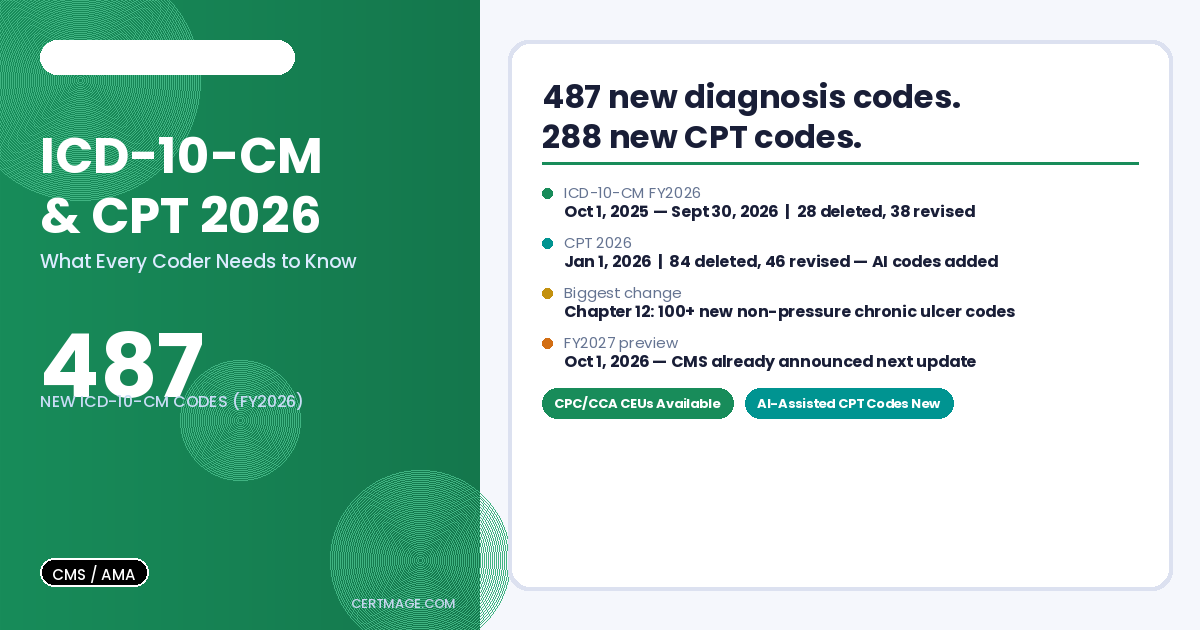
The FY2026 ICD-10-CM code set (effective October 1, 2025 through September 30, 2026) added 487 new diagnosis codes, deleted 28, and revised 38. The CPT 2026 code set (effective January 1, 2026) added 288 new procedure codes, deleted 84, and revised 46. Together, these updates affect billing accuracy, claim denial rates, and CEU requirements for every CPC, CCA, CCS, and RHIA holder. Whether you’re pursuing one of the highest-paying medical coding certifications or already working in the field, staying current with annual coding updates is essential for career growth.
CMS has also announced the FY2027 ICD-10-CM update (effective October 1, 2026), meaning coders preparing for certification exams in fall 2026 need to verify which fiscal year’s code set their exam uses. These revisions are equally important for professionals seeking medical billing and coding jobs, as employers expect candidates to demonstrate familiarity with the latest ICD-10-CM and CPT coding standards.
This guide covers every major change in both code sets, what it means for your daily coding work, and how to earn the CEUs you need to maintain your certification.
Why Annual Code Updates Matter for Certified Coders
Medical coders who use outdated codes on claims face denial, audit risk, and compliance exposure. More immediately, certified coders who do not stay current on code changes cannot pass their annual maintenance assessments and risk losing their CPC, CCA, CCS, or RHIT/RHIA credential.
| Certification | Annual CEU requirement | Update relevance |
| CPC (AAPC) | 36 credits per 2-year cycle | 1 CEU per approved annual update course |
| CCA (AHIMA) | 20 CEUs per 2-year cycle | Code update education earns CEUs |
| CCS (AHIMA) | 20 CEUs per 2-year cycle | Advanced code changes directly testable |
| RHIT (AHIMA) | 20 CEUs per 2-year cycle | Clinical documentation updates relevant |
| RHIA (AHIMA) | 20 CEUs per 2-year cycle | Governance and compliance updates most relevant |
| CFE (if serving in healthcare fraud) | 20 hours per year | Coding fraud typologies update with code changes |
ICD-10-CM FY2026: The Changes That Matter Most
The FY2026 ICD-10-CM update is one of the most significant in recent years by volume and by the number of areas affected. Here is a chapter-by-chapter breakdown of the most impactful changes.
Chapter 1: Infectious and Parasitic Diseases
New codes added:
- Demodex mite infestation: new specific codes for Demodex folliculorum and Demodex brevis infestations, with corresponding codes for Demodex blepharitis (eyelid inflammation caused by Demodex)
- COVID-19 sequencing guideline update: enhanced clarification for exact code pairings when COVID-19 is documented with respiratory manifestations. Coders must now differentiate lower respiratory infections, unspecified respiratory infections, and defined conditions (pneumonia, bronchitis) – each requires specific additional codes
- Post-COVID condition guidance: clarified that post-COVID condition codes can be assigned when sequelae persist regardless of initial severity of COVID-19 illness
What this means for coders: COVID-19-related claims continue to be a high-audit-risk area. The clarified sequencing guidelines reduce ambiguity but require coders to document more specifically what respiratory manifestation is present rather than defaulting to “unspecified.”
Chapter 4: Endocrine, Nutritional, and Metabolic Diseases
New codes and revisions:
- Expanded obesity codes: new subcategories for obesity classification with increased specificity for metabolic comorbidities
- Type 2 diabetes with complications: revised sequencing guidance for patients with Type 2 diabetes presenting with multiple complication types simultaneously
- BMI codes (Z68): update to align BMI code thresholds with current clinical practice standards
Chapter 6: Diseases of the Nervous System
Major additions:
- Primary progressive apraxia of speech: new specific code (previously captured under aphasia or apraxia NEC)
- Multiple sclerosis subtypes: expanded codes distinguishing relapsing-remitting MS, primary progressive MS, and secondary progressive MS more granularly
- Muscular dystrophy variants: new codes for specific dystrophies previously classified together under broad categories
What this means for coders: Neurology coding specificity is increasing significantly. Facilities with neurology practices should review their charge description masters (CDMs) to ensure new codes are loaded and clinical documentation is capturing the information needed to assign them.
Chapter 7: Eye and Adnexa
New codes:
- Eyelid inflammation by location: expanded codes specifying exact anatomical location of blepharitis, chalazion, and hordeolum (previously coded to right/left eye; now codes specify lid margin, lacrimal punctum, etc.)
- Thyroid orbitopathy: new codes providing greater specificity for thyroid eye disease complications
- Demodex blepharitis: see Chapter 1 notes – these codes cross-reference
Chapter 9: Diseases of the Circulatory System
Guideline revision:
- Hypertension with heart disease and CKD: clarified sequencing for patients with both hypertension-related heart disease and chronic kidney disease. The assumed relationship rule is updated – coders must now carefully review documentation to assign these correctly
Chapter 12: Diseases of the Skin and Subcutaneous Tissue
Largest chapter expansion in the FY2026 update.
- Non-pressure chronic ulcers: over 100 new codes adding granularity by anatomical site, laterality, and ulcer severity (limited to breakdown, fat layer exposed, necrosis of muscle, necrosis of bone)
- This expansion is the single most significant category change in the entire FY2026 update
- Coders in wound care, dermatology, and long-term care settings will see the most direct impact
What this means for coders: If your facility codes wound care or chronic ulcer management, this is the most important FY2026 update to internalize. The new specificity requirements mean that clinical documentation must capture the exact anatomical site, which limb, and the ulcer severity level. Facilities should update their clinical documentation improvement (CDI) queries accordingly.
Chapter 14: Diseases of the Genitourinary System
New specificity:
- Urinary incontinence: expanded codes specifying type (stress, urge, reflex, overflow, mixed) with laterality where applicable
Chapter 17: Congenital Malformations
Additions for rare conditions:
- New codes for previously NEC-classified rare genetic conditions, aligned with advances in genetic diagnosis
Chapters 19-20: Injury and External Causes
Major expansion:
- Genetic susceptibility to malignancy: new codes extending genetic cancer risk coding to fallopian tubes, urinary tract, digestive system, and colorectal cancer
- Inflammatory breast cancer: new specific code for malignant inflammatory breast disease, separated from other breast malignancy codes
CPT 2026: The Procedure Code Changes That Affect Your Claims
The CPT 2026 update (effective January 1, 2026) is the most technology-forward CPT update in the code set’s history, reflecting the integration of AI, remote monitoring, and advanced diagnostic testing into mainstream clinical practice.
Radiology: Comprehensive Code Restructuring
The most extensive CPT revision involves lower extremity revascularization imaging. The entire code family for vascular and interventional imaging in lower extremities was restructured. Facilities and physician practices with high volumes of peripheral arterial disease procedures must update their code lists urgently.
| Change type | Impact |
| Code deletions | Legacy codes for lower extremity revascularization deleted |
| New comprehensive codes | New bundled codes capturing combined angiography + intervention |
| Documentation requirements | New codes require specific documentation of vessel(s) treated |
Coders in interventional radiology practices or cardiovascular surgery coding teams should immediately review the full AMA CPT change summary for these sections – claim denials are likely if the old codes continue to be used.
AI-Augmented Services: New CPT Codes
CPT 2026 introduced the first dedicated codes for AI-assisted clinical services. This is a new category of codes.
| Service | CPT approach |
| AI-assisted radiology interpretation | New CPT codes for AI software used to augment radiologist interpretation |
| AI-assisted documentation | New codes for AI tools used in clinical documentation generation |
| Reporting requirements | Payer policies on AI code coverage vary significantly – verify before billing |
Important note for coders: The existence of a CPT code does not guarantee payer coverage. Many payers are still developing coverage policies for AI-assisted services. Coding AI-augmented services requires verifying that the specific payer covers the service before filing claims.
Remote Patient Monitoring (RPM): Revised Thresholds
| Old RPM structure | New CPT 2026 structure |
| Required 20 minutes minimum for monthly management | New code for 10-20 minutes of RPM per calendar month |
| 2-15 days monitoring = not separately billable | New code for 2-15 days of RPM within a 30-day period |
| Limited to certain qualifying devices | Expanded device eligibility for qualified monitoring |
The RPM changes significantly expand billable RPM services, creating new revenue opportunities for practices with telehealth and chronic disease management programs. However, documentation requirements are specific – coders must ensure the patient record captures the qualifying time and monitoring device.
Proprietary Lab Analyses (PLA): 75+ New Codes
More than 75 new PLA codes were added for advanced diagnostic lab tests. PLA codes use a 0000U-9999U series and identify specific tests by manufacturer and laboratory.
| Category | Examples of new PLA codes |
| Oncology | New genomic profiling tests for solid tumors |
| Cardiology | Advanced lipid panel tests with risk stratification |
| Neurology | Biomarker panels for neurodegenerative conditions |
| Infectious disease | Multiplex PCR panels for hospital-acquired infections |
Facilities that perform or refer for advanced laboratory testing should review the full PLA code additions to ensure their charge master captures all newly codeable tests.
Evaluation and Management (E&M): Continued Clarifications
No major structural changes to E&M coding in CPT 2026, but additional clarifications to:
- Telehealth E&M documentation requirements
- Prolonged service code applicability
- Split/shared visit coding in teaching hospital settings
ICD-10-CM FY2027 Announced: What Coders Need to Know Now
CMS announced the FY2027 ICD-10-CM update (effective October 1, 2026) in June 2026. Key early-announced areas include:
- Further expansion of neurodevelopmental disorder codes
- New codes for emerging infectious diseases and post-infection syndromes
- Continued expansion in rare genetic condition coding
- Updated COVID-19 related guidance
Exam timing note: Candidates scheduling CPC, CCA, or CCS exams in September or October 2026 should verify with AAPC or AHIMA whether their exam uses FY2026 or FY2027 ICD-10-CM. Both organizations typically have a transition window.
Earning CEUs From Code Updates
Every major certification body accepts annual code update education for CEU credit. Here is how to maximize your CEU earnings from the 2026 updates.
| CEU source | Credits available | Certification accepted |
| AAPC Annual Updates webinar | 1-3 CEUs | CPC, COC, specialty CPCs |
| AHIMA Annual Updates webinar | 1-3 CEUs | CCA, CCS, RHIT, RHIA |
| AAPC local chapter update meetings | 1 CEU per session | CPC and all AAPC credentials |
| Third-party approved coding courses (ICD-10/CPT focus) | Variable | Must be from AAPC/AHIMA approved provider |
| Self-study with coding reference materials | Not applicable (no CEU credit for self-study alone) | N/A |
| CertMage update-aligned practice exams | Practice only (contact AAPC/AHIMA for CEU eligibility) | Study tool |
FAQs
When did the FY2026 ICD-10-CM codes become effective?
October 1, 2025. The FY2026 ICD-10-CM code set covers patient encounters from October 1, 2025 through September 30, 2026. The FY2027 update takes effect October 1, 2026.
How many new codes were added in the FY2026 ICD-10-CM update?
487 new diagnosis codes were added, with 28 deleted and 38 revised. The largest single expansion was in Chapter 12 (skin conditions) where over 100 new codes were added for non-pressure chronic ulcers with greater anatomical specificity and severity classification.
When did the CPT 2026 codes take effect?
January 1, 2026. CPT codes are updated annually by the AMA effective January 1.
How many new CPT codes were added in 2026?
288 new codes were added, 84 were deleted, and 46 were revised. The largest categories of new codes are proprietary lab analyses (PLA codes) and AI-augmented services.
Do the new AI-assisted CPT codes guarantee reimbursement?
No. A CPT code being added does not guarantee payer coverage. AI-assisted service codes in CPT 2026 will be covered differently by Medicare, Medicaid, and commercial payers. Coders must verify coverage before billing these codes.
How do I earn CEUs from the 2026 code updates?
AAPC and AHIMA both offer approved annual code update webinars that earn 1-3 CEUs. Local AAPC chapter meetings typically offer 1 CEU per update session. All CEU activities must be from an approved provider to count toward your certification renewal.
What is the most important ICD-10-CM FY2026 change for wound care coders?
The expansion of non-pressure chronic ulcer codes in Chapter 12, which added over 100 new codes specifying anatomical site (ankle, heel, calf, thigh, foot, other lower leg), laterality, and ulcer severity. Coders in wound care, long-term care, and home health must update their coding patterns and ensure clinical documentation captures the needed specificity.
What changed for COVID-19 coding in FY2026?
The ICD-10-CM FY2026 update clarified sequencing for COVID-19 combined with respiratory manifestations, requiring coders to distinguish between lower respiratory infections, unspecified respiratory infections, and defined conditions (pneumonia, bronchitis) with specific additional codes. Post-COVID condition coding was also clarified.
Where can I find the complete list of FY2026 ICD-10-CM changes?
CMS publishes the complete ICD-10-CM FY2026 files at cms.gov/medicare/coding-billing/icd-10-codes. The AMA publishes the complete CPT 2026 change summary at ama-assn.org. Both are the authoritative sources.
How does staying current on code updates help my coding career?
Coding accuracy directly affects claim reimbursement and denial rates for the facilities and practices you work for. Coders who keep up with annual updates have lower error rates, fewer audit findings, and are more valuable to employers. Many healthcare compliance audits specifically test whether coders are using current versus outdated codes.