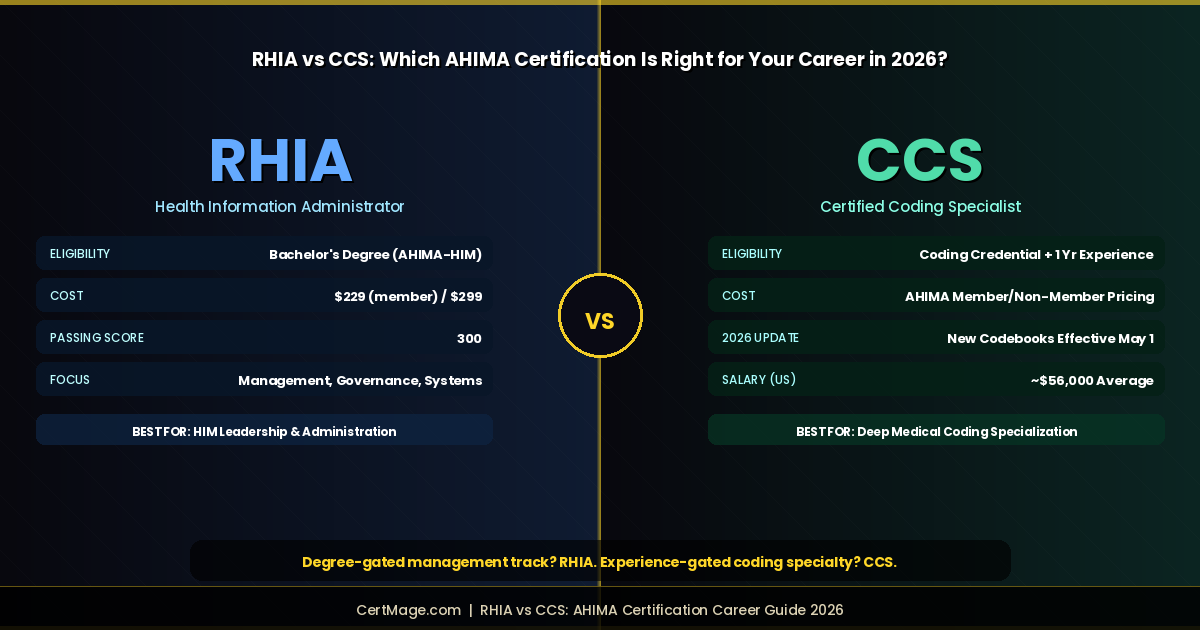
RHIA and CCS lead to genuinely different healthcare careers, even though both are issued by AHIMA. RHIA (Registered Health Information Administrator) is AHIMA’s flagship management credential, requiring a bachelor’s degree from an AHIMA-accredited Health Information Management program, and it qualifies you for leadership roles overseeing health information systems, data governance, privacy, and compliance. CCS (Certified Coding Specialist) is a specialist coding credential requiring hands-on coding experience rather than a specific degree, and it validates deep expertise in inpatient and outpatient medical coding for reimbursement and compliance purposes. If your goal is to manage a health information department, oversee data systems, or move into healthcare administration leadership, RHIA is your path. If your goal is to specialize deeply in medical coding accuracy and earn a credential respected specifically for coding expertise, CCS is your path. The two are not really competing for the same job; RHIA is a degree-gated management credential, and CCS is an experience-gated coding specialization.
This guide breaks down what each certification requires, what each tests, and how to decide which fits your healthcare career goals.
RHIA vs CCS: Quick Comparison
| Factor | RHIA | CCS |
| Full name | Registered Health Information Administrator | Certified Coding Specialist |
| Issuing body | AHIMA | AHIMA |
| Core focus | Health information management, systems administration, governance | Inpatient and outpatient medical coding |
| Eligibility | Bachelor’s degree from an AHIMA-accredited HIM program (health informatics not currently accepted) | Coding credential from another organization plus 1 year of coding experience, or equivalent AHIMA-recognized coding background |
| Cost | $229 (AHIMA member) / $299 (non-member) | Comparable AHIMA member/non-member pricing structure |
| Passing score | 300 | Set via standard-setting process (criterion-referenced, not a fixed percentage) |
| Format | Computer-based, Pearson VUE testing centers | Live testing administration |
| 2026-specific update | None major announced | Exam updates to the 2026 codebook list effective May 1, 2026; candidates must bring correct code books to the test center |
| Typical role | Health Information Manager, Compliance Officer, Data Analyst, Healthcare Administrator | Inpatient/outpatient coder, coding compliance specialist, coding educator |
| Typical salary (US) | Higher end of HIM salaries, reflecting management scope | Around $56,000 average, with potential for growth via experience and specialization |
| Recertification | Every 2 years via CEUs and recertification fee | Every 2 years via CEUs and recertification fee |
What RHIA Covers
RHIA equips individuals with comprehensive knowledge of medical, administrative, ethical, and legal requirements and standards for healthcare delivery and privacy of protected patient information. RHIAs act as an essential link between all the different parties involved in the healthcare system.
RHIA Core Competency Areas
RHIA-credentialed professionals are experts in managing patient health information and medical records, administering computer information systems, and ensuring the privacy and security of data. The certification covers domains spanning data governance and management, information technology and systems, privacy and security compliance, healthcare statistics and analytics, and leadership and organizational management within health information departments.
RHIA Eligibility Requirements
To be eligible for the RHIA exam, you must complete a bachelor’s degree in a health information management program accredited by the relevant accrediting body. Currently, AHIMA only accepts HIM degree programs to sit for the RHIA; health informatics degrees are not currently supported for the RHIA exam, which is an important distinction for anyone assuming a related degree might qualify.
RHIA Exam Details
| Detail | Information |
| Format | Computer-based, scheduled at a Pearson VUE testing center |
| Passing score | 300 |
| Cost | $229 (AHIMA member) / $299 (non-member) |
| Retake wait | 30 days before a new application is approved and a retake can be scheduled |
| Retake cost | Same as the original exam fee |
| Certified professionals (as of late 2025) | 13,848 |
Who RHIA Is For
RHIA is for those who want to move beyond coding and into management and leadership roles within health information. Health information managers, compliance officers, data analysts, clinical documentation specialists, and healthcare administrators are the typical roles RHIA prepares candidates for. If your career goal is departmental leadership rather than hands-on coding, RHIA is the credential that signals that trajectory.
What CCS Covers
CCS recognizes expertise in hospital-based inpatient coding, along with outpatient coding competency. It is a natural progression for professionals already experienced in coding inpatient and outpatient records, or those who hold a CCA (Certified Coding Associate) and are ready to demonstrate deeper specialization.
CCS Exam Domains
CCS competencies fall into five domains, with each domain accounting for a specific percentage of total exam questions, covering areas including clinical classification systems, coding guidelines, regulatory compliance, and reimbursement methodologies, with the precise domain weightings detailed in AHIMA’s official Exam Content Outline.
CCS Eligibility Requirements
Unlike RHIA, CCS does not require a specific bachelor’s degree. Eligibility paths include holding a coding credential from another certifying organization plus 1 year of coding experience directly applying codes, or completing AHIMA-recognized coding training and experience pathways. This makes CCS accessible to coders who built their skills through hands-on work and other credentials, rather than requiring a 4-year HIM degree.
The 2026 Codebook Update
The CCS exam is updating to the 2026 codebook list starting May 1, 2026. All exams delivered on or after that date require candidates to have the 2026 code books from the official 2026 code book list. On test day, all candidates must bring the correct code books to the test center, since the exam is open-book by design but requires the correct edition. Candidates scheduling exams around this transition date should confirm which codebook edition their specific exam date requires.
Who CCS Is For
Coding specialists create coded data used by hospitals and medical providers to obtain reimbursement from insurance companies or government programs such as Medicare and Medicaid; researchers and public health officials also use this data to monitor patterns and explore new interventions. CCS suits experienced coders handling complex inpatient and outpatient records, who may also train other coders or contribute to compliance efforts within their organization.
RHIA vs CCS: The Practical Difference With an Example
Consider a scenario: a hospital is auditing its inpatient coding accuracy after a compliance review flags inconsistent reimbursement claims.
CCS knowledge addresses: Were the correct ICD-10-CM and ICD-10-PCS codes applied to each inpatient record based on the documentation? Do the codes accurately reflect the complexity and severity of the patient’s condition for appropriate reimbursement? Are coders correctly applying the current year’s codebook guidelines? What specific coding errors are causing the compliance flags, and how should individual records be corrected?
RHIA knowledge addresses: Does the department have adequate data governance policies to prevent these inconsistencies going forward? What does the broader pattern of coding errors reveal about training gaps, system issues, or workflow problems across the department? How should this be reported to hospital leadership and compliance officers? What changes to information systems, privacy practices, or department structure would reduce this risk in the future?
The two roles operate at different altitudes on the same problem. CCS expertise identifies and corrects the coding-level accuracy issue. RHIA expertise addresses the systemic, governance-level response. A hospital’s health information department typically needs both: coders applying CCS-level expertise to individual records, and a manager or administrator applying RHIA-level oversight to the department’s systems and compliance posture.
RHIA vs CCS: Which Should You Pursue?
| Your Situation | Recommended Path |
| You hold or are completing a bachelor’s degree in an AHIMA-accredited HIM program | RHIA |
| You have hands-on coding experience or hold CCA and want to specialize further in coding | CCS |
| Your career goal is health information department leadership or compliance management | RHIA |
| Your career goal is deep coding specialization, potentially training other coders | CCS |
| You do not have and do not plan to pursue a bachelor’s degree in HIM specifically | CCS is the more accessible path, since it does not require RHIA’s specific degree |
| You already hold RHIT and want to advance toward management | RHIA is the natural next step, since RHIT is positioned as supporting RHIA-credentialed administrators |
| You want the credential most directly tied to reimbursement and revenue cycle accuracy | CCS |
There is no “harder” or “easier” framing that applies cleanly here, because the two certifications gate eligibility through entirely different mechanisms: RHIA through a specific 4-year degree, CCS through coding experience and credentials. The right choice depends on which gateway matches your current educational and career background, not on a difficulty comparison.
RHIA vs CCS: Salary Comparison
| Certification | Typical Salary Range | Context |
| RHIA | Higher end of HIM compensation, reflecting management and administrative scope; historically reported ranges scale meaningfully higher with a master’s degree and senior title | Salary reflects oversight responsibility across data systems, compliance, and departmental leadership |
| CCS | Approximately $56,000 average, with potential to increase with experience and further specialization | CCS holders typically handle more complex records and may train other coders, supporting gradual salary growth within the coding specialization track |
| Non-certified coders (for context) | $35,000-$42,000 | Illustrates the meaningful premium AHIMA coding certifications add over non-certified roles |
The salary gap between RHIA and CCS largely reflects the gap between a management/administration track and a specialist coding track, rather than one credential being inherently more difficult or valuable than the other.
RHIA vs CCS: How They Fit With RHIT
A third AHIMA credential, RHIT (Registered Health Information Technician), is worth understanding alongside this comparison, since it often comes up as a stepping stone or parallel option.
| Certification | Degree Requirement | Typical Scope |
| RHIT | Associate degree | Designed for health information technicians who work directly with medical records, coding, and data quality, supporting RHIA-credentialed administrators |
| RHIA | Bachelor’s degree (HIM-accredited) | Management and leadership across health information systems and departments |
| CCS | Coding experience plus credential, no specific degree | Deep coding specialization for inpatient and outpatient records |
For the complete breakdown of how RHIA and RHIT differ, including which to pursue based on your current degree level and career stage, our RHIA vs RHIT guide covers that foundational decision in full detail. This RHIA vs CCS comparison addresses a different fork: choosing between the administrative/management track (RHIA) and the specialist coding track (CCS), rather than the degree-level distinction RHIA vs RHIT addresses.
For broader context on medical coding career compensation across all major coding credentials, our medical coding salary guide covers CCA, CCS, and CCS-P salary data in detail, alongside the healthcare certifications landscape more broadly covered in our healthcare certifications guide.
FAQS
What is the difference between RHIA and CCS?
RHIA (Registered Health Information Administrator) is a management-track credential requiring a bachelor’s degree from an AHIMA-accredited HIM program, focused on health information systems, governance, and leadership. CCS (Certified Coding Specialist) is a specialist coding credential requiring coding experience rather than a specific degree, focused on inpatient and outpatient medical coding accuracy.
Do I need a degree for CCS like I do for RHIA?
No. CCS eligibility is based on holding a coding credential from another certifying organization plus 1 year of coding experience, or an equivalent AHIMA-recognized pathway, rather than requiring a specific bachelor’s degree. RHIA requires a bachelor’s degree from an AHIMA-accredited HIM program specifically; health informatics degrees are not currently accepted for RHIA eligibility.
Which pays more, RHIA or CCS?
RHIA, as a management and leadership credential, generally commands higher compensation reflecting its oversight scope, while CCS holders average around $56,000 with room to grow through experience and specialization. The gap largely reflects management versus specialist career tracks rather than one credential being more valuable in absolute terms.
What is changing with CCS in 2026?
The CCS exam is updating to the 2026 codebook list effective May 1, 2026. All exams delivered on or after that date require the 2026 code books, which candidates must bring to the test center on exam day.
Can I get CCS without a CCA first?
Yes. While CCS is described as a natural progression for those holding a CCA, eligibility can also be met by holding a coding credential from another certifying organization plus 1 year of direct coding experience, meaning CCA is not a strict prerequisite for everyone.
What is the passing score for RHIA?
The RHIA passing score is 300. CCS uses a criterion-referenced standard-setting process to determine its passing point, rather than a single universally fixed percentage.
Should I get RHIT before RHIA?
RHIT requires an associate degree and is positioned as supporting RHIA-credentialed administrators in direct work with medical records, coding, and data quality. Many professionals use RHIT as a stepping stone while completing a bachelor’s degree, then pursue RHIA once degree-eligible. For the complete comparison, our RHIA vs RHIT guide covers this specific progression.
How often do RHIA and CCS need to be renewed?
Both require recertification, generally on a 2-year cycle, through completion of continuing education units (CEUs) and payment of a recertification fee, consistent with AHIMA’s standard certification maintenance structure.
Is CCS harder to get into than RHIA?
Not harder, just gated differently. RHIA’s barrier is educational (a specific 4-year accredited degree). CCS’s barrier is experiential (coding credentials and hands-on experience). Someone without a HIM degree but with strong coding experience may find CCS the more accessible path, while someone completing a HIM bachelor’s degree may find RHIA the more natural fit.
Can someone hold both RHIA and CCS?
Yes, though they serve different purposes and most professionals choose based on career direction (management versus coding specialization) rather than pursuing both simultaneously. Holding both can signal a combination of administrative oversight capability and hands-on coding expertise, which can be valuable for roles bridging both functions, such as compliance auditing.