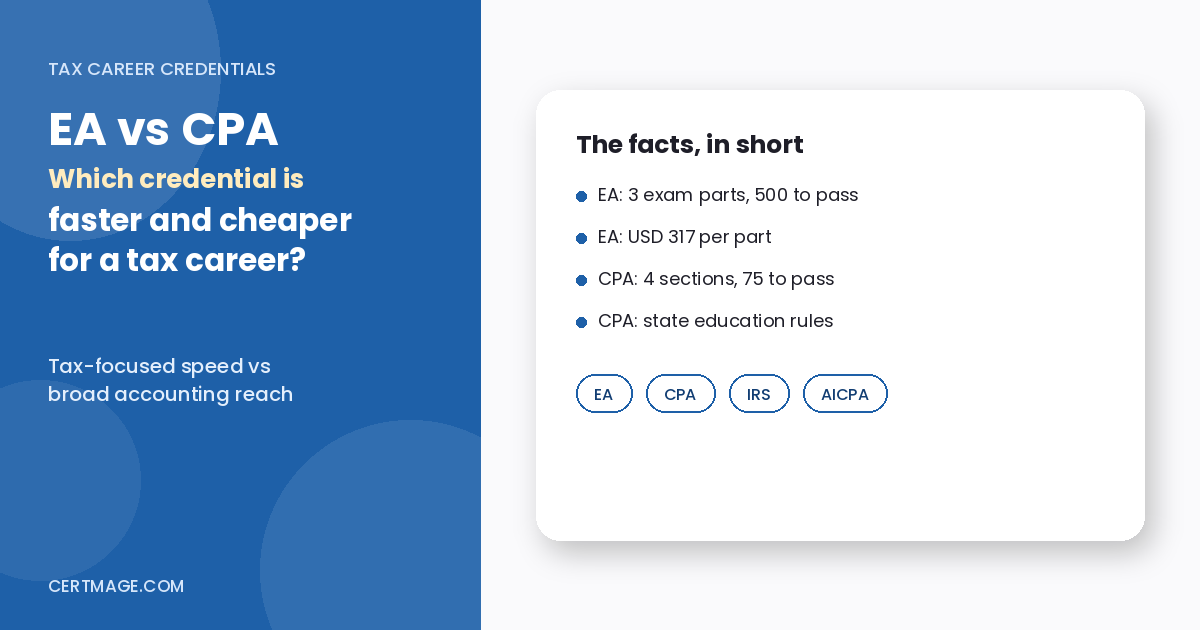
TL;DR: For a career that is only about tax (preparing returns, representing clients before the IRS, resolving tax problems), the Enrolled Agent (EA) is usually the faster and cheaper credential. The IRS route is three exam parts at USD 317 each, a USD 140 enrollment application, a PTIN and a suitability check, and the IRS lists no degree or work-experience step. The CPA is the broader, state-licensed credential: four exam sections, an education requirement set by your state (traditionally 150 credit hours, with a 120-hour plus 2 years of experience route spreading across states) and licensing steps on top. Choose the CPA if your goal reaches beyond tax into audit, corporate accounting, firm leadership or any role that needs a CPA license.
Key Takeaways
- EA is faster to reach. The IRS steps are PTIN, three SEE parts, Form 23 and a suitability check. The CPA adds a state education requirement and an experience requirement on top of its four exam sections.
- EA IRS-side fees are lower and fixed. Three SEE parts at USD 317 plus the USD 140 enrollment application come to USD 1,091. CPA exam fees vary by state and run roughly USD 980 to USD 1,950 per one published guide, before review courses and any extra credit hours.
- Both can represent clients before the IRS. The IRS says EAs, like attorneys and CPAs, are generally unrestricted as to which taxpayers they can represent, what tax matters they can handle and which IRS offices they can represent clients before.
- The CPA is broader. The exam covers audit, financial reporting and tax, and the CPA license is the credential employers expect for public accounting and many senior finance roles.
- The EA is tax only. All three SEE parts are about tax, and the credential does not open audit or attest work.
- Timing matters right now. The IRS lists a domestic SEE testing window of July 1, 2026 to February 28, 2027, with no testing in March and April 2027 while the exam is updated.
- Where you live matters. CPA licensure is state-based. The EA is a federal credential.
Quick Facts
| Item | Enrolled Agent (EA) | CPA |
| Issued by | IRS (Office of Enrollment) | State Boards of Accountancy (exam by AICPA and NASBA) |
| Exam | Special Enrollment Examination (SEE), 3 parts | 4 sections: AUD, FAR, REG plus one discipline (BAR, ISC or TCP) |
| Questions and time | 100 questions per part (85 scored, 15 unscored), 3.5 hours per part | Four hours per section, 16 hours in total |
| Passing score | 500 on a 200 to 800 scale | 75 per section |
| Topics | Part 1 Individuals, Part 2 Businesses, Part 3 Representation, Practices and Procedures | Audit, financial reporting, tax and one discipline of your choice |
| Education | No degree step listed by the IRS | Set by your state. Traditionally 150 credit hours, with 120-hour pathways in some states |
| Experience | None listed for the exam route (certain former IRS employees may be exempt from the exam) | Set by your state. Commonly 1 year (150-hour route) or 2 years (120-hour route) |
| Exam fees | USD 317 per part, USD 951 for all three | Varies by state. NASBA recommends USD 262.64 per section for the exam fee, plus registration and application fees |
| Other fees | USD 140 enrollment application | State application, registration and licensing fees |
| Score validity | Passing parts carry over up to three years | Typically a 30-month window in many jurisdictions, set by your board |
| Keeping it current | 72 hours of CE per three-year cycle, minimum 16 per year including 2 ethics hours | Set by your state board. Commonly 120 hours every three years (varies) |
| Scope | Tax preparation and IRS representation | Audit, tax, accounting and consulting, depending on role |
Prices, windows and rules change. Confirm on the IRS and your state board’s pages before you pay or plan.
What Is an Enrolled Agent?
An enrolled agent is a federally authorized tax practitioner, licensed by the IRS. The IRS describes the route plainly: obtain a PTIN, apply to take the Special Enrollment Examination, pass all three parts, apply for enrollment on Form 23 and pass a suitability check. Certain former IRS employees may be exempt from the exam based on technical experience.
The suitability check looks at tax compliance (required returns filed and no unresolved liabilities, unless acceptable payment arrangements exist) and criminal background. The IRS notes that felony convictions under federal tax law, or felonies involving dishonesty or breach of trust that are less than ten years old, can negatively affect consideration.
The big draw is representation. EAs can represent taxpayers before the IRS on audits, collections and appeals, and the IRS says EAs, like attorneys and CPAs, are generally unrestricted as to which taxpayers they can represent and which IRS offices they can represent them before. For a detailed fact sheet, see the IRS’s official enrolled agent FAQ.
What Is a CPA?
A CPA is a Certified Public Accountant, a license issued by a state Board of Accountancy after you meet education, exam and experience requirements. The CPA Exam, per AICPA, is a four-section, 16-hour assessment: three core sections (Auditing and Attestation, Financial Accounting and Reporting, and Taxation and Regulation) and one discipline section of your choice (Business Analysis and Reporting, Information Systems and Control, or Tax Compliance and Planning). You need a minimum score of 75 on each section.
Licensure rules vary by state. The traditional route is a bachelor’s degree plus 30 more credit hours (150 in total) and one year of experience. A newer route lets you sit for licensure with a bachelor’s in accounting (120 credit hours) and two years of experience. AICPA and NASBA modeled this pathway, but each state decides whether to adopt it, so adoption and timing vary. If you want a CPA with a tax focus, the TCP discipline section lines up with it.
For how the CPA compares with other accounting credentials, see our CMA vs CPA guide and CPA vs CIA guide.
How Do the Exam Contents Compare?
The EA exam is all tax. The CPA exam covers tax as one of several areas.
| Area | EA (SEE) | CPA |
| Individual tax | Part 1, Individuals | Part of REG (Taxation and Regulation) and, if chosen, TCP |
| Business tax | Part 2, Businesses | Part of REG and TCP |
| Representation and IRS procedures | Part 3, Representation, Practices and Procedures | Limited. Ethics and professional responsibilities appear in the exam |
| Financial accounting and reporting | Not tested | FAR |
| Audit and attestation | Not tested | AUD |
| Technology and data | Not tested | ISC (if chosen as your discipline) |
| Business analysis | Not tested | BAR (if chosen as your discipline) |
If your job is tax from day to day, the EA exam is the closer match to the work. If you want the freedom to move between tax, audit and accounting, the CPA’s breadth is the point.
The SEE reflects tax law through December 31, 2025, according to the IRS’s testing information, and the exam is being updated between the current window and the next one.
How Do the Exam Formats Compare?
The EA is three shorter tests with a three-year carryover. The CPA is four longer tests inside a rolling window.
- EA: each of three parts has 100 questions (85 scored and 15 unscored) over 3.5 hours (4 hours of seat time with a tutorial, survey and two 10-minute breaks). Scores are scaled from 200 to 800 and 500 passes. A passing part carries over for up to three years, and you apply for enrollment within one year of passing the third part. You can take each part up to four times per testing window, with a 24-hour wait before retaking the same part. PSI replaced Prometric as the testing vendor effective March 1, 2026.
- CPA: four sections of four hours each, with a minimum 75 on each. Rules on how long you have to pass all sections are set by your state board. NASBA approved extending the window from 18 to 30 months in 2023, and states have been adopting it, so check your jurisdiction instead of relying on older material.
Timing notes for the EA, as of November 2026: the IRS lists the domestic testing window as July 1, 2026 to February 28, 2027, with no testing in March and April 2027. If you want to test on the current version, plan to finish before the window closes. International scheduling and testing are delayed with no new start date set, and the IRS says international testing will be remote with a proctor only.
What Are the Requirements for Each?
The EA has the shorter checklist. The CPA is a state-by-state requirement stack.
EA requirements (IRS):
- Get a PTIN.
- Apply for and pass all three SEE parts.
- Apply for enrollment using Form 23 within one year of passing Part 3, with the USD 140 application fee.
- Pass the suitability check.
- Complete 72 hours of continuing education per three-year cycle, at least 16 per year including two ethics hours, from an IRS-approved provider.
The IRS lists no degree or work-experience step for the exam route.
CPA requirements (state boards):
- Meet your state’s education requirement (150 credit hours, or a 120-hour pathway in states that have adopted it).
- Apply to your state board to sit for the exam, and pass all four sections.
- Meet your state’s experience requirement (commonly one year on the 150-hour route and two years on the 120-hour route).
- Pass any state ethics exam and complete the license application.
- Maintain the license with continuing professional education set by your board.
If you plan to move between states, check how your board treats experience, education and mobility. Mobility between states is decided by each board, so confirm before you move.
How Much Do They Cost?
For the credential itself, the EA usually costs less, and it avoids the extra education that can be the largest CPA expense.
| Cost item | EA | CPA |
| Exam fees | USD 317 per part, USD 951 total | NASBA recommends USD 262.64 per section for the exam fee, USD 1,050.56 for four sections. Registration and application fees are added by state |
| Application or enrollment | USD 140 (Form 23) | A state application fee, commonly from about USD 20 to USD 150 per one published guide |
| Typical total exam-related fees | USD 1,091 for IRS-side fees | Roughly USD 980 to USD 1,950, averaging near USD 1,400, per a September 2026 Becker guide |
| Review course (optional) | Optional, priced by providers | Typically USD 2,000 to USD 5,000 per that guide |
| Education | None listed by the IRS | Tuition for extra credit hours if you do not already have 150 (or the 120-hour pathway applies in your state) |
| Other | A PTIN is required, and a renewal fee applies to EAs. The amount was not on the IRS pages we reviewed | Some states require an ethics exam (about USD 250 to USD 320 per that guide) and a licensing fee, plus an extra USD 390 per section for international candidates, per that guide |
| Ongoing education | 72 hours per three years from an IRS-approved provider | Set by your state board, commonly 120 hours every three years |
The CPA figures come from a review-course vendor’s published guide and vary by state, so treat them as ranges. The EA exam and application fees come directly from the IRS.
Why “cheaper” is the right word for EA, with a caveat: the big CPA cost for many people is not the exam. It is the education requirement and the review course. If you already have a 150-hour degree path and an employer paying for your review course, the CPA’s out-of-pocket gap shrinks.
How Fast Can You Get Each One?
The EA can be done faster because its route has fewer gates, but speed depends on how quickly you pass three parts.
The IRS does not publish typical study times. Many candidates plan roughly three to six months of study across three parts, but treat that as our planning estimate. Because passing parts carry over for three years and each part can be retaken up to four times per testing window, you can pace the parts and avoid retaking the whole exam.
The CPA depends on your state’s education and experience rules. Even if you pass the exam quickly, the license may wait until the experience requirement is met. Candidates in states that have adopted the 120-hour pathway can reach the exam stage sooner, but they trade extra credit hours for an extra year of experience. A common planning range is 12 to 24 months for the exam alone, but this varies a lot and is also our estimate.
How Hard Are the Exams?
Neither credential’s exam is easy, and neither body’s published numbers let us rank them fairly here. The IRS and AICPA both publish pass-rate information, but we did not verify current figures for this guide, so check their sites.
What we can say from the structure: the EA is narrower (tax only) and splits content across three shorter exams, which many candidates find easier to manage. The CPA is broader and longer, with four-hour sections and a mix of question types, so many candidates need more study time overall. If you struggle with audit or financial reporting theory but are comfortable with tax, the EA tests the area where you are strongest.
Which Fits Which Career?
The right credential depends on whether your career is mostly tax or mostly accounting.
| Your goal | Better fit | Why |
| Tax preparation for individuals and small businesses | EA | The exam matches the work, the route is shorter and the IRS credential is recognized for representation |
| IRS representation, audits, collections or appeals | EA (or CPA) | Part 3 covers representation, and both can represent clients |
| Tax resolution practice | EA | Focused on IRS procedures |
| Public accounting, audit or attest work | CPA | Requires a CPA license in most settings |
| Corporate accounting, controller or CFO track | CPA | Employers commonly expect or prefer it |
| Tax role inside a large accounting firm | CPA | Firm promotion paths often depend on licensure |
| No degree or limited time | EA | The IRS lists no degree step |
| Planning to work across states and clients nationwide | EA | A federal credential. CPA licensure and mobility depend on state rules |
| Internal audit or IT audit | Neither as a first choice | See our CIA vs CISA guide |
If you are weighing other finance credentials too, our CFP vs CFA guide and FRM vs CFA guide cover investment and planning paths.
Decision Framework: Which Should You Earn First?
Work through these questions in order:
- Is your goal only tax work? If yes, the EA is the more direct route. If your goal includes audit, financial reporting or partnership in a firm, lean CPA.
- Do you already have 150 credit hours, or a 120-hour pathway in your state? If yes, the CPA’s education gate is smaller for you. If no, the EA avoids it.
- Can you wait for the CPA’s experience requirement? If you need to earn a credential and start charging clients soon, the EA is faster.
- Does your target employer require a CPA? Check job postings. Public accounting and some corporate roles ask for it by name.
- How soon do you need to test? The IRS domestic SEE window closes February 28, 2027, with no March or April testing. If you are outside the US, international scheduling is delayed, so check the IRS page.
- Could you do both? Some people earn the EA first, build a tax practice and add the CPA later. If you are already on a CPA path, the EA adds little unless you want it as a focused tax credential.
Career Value
The EA is the credential for hands-on tax work, and the CPA is the credential for the widest set of accounting careers. An EA signals deep, tested knowledge of tax law and IRS procedure and lets you represent clients in front of the IRS. A CPA signals the broadest accounting qualification and is required for many audit and leadership roles.
We do not quote salaries. Pay depends on your role, employer, region and book of clients, and neither the IRS nor the AICPA publishes salary data. Before you commit, search for your target job title and see which credential employers ask for.
Study Plan Ideas
EA (about 3 to 6 months, our estimate):
- Weeks 1 to 8: Part 1 (Individuals). Work through individual filing, income, deductions and credits with practice questions.
- Weeks 9 to 14: Part 2 (Businesses). Focus on entities, depreciation and business returns.
- Weeks 15 to 18: Part 3 (Representation, Practices and Procedures). Learn Circular 230 rules, IRS procedures and ethics.
- Spacing: book each part for the end of its block so a pass counts toward the three-year carryover.
CPA (about 12 to 24 months for the exam, our estimate):
- Choose your discipline section early, since it affects your study plan.
- Study one section at a time and schedule it soon after finishing, since the window runs on a clock.
- If you are tax-focused, put REG first and consider TCP as your discipline.
- Plan around your state’s education and experience steps so the license does not lag the exam.
Common Mistakes to Avoid
- Choosing the EA when your goal is public accounting. Audit and attest roles generally need a CPA license.
- Choosing the CPA only for tax work. If you need speed and low cost, the EA may fit better.
- Waiting for the SEE window to close. The domestic window ends February 28, 2027, with no testing in March and April.
- Assuming the CPA window is 18 months. NASBA approved 30 months, but your board sets the rule.
- Ignoring state differences. CPA education, experience and mobility rules vary by state.
- Forgetting ongoing education. EAs need 72 hours per three years. CPAs follow state rules.
- Skipping the suitability check. EA enrollment depends on tax compliance and a criminal background review.
FAQS
Is an enrolled agent the same as a CPA?
No. An EA is an IRS-authorized tax practitioner focused on tax, and a CPA is a state-licensed accountant with a broader scope. Both can represent taxpayers before the IRS.
Which is faster, EA or CPA?
The EA is usually faster. It has three exam parts and no degree or experience step listed by the IRS, while the CPA adds education and experience requirements set by your state.
Which is cheaper, EA or CPA?
The EA is usually cheaper. IRS-side fees come to USD 1,091 (three SEE parts at USD 317 plus a USD 140 enrollment fee). CPA fees vary by state and often add review-course and education costs.
How many parts is the EA exam?
Three parts: Individuals, Businesses, and Representation, Practices and Procedures. Each has 100 questions and a 3.5-hour limit.
What is the EA passing score?
500 on a 200 to 800 scale, per the IRS.
Do I need a degree to become an enrolled agent?
The IRS lists no degree requirement among its steps. You need a PTIN, passing scores on all three parts, Form 23 and a suitability check.
How many sections are on the CPA exam?
Four: AUD, FAR, REG and one discipline (BAR, ISC or TCP). Each is four hours, with a minimum score of 75.
Can an EA represent clients before the IRS?
Yes. The IRS says EAs, like attorneys and CPAs, are generally unrestricted as to which taxpayers they can represent and which IRS offices they can represent them before.
Can an EA do audits like a CPA?
The EA is a tax credential and does not open audit or attest work. Those services generally require a CPA license under state law, so check your state.
How long does an EA exam score last?
Passing scores carry over for up to three years from the date you passed that part, per the IRS.
What are the continuing education requirements?
EAs need 72 hours per three-year cycle, at least 16 per year, including two ethics hours. CPA requirements are set by your state board.
Can I take the SEE from outside the US?
The IRS says international scheduling and testing are delayed with no new start date, and that international testing will be remote with a proctor only. Check the IRS site for updates.
Should I get both an EA and a CPA?
Some people earn the EA first and add the CPA later, but many do not need both. If your career is tax only, the EA may be enough. If you want a broad accounting career, go straight to the CPA.
Final Thoughts
If your career is tax, the EA is the faster, cheaper and more direct route to a credential that lets you prepare returns and represent clients before the IRS. If your career could lead into audit, corporate accounting or firm leadership, the CPA’s extra time and cost buy a much wider set of doors. Check your state’s CPA rules, watch the IRS testing window and confirm current fees on the official pages before you commit. The IRS’s enrolled agent FAQ covers the process step by step.