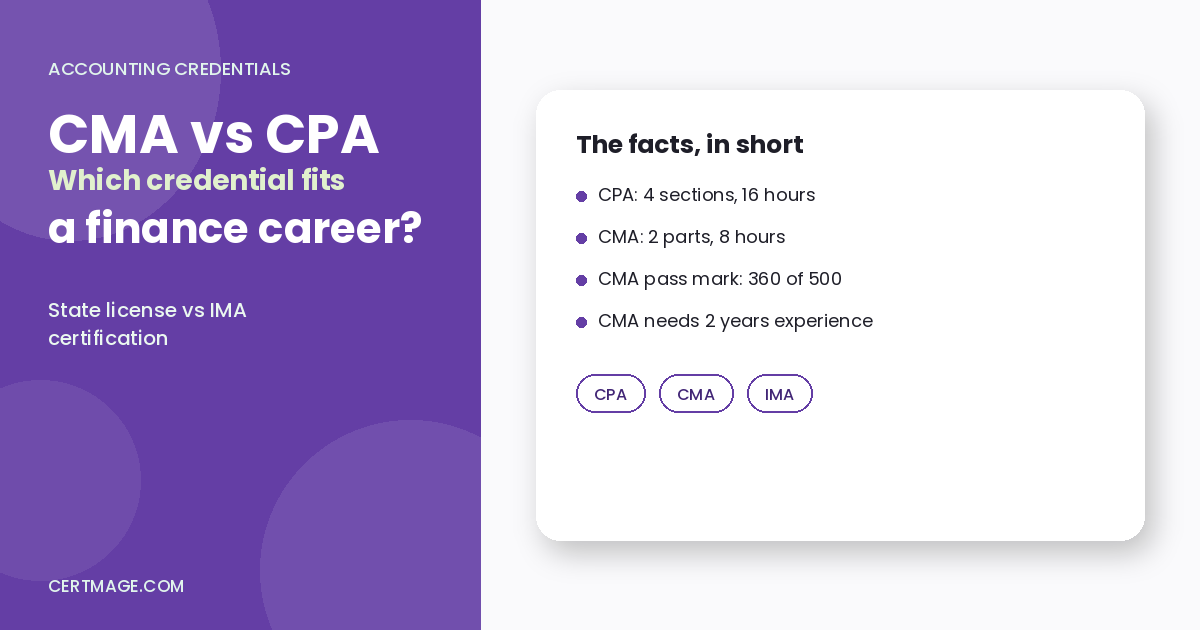
Short answer: Choose the CPA (Certified Public Accountant) if you want the broadest U.S. accounting license, with a path into public accounting, external audit, tax, and roles that legally require licensure. Choose the CMA (Certified Management Accountant) if your career is inside a company: budgeting, forecasting, cost management, performance analysis, and strategic finance. The CPA is a state-issued license built from four four-hour exam sections, a 75 passing score and education and experience rules set by each state board. The CMA is a professional certification from the Institute of Management Accountants (IMA), built from two four-hour exam parts, a 360 passing score on a scale of 0 to 500, and a requirement of two years of management accounting or financial management experience. They are not rivals so much as different tools. The CPA fits the audit, tax, and licensure side of accounting. The CMA fits corporate finance and management accounting. Many professionals eventually hold both.
Key takeaways
- CPA is a license. CMA is a certification. Your state Board of Accountancy grants the CPA license, while the IMA grants the CMA.
- They answer different questions. The CPA proves accounting, audit and tax competence. The CMA proves management accounting and financial management competence.
- The CPA exam is longer. Four sections of four hours each is 16 hours of testing. The CMA is two parts of four hours each, 8 hours in total.
- The CMA exam format is changing. Prep providers report that the CMA essay questions are being replaced by case-based questions in 2026. Check the IMA’s current exam format before you study.
- Education rules differ. The CPA usually needs 150 credit hours in most states, while the CMA needs a bachelor’s degree from an accredited institution, or an IMA-approved professional certification in its place, according to prep provider summaries of IMA’s rules.
- Experience rules differ. The CMA needs two continuous years of professional experience in management accounting or financial management. The CPA needs state-defined supervised experience, often one to two years.
- The costs differ in structure. The CMA charges an IMA membership, an entrance fee and a fee per exam part. CPA fees depend on your state and jurisdiction.
Quick Facts: CMA vs CPA
| Item | CMA | CPA |
| Full name | Certified Management Accountant | Certified Public Accountant |
| Granted by | Institute of Management Accountants (IMA) | State or jurisdiction Board of Accountancy (exam set by AICPA, delivered through NASBA and testing providers) |
| Type | Professional certification | License to practice |
| Core focus | Management accounting, financial planning, performance, strategic finance | Accounting, external audit and attestation, tax, financial reporting |
| Exam structure | 2 parts: Financial Planning, Performance, and Analytics (Part 1) and Strategic Financial Management (Part 2) | 3 Core sections (AUD, FAR, REG) plus 1 Discipline section (BAR, ISC or TCP) |
| Testing time | 4 hours per part, 8 hours total | 4 hours per section, 16 hours total |
| Question format | 100 multiple-choice questions plus written or case-based questions (the essay format is being replaced by case-based questions in 2026 per prep providers) | Multiple choice plus task-based simulations |
| Passing score | 360 on a scale of 0 to 500 per part | 75 on a scale of 0 to 99 per section |
| Education | Bachelor’s degree or an IMA-approved certification in its place | Set by your state, commonly 150 credit hours, with other pathways in some states |
| Experience | 2 continuous years in management accounting or financial management | Set by your state, commonly 1 to 2 years supervised |
| Time to finish | Pass both parts within 3 years of paying the entrance fee | At least 30 months to pass all sections in most jurisdictions |
| Maintenance | 30 hours of continuing professional education a year, including ethics, plus annual IMA membership | State CPE rules |
The CPA figures come from the AICPA and NASBA. The CMA figures reflect IMA’s rules as summarized by major CMA prep providers and were checked in November 2026. Requirements, fees and exam formats change, so confirm on the official IMA and state board pages before you apply.
What Is the Difference Between CMA and CPA?
The CPA is a state-issued license for accountants, centered on accounting, external audit and attestation, tax and financial reporting. The CMA is a certification for accountants and finance professionals who work inside organizations, centered on planning, budgeting, cost accounting, performance management, decision analysis and strategic finance. In short, a CPA is licensed to practice public accounting, and a CMA is certified in management accounting.
That difference shapes everything else: who sets the rules, how the exam is built, which jobs ask for each credential and how the two combine over a career.
One name check. You may see “CGMA” in some searches, a separate designation connected to the AICPA and CIMA. The CMA discussed here is the IMA credential.
What Is the CPA?
The CPA is the primary accounting license in the United States. Each jurisdiction’s Board of Accountancy sets education, experience and ethics requirements and decides who receives a license, while all candidates take the same Uniform CPA Examination.
Key facts:
- Exam structure: Three four-hour Core sections, Auditing and Attestation (AUD), Financial Accounting and Reporting (FAR) and Taxation and Regulation (REG), plus one four-hour Discipline section of your choice: Business Analysis and Reporting (BAR), Information Systems and Controls (ISC) or Tax Compliance and Planning (TCP).
- Total time: 16 hours of testing, with a standardized 15-minute break in each section that does not count against testing time.
- Scoring: 75 on a scale of 0 to 99 per section. The score is not a percentage, and it is not curved.
- Question mix: Each section blends multiple-choice questions and task-based simulations, weighted evenly for the Core and most Discipline sections. ISC is weighted 60% multiple choice and 40% simulations.
- Pass rates: The AICPA publishes pass rates quarterly. For Q1 to Q3 2026, the cumulative rates were about 50% for AUD, 44% for FAR, 66% for REG, 44% for BAR, 69% for ISC and 80% for TCP.
- Time window: Most jurisdictions allow at least 30 months to pass all sections, with the exact clock set by the state.
- Education and experience: Set by each Board of Accountancy. The traditional route is 150 credit hours, but some states have adopted other pathways. Experience is commonly one to two years under a licensed CPA.
For a deeper look at upcoming testing logistics, see our guide to the CPA exam platform change, blackout dates and score-release schedule.
What Is the CMA?
The CMA is the IMA’s flagship certification for management accountants and financial professionals. It tests how you plan, analyze, control and make decisions with financial information inside an organization.
Key facts (from IMA rules as summarized by CMA prep providers):
- Exam structure: Two parts. Part 1 is Financial Planning, Performance, and Analytics. Part 2 is Strategic Financial Management. You must pass both, and you can take them in either order.
- Questions and time: Each part is a four-hour test with 100 multiple-choice questions and written questions. One prep provider describes three hours for the multiple-choice section and one hour for the written section.
- Format change: Historically each part included two essay scenarios. Prep providers report that, starting in 2026, essays are being replaced by case-based questions, short business scenarios followed by several application questions. The rollout is phased across the 2026 testing windows, so check which format applies to your window.
- Scoring: Scores range from 0 to 500, and the minimum passing score is 360 for each part, per prep provider summaries.
- Testing windows: The CMA exam is offered in three windows a year: January and February, May and June, and September and October.
- Pass rates: Prep providers cite a pass rate of roughly 45% per part, but the supporting data they quote is old, so treat it as a rough guide rather than a current statistic.
- Time window: You must pass both parts within three years of paying the entrance fee, or you must re-enroll and pay again.
- Maintenance: 30 hours of continuing professional education each year, including an ethics component, plus an annual IMA membership.
Exam Content Side by Side
| CPA section | What it covers (at a high level) |
| AUD | Auditing and attestation, ethics, professional responsibilities, engagement planning and reporting |
| FAR | Financial accounting and reporting for business entities, governmental entities and not-for-profits |
| REG | Federal tax, business law and professional responsibilities |
| BAR (Discipline) | Business analysis and reporting, including technical accounting and analytics |
| ISC (Discipline) | Information systems and controls |
| TCP (Discipline) | Tax compliance and planning |
| CMA part | What it covers (at a high level) |
| Part 1: Financial Planning, Performance, and Analytics | External financial reporting decisions, planning, budgeting and forecasting, performance management, cost management, internal controls and technology and analytics |
| Part 2: Strategic Financial Management | Financial statement analysis, corporate finance, decision analysis, risk management, investment decisions, professional ethics |
The practical split: the CPA reaches deep into audit, tax and technical financial reporting. The CMA reaches into planning, cost accounting, decision-making and corporate finance. If your daily work is variance analysis, forecasting and business partnering, CMA topics will feel familiar. If your daily work is audit, tax returns and external reporting, CPA topics will.
How Do Eligibility Requirements Compare?
CMA
According to prep provider summaries of IMA’s rules:
- Education: A bachelor’s degree from an accredited college or university, or an IMA-approved professional certification in its place. The degree does not have to be finished before you sit the exam, and candidates have up to seven years after passing to submit proof of education.
- Experience: Two continuous years of professional experience in management accounting or financial management. You can complete this before the exam, during prep, or within seven years after passing.
- Membership: You must be an IMA member before you register for the exam.
Confirm all of this on IMA’s current pages, because rules and deadlines are updated from time to time.
CPA
Set by each state board. The traditional route is 150 credit hours with a set number of accounting and business credits, and some states have adopted alternative pathways. Experience is commonly one to two years under a licensed CPA. Ethics exams or other requirements may apply. If you are not sure which state to apply through, check each board’s rules before you choose, since rules differ.
Which is easier to qualify for?
The CMA is more flexible on timing. You can start the exam with a degree in progress and finish the experience requirement after you pass. The CPA is stricter, because most states require the education credits to be in place before you can sit all sections or be licensed. For candidates outside the United States, the CMA is often the more accessible route, while the CPA depends on a state board’s rules for foreign candidates.
How Do the Exams Compare?
| Feature | CMA | CPA |
| Total testing time | 8 hours (two parts) | 16 hours (four sections) |
| Question types | Multiple choice plus written or case-based questions | Multiple choice plus task-based simulations |
| Passing score | 360 of 500 per part | 75 per section |
| Scoring note | Scaled score; multiple choice carries most of the weight per prep providers | Scaled score; not a percentage and not curved |
| Time limit to finish | 3 years from the entrance fee | At least 30 months in most jurisdictions |
| Testing windows | Three windows a year | Year-round with some blackout periods (see our platform change guide) |
The CPA asks for more hours of testing and more depth in audit and tax. The CMA asks for fewer hours but still demands strong command of analysis and decision-making.
How Do the Costs Compare?
| Cost item | CMA (professional rate) | CPA |
| Membership | IMA membership: USD 295 a year (professional) per prep providers; student and academic rates are lower | Not required by the exam; state society dues are optional |
| Entrance fee | USD 300 per prep providers | Application fees vary by state |
| Exam fee | USD 545 per part per prep providers, so USD 1,090 for both parts | Set per section through NASBA and your board; varies by jurisdiction |
| Total without retakes | About USD 1,685 at the professional rate per prep providers | Depends on your state, review course and number of sections |
| Retakes | Pay the exam fee again for a failed part | Pay for each retake of a section |
| Annual cost to keep it | Annual IMA membership plus CPE | State license renewal plus CPE |
The CMA figures above come from prep provider summaries of IMA’s fees, and IMA changes its fees from time to time, so confirm the current amounts on IMA’s fee page. For the CPA, there is no single national price, so budget using your state board’s fee schedule and the exam section fees. Review courses are a separate cost for both credentials. Ask your employer about reimbursement before you pay.
How Do the CMA Case-Based Questions Work?
The format change is the biggest CMA news for 2026, so it deserves its own explanation. According to prep provider summaries, each CMA part has historically included 100 multiple-choice questions plus two essay-style scenarios. Starting in 2026, the essays are being replaced by case-based questions (CBQs). A CBQ is a short business scenario, typically around 250 words, followed by six or seven application questions. Some of these questions may use short answers or drag-and-drop ordering instead of multiple choice.
What this means for you:
- Time split. One prep provider describes three hours for the multiple-choice section and one hour for the case-based section within the four-hour part.
- Skill shift. You are tested on applying a concept to a scenario, not on writing a long essay. Practise reading a short case, picking out the numbers that matter and answering in a structured way.
- Rollout. The change is described as phased across the 2026 testing windows. Which format you see depends on your window and region, so check IMA’s announcements before you book.
- Older scoring rules. Under the older essay format, prep providers say candidates needed at least 50% on the multiple-choice section to advance to the essays, with multiple choice worth about 75% of the score and the written section about 25%. These weights may not carry over unchanged to the new format, so do not rely on them without checking IMA’s current guidance.
If you are mid-preparation with older books or question banks, make sure they include case-based practice.
How Do CPA Pass Rates Compare Across Sections?
The AICPA publishes pass rates quarterly. For Q1 to Q3 2026, the cumulative rates were:
| CPA section | Type | Cumulative pass rate (Q1 to Q3 2026) |
| AUD | Core | About 50% |
| FAR | Core | About 44% |
| REG | Core | About 66% |
| BAR | Discipline | About 44% |
| ISC | Discipline | About 69% |
| TCP | Discipline | About 80% |
Two practical points. First, the Discipline section you choose changes your odds: ISC and TCP show higher rates than BAR, though the people who choose each Discipline differ, so do not read this as a guarantee. Second, FAR is usually where candidates spend the most study time, so plan it early. For CMA, prep providers cite roughly 45% per part, but the data behind that number is old.
How Do Retakes and Time Limits Work?
| Question | CMA | CPA |
| What if I fail a part or section? | Pay the exam fee again and retake the part | Pay for a new attempt at the section |
| How long do passed scores last? | Both parts must be passed within three years of paying the entrance fee, or passed part scores expire and you must reapply and pay again | Most jurisdictions allow at least 30 months to pass all sections, with the clock set by the state |
| Can I take parts or sections in any order? | Yes, Part 1 and Part 2 can be taken in either order | Yes, sections can generally be taken in any order, subject to your state’s rules |
| How often can I test? | Three windows a year (January and February, May and June, September and October) | Year-round with some blackout periods |
| How do I see my results? | A performance report arrives by email about 14 days after results, per one prep provider | Score release follows the AICPA schedule; see our platform change guide |
Plan around the clock. If you pick the CMA, remember that the three-year window starts when you pay the entrance fee, so pay it when you are ready to start studying, not months earlier. If you pick the CPA, check your state’s rule on how long passed sections stay valid.
What Does a Realistic Budget Look Like?
Using the prep provider figures for the CMA at the professional rate (IMA membership USD 295, entrance fee USD 300 and USD 545 per part):
| CMA budget scenario | Calculation | Total |
| Pass both parts the first time | 295 + 300 + (2 x 545) | USD 1,685 |
| Retake one part once | 1,685 + 545 | USD 2,230 |
| Retake both parts once | 1,685 + 1,090 | USD 2,775 |
Student and academic rates are lower. One prep provider lists a total of USD 1,088 for students and USD 1,199 for academic members, without retakes. Review courses, books and question banks are extra for both credentials, so add them to your plan.
For the CPA there is no single national price. Your total depends on your state’s application and licensing fees, the exam fee for each section, any extra credit hours you need for the 150-hour rule and your review course. Ask your employer whether they reimburse exam fees, because many do for professional credentials.
Confirm every number on IMA’s fee page before you pay, since fees change.
What Is a Realistic Timeline?
These are suggestions for planning, not official figures.
| Path | Planning idea |
| CMA, full-time job, steady study | Many candidates aim for one part per testing window. With three windows a year, finishing both parts in two windows is possible, but the three-year limit gives you room for a retake |
| CMA, short on time | Take Part 1 in one window, then Part 2 in the next window, and keep the third window as a safety net |
| CPA, full-time job | Most people take one section at a time. Four sections in four to six testing windows is a common plan, and the 30-month minimum window leaves room for a retake |
| CPA with a retake | Build a buffer. A failed section can push the plan by a full testing window |
Whichever path you pick, write the dates of your three-year (CMA) or 30-month (CPA) deadline in your calendar on day one.
What Are Common Mistakes to Avoid?
- Paying the CMA entrance fee too early. The three-year clock starts then.
- Studying with old CMA material. If your question bank still teaches the essay format, add case-based practice.
- Assuming the CPA is optional everywhere. In some roles, only a licensed CPA can sign audit reports. Check what your target jobs require.
- Ignoring state differences for the CPA. Education, experience and ethics rules differ by state. Choose your jurisdiction deliberately.
- Treating pass rates as personal odds. A 44% section pass rate describes the whole pool, not you.
- Skipping the experience rules. The CMA needs two continuous years in management accounting or financial management. Make sure your role counts, and document it.
- Forgetting maintenance. The CMA needs 30 hours of continuing professional education a year and an active IMA membership. The CPA needs state CPE and renewal.
How Do These Credentials Show Up in Real Careers?
Titles and requirements vary by employer, so treat this as a general map, not a promise.
| Career area | How the credentials are typically used |
| Public accounting (audit and tax) | The CPA license is the standard expectation, and it is often required to sign reports |
| Corporate accounting and controllership | Employers often value the CPA, and many also value the CMA for cost and planning skills |
| FP&A and finance business partnering | The CMA content (budgeting, forecasting, performance) matches the daily work |
| Cost accounting and management reporting | The CMA aligns closely with the work |
| Strategic finance and decision support | The CMA’s Part 2 content on corporate finance and decision analysis fits well |
| Internal audit and risk | See our CPA vs CIA guide, because the CIA is built for this |
Which One Should You Pick? Five Quick Scenarios
- You are an accounting graduate at a regional audit firm. Start with the CPA. Your firm likely expects it, and the license matters for your path.
- You are an FP&A analyst at a manufacturing company. The CMA fits your daily work and costs less testing time. Consider the CPA later if your employer values it.
- You work in industry outside the United States. The CMA is usually the more accessible option, because it is not tied to a state board.
- You are a controller with a CPA, aiming at strategic finance. Add the CMA to show planning and decision skills.
- You are undecided. Read five job postings for the role you want in two years and count which credential appears. Pick that one.
Which Is Harder?
Neither organization’s official material gives a simple difficulty ranking, so any claim is a judgment. What the data shows is a difference in load. The CPA requires 16 hours of testing, four sections and stricter education rules. The AICPA publishes quarterly pass rates, and for Q1 to Q3 2026 the cumulative rates ranged from about 44% for FAR and BAR to 80% for TCP. CMA prep providers cite a pass rate of roughly 45% per part, but the underlying data is older, so do not treat it as current.
In practice, the CPA is the longer and more demanding commitment. The CMA is shorter, but its two parts are broad and analytical, and a pass rate near the mid-40s per part means preparation matters.
Which Credential Fits Which Career?
| Your goal | Better fit | Why |
| Work in public accounting, audit or tax | CPA | Licensure is expected or required for many roles |
| Become a controller, FP&A manager or finance business partner | CMA, and possibly CPA | CMA content matches planning, cost and decision work |
| Move into corporate finance or strategic finance | CMA | Covers planning, analysis and decision support |
| Sign audit reports or practice as a licensed accountant | CPA | Only the license grants this authority |
| Work outside the United States in management accounting | CMA | Not tied to a state board |
| Career in internal audit | See our CPA vs CIA guide | The CIA targets internal audit specifically |
| Interested in fraud examination | See our CFE guide | Different specialty |
| Heading to a risk or investment career | See our FRM vs CFA comparison | Different path |
| Not sure yet | Choose by the jobs you want | Check job postings in your market |
If your target employers list both, ask what each credential unlocks in that company, such as a promotion path, a license requirement or a salary band. We do not quote salary figures here, because they vary by employer, region and role.
Should You Get Both?
Many finance leaders do, and the two complement each other. A CPA plus a CMA signals both technical accounting and management accounting skills. A common sequence is to earn the CPA first if you are headed toward public accounting, then add the CMA when you move into industry. The reverse also works: some management accountants earn the CMA first, then add the CPA if licensure becomes useful. Doing both at once is demanding, since each takes many months of study. Holding both also means two sets of continuing education and fees, so check what your employer values before you commit.
For other audit and control credentials that sometimes sit alongside these, see our roundup of the most rewarding IT auditing certifications and our CIA vs CISA guide.
A 12-Week Study Plan for Each Credential
This is a suggested pace, not a requirement. Adjust it to your schedule and background.
| Week | CMA focus | CPA focus (one section) |
| 1 | Read IMA’s content outline and the current exam format; rate your strengths | Choose your first section; read the AICPA blueprint |
| 2 to 4 | Part 1: planning, budgeting, forecasting, performance management | Core content for your section |
| 5 to 6 | Part 1: cost management, internal controls, analytics | Practice multiple-choice sets |
| 7 to 9 | Part 2: financial statement analysis, corporate finance, risk | Task-based simulations |
| 10 to 11 | Part 2: decision analysis, investment decisions, ethics; practice written or case-based questions | Timed practice exams |
| 12 | Full-length mock exam for the part you will sit first | Final review and mock exam |
The CPA plan covers one section only. A full CPA effort runs across four sections and often spans a year or more.
For practice material, see our CMA exam questions.
Is a CMA or CPA Worth It?
It depends on your employer, region and role. A CPA is often required for licensed public accounting work. A CMA is valued in corporate finance and management accounting roles. Review job postings in your market, note which credential employers name, and weigh fees, study time and ongoing requirements. We avoid quoting salary numbers, because they differ widely.
FAQS
What is the difference between CMA and CPA?
The CPA is a state-issued license focused on accounting, audit and tax. The CMA is a certification from the IMA focused on management accounting and financial management inside organizations.
Which is better, CMA or CPA?
Neither is better overall. The CPA fits public accounting, audit and tax. The CMA fits corporate finance, FP&A and management accounting.
How many exams are there for CMA and CPA?
The CMA has two parts of four hours each. The CPA has four sections of four hours each: three Core sections and one Discipline section.
What is the passing score for the CMA?
360 on a scale of 0 to 500 for each part, per CMA prep provider summaries of IMA’s rules.
What is the passing score for the CPA?
75 on a scale of 0 to 99 for each section. The score is not a percentage.
Are the CMA essays going away?
Prep providers report that, starting in 2026, CMA essay questions are being replaced by case-based questions, with a phased rollout across testing windows. Check IMA’s current exam format for your testing window.
How long do I have to finish the CMA?
You must pass both parts within three years of paying the entrance fee, or you must re-enroll and pay the entrance fee again.
How long do I have to finish the CPA exam?
Most jurisdictions allow at least 30 months to pass all sections, with the exact clock set by the state.
Do I need a degree for the CMA?
You need a bachelor’s degree from an accredited college or university, or an IMA-approved professional certification in its place, according to prep provider summaries. Check IMA’s current rules.
Do I need 150 credit hours for the CMA?
No. The 150-credit-hour rule is a common CPA requirement set by state boards, not a CMA rule.
How much does the CMA cost?
Prep providers list professional-rate fees of USD 295 for annual IMA membership, USD 300 for the entrance fee and USD 545 per exam part, about USD 1,685 in total without retakes. Confirm current amounts with IMA.
Can I get both CMA and CPA?
Yes. Many finance professionals hold both, often earning one first and the other later as their role changes.
Is a CMA or CPA worth it?
It depends on your employer and target role. Review job postings in your market and weigh fees, study time and ongoing requirements before you decide.
Final Thoughts
The CPA and CMA measure different things. The CPA says you can practice accounting, audit and tax under a state license. The CMA says you can plan, analyze and guide a business with financial information. Choose by the work you do today and the roles you want next, then confirm eligibility, exam format and fees on the official IMA CMA page and your state board of accountancy before you apply.