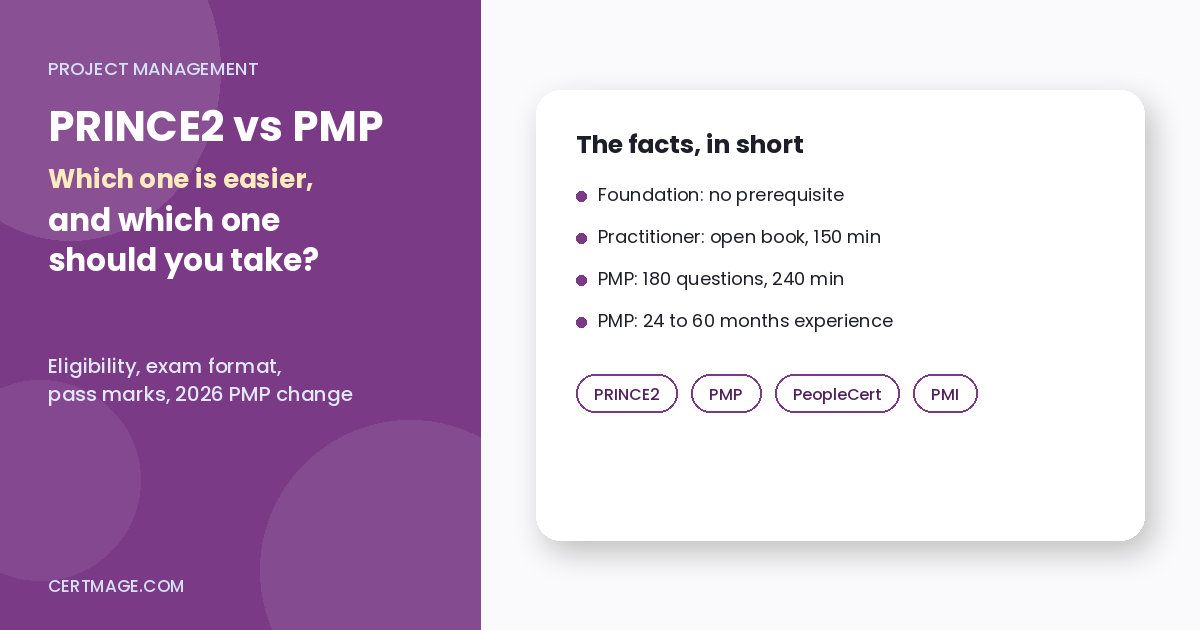
TL;DR: PRINCE2 Foundation is the easiest of the three exams you are really comparing. It is a 60-minute, closed-book, 60-question test that has no experience requirement. But “PRINCE2” on a CV usually means Foundation plus Practitioner, and Practitioner is a 150-minute, scenario-based, open-book exam that asks you to apply the method. PMP is harder to get into and longer to sit: you need documented project leadership experience (24 to 60 months depending on your education), 35 hours of project management training or a CAPM, and a 240-minute exam that, since July 2026, puts 26% of its weight on business environment topics and 60% on agile and hybrid approaches. So the short answer is: PRINCE2 is easier to start and easier to qualify for, PMP is harder on both counts, and the exam itself depends on how you study (memorizing a method versus judging scenarios). Neither vendor publishes pass rates, so any “X% pass” claim you see is a training provider’s own number.
Key Takeaways
- Entry barrier: PRINCE2 Foundation has none. PMP requires 24 to 60 months of project leadership experience plus 35 hours of training (or CAPM).
- Exam length: PRINCE2 Foundation is 60 minutes and Practitioner is 150 minutes (210 minutes in total). PMP is one 240-minute exam.
- Book rules: Foundation is closed book. Practitioner is open book (official manual only). PMP is closed book.
- Thinking level: Foundation tests recall and understanding (Bloom levels 1 and 2). Practitioner tests application and analysis (levels 3 and 4). PMP is scenario-heavy throughout.
- Pass marks: Foundation is 36 of 60 (60%). Practitioner is 42 of 70 marks (60%). PMI does not publish a PMP passing score.
- Two exams versus one: PRINCE2 splits the work into two sittings. PMP is one big sitting.
- Cost: PMP exam fees are published by PMI (USD 405 for members, USD 555 for non-members). We could not confirm PeopleCert’s current PRINCE2 exam prices from an official page.
- Timing: PMP’s exam changed on July 9, 2026, so older “PMP is easier than you think” advice may describe the old exam.
Quick Facts
| Item | PRINCE2 7 Foundation | PRINCE2 7 Practitioner | PMP (July 2026 exam) |
| Body | PeopleCert (PRINCE2 7) | PeopleCert (PRINCE2 7) | PMI |
| Questions | 60 multiple choice | 70 part questions, worth 70 marks | 180 (170 scored, 10 unscored) |
| Time | 60 minutes | 150 minutes | 240 minutes plus two 10-minute breaks |
| Book | Closed | Open (official PRINCE2 7 manual only) | Closed |
| Pass mark | 36 of 60 (60%) | 42 of 70 (60%) | Not published (psychometric scoring) |
| Thinking level | Recall and understand | Apply and analyze | Applied judgment in scenarios |
| Prerequisite | None | A listed qualification (see below) | Education tier plus 24 to 60 months of experience, plus 35 hours of training or CAPM |
| Validity | 3 years (per a third-party guide) | 3 years (per a third-party guide) | 3-year renewal cycle (PMI handbook) |
| Fee | Not confirmed from an official page | Not confirmed from an official page | USD 405 members, USD 555 non-members (PMI) |
| Retakes | Take2 option exists. Terms unconfirmed | Same | Up to 3 attempts in your 1-year eligibility window (PMI handbook), fees paid again |
What Does “Easier” Actually Mean?
“Easier” can mean four different things, and PRINCE2 and PMP win on different ones. Before you compare them, separate:
- Easier to qualify for. Can you sit the exam at all? PRINCE2 Foundation wins easily.
- Easier to prepare for. How much material do you need to absorb and how deep? PRINCE2 Foundation is lighter. PMP covers more ground.
- Easier to pass on the day. Question style, time pressure and open-book rules. This is closer than people expect, because Practitioner is open book but scenario-based.
- Easier to keep and use. Renewal, employer recognition and where the credential travels.
The rest of this guide takes them in order.
How Do the Entry Requirements Compare?
This is the clearest gap.
PRINCE2 Foundation: no prerequisite. Anyone can book it.
PRINCE2 Practitioner: you need a qualifying credential first. One study guide lists PRINCE2 7 Foundation, PRINCE2 5th or 6th Edition Foundation or Practitioner, PMP, CAPM and several other project management credentials as accepted. PeopleCert’s own list is what counts, so confirm it before you book.
PMP: according to PMI’s July 2026 content outline you need one education tier with matching experience:
| Education | Project leadership experience |
| Secondary school completion | 60 months (5 years) |
| Associate’s-level or equivalent | 48 months (4 years) |
| Bachelor’s degree or higher | 36 months (3 years) |
| Bachelor’s or postgraduate degree from a PMI GAC-accredited program | 24 months (2 years) |
Experience must be in a professional setting, recorded in non-overlapping months, and fall within the last 10 years. You also need 35 hours of project management training aligned to the outline, or an active CAPM. Books and practice exams alone do not count.
One source conflict to know about: PMI’s PMP certification page, as we read it, still described an eight-year experience window, while the July 2026 content outline says 10 years. We treat the newer outline as the better source, but confirm this when you apply. Our PMP exam changes guide tracks what changed and when, including a rule about training providers that we covered there.
What this means for “easy”: if you are new to project management, PMP is closed to you until you have the experience. PRINCE2 Foundation is open today.
How Do the Exams Themselves Compare?
PRINCE2 7 Foundation
- 60 multiple-choice questions, each worth one mark, in 60 minutes.
- Closed book, no negative marking.
- Pass mark 36 of 60 (60%). The previous edition’s mark was 55% (33 of 60), according to one study guide.
- Questions are Bloom levels 1 and 2: remember and understand.
- Question styles include standard, missing word, “select two correct statements” lists and, occasionally, negative standard questions.
| Syllabus area | Weight |
| Key concepts relating to projects and PRINCE2 | 3% |
| How the principles underpin the method | 8% |
| The importance of people in successful projects | 14% |
| Practices and how they are applied | 60% |
| Processes and how they are carried out | 15% |
The syllabus is dominated by the practices (business case, organizing, plans, quality, risk, issues and progress), which are 60% of the questions.
PRINCE2 7 Practitioner
- 70 part questions worth 70 marks, in 150 minutes. Candidates testing outside their native or working language can receive 25% extra time.
- Open book, but only the official PRINCE2 7 manual (annotations allowed in a printed copy, per the syllabus).
- Pass mark 42 of 70 (60%). No negative marking.
- Questions are built on a project scenario. Question types include classic four-option questions (1 mark) and matching questions (3 marks).
- Bloom levels 3 and 4: apply and analyze.
| Syllabus area | Weight |
| Applying principles in context | 10% |
| People management (leadership, change, communication) | 9% |
| Applying and tailoring practices | 51% |
| Applying and tailoring processes | 30% |
We found a small discrepancy in how third-party pages describe the question structure (one said 56 questions and sub-questions, while the syllabus document says 70 part questions). We use the syllabus figure of 70 marks, and you should check the current sample paper for exact structure.
PMP (July 2026 exam)
- 180 questions: 170 scored and 10 unscored pretest items. Some websites cite 175 or 185. PMI’s outline says 180.
- 240 minutes, plus two 10-minute breaks. You cannot go back to a previous section once you start a break.
- Question types include case or scenario items, graphic-based items, single and multiple response, and (computer-based only) matching, point-and-click and pull-down items.
- No published passing score. PMI says passing scores are set by psychometric analysis, and describes the PMP as a criteria-based exam.
| Domain | Weight | Tasks |
| People | 33% | 8 |
| Process | 41% | 10 |
| Business Environment | 26% | 8 |
About 40% of items cover predictive approaches and about 60% cover agile, adaptive and hybrid approaches.
Which Exam Feels Harder on the Day? (Our Reading)
This table is our own interpretation of the published formats, not an official difficulty ranking.
| Factor | PRINCE2 Foundation | PRINCE2 Practitioner | PMP |
| Time per question (our arithmetic) | About 1 minute | About 2.1 minutes per mark | About 1.3 minutes per question |
| Stamina | Low | Medium (2.5 hours) | High (4 hours) |
| Memory load | Medium: terms, principles, themes | Lower, because the manual is open | High: broad content across three domains |
| Judgment load | Low | High: scenario analysis | High: scenario and case items |
| Pass mark visibility | Published (60%) | Published (60%) | Hidden |
| Open book | No | Yes | No |
What stands out: PRINCE2 Foundation tests whether you know the method. Practitioner tests whether you can use it, and the open book helps only if you already know where things are and how to apply them. PMP is the longest and the least transparent, because you do not know the pass mark and the question mix is broader.
How Hard Is the Prep? (Our Estimates, Not Official)
These ranges are our planning estimates for a working adult. They are not vendor guidance, and neither PMI nor PeopleCert publishes official study-hour figures.
| Path | Background | Estimated prep time | Main work |
| PRINCE2 Foundation | New to project management | 3 to 4 weeks | Vocabulary, seven principles, practices, processes |
| PRINCE2 Foundation | Some project experience | 2 to 3 weeks | Method-specific terms and roles |
| PRINCE2 Practitioner | Foundation passed | 3 to 5 weeks | Scenario practice and manual navigation |
| PMP | Hands-on project lead | 8 to 12 weeks | Three domains, agile and hybrid, timed scenario practice |
| PMP | Little agile experience | 10 to 14 weeks | Agile and hybrid concepts, business environment |
One study guide for PRINCE2 7 Foundation suggests around 20 hours and consistent mock scores above 75% before booking. That is a single provider’s suggestion, not an official benchmark.
What Do the Pass Rates Tell Us?
Very little. PeopleCert and PMI do not publish global pass rates in the pages we read. A guide on PRINCE2 7 Foundation cites a first-time pass rate of 81% for 2024 from one training company, and others advertise above 90%, but those are figures from parties that sell courses, usually for cohorts that completed all coursework. We found no comparable PMP pass rate from PMI. Because of this, “PRINCE2 has a higher pass rate than PMP” is not something you can establish from public data.
How Do the Costs Compare?
| Cost item | PRINCE2 | PMP |
| Exam fee | Not confirmed from an official page. One study guide showed a dated storefront reference of USD 701 including VAT for Foundation, with no clear statement of what that includes | USD 405 (members), USD 555 (non-members), per PMI |
| Training | Optional for Foundation. Often bought as a bundle. One provider lists bundles from USD 2,325 | 35 hours required unless you hold CAPM. Prices vary by provider |
| Retake | Take2 option exists. Terms unconfirmed | Fee paid again for the second and third attempts. One source lists USD 275 for members and USD 375 for non-members |
| Keeping it active | Renewal every 3 years by resit, another suite exam or CPD (third-party guide) | Renew every 3 years through PMI’s continuing certification program (PDU details on PMI’s site) |
A cautious reading: we cannot state which is cheaper in total, because we could not confirm PeopleCert’s current exam prices and training costs vary widely. What we can say is that PMP’s exam fee is public and PMI membership changes the price, so compare the member and non-member totals before you pay. Our PMI promo codes guide lists the discount routes we have found.
Which Credential Is Easier to Use at Work?
Ease of passing is not ease of using. Some points that matter more than exam difficulty:
- PRINCE2 gives you a structured method: principles, themes or practices, and processes, with defined roles, stage-based control and management by exception. It is a method you can apply directly.
- PMP is broader: people, process and business environment, with predictive, agile and hybrid approaches, and it is closely tied to PMI’s body of knowledge.
- Employer demand varies by region and sector. We do not publish salary figures, and we could not verify employer-demand data from an official source, so check job postings in your target country and industry.
If you are comparing PMP with a more agile credential rather than with PRINCE2, see our PMP vs PMI-ACP guide. If you are comparing it with the entry-level PMI credential, see PMP vs CAPM. If you work in IT and are choosing between management and security paths, see PMP vs CISSP.
Which One Is Easier for You? Seven Scenarios
- New graduate with no project experience: PRINCE2 Foundation is the only one you can sit now. PMP needs documented project leadership months.
- Team lead with four years of project experience and a bachelor’s degree: you meet PMP’s 36-month tier. PRINCE2 Foundation would be easier, but PMP may carry more weight if your employer asks for it.
- Project coordinator with an associate’s-level education: the PMP route needs 48 months, so PRINCE2 or CAPM may be the practical first step.
- Someone who dislikes memorizing terminology: PRINCE2 Foundation is heavy on method vocabulary, so it may feel harder than expected. PMP leans more on judgment.
- Someone who dislikes long exams: PRINCE2’s split into 60 and 150 minutes may suit you better than one four-hour sitting.
- Agile-first practitioner: PMP’s 60% agile and hybrid mix may feel more natural. See our PMP vs PMI-ACP guide above.
- Working in the UK, Europe or the public sector: PRINCE2 is often named there, but check actual postings rather than relying on general claims.
Do You Need Both?
Not usually. They overlap in purpose but differ in style. Some people take PRINCE2 Foundation and Practitioner first, then PMP once they have the experience. Some PMP holders add PRINCE2 for method-specific roles. A listed qualification such as PMP can also satisfy the Practitioner prerequisite according to one study guide, but verify that with PeopleCert before you book.
A Short Decision Framework
- Do I meet PMP’s experience tier? If not, start with PRINCE2 Foundation or CAPM.
- What do my target job postings name? Count how many ask for PRINCE2 and how many ask for PMP.
- Do I want a method or a framework? PRINCE2 is a defined method. PMP is a broader professional standard.
- How do I handle long exams? Choose accordingly between a 4-hour PMP and two shorter PRINCE2 sittings.
- What is my budget? Compare PMI member and non-member totals against PeopleCert and any training bundle.
- When do I need it? PRINCE2 Foundation can be done in weeks. PMP needs application approval and preparation.
Study Plan Ideas
A 4-week PRINCE2 Foundation plan (example)
- Week 1: Concepts, the seven principles and the overall structure of the method.
- Week 2: The practices (business case, organizing, plans), which carry the most weight.
- Week 3: Quality, risk, issues and progress, then the processes.
- Week 4: Timed practice at 60 questions in 60 minutes, then review weak areas.
A 4-week PRINCE2 Practitioner plan (example)
- Week 1: Re-read the practices and tag your manual so you can find things fast.
- Week 2: Scenario questions on business case, organizing and plans.
- Week 3: Scenario questions on risk, issues, progress and processes, including tailoring.
- Week 4: Full timed papers (70 marks in 150 minutes) and matching-question practice.
A 10-week PMP plan (example)
- Weeks 1 to 2: The exam content outline, People domain.
- Weeks 3 to 4: Process domain: planning, execution, monitoring and delivery.
- Weeks 5 to 6: Business Environment domain: governance, compliance, risk and change.
- Weeks 7 to 8: Agile and hybrid approaches across all domains.
- Week 9: Case-study and scenario practice.
- Week 10: Full-length 180-question timed practice with the break structure.
Common Mistakes
- Comparing only Foundation with PMP. The fair comparison is Foundation plus Practitioner against PMP.
- Assuming open book means easy. Practitioner is open book, but it is scenario-based and time-limited.
- Using pre-July 2026 PMP materials. The domain weights and format changed.
- Trusting pass-rate claims. They come from training providers.
- Ignoring PMP eligibility. Experience months must be non-overlapping and within the window.
- Using the wrong edition. Make sure your PRINCE2 materials are for the 7th edition and your PMP materials are for the July 2026 exam.
- Skipping timed practice. The PMP is four hours, and Practitioner pacing matters.
- Assuming the credentials are interchangeable. They are tested and applied differently.
FAQS
Is PRINCE2 easier than PMP?
To qualify for and to start, yes: Foundation has no prerequisite and is a short, closed-book test. Overall difficulty depends on which PRINCE2 level you compare and how you study.
Which is easier, PRINCE2 Foundation or Practitioner?
Foundation. It tests recall and understanding, while Practitioner tests application through scenarios, though Practitioner allows the official manual.
How many questions are on the PMP exam now?
180, of which 170 are scored and 10 are unscored, in 240 minutes, per PMI’s July 2026 outline.
What is the PRINCE2 7 pass mark?
36 of 60 for Foundation and 42 of 70 for Practitioner (both 60%).
What is the PMP passing score?
PMI does not publish a numeric passing score.
Do I need experience for PRINCE2?
Not for Foundation. Practitioner requires a qualifying credential first.
What experience do I need for PMP?
24 to 60 months of project leadership experience depending on your education, plus 35 hours of training or a CAPM.
Is PRINCE2 open book?
Practitioner is open book with the official manual only. Foundation is a closed book.
Can I retake the PMP if I fail?
Yes, up to three attempts within your one-year eligibility period, and you pay again for retakes, per the PMI handbook.
Do the credentials expire?
PMP renews on a three-year cycle. A third-party guide says PRINCE2 Practitioner is valid for three years, so confirm renewal rules with PeopleCert.
Which has better job prospects?
It varies by country and industry, and we did not verify demand data. Check job postings in your market.
Should I take PMP or PRINCE2 first?
If you do not yet meet PMP’s experience tier, PRINCE2 Foundation or CAPM is the practical first step.
Does the July 2026 PMP change make it harder?
It changed the weighting (Business Environment rose to 26%) and the mix (60% agile and hybrid). Whether that is harder depends on your background.
Final Thoughts
PRINCE2 is easier to start, and PMP is harder to qualify for and longer to sit. Beyond that, “easier” depends on your background and how you handle memorization, scenarios and long exams. Before you decide, read PMI’s July 2026 PMP examination content outline, compare the credentials named in the job postings you want, and confirm current PRINCE2 exam rules and prices with PeopleCert.