TL;DR
- PMI launched a new PMP exam on July 9, 2026. The previous version retired on July 8, with no overlap and no option to sit the old one. If your study plan was built on the 2021-era outline, it needs rework.
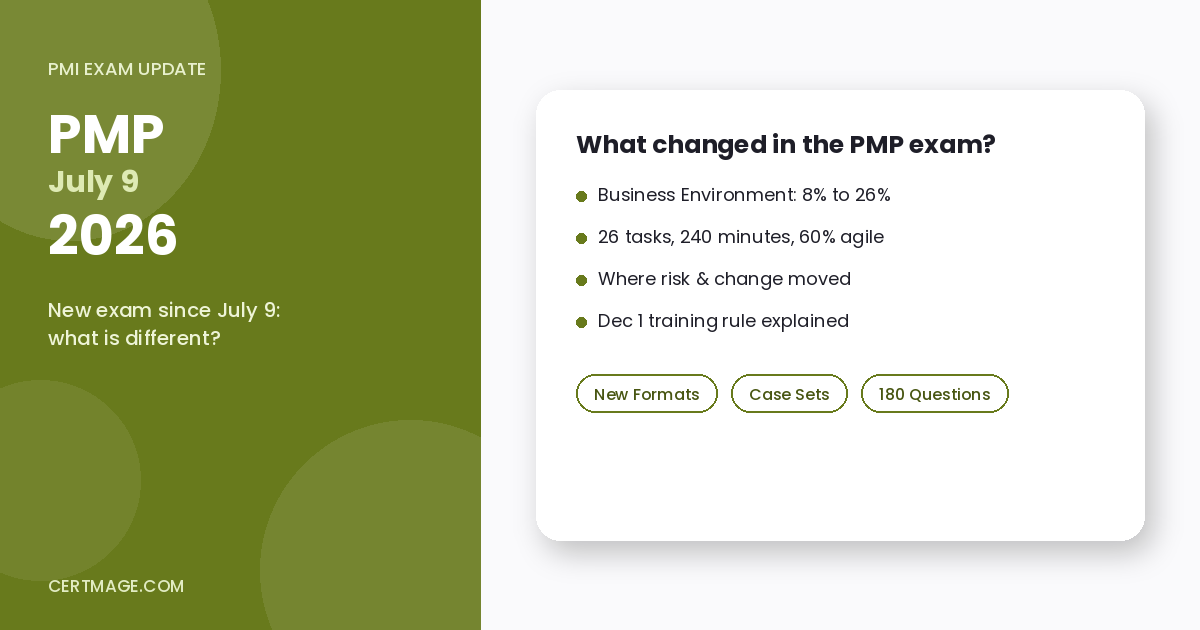
- The headline change is the domain split. Business Environment jumps from 8% to 26%, People drops from 42% to 33%, and Process drops from 50% to 41%. Much of the change is relocation: risk, change control, governance and impediment removal moved out of Process into Business Environment.
- PMI’s own Examination Content Outline (ECO) lists 26 tasks (8 People, 10 Process, 8 Business Environment), down from 35.
- The exam is still 180 questions, but 10 are now unscored pretest items (up from 5), leaving 170 scored. Time rises from 230 to 240 minutes, with two 10-minute breaks.
- The methodology mix shifts to roughly 40% predictive and 60% agile or hybrid, from about 50/50.
- New question formats include case or scenario sets (one situation followed by several linked questions) and graphic-based questions. AI and sustainability are explicitly in scope, as questions about using AI tools and meeting sustainability expectations, not about building AI.
- Eligibility changed too: the experience lookback window widened from 8 to 10 years, and from December 1, 2026, live instructor-led training hours only count when delivered by eligible providers. Self-paced training is not affected, and training completed before December 1 stays valid.
- Already hold the PMP? Nothing changes for you. You keep your credential and the same 60 PDUs per three-year cycle.
Quick Facts: Old vs New PMP Exam
| Previous exam (through July 8, 2026) | Current exam (from July 9, 2026) | |
| People domain | 42% | 33% (8 tasks) |
| Process domain | 50% | 41% (10 tasks) |
| Business Environment domain | 8% | 26% (8 tasks) |
| Total tasks | 35 | 26 |
| Total questions | 180 | 180 |
| Scored questions | 175 | 170 |
| Unscored pretest questions | 5 | 10 |
| Duration | 230 minutes | 240 minutes |
| Breaks | Two 10-minute breaks | Two 10-minute breaks |
| Predictive vs agile/hybrid | About 50/50 | About 40% predictive, 60% agile/hybrid |
| Experience lookback window | 8 years | 10 years |
| New question types | None | Case or scenario sets, graphic-based questions |
| Exam fee | $405 member / $555 non-member (reported) | Same (reported; confirm on PMI.org) |
| Validity | 3 years, 60 PDUs | 3 years, 60 PDUs |
A Note on Conflicting Information Online
Several PMP pages published around this change disagree on basic numbers, so check which ones you are reading.
- Scored questions. Some pages say 175 scored questions. Others say the exam has 185 questions. PMI’s own ECO states 180 total, made up of 170 scored and 10 pretest. Use that.
- “Same weights as before.” A few older summaries describe the exam as only lightly updated. The domain weights changed substantially.
- PMBOK Guide 8th Edition. Many articles link the new exam to PMBOK 8. Training providers who have looked at it point out that the exam is built on PMI’s ECO, not on any single book, and PMI cites more than one reference source. Treat the PMBOK Guide as one resource among several.
- Fees. Pages list slightly different amounts for non-members. The figures here are the ones most 2026 sources agree on, but PMI recommends confirming at the moment you book.
Timeline: How We Got Here
| Date | What happened |
| November 2025 | PMI published the new Examination Content Outline at its Global Summit |
| January 5 to 30, 2026 | Exam pilot window, as reported |
| July 8, 2026 | Last day of the previous exam |
| July 9, 2026 | New exam goes live |
| December 1, 2026 | Live instructor-led training hours must come from eligible providers to count toward the 35-hour requirement |
The change has already happened. If you are reading this in autumn 2026, the question is no longer “should I test before the cutoff” but “is my study material correct for the exam I will actually sit?”
Where Did My Topic Go? A Relocation Map
Because the shift is as much about moving topics as about changing them, the most useful way to see it is to ask where familiar topics now live. The mapping below uses PMI’s task list and training providers’ descriptions of what moved. It is an interpretation, since PMI does not publish an old-to-new crosswalk.
| Topic | Where it sat before (as reported) | Where it sits now |
| Risk planning and management | Process | Business Environment (“Plan and manage risk”) |
| Change control | Process | Business Environment (“Manage and control changes”) |
| Project governance | Process | Business Environment (“Define and establish project governance”) |
| Removing impediments and managing issues | Process | Business Environment (“Remove impediments and manage issues”) |
| Compliance | No published crosswalk | Business Environment (“Plan and manage project compliance”) |
| Finance, funding and contingency | Process | Process, now a dedicated task (“Plan and manage finance”) |
| Stakeholder engagement | People | People, with deeper emphasis (“Engage stakeholders,” “Align stakeholder expectations,” “Manage stakeholder expectations”) |
| Value delivery | No published crosswalk | Process task (“Help ensure value-based delivery”) |
| Continuous improvement | No published crosswalk | Business Environment (“Continuous improvement”) |
| Organizational change | No published crosswalk | Business Environment (“Support organizational change”) |
| External environment | No published crosswalk | Business Environment (“Evaluate external business environment changes”) |
The practical effect: someone who learned risk and change management as Process topics studied them for a domain worth 50% of the exam. They now sit in a domain worth 26%, alongside governance, compliance and organizational change, and they are tested more from a business and strategy angle.
PMI’s 26 Tasks, by Domain
These are the task statements from PMI’s official outline.
Domain I: People (33%, 8 tasks)
- Develop a common vision
- Manage conflicts
- Lead the project team
- Engage stakeholders
- Align stakeholder expectations
- Manage stakeholder expectations
- Help ensure knowledge transfer
- Plan and manage communication
Domain II: Process (41%, 10 tasks)
- Develop an integrated project management plan and plan delivery
- Develop and manage project scope
- Help ensure value-based delivery
- Plan and manage resources
- Plan and manage procurement
- Plan and manage finance
- Plan and optimize quality of products and deliverables
- Plan and manage schedule
- Evaluate project status
- Manage project closure
Domain III: Business Environment (26%, 8 tasks)
- Define and establish project governance
- Plan and manage project compliance
- Manage and control changes
- Remove impediments and manage issues
- Plan and manage risk
- Continuous improvement
- Support organizational change
- Evaluate external business environment changes
The task count falling from 35 to 26 does not mean there is less to learn. Tasks are broader, and enablers underneath each one carry the detail.
What Is Actually New in the Content
Business Environment becomes a real domain. At 8% it was a small footnote. At 26% it is more than a quarter of the exam. It covers governance, compliance, change, risk, organizational change and the external environment, with an emphasis on business value.
Value delivery is a primary lens. Training providers describe the exam as asking whether a project delivers measurable value, not only whether it meets schedule, budget and scope. PMI’s outline includes “Help ensure value-based delivery” as its own Process task.
AI appears as a project management tool. Providers report questions about evaluating and applying AI tools for scheduling, risk analysis and resource planning, and about leading teams that use AI. The exam is not testing how to build or train models.
Sustainability threads through existing topics. It shows up inside quality, compliance and risk questions, not as a standalone section.
Finance gets its own task. “Plan and manage finance” covers funding, contingency, tracking and reserves.
Agile and hybrid carry more weight. About 60% of the exam draws on adaptive, agile or hybrid approaches, and about 40% on predictive. These approaches are blended through all three domains rather than separated.
What Stays the Same
- 180 total questions.
- Two 10-minute breaks.
- Three domains, People, Process and Business Environment.
- The situational style. Questions still ask you to choose the best response in a realistic scenario.
- The credential itself, its three-year validity, and the 60 PDU renewal requirement.
- The 35-hour training requirement (see eligibility below).
Providers estimate that most prior knowledge, perhaps 80%, still transfers. That figure is one provider’s estimate, not PMI’s, but the direction is right: this is a reshuffle with new emphasis, not a new exam from scratch.
The New Format: What to Expect on Exam Day
PMI’s outline lists these question types: case or scenario sets (new), graphic-based questions (new), enhanced matching, multiple-choice single response, multiple-response, point and click, matching, and pull-down lists.
| Format | What it looks like |
| Case or scenario set (new) | One detailed situation, sometimes with charts or exhibits, followed by several linked questions |
| Graphic-based (new) | Interpret a chart, diagram or image to answer |
| Enhanced matching | Drag answers onto charts or diagrams |
| Pull-down list | Select from drop-down menus to complete a statement |
| Point and click | Select an area or element on screen |
| Multiple choice / multiple response | Familiar formats |
Two practical notes. First, training providers report that enhanced matching and pull-down lists are available at test centers only, so confirm the details if you plan to test online. Second, the breaks are structured: reported as one after the case-study section and one midway through the independent questions, and once a break starts you cannot return to the previous section.
Pacing
180 questions in 240 minutes works out to about 80 seconds per question on average (the previous exam gave about 77 seconds). That is arithmetic, not guidance from PMI. Case sets will take longer to read, though several short questions then draw on the same scenario, so the time often balances out. Practice with timed sets that include a case study rather than only standalone questions.
Eligibility: What Changed and What Did Not
| Education | Required experience managing projects |
| High school diploma or GED | 5 years |
| Associate degree | 4 years |
| Bachelor’s degree or higher | 3 years |
| PMI Global Accreditation Center program (bachelor’s or postgraduate) | 2 years |
- Lookback window: your experience must fall within the last 10 years, widened from 8.
- Training: 35 hours of project management training are required, or an active CAPM certification. Sources describe the CAPM credit differently (some say it covers the whole requirement, others say it reduces what you need by 23 hours), so check PMI’s page before relying on it.
- Education: training providers report that PMI now recognizes a wider range of international education equivalencies.
The December 1, 2026 Training Rule
From December 1, 2026, live instructor-led hours only count toward the 35-hour requirement when delivered by eligible providers: PMI Authorized Training Partners, China Registered Education Providers, accredited academic programs, and PMI Global Accreditation Center qualifying programs. Per training providers citing PMI:
- Training completed before December 1, 2026 stays eligible under current rules.
- Self-paced, on-demand training is not affected and can still come from any organization.
If you plan to use live classroom or live virtual training, check that the provider is eligible before you pay, and note the deadline.
Cost
| Item | Amount |
| Exam fee, PMI member | $405 |
| Exam fee, non-member | $555 |
| Retake, member | $275 |
| Retake, non-member | $375 |
| New PMI membership | $129 plus a $10 one-time application fee |
| Membership renewal | $164 per year |
These figures are as reported in 2026 sources. One source notes that the non-member exam price is scheduled to rise later in 2026. PMI recommends confirming current fees at checkout, and amounts can vary by region and currency.
Membership math: the non-member premium is $150, while first-year membership costs $139, so joining first saves about $11 on the exam alone, plus member benefits. For ways to cut cost, see CertMage’s PMI promo codes and discounts guide.
Retakes: PMI’s page states you can take the exam up to three times in one year.
If You Studied From Old Material
This is the largest group affected, and the risk is concrete.
- Map every study block to a task in the 2026 outline. If a topic does not appear in one of the 26 tasks, move it down your list.
- Triple your attention to Business Environment. Anyone using 2021-era materials has likely under-invested in this domain by roughly a factor of three.
- Re-learn where risk and change fit. They are no longer Process topics. Expect them framed around governance, compliance and organizational impact.
- Add AI, sustainability and finance context to topics you already know, instead of treating them as separate chapters.
- Practice the new formats under 240-minute pacing.
- Check your practice exam’s age. If it uses a 50/50 predictive and agile split, it is out of date.
A Study Plan Weighted to the New Outline
Allocate study time roughly in line with the domain weights. This is a suggested structure, not a PMI requirement.
| Phase | Focus | Notes |
| Weeks 1 to 2 | Read PMI’s ECO, take a diagnostic, map your experience to the 26 tasks | Identify which domains match your work history |
| Weeks 3 to 6 | Process (41%) | The largest domain: scope, schedule, finance, resources, quality, procurement, status, closure |
| Weeks 5 to 8 | People (33%) | Leadership, conflict, stakeholders, communication, knowledge transfer |
| Weeks 7 to 9 | Business Environment (26%) | Governance, compliance, change, risk, improvement, organizational change, external environment |
| Weeks 10 to 11 | Case sets and mixed practice | Timed sets with scenario exhibits |
| Week 12 | Full-length timed exam | 180 questions in 240 minutes, then targeted review |
Adjust the order to your background. Someone who works in risk and governance may move Business Environment earlier. Someone from a pure delivery role may need extra time there.
Career Impact and Salary
| Source | Figure |
| PMI Project Management Salary Survey, 14th Edition (December 2025) | $135,000 median for PMP holders in the US; 24% higher than non-certified US respondents; 17% higher globally across 21 countries |
| ZipRecruiter, October 4, 2026 | $122,388 average; middle range $107,500 to $143,500; 90th percentile $155,500 |
The two figures differ for ordinary reasons. PMI’s survey reports a median across respondents, while ZipRecruiter averages job listings and salary reports that mention PMP, across many titles and seniority levels. Both put PMP holders well into six figures in the US.
Two limits. First, neither source separates holders by exam version, and the new exam is only a few months old, so there is no data on whether new-version holders earn differently. Second, PMP holders typically have years of experience, so the salary reflects the person as much as the credential. For how PMP compares with related credentials, see CertMage’s PMP vs PMI-ACP, PMP vs CAPM and PMP vs CISSP guides.
Already Hold the PMP?
Nothing changes. Your credential stays valid, and you keep earning 60 PDUs in each three-year cycle through learning, teaching, presenting, reading, volunteering or creating content. There is no requirement to retake the exam because the outline changed. The new outline is still worth reading for where PMI sees the profession heading: more business value, more AI, more hybrid delivery.
What We Don’t Know Yet
- Pass rates on the new exam. PMI does not publish them, and the exam is only months old.
- Exact fee changes later in 2026. One source reports a scheduled rise in the non-member price. Confirm on PMI.org when you book.
- Whether all new formats are available online. Providers report some as test-center only.
- How the CAPM credit applies in detail. Sources describe it differently. Check PMI’s page.
How to Prepare
- Start with PMI’s ECO. It is short, official and lists all 26 tasks.
- Check every resource’s date. Anything built on the 2021 outline needs the relocation map above applied.
- Weight your time to the new domains. Process 41%, People 33%, Business Environment 26%.
- Treat Business Environment as new content, not a refresher.
- Practice with case sets. One scenario, several linked questions, under time pressure.
- Think in value terms. Ask what delivers the most measurable business outcome, not just which action keeps the schedule.
- Be fluent across approaches. With about 60% agile or hybrid content, you need to know when each approach fits.
- Plan your training source. If you want live instruction, confirm provider eligibility, especially for classes starting on or after December 1.
Common Mistakes
- Using old practice exams. A 50/50 methodology split and a small Business Environment section mean the practice is out of date.
- Studying risk and change as Process topics. Both now sit in Business Environment.
- Believing “same exam, small tweaks.” Business Environment more than tripled.
- Relying on a 175 or 185 question count. PMI’s outline says 180 total with 170 scored.
- Treating the PMBOK Guide as the syllabus. The exam follows PMI’s outline.
- Ignoring the December 1 rule. Live training from an ineligible provider will not count if completed on or after that date.
- Skipping timed practice. Case sets and new formats change pacing.
Related Reading on CertMage
For related comparisons and costs, see PMP vs PMI-ACP, PMP vs CAPM, PMP vs CISSP, PMI Promo Codes and Discounts, and Types of Project Managers.
FAQS
When did the new PMP exam start?
July 9, 2026. The previous exam retired on July 8, 2026.
What are the new PMP domain weights?
People 33%, Process 41%, Business Environment 26%.
How many questions are on the new PMP exam?
180 total, with 170 scored and 10 unscored pretest questions.
How long is the new PMP exam?
240 minutes, with two 10-minute breaks.
Did the old exam have different numbers?
Yes. 180 questions with 175 scored and 5 pretest, in 230 minutes.
What moved into Business Environment?
Risk, change control, governance and impediment removal moved there from Process, alongside compliance, continuous improvement, organizational change and the external environment.
How many tasks does the new outline have?
26: 8 in People, 10 in Process and 8 in Business Environment, down from 35.
Is the new exam more agile?
Yes. About 60% of content draws on agile or hybrid approaches, with about 40% predictive.
Is AI on the PMP exam?
Yes, as a project management tool: evaluating and applying AI, and leading teams that use it. Building AI is not tested.
Is the exam based on PMBOK Guide 8th Edition?
It is based on PMI’s Examination Content Outline. PMBOK 8 is one reference among several.
What changed in PMP eligibility?
The experience lookback widened from 8 to 10 years. From December 1, 2026, live instructor-led training hours must come from eligible providers, while self-paced training is unaffected.
How much does the PMP exam cost?
$405 for PMI members and $555 for non-members as reported, with retakes at $275 and $375. Confirm current fees on PMI.org.
Do I need to retake the PMP if I already hold it?
No. The change applies to new candidates. Holders keep the same 60 PDUs per three-year cycle.