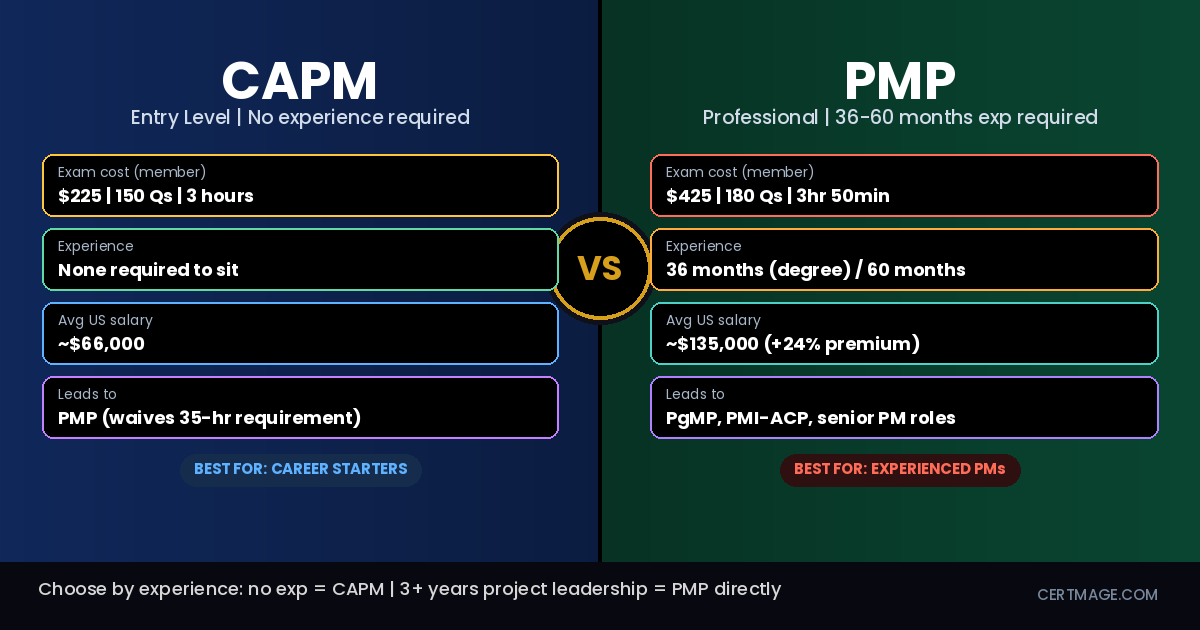
CAPM (Certified Associate in Project Management) is the right first choice if you have fewer than three years of documented project leadership experience or are transitioning into project management from another field. PMP (Project Management Professional) is the right choice if you already have three or more years of project leadership experience and are ready to validate expertise that employers require for senior roles. These are not competing credentials for the same candidate. They are designed for different stages of the same career.
Quick Comparison Table
| Factor | CAPM | PMP |
| Issuing body | PMI | PMI |
| Level | Entry / Associate | Professional |
| Experience required | None (optional: 1,500 hours) | 36 months (degree) or 60 months (no degree) |
| Education required | High school diploma + 23 contact hours | Any degree + 35 contact hours |
| Exam questions | 150 | 180 |
| Exam duration | 3 hours | 3 hours 50 minutes |
| Exam cost (member) | $225 | $425 |
| Exam cost (non-member) | $300 | $675 |
| Passing score | Not published | Not published |
| Validity | 5 years | 3 years |
| PDUs to renew | 15 | 60 |
| Renewal fee (member) | $60 | $60 |
| Avg US salary | $66,000 | $135,000 |
| Leads to | PMP | PgMP, PfMP, PMI-ACP |
The Experience Gate Is the Entire Decision
Most PMP vs CAPM comparisons focus on exam difficulty or cost. Those are real factors, but they are secondary to one question: do you currently meet PMP’s experience requirements?
PMP requires documented project leadership experience across PMI’s project management process groups. With a bachelor’s degree, you need 36 months. Without a degree, you need 60 months. That experience must have occurred within the past ten years and must reflect genuine leadership and decision-making, not just participation as a team member.
If you do not meet this requirement today, the decision is made for you: CAPM first. You cannot apply for PMP regardless of how prepared you feel for the exam.
If you do meet the experience requirement, the calculus shifts entirely. Taking CAPM when you already qualify for PMP is usually a detour, not a stepping stone. PMP carries more recognition, more salary impact, and more job market weight. A candidate who can document three years of project leadership experience has almost nothing to gain from CAPM first.
| Your situation | Right choice |
| Less than 36 months project leadership experience | CAPM |
| No degree and less than 60 months experience | CAPM |
| Already meet PMP experience requirements | PMP directly |
| Career changer with no PM experience | CAPM |
| Recent graduate entering project management | CAPM |
| Current project team member building toward PM role | CAPM |
| Experienced PM targeting senior or global roles | PMP directly |
What CAPM Actually Tests in 2026
CAPM is built around the PMBOK Guide and tests understanding of foundational project management terminology, frameworks, and processes. The 2023 exam update added scenario-based questions, interactive item types (drag-and-drop, hotspot), and meaningful coverage of both predictive (waterfall) and agile approaches.
| Domain | What it covers |
| Project Management Core Concepts | Foundational terms, processes, and frameworks |
| Predictive Plan-Based Methodologies | Waterfall-style project lifecycle, planning, monitoring |
| Agile Frameworks and Methodologies | Scrum, Kanban, iterative development principles |
| Business Analysis Frameworks | Stakeholder engagement, requirements, solution evaluation |
CAPM is genuinely challenging despite being entry-level. The 150-question, 3-hour exam tests conceptual depth across both waterfall and agile content areas. Candidates without project management work experience often spend 4 to 8 weeks of focused study to pass. The exam is not a formality.
What PMP Actually Tests in 2026
PMP tests judgment and applied decision-making, not just knowledge of frameworks. The July 2026 exam update introduced content aligned with the PMBOK Guide 8th Edition, including AI in project management, sustainability, and value delivery frameworks.
| Domain | Weight | What it covers |
| People | ~42% | Team leadership, stakeholder management, conflict resolution |
| Process | ~50% | Project delivery across predictive, agile, and hybrid methods |
| Business Environment | ~8% | Benefits realization, strategy alignment, compliance |
The PMP exam is scenario-heavy. Most questions present a workplace situation and ask what a project manager should do. There is rarely a single obviously correct answer. The exam is testing whether your instincts, shaped by real experience, align with PMI’s professional standards. This is why experience is not just a checkbox for PMP eligibility. It directly determines how intuitive the exam content feels.
The exam currently runs approximately 50% predictive (traditional waterfall), 50% agile or hybrid. Candidates who only know one approach fail at higher rates than those who understand both.
Exam Difficulty Compared
| Factor | CAPM | PMP |
| Question type | Multiple choice, drag-and-drop, hotspot | Multiple choice, matching, hotspot, fill-in-blank |
| Content depth | Conceptual | Applied and judgment-based |
| Study time needed | 4-8 weeks | 8-12 weeks |
| First-attempt pass rate (estimated) | 65-75% | 55-65% |
| Can pure study substitute for experience? | Yes | Partially, but experience matters significantly |
| Hardest content area | Agile frameworks | Scenario-based people domain questions |
Cost Comparison: Full Picture
| Cost item | CAPM | PMP |
| PMI membership (annual) | $164 + $10 app fee | $164 + $10 app fee |
| Exam fee (member) | $225 | $425 |
| Exam fee (non-member) | $300 | $675 |
| Training course (23/35 contact hours) | $15-$500 | $15-$2,500 |
| Retake fee (member) | $150 | $275 |
| Retake fee (non-member) | $200 | $375 |
| CAPM total (member, first attempt) | $404-$889 | N/A |
| PMP total (member, first attempt) | N/A | $604-$3,104 |
One cost-saving chain that most candidates miss: an active CAPM certification waives PMP’s 35-contact-hour application requirement entirely. If you plan to take both, taking CAPM first eliminates the need to pay separately for a 35-hour PMP prep course, which at an Authorized Training Partner can cost $800 to $2,500. This makes the CAPM-first path financially efficient for candidates planning to pursue both credentials.
Salary Comparison
| Certification | Typical US salary range | PMI data |
| CAPM | $60,000-$85,000 | Average ~$66,000 |
| PMP | $115,000-$155,000 | Median ~$135,000 |
| PMP premium vs non-certified | +24% median salary (US) | PMI Earning Power Survey |
| PMP premium globally | +33% median salary | PMI Earning Power Survey |
The salary gap is the clearest data point in this comparison. PMI’s own Earning Power Survey consistently reports a 24 percent salary premium for PMP holders in the United States and 33 percent globally. CAPM does not produce a comparable survey-documented premium, which reflects its positioning as a stepping stone rather than a career-defining credential.
The CAPM-to-PMP Path
Many candidates use CAPM strategically as a bridge to PMP. This approach is most effective when:
You are in a project team role and need a credential to support a promotion into a project manager position, where you will then accumulate the experience needed for PMP. Your target employer specifically values CAPM for entry and mid-level project roles. You want to build familiarity with PMI’s testing approach before attempting the more rigorous PMP exam.
The path is: CAPM now, accumulate 36 to 60 months of documented project leadership experience, then apply for PMP within the 5-year validity window of your CAPM. When you apply for PMP, your active CAPM waives the 35-contact-hour requirement, saving you one major cost and administrative step.
The July 2026 PMP Exam Update
PMI updated the PMP exam content outline effective July 2026, incorporating PMBOK Guide 8th Edition content including AI in project management, sustainability practices, and updated value delivery frameworks. Candidates with exam dates on or after that date should verify their prep materials reflect the updated content. CAPM is not affected by this update.
FAQs
Do I need CAPM before PMP?
No. CAPM is not a prerequisite for PMP. If you meet PMP’s experience requirements (36 months with a degree, 60 months without), you can apply for PMP directly. CAPM is only the right starting point when you do not yet qualify for PMP.
What is the salary difference between CAPM and PMP?
Significant. CAPM holders average approximately $66,000 in the US. PMP holders average $135,000, representing more than double the CAPM average. PMI’s Earning Power Survey documents a 24 percent salary premium for PMP holders over non-certified peers in the same roles.
How long does CAPM last before it expires?
Five years. CAPM renewal requires earning 15 PDUs and paying a $60 renewal fee (member) or $150 (non-member). If you earn your PMP within that window, the CAPM becomes redundant as a standalone credential.
Can CAPM replace the 35-hour PMP requirement?
Yes. An active CAPM certification satisfies PMP’s 35-contact-hour application requirement entirely. If you hold CAPM when you apply for PMP, you do not need to document or pay for a separate 35-hour training course.
Is CAPM recognized by employers?
Yes, primarily at entry and mid-level project roles. PMP is the more universally recognized credential at senior levels. Most Fortune 500 companies and federal agencies list PMP as a requirement or strong preference for project manager positions, not CAPM.
How hard is the CAPM exam in 2026?
Harder than many candidates expect. The 2023 exam update added scenario-based questions, interactive item types, and significant agile content. Candidates typically spend 4 to 8 weeks of focused study. A first-attempt pass rate in the 65 to 75 percent range is the community consensus.
How hard is the PMP exam in 2026?
Significantly harder than CAPM. The 180-question exam tests applied judgment across predictive, agile, and hybrid project environments. First-attempt pass rates are estimated at 55 to 65 percent. Real-world experience significantly improves the intuition needed for scenario questions.
Can I take both CAPM and PMP?
Yes, and many professionals do. The typical path is CAPM while accumulating experience, then PMP once experience requirements are met. Once you hold PMP, the CAPM becomes secondary since PMP supersedes it in recognition.
What experience counts toward PMP eligibility?
PMI requires documented project leadership experience in which you made decisions and directed project outcomes. Pure participation as a team member does not count. The experience must fall within the past ten years.
Which is better for switching careers into project management?
CAPM, without question. It requires no prior project management experience, is accessible to career changers, and provides the foundational credential that helps you land your first project team or junior PM role.