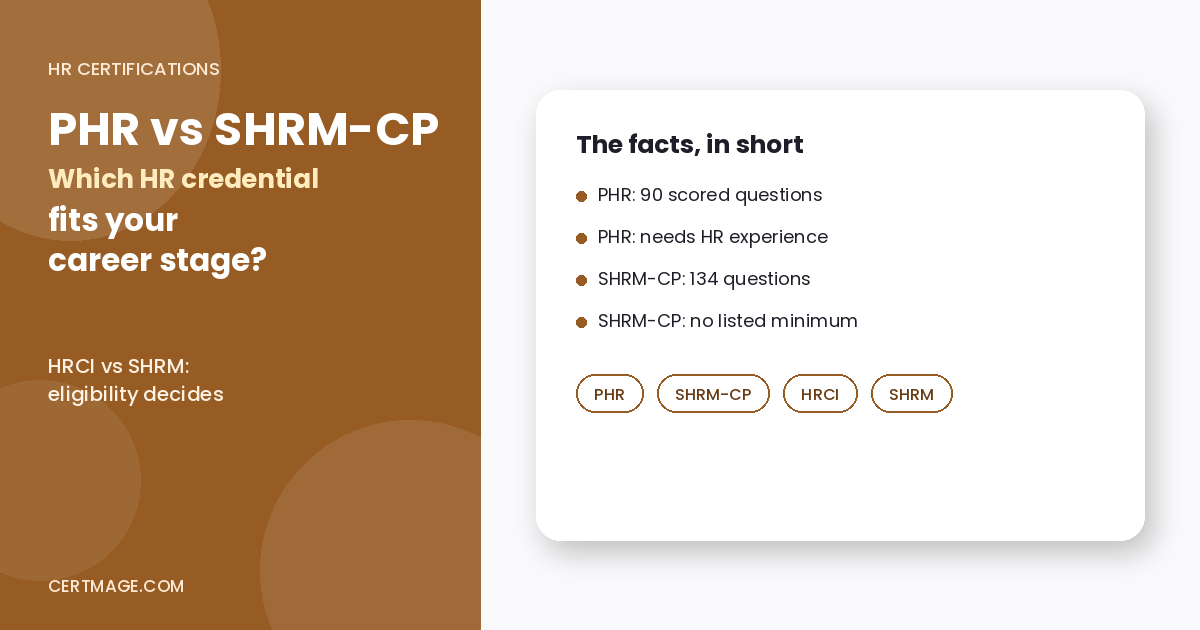
TL;DR: The PHR (HRCI) and the SHRM-CP (SHRM) are the two best-known mid-level HR certifications in the US, and neither is “the better one” for everyone. The deciding factors are your career stage, your eligibility and what your target employers ask for. The PHR has formal eligibility: 1 year of professional HR experience plus a master’s degree, 2 years plus a bachelor’s degree, or 4 years of experience. The SHRM-CP lists no degree or experience minimum, which makes it the more open door for students and career changers. The exams also test differently: the PHR is a knowledge exam across seven functional areas, while the SHRM-CP mixes HR knowledge questions with situational judgment questions. If you are early in your career, check whether you qualify for the PHR first. If you do not, the SHRM-CP is the practical entry. If you do qualify for both, let job postings and your employer break the tie.
Key Takeaways
- Eligibility is the sharpest difference. The PHR requires professional-level HR experience (1, 2 or 4 years depending on your degree). The SHRM-CP’s own pages list no degree or experience requirement.
- The exams reward different skills. The PHR has 90 scored questions across seven functional areas. The SHRM-CP has 134 questions (80 knowledge and 54 situational judgment), with about half the items on behaviors and half on HR knowledge.
- Both renew every three years with 60 credits. HRCI and SHRM each list 60 recertification credits per three-year cycle, or retaking the exam.
- Both have a path to a senior credential. HRCI’s senior level is the SPHR, and SHRM’s is the SHRM-SCP. We focus on the mid-level exams here.
- Cost is not a clean comparison. HRCI’s page lists USD 395 for the exam plus USD 100 for the application. SHRM’s official pages we reviewed do not list fees, and third-party figures vary, so check SHRM’s fee page.
- Employers decide. Many job postings accept either. Some name one. Look at your target postings before paying.
Quick Facts
| Item | PHR (HRCI) | SHRM-CP (SHRM) |
| Issued by | HR Certification Institute (HRCI) | Society for Human Resource Management (SHRM) |
| Level | Professional in Human Resources | Certified Professional |
| Eligibility | 1 year of professional HR experience plus a master’s or higher, 2 years plus a bachelor’s, or 4 years | No degree or prior HR experience required, per SHRM’s eligibility page. Basic HR knowledge recommended |
| Exam format | 90 scored plus 25 pretest questions | 134 questions: 80 knowledge items and 54 situational judgment items (24 unscored field-test items) |
| Time | 2 hours plus 30 minutes administration | 4 hours total including 3 hours 40 minutes of testing |
| Test delivery | Pearson VUE center or remote (OnVUE) | Authorized Prometric test center |
| Passing score | A third-party summary lists 500 on a 100 to 700 scale | 200, per SHRM’s process page. A third-party source lists a 120 to 200 scale |
| Content | Seven functional areas (Employee and Labor Relations is the largest at 20%) | Three behavioral competency clusters plus three HR knowledge domains |
| Fees | USD 395 exam plus USD 100 application, per HRCI’s PHR page | Not listed on the SHRM pages we reviewed. Third-party sources list a wide range |
| Testing windows | HRCI page does not list windows | SHRM lists May to July and December to February |
| Valid for | 3 years | 3 years |
| Recertification | 60 credits or retake the exam | 60 PDCs or retake the exam |
Confirm every row on the issuer’s page before you apply.
What Is the PHR?
The PHR, Professional in Human Resources, is HRCI’s mid-level US certification. It is built around professional-level HR experience. HRCI lists three ways to qualify:
- 1 year of professional-level HR experience plus a master’s degree or higher.
- 2 years of professional-level HR experience plus a bachelor’s degree.
- 4 years of professional-level HR experience.
The word “professional-level” matters. It generally means work involving HR judgment and responsibility rather than only clerical tasks, so read HRCI’s definition before you count your own years. The exam is computer-based and HRCI says it is available at a Pearson VUE testing center or remotely through OnVUE. HRCI’s page says exam fees are non-refundable once an application is approved, even if you withdraw. An updated content outline took effect on March 1, 2024.
What Is the SHRM-CP?
The SHRM-CP is SHRM’s Certified Professional credential. SHRM describes it for people doing general or operational HR work, such as implementing policy and serving as a day-to-day HR contact, and also for students and people pursuing HR careers. Its eligibility page says no degree or prior HR experience is required to apply, and recommends basic working knowledge of HR practices or a degree from an Academically Aligned program. You do not need an HR job title. SHRM’s official eligibility criteria page is the place to confirm this, since SHRM also has separate criteria for the senior SHRM-SCP.
The SHRM-CP is organized around the SHRM Body of Applied Skills and Knowledge (SHRM BASK). Roughly half the exam covers three behavioral competency clusters and the other half covers three HR knowledge domains. Exams are given at authorized Prometric test centers, in two testing windows a year: May to July and December to February.
How Do the Exam Contents Compare?
The PHR asks what you know about HR functions. The SHRM-CP also asks how you would act.
| Topic | PHR (functional areas, per a third-party summary of HRCI’s outline) | SHRM-CP (per SHRM and a third-party summary) |
| Employee relations and labor law | Employee and Labor Relations, 20% | Organization knowledge domain (employee relations) and Workplace (employment law) |
| Engagement and retention | Employee Engagement, 17% | People knowledge domain |
| Pay and benefits | Total Rewards, 15% | People knowledge domain |
| Business knowledge | Business Management, 14% | Business competency cluster (business acumen, consultation, analytical aptitude) |
| Hiring and workforce planning | Workforce Planning and Talent Acquisition, 14% | People knowledge domain |
| Training and development | Learning and Development, 10% | People knowledge domain |
| HR systems and data | HR Information Management, 10% | Organization knowledge domain (HR technology and data) |
| Leadership, ethics, communication | Not separate areas | Leadership and Interpersonal competency clusters |
The PHR weights come from a third-party summary that cites HRCI, so check HRCI’s current outline. The SHRM domains are described by SHRM as splitting about evenly between behavioral competencies and HR knowledge. A third-party source lists each of the six areas at 16 to 17 percent of scored items.
What this means for you: if you are strong on technical HR content (law, compensation, recruiting processes) the PHR’s structure suits you. If you handle situations daily and want to be tested on judgment as well as facts, the SHRM-CP’s situational items fit that experience.
How Do the Exam Formats Compare?
The PHR is a shorter, more knowledge-focused test. The SHRM-CP is longer and mixes question types.
- PHR: 90 scored questions plus 25 unscored pretest questions. HRCI lists 2 hours plus 30 minutes of administration time. A third-party summary lists a scaled passing score of 500 on a 100 to 700 range, and notes it is not a percentage. HRCI’s page did not state the passing score.
- SHRM-CP: 134 questions, of which 80 are knowledge items and 54 are situational judgment items, with 24 unscored field-test items. SHRM says the exam takes about 3 hours 40 minutes of testing time. SHRM’s process page says a passing score is 200, and results are shown immediately.
Situational judgment questions describe a workplace scenario and ask you to pick the best response. They reward practice. Many candidates find them different from straight recall, so build time into your study plan to practice the style.
Neither exam’s pass rate was found on an official page, and we do not quote unofficial pass rates here.
What Are the Requirements for Each?
The PHR checks your experience. The SHRM-CP, per its own pages, does not.
| If you are… | PHR | SHRM-CP |
| A student in an HR program | Not eligible yet (needs professional HR experience) | Eligible. SHRM mentions student exam pricing for those enrolled in an HR degree program |
| A career changer with no HR experience | Not eligible yet | Eligible by SHRM’s listed criteria. Basic HR knowledge recommended |
| In HR with under 1 year of experience | Not eligible yet | Eligible |
| In HR with 2 years and a bachelor’s degree | Eligible | Eligible |
| In HR with 4+ years and no degree | Eligible | Eligible |
| In HR with 1 year and a master’s degree | Eligible | Eligible |
| Moving toward senior HR leadership | Look at the SPHR later | Look at the SHRM-SCP later |
Eligibility on its own does not mean readiness. Because the SHRM-CP has no listed minimum, some candidates sit for it with little experience and find the situational items hard. The PHR’s experience requirement means candidates have usually seen more real situations before the exam. Neither choice is wrong for an early-career professional, but plan your study time to match.
How Much Do They Cost?
HRCI lists its fees on the PHR page. SHRM’s fees are on a separate page that we could not review, so treat the SHRM figures below as third-party.
| Cost item | PHR | SHRM-CP |
| Application fee | USD 100 per HRCI’s PHR page | Included in the total per a third-party source (USD 50 early-bird, USD 125 standard) |
| Exam fee | USD 395 per HRCI’s PHR page | A third-party source lists USD 520 to 695 in total depending on membership and early-bird timing. Another lists a different range, so check SHRM |
| Total listed | USD 495 | Varies by membership and timing. Confirm on SHRM’s fee page |
| Membership discount | Not listed on the page we reviewed | SHRM members receive a discount per third-party sources |
| Refunds | Non-refundable once your application is approved, per HRCI | Application fee is non-refundable per a third-party source |
| Renewal | 60 credits per 3 years. Recertification fee not listed on the page | 60 PDCs per 3 years. Fee not listed on the pages we reviewed |
| Prep materials | Optional | Optional. SHRM offers its own prep products |
The ranges differ because SHRM uses membership and early-bird pricing and its fees have been listed differently across sources. Use SHRM’s official fee page the week you apply.
Which Is Harder?
We cannot say which is harder, and published pass rates are not a fair guide.
The structures differ more than the difficulty does. The PHR demands recall across seven functional areas, with the heaviest weight on employee and labor relations. The SHRM-CP demands both recall and judgment across six areas, in a longer sitting. A candidate who has handled many employee situations but has not studied employment law formally may find the PHR content harder. A candidate with strong HR theory but little practical exposure may find the situational questions harder.
Take a timed practice test for each style before you commit. The result tells you more about fit than any published statistic.
Which Certification Fits Which Career Stage?
The best way to choose is by where you are right now.
| Career stage | Better fit | Why |
| Student or recent graduate (no HR experience) | SHRM-CP | PHR needs experience. SHRM has student pricing for enrolled HR students |
| Career changer moving into HR | SHRM-CP | No listed experience minimum |
| HR coordinator or assistant (0 to 2 years) | SHRM-CP, or PHR if you qualify | Operational roles match the SHRM-CP’s description |
| HR generalist (2 to 4 years) | Either | You likely qualify for both. Employer and posting preference decide |
| HR specialist (recruiting, comp, employee relations) | PHR if your work matches a heavy area | The PHR’s weighted functional areas map to specialist duties |
| HR manager aiming for a senior role | Mid-level now, SPHR or SHRM-SCP later | Check the senior eligibility rules on each site |
| HR professional with a degree and experience who wants a technical proof point | PHR | Formal eligibility and a knowledge-focused exam |
| HR professional who wants judgment and competencies tested | SHRM-CP | Situational judgment is part of the exam |
If you handle sensitive employee data and may add a privacy credential later, our CIPP/E vs CIPP/US guide and CHPS vs CIPM guide cover that side.
Decision Framework: Which Should You Take?
Work through these questions in order.
- Do you qualify for the PHR? Count your professional-level HR years carefully against HRCI’s three options. If you do not qualify, the SHRM-CP is your practical option now.
- What do your target job postings say? Search ten postings for the roles you want. If they name one credential, follow it. Many list both.
- What does your employer prefer? Some employers reimburse one exam or favor one body. Ask HR leadership.
- How do you handle exam styles? If scenario questions worry you, take a practice test of each style before you book.
- When can you test? SHRM uses windows (May to July, December to February). HRCI’s page did not list windows, so check it.
- What does your budget look like? The total can differ by hundreds of dollars once you add membership, early-bird pricing and prep materials. Confirm both fees.
- Do you need both? Most people do not. Pick one for your first credential. If you later want the other, check whether it adds anything for your target roles.
Career Value
Both credentials show tested HR knowledge, and the right one is the one your employers recognize. The PHR signals that you have met experience requirements and passed a knowledge exam. The SHRM-CP signals that you have been tested on both HR knowledge and workplace judgment, and it is open to people early in their careers.
We do not quote salaries. Pay depends on region, industry, employer size and your responsibilities, and neither HRCI nor SHRM publishes salary data for these exams. Look at current postings in your area and note which credentials come up.
If you are comparing HR with other career credentials that follow the same choose-by-stage logic, our CMA vs CPA, CPA vs CIA and CFP vs CFA guides walk through similar decisions in finance and accounting.
Study Plan Ideas
PHR (about 8 to 12 weeks, our estimate):
- Weeks 1 to 3: Employee and Labor Relations (20%) first. Cover federal employment law, discrimination, leave and workplace safety.
- Weeks 4 to 5: Employee Engagement and Total Rewards (32% combined).
- Weeks 6 to 7: Business Management and Workforce Planning and Talent Acquisition.
- Week 8: Learning and Development and HR Information Management.
- Weeks 9 to 10: timed practice tests, with error review by area.
SHRM-CP (about 10 to 14 weeks, our estimate):
- Weeks 1 to 2: read the SHRM BASK outline and take a diagnostic practice test.
- Weeks 3 to 6: the three HR knowledge domains (People, Organization, Workplace).
- Weeks 7 to 9: behavioral competencies. Study how the situational items frame the “best” answer.
- Weeks 10 to 12: timed practice with scenario questions. Review why each wrong option was wrong.
- Book your exam inside a testing window and apply before the window deadline.
Common Mistakes to Avoid
- Counting clerical years as professional-level. Read HRCI’s definition before applying.
- Choosing by name recognition. Check postings and employer preferences.
- Skipping scenario practice for the SHRM-CP. Situational questions are a separate skill.
- Using an old PHR outline. The current outline took effect March 1, 2024.
- Missing SHRM’s application window. Plan around May to July or December to February.
- Assuming fees are the same. Check membership and early-bird pricing.
- Forgetting recertification. Both need 60 credits per three-year cycle, or a retake.
FAQS
What is the difference between PHR and SHRM-CP?
The PHR is HRCI’s mid-level certification and requires professional HR experience. The SHRM-CP is SHRM’s mid-level certification and lists no experience minimum. The exams also differ in structure.
Which is better, PHR or SHRM-CP?
Neither is better for everyone. The right one depends on your eligibility, career stage and what your target employers ask for.
Can I take the SHRM-CP without HR experience?
SHRM’s eligibility page says no degree or prior HR experience is required, and recommends basic working knowledge of HR practices. Confirm the current rules on SHRM’s site.
Do I need a degree for the PHR?
Not necessarily. HRCI’s third option is 4 years of professional-level HR experience with no degree requirement listed.
How many questions are on the PHR?
90 scored questions plus 25 unscored pretest questions, with 2 hours of exam time plus 30 minutes of administration, per HRCI.
How many questions are on the SHRM-CP?
134 questions: 80 knowledge items and 54 situational judgment items, including 24 unscored field-test items, per SHRM.
What is the passing score for each?
SHRM says a passing score is 200. HRCI’s page did not state the PHR passing score. A third-party summary lists 500 on a 100 to 700 scale.
How much does the PHR cost?
HRCI lists USD 395 for the exam and USD 100 for the application, which total USD 495.
How much does the SHRM-CP cost?
SHRM’s pages we reviewed did not list fees. Third-party sources list different ranges depending on membership and timing, so check SHRM’s fee page.
How long does each certification last?
Both are valid for three years, then need 60 credits or a retake, per HRCI and SHRM.
Can I take the exam remotely?
HRCI says the PHR is available at a Pearson VUE center or remotely via OnVUE. SHRM’s pages we reviewed mention Prometric test centers.
Should I get both?
Most people do not need both. Earn the one that fits your eligibility and target employers first.
What comes after the PHR or SHRM-CP?
HRCI’s senior credential is the SPHR and SHRM’s is the SHRM-SCP. Check each body’s eligibility rules before planning that step.
Final Thoughts
Choose by career stage. If you have the experience, the PHR is a knowledge-focused credential with formal eligibility. If you are earlier in your career or changing fields, the SHRM-CP’s open eligibility and judgment-based exam give you a practical way in. Either way, check postings, confirm current fees and outlines on the issuer’s pages and book your exam with a study plan built around the exam style you chose.