Epic certification is module-specific, which means the question “should I get Epic certified” is really the wrong question. The right one is “which module,” and for most people entering this field, that choice comes down to Ambulatory or Inpatient, also called ClinDoc in job postings and internal Epic documentation. A physician or analyst certified in Ambulatory is not automatically certified in Inpatient, and the reverse is equally true. These are 2 separate credentials built around 2 genuinely different care settings, and picking the wrong one first can cost you months of employer-funded training time you don’t get to redo.
What Each Track Actually Covers
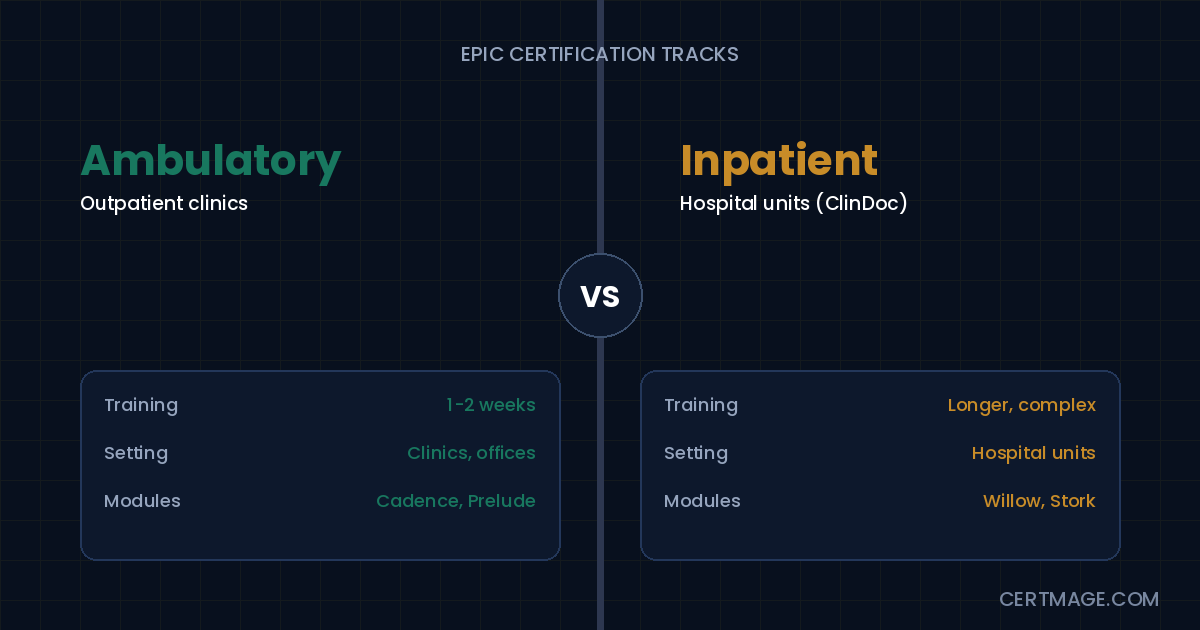
Ambulatory is built around outpatient care: documentation, scheduling, orders, and inbox management for clinical staff working in clinics and physician offices. The daily work of an Ambulatory-certified analyst centers on outpatient visit workflows, chart review before a visit, order entry during a visit, and inbox management for results and messages after a visit. If your organization’s Epic build revolves around outpatient visits, primary care, specialty clinics, or ambulatory surgery, this is your track.
Inpatient, more commonly called ClinDoc in job postings and internal Epic documentation, centers on hospital-based care: admission, assessment, nursing documentation, and the Medication Administration Record. ClinDoc is what nurses and clinical staff use to document a patient’s entire hospital stay, from the moment they’re admitted through discharge, including vitals, assessments, care plans, and medication administration tracked in real time throughout a multi-day stay.
| Detail | Ambulatory | Inpatient (ClinDoc) |
| Care setting | Outpatient clinics, physician offices, ambulatory surgery | Hospital-based inpatient care |
| Core workflows | Scheduling, charting, orders, inbox management | Admission, assessment, MAR, nursing documentation |
| Typical training length | 1 to 2 weeks | Often longer, closer to the 4 to 6 week range for complex builds |
| Who typically holds it | Clinical analysts, implementation specialists, trainers working in clinic settings | Nurses, clinical analysts, and trainers working in hospital settings |
| Related modules often bundled together | Cadence (scheduling), Prelude (registration) | Willow Inpatient (pharmacy), Stork (obstetrics), Surgical Workflows |
| National average analyst salary | $108,276 per year (ZipRecruiter, 2026) | Not independently published at the same granularity, tracks with broader Epic analyst progression data |
Real Job Postings, Not Generic Descriptions
Reading actual job postings for both tracks makes the distinction concrete in a way generic descriptions can’t. A recent Boulder Community Health posting for an “Epic Systems Analyst, Epic Ambulatory” role paid $29.22 to $71.40 an hour, full-time with an on-call requirement, and required Colorado residency specifically. A Hackensack Meridian Health posting for an Applications Analyst III described daily responsibilities including mentoring junior analysts and noted “Epic Ambulatory specialties certifications highly preferred.” A separate posting for a “Lead Epic Ambulatory and Population Health Analyst” required “Epic certification in Ambulatory or Orders” specifically, alongside “solid knowledge of inpatient” workflows, an example of a senior role that expects cross-module fluency even when the primary certification requirement names one track.
On the Inpatient side, a recent Epic Principal Trainer posting at Cedars-Sinai specifically required Inpatient certification, preferably in ClinDoc or Willow Inpatient specifically, with 3 or more years of Epic Inpatient systems experience, paying $87,568 to $126,984. Other postings researched for this comparison explicitly listed “EpicCare Ambulatory or EpicCare Inpatient” as interchangeable requirements for the same role, a genuine signal that some employers, particularly at the senior analyst level, care more about demonstrated Epic build competence generally than which specific module you certified in first.
Note on module naming: some postings reference “Epic Willow Ambulatory” specifically, which is a distinct pharmacy-focused certification within the Ambulatory family, not the same as the general Ambulatory certification covering scheduling and charting. If you see a posting naming a specific sub-module like this, confirm exactly which certification it’s asking for before assuming your general Ambulatory credential satisfies it.
Why This Isn’t Really an Either-Or Decision
Here’s what most guides get wrong about this comparison: it’s not really “Ambulatory vs Inpatient” the way a certification comparison usually works, where you weigh 2 options against each other and pick one. It’s “which setting does your employer actually operate in, and which module does your specific role touch.” A hospital system with both outpatient clinics and inpatient units often certifies different staff in different modules entirely, and larger organizations frequently need people certified in both, sometimes explicitly listing either as acceptable for the same senior-level posting, as seen in the job postings above.
The Numbers
Epic certification itself is free once you have employer sponsorship, but the training behind it isn’t cheap for the organization footing the bill. Training costs typically run $3,000 to $8,000 per track, and can climb toward $15,000 for more complex modules, all paid by the sponsoring organization, not the individual. Training length runs 1 to 6 weeks depending on the module, with Ambulatory generally on the shorter end and more complex clinical builds, including many Inpatient and ClinDoc-adjacent modules, running longer.
Epic doesn’t publish official pass rates for either exam. A “3 percent success rate” figure circulates on Reddit and Quora, and it’s worth debunking directly: that number, where it can be traced, measures the entire hiring-to-certification funnel, skills screening, training, exam, and interviews combined, not the exam itself. Epic has never confirmed this figure, and treating it as the actual exam pass rate is a common and understandable mistake that leads candidates to either overestimate the exam’s difficulty or dismiss the whole process as nearly impossible when it isn’t. The passing score itself is commonly cited around 80 percent, though this isn’t officially published either.
Salary by Track, With Real Regional Data
Ambulatory-specific salary data is genuinely well documented. ZipRecruiter’s 2026 aggregated data puts the national average for an Epic Ambulatory Analyst at $108,276 a year, with most workers earning between $83,000 and $143,500 depending on experience, location, and employer. Regional variation is real and worth knowing before you negotiate: New York averages $118,458, meaningfully above the national figure, while California averages $106,858, close to the national average despite its higher cost of living in major metro areas. Remote Ambulatory analyst roles track almost identically to the national in-office average, suggesting geography matters less for fully remote positions specifically.
Inpatient and ClinDoc-specific salary data isn’t published at the same granularity, but it tracks with the broader Epic analyst salary progression: Analyst I roles averaging around $84,170, Associate Analyst around $99,483, and Senior Analyst around $120,563, with specialized Inpatient or ClinDoc trainer and principal-level roles, like the Cedars-Sinai posting above, landing in the $87,568 to $126,984 range depending on seniority and years of Inpatient-specific experience required.
Who Should Choose Which
Clinical analysts and implementation specialists working with outpatient clinics, physician practices, or ambulatory surgery centers. Ambulatory is the direct match, and it’s also generally the faster certification to complete, making it a reasonable first module if you’re new to Epic certification entirely. Real postings in this space, like the Boulder Community Health and Hackensack Meridian examples above, consistently pay in the $83,000 to $143,000 range depending on seniority.
Nurses, clinical analysts, and trainers working within hospital units. ClinDoc is built specifically around what your role actually touches daily, admission through discharge documentation, and it’s the credential hospital-side job postings will name explicitly, as the Cedars-Sinai Principal Trainer example shows.
IT professionals and analysts pursuing the full build certification path rather than end-user training. Your organization’s specific Epic footprint should drive this choice more than any general preference, since build-side certification assumes deep, ongoing responsibility for configuring and maintaining that specific module.
Senior analysts and leads whose roles span both settings. As the “Ambulatory or Orders” and “Ambulatory or Inpatient” job postings referenced above demonstrate, some senior and lead-level roles explicitly accept certification in either track, valuing broad Epic build competence over a single specific module. If you’re operating at this level, holding certification in both, or at minimum deep working knowledge of both, genuinely strengthens your candidacy.
Career changers with no current Epic employer. This is the harder starting position for either track, since Epic requires sponsorship to even access training. If you’re in this position, see our guide on how to get Epic certified without already working in healthcare IT before choosing a track at all.
Decision Checklist
- Confirm which setting your actual employer or target employer operates in, outpatient clinics, hospital units, or both, before assuming either track is the “default” choice.
- Check actual job postings for your target role and note whether they name a specific module. Many do, but a meaningful share of senior and lead-level postings accept either Ambulatory or Inpatient interchangeably, or even list Orders as an alternative to Ambulatory specifically.
- If your organization runs both settings, ask whether your specific role is expected to certify in one module or eventually both, since larger health systems often expect senior analysts to hold multiple certifications over time.
- Don’t assume Ambulatory is “easier” and therefore a safer default. It’s often shorter to train for, but the right choice depends entirely on where you’ll actually be working, not which one sounds less intimidating.
- Watch for sub-module naming in job postings, “Willow Ambulatory” or “Clarity Data Model for EpicCare Ambulatory” are more specific credentials than general Ambulatory certification, and confirming the exact requirement before applying saves wasted effort.
- If cost estimates you’re seeing feel wildly different between sources, remember the real range is $3,000 to $15,000 in training cost paid by your employer, not by you directly, and confirm with your specific sponsoring organization what they’re actually covering.
For the complete picture of how Epic certification works overall, including cost, timeline, and the sponsorship requirement, see our Epic Certification guide. If you’re also weighing Epic against a competing EHR platform’s certification landscape, see our Epic vs Cerner (Oracle Health) Certification comparison and our Epic vs Meditech Certification guide. And if renewal timing factors into your decision at all, see our Epic Certification Renewal guide for what happens after you’re certified.
FAQS
Can I be certified in both Ambulatory and Inpatient?
Yes, and larger health systems with both outpatient and inpatient Epic deployments often expect senior analysts to eventually hold multiple module certifications, though most people start with one. Some senior and lead postings explicitly accept either as satisfying the same requirement.
Which Epic certification is faster to complete, Ambulatory or Inpatient?
Ambulatory trains generally train faster, often 1 to 2 weeks, while Inpatient and related clinical documentation modules can run longer, closer to 4 to 6 weeks, depending on complexity.
Is the “3 percent Epic certification success rate” real?
Not as an exam pass rate specifically. That figure, where traceable, measures the entire hiring-to-certification funnel, skills screening, training, exam, and interviews combined, not the certification exam alone, and Epic has never confirmed it.
Do I pay for Epic certification myself?
No, certification itself is free once you have employer sponsorship. The training behind it, typically $3,000 to $15,000, is paid by the sponsoring healthcare organization.
Which pays more, Ambulatory or Inpatient certification?
Ambulatory has well-documented national data, averaging $108,276 a year, with New York running higher at $118,458 and California close to the national average at $106,858. Inpatient-specific data is less granular but tracks with broader Epic analyst progression, generally landing in a comparable overall range once seniority is factored in.
Can I choose my Epic certification track without employer input?
Not really. Since Epic requires sponsorship to access training, your track is typically determined by your employer’s specific Epic deployment and your role within it, not a free personal choice.
What is “Willow Ambulatory,” and is it the same as general Ambulatory certification?
No, Willow Ambulatory is a distinct, pharmacy-focused certification within the broader Ambulatory family. If a job posting names it specifically, a general Ambulatory certification alone may not satisfy that requirement.
Do employers ever accept either Ambulatory or Inpatient certification for the same role?
Yes, particularly at senior and lead-analyst levels. Several real postings researched for this guide explicitly listed “Ambulatory or Orders” or “Ambulatory or Inpatient” as acceptable alternatives, valuing broad Epic build experience over one specific track.
Is remote work available for either Epic certification track?
Yes, remote Ambulatory analyst postings are common and pay comparably to in-office roles nationally, averaging $108,276, though some postings restrict eligibility to specific states for licensing or residency reasons.