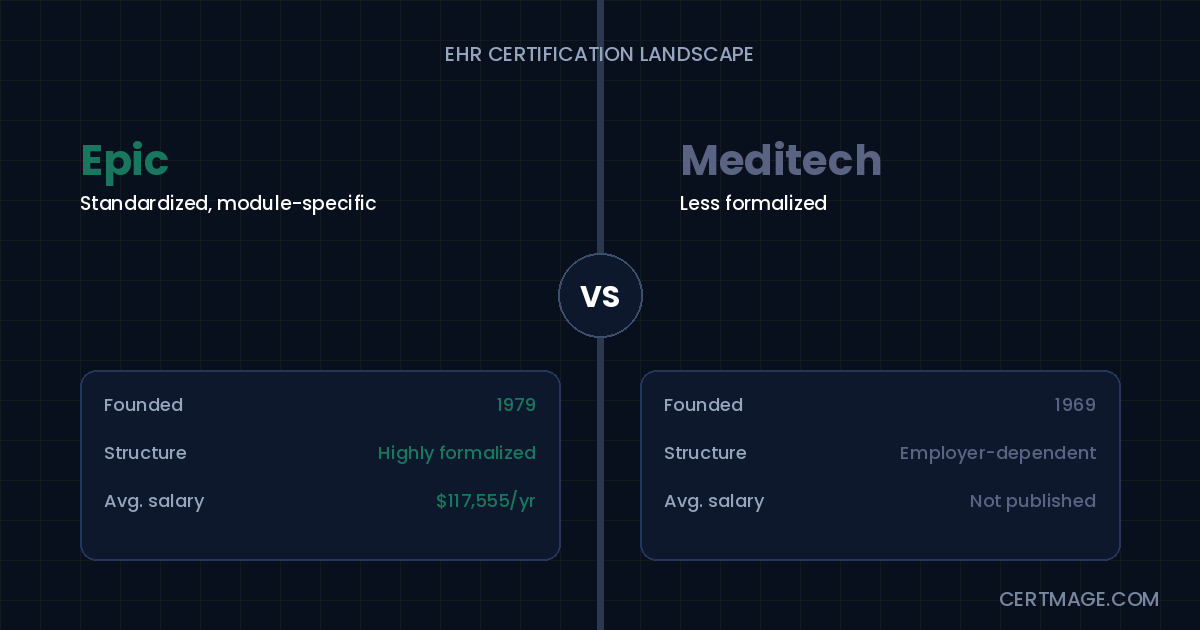
Epic and Meditech are 2 of the oldest names in electronic health records, Meditech founded in 1969, Epic a decade later in 1979, but their certification landscapes today look nothing alike. Epic runs a rigid, employer-sponsored, module-specific certification system that’s become the single biggest gatekeeper in healthcare IT hiring. Meditech’s credentialing path is real but far less standardized, less documented publicly, and, tellingly, job postings for Meditech roles consistently describe “training” candidates need to “complete and pass,” not a formal certification exam the way Epic postings do. If you’re choosing which EHR platform to build a career around, this structural difference matters more than either platform’s specific feature set.
Company Backgrounds, Briefly
Meditech, headquartered in Massachusetts, is one of the oldest healthcare-focused software vendors in the industry, with a long history serving community hospitals and mid-sized health systems, and its current flagship platform is Meditech Expanse. Epic Systems, based in Verona, Wisconsin, has grown into the dominant EHR vendor at large academic medical centers and major health systems specifically, and its certification program has become correspondingly more formalized as the platform’s market position grew.
How Epic Certification Actually Works
Epic certification is module-specific, meaning you don’t get certified in “Epic” generally, you get certified in Ambulatory, Inpatient (ClinDoc), Cadence, Willow, Resolute, or another of Epic’s specific applications. It requires sponsorship from a customer organization, training runs 1 to 6 weeks depending on the module, typically at Epic’s Verona campus, and the certification itself is free once sponsored, though the training behind it costs the sponsoring organization $3,000 to $15,000 per person. Epic Ambulatory Analysts specifically average $108,276 a year nationally as of 2026, according to ZipRecruiter, and the credential is explicitly named in job postings across hospitals, health systems, and consulting firms at a scale no other EHR certification currently matches.
How Meditech Credentialing Actually Works
This is where the comparison gets genuinely interesting, and where the language used in real job postings tells the story clearly. A recent UK-based EPR Maternity Analyst posting at Norfolk and Norwich University Hospital, requiring Meditech Expanse work specifically, describes the requirement as needing to “complete and pass the relevant MEDITECH Expanse training,” language that describes an internal training-and-assessment process, not a named, standardized certification exam with an official credential attached the way “Epic Certified, Ambulatory” functions.
What exists instead across the Meditech ecosystem is more fragmented: Meditech offers its own training and educational resources for customer organizations implementing Expanse, and individual professionals build expertise through a combination of employer-provided training, Meditech’s own documentation and learning resources, and hands-on implementation experience, without the same rigid “pass this exam, earn this specific credential” structure Epic has built.
The honest read: if you search for “Meditech certification” expecting to find an equivalent to Epic’s system, module names, exam structure, published pass rates, you’ll find much thinner, less consistent information, and real job postings confirm this isn’t just a documentation gap, it reflects how the credentialing process is actually structured. This doesn’t mean Meditech expertise isn’t valuable, hospitals running Expanse absolutely need skilled analysts and implementation staff, but the credentialing path is less formalized, less portable between employers, and less consistently named in job postings compared to Epic’s system.
Real Salary Data, Side by Side
This is where the comparison gets concrete. Meditech Analyst roles nationally average $35.24 an hour, with most workers earning between $22.60 and $43.75 an hour, according to 2026 ZipRecruiter data, working out to roughly $47,000 to $91,000 annualized depending on hours and role. Remote Meditech Expanse roles specifically run lower, averaging $25.17 an hour, with most workers between $22.84 and $25.24, notably below Epic’s remote analyst averages. Specialized, senior Meditech roles can run meaningfully higher: one MEDITECH Expanse data extraction engineer posting paid $85 an hour, and UK-based Meditech Expanse analyst roles, like the Norfolk and Norwich University Hospital posting, list salaries around £29,970 to £36,483 a year.
| Detail | Epic | Meditech |
| Founded | 1979 | 1969 |
| Headquarters | Verona, Wisconsin | Massachusetts |
| Flagship platform | Epic (Hyperspace, various modules) | Meditech Expanse |
| Credentialing structure | Highly standardized, module-specific certification | Employer-based training, described in postings as training to “complete and pass,” not a formal certification |
| Sponsorship required | Yes, formally required for exam access | Typically employer-provided training, less formal sponsorship gatekeeping |
| Training length | 1 to 6 weeks per module | Varies by organization, less publicly documented |
| Market position | Dominant at large academic medical centers and major health systems | Strong at community hospitals and mid-sized health systems, and internationally including the UK NHS |
| National average analyst pay | $108,276/year (Ambulatory Analyst specifically) | Roughly $47,000 to $91,000/year annualized (general Analyst hourly range) |
| Remote-specific pay | Comparable to national average | Notably lower, averaging $25.17/hour |
| International presence in job data | Primarily US-focused in available postings | Confirmed active UK/NHS market, alongside the US |
The Staffing Firms That Bridge Both Platforms
One detail worth knowing if you’re deciding between these 2 ecosystems: some healthcare IT staffing and consulting firms deliberately staff both. CereCore, a major healthcare IT staffing firm, places consultants on both Epic and Meditech engagements, and its international arm has posted UK-based EPR Programme Manager roles explicitly listing “previous experience with EPR systems such as Epic, Cerner, Meditech, or Nervecentre” as desirable rather than required on a single platform. This suggests that at the consulting and staffing level specifically, cross-platform EHR experience is genuinely valued, even though Epic and Meditech’s individual credentialing paths remain structurally very different. Other organizations, including HCA and Parallon, run large-scale Meditech-specific analyst and product support functions, comparable in scale to Epic-focused employers, just without an equivalent standardized certification badge attached to the role.
What This Means for Your Career Choice
If your goal is maximum career portability and the strongest possible market signal on a resume, Epic’s certification carries more weight simply because it’s more standardized and more consistently named in job postings, and it pays a meaningfully higher national average, $108,276 for Ambulatory Analysts specifically, compared to Meditech’s roughly $47,000 to $91,000 annualized range for general analyst roles. A hiring manager screening resumes knows exactly what “Epic Certified, ClinDoc” means and can verify it against a well-documented system. Meditech experience is real and valuable, but it’s harder to package into a single, universally recognized credential the way Epic’s system allows, and the pay data reflects that portability gap directly.
That said, this doesn’t make Meditech the wrong choice, it makes it a different kind of bet. Community hospitals and mid-sized health systems running Meditech Expanse need skilled analysts just as much as academic medical centers running Epic do, and the platform has a genuine international footprint, including active UK NHS demand, that Epic’s US-concentrated job market doesn’t match as clearly. If your local job market or existing employer runs Meditech specifically, building deep platform expertise there is a legitimate path, even without an equally portable formal credential behind it.
| Your Situation | Better Fit |
| You want the most standardized, widely recognized EHR credential for career portability | Epic |
| Your current employer or local job market runs Meditech specifically | Building Meditech expertise where you are, even without Epic’s formal certification structure |
| You’re choosing a platform to specialize in from scratch, with no current employer constraint | Epic, given its stronger market position, more standardized certification path, and higher documented pay |
| You already have deep Meditech implementation experience | Continue building on that, since real hands-on expertise matters regardless of formal certification structure |
| You’re interested in international healthcare IT work, particularly in the UK | Meditech has a more established presence in that specific market based on current job posting data |
| You want to stay flexible across both platforms | Consider a staffing firm like CereCore that places consultants across Epic, Meditech, and other EHR systems |
Decision Checklist
- Check which EHR platform your target employers or region’s hospitals actually run before choosing which one to specialize in, since neither certification transfers meaningfully if your market runs the other platform.
- If you’re choosing from scratch with no current constraint, weigh Epic’s stronger formal certification structure, higher documented pay, and more consistent job posting language against Meditech’s real but less standardized credentialing path.
- Don’t assume Meditech lacks a credentialing path entirely. It’s less standardized and less publicly documented than Epic’s, not nonexistent, and employer-provided training still builds genuine, valuable expertise, even when job postings describe it as training to “complete and pass” rather than a named certification.
- If international work interests you, particularly in the UK, note that Meditech shows a more active presence in that specific job market based on current postings than Epic does.
- If you already have Meditech experience, don’t discount it just because it’s harder to package into a single named credential. Real implementation and analyst experience on any major EHR platform carries weight with employers who use that platform, and cross-platform staffing firms like CereCore specifically value experience across multiple systems.
- Confirm current details directly with either vendor or your employer’s training department before committing significant time, since certification structures, especially Meditech’s less formalized path, can vary by organization.
For the complete breakdown of how Epic’s own certification system works, including cost, timeline, and the sponsorship requirement, see ourEpic Certification guide and our guide on how to get Epic certified without already working in healthcare IT. If you’re weighing Epic against a third major EHR vendor instead, see our Epic vs Cerner (Oracle Health) Certification comparison for how that landscape compares, and for the specific track-level decision within Epic itself, see our Epic Ambulatory vs Inpatient (ClinDoc) Certification guide.
FAQS
Does Meditech have a certification program like Epic’s?
Not to the same standardized degree. Real job postings for Meditech Expanse roles describe candidates needing to “complete and pass” employer-provided training rather than a named, standardized certification exam, reflecting a less formalized credentialing path than Epic’s module-specific system.
Which EHR certification is more valuable for a healthcare IT career, Epic or Meditech?
Epic’s certification generally carries more market weight due to its standardization, higher documented pay, and consistent presence in job postings, but the right choice depends heavily on which platform your target employers or region actually run.
Is Meditech experience still valuable without a formal certification?
Yes. Hospitals and health systems running Meditech Expanse need skilled analysts and implementation staff, and real hands-on experience carries genuine value even without Epic-style formal credentialing.
How much do Meditech analysts earn compared to Epic analysts?
Meditech Analysts average $35.24 an hour nationally, roughly $47,000 to $91,000 annualized depending on role and hours, while Epic Ambulatory Analysts average $108,276 a year, a meaningful gap that likely reflects Epic’s stronger market position and more standardized credentialing.
Is Meditech more common outside the United States?
Based on current job posting data, Meditech shows an active, established presence in markets like the UK NHS, while Epic’s available job data skews heavily toward the US market specifically.
Do any staffing firms place consultants on both Epic and Meditech projects?
Yes, CereCore is a notable example, staffing consultants across Epic, Meditech, and other EHR platforms, and explicitly valuing cross-platform EHR experience for certain roles, particularly internationally.
Which company was founded first, Epic or Meditech?
Meditech, founded in 1969, a decade before Epic Systems was founded in 1979.
Should I choose Epic or Meditech if I’m starting a healthcare IT career from scratch?
If you have no current employer constraint, Epic’s more standardized certification, stronger market position, and higher documented pay generally make it the safer specialization choice, though this should still be weighed against which platform is actually used by employers in your target job market, and whether international opportunities matter to you.