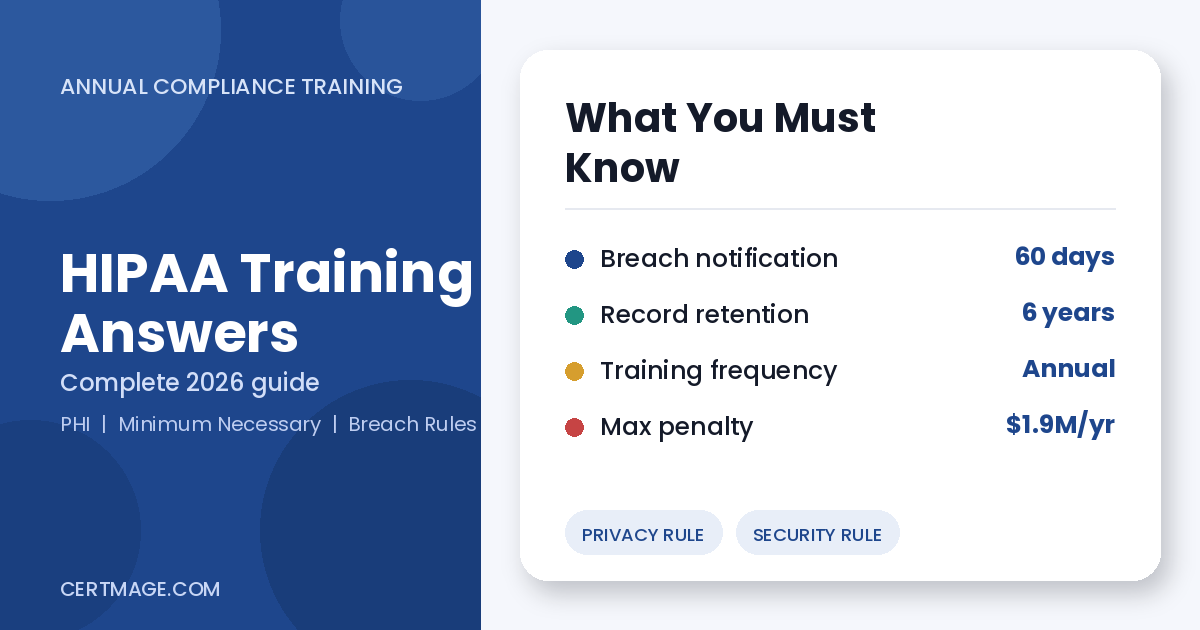
HIPAA training is mandatory annual education required under 2 separate federal rules, the Privacy Rule at 45 CFR §164.530(b) and the Security Rule at 45 CFR §164.308(a)(5), and this guide walks through every topic area your training actually covers, explaining the reasoning behind the correct answers so you understand the concepts, not just pass the knowledge check.
The direct answer: There is no single, universal HIPAA training exam the way there is a single DoD Cyber Awareness Challenge. Every covered entity and business associate runs its own HIPAA training, often through vendors like HealthStream, Relias, or MedTrainer, using different question wording. What stays constant across virtually every version is the underlying content: what counts as PHI, the minimum necessary standard, permitted uses and disclosures, breach notification timelines, and patient rights. This guide covers that constant core so the reasoning transfers regardless of which specific training platform your employer uses. Official regulatory text lives at HHS’s HIPAA Privacy Rule summary and HHS’s Security Rule summary.
HIPAA Training Requirements at a Glance
| Requirement | Detail |
| Legal basis | Privacy Rule, 45 CFR §164.530(b), and Security Rule, 45 CFR §164.308(a)(5) |
| Who must be trained | All workforce members of covered entities and business associates, employees, volunteers, trainees, anyone under the organization’s direct control who accesses PHI |
| When | Within a reasonable period after hire, before PHI access, and whenever policies or procedures materially change |
| Frequency | No fixed federal interval, but annual refresher training is the accepted industry standard and what OCR expects to see documented |
| Record retention | Minimum 6 years |
| Penalty range | $100 to $50,000 per violation, with annual caps reaching $1.9 million per violation category |
Important: HIPAA itself does not use the word “annual” anywhere in the regulatory text. The law requires training at hire and after material changes, plus an ongoing security awareness program. Annual refresher training became the de facto standard because it is the most defensible, consistent way to satisfy that rolling obligation, and OCR investigators routinely cite organizations that train once at onboarding and never again, even when no breach occurred.
What HIPAA Training Actually Covers
Domain 1: What Counts as Protected Health Information
PHI is any individually identifiable health information transmitted or maintained in any form, electronic, paper, or oral, connected to an individual’s past, present, or future physical or mental health condition, healthcare provision, or payment for healthcare.
Key point: A common knowledge-check question asks candidates to identify which of several examples counts as PHI. The trap most people fall into is assuming PHI only means medical diagnoses or test results. It also includes names, addresses, dates directly related to an individual, phone numbers, email addresses, and 18 specific identifier categories, when connected to health information. A patient’s name alone, sitting in a general directory, is not PHI. That same name connected to an appointment reason or diagnosis is.
Domain 2: The Minimum Necessary Standard
| Concept | What It Means |
| Minimum necessary standard | Workforce members should access, use, or disclose only the PHI reasonably necessary to accomplish the specific task |
| Applies to | Most uses and disclosures of PHI |
| Does not apply to | Disclosures to the patient themselves, disclosures required by law, or disclosures made with patient authorization |
Note: This is the single most commonly missed knowledge-check concept. Candidates frequently answer that minimum necessary applies universally, when it actually has specific carve-outs. Treatment-related disclosures between providers directly involved in a patient’s care are generally not subject to the same minimum necessary restriction that applies to, for example, administrative or billing access.
Domain 3: Permitted Uses and Disclosures Without Authorization
| Category | Example |
| Treatment | Sharing PHI between providers directly involved in a patient’s care |
| Payment | Sharing PHI with a health plan to process a claim |
| Healthcare Operations | Using PHI for quality improvement, training, or auditing |
| Required by law | Disclosures mandated by court order, subpoena, or public health reporting requirements |
Important: These 3 categories, commonly abbreviated TPO, treatment, payment, and healthcare operations, are the most frequently tested exception to the general rule that PHI disclosure requires patient authorization. A typical knowledge-check scenario describes a nurse discussing a patient’s condition with the patient’s physician. This falls under Treatment and does not require separate authorization.
Domain 4: When Authorization IS Required
| Situation | Authorization Required? |
| Marketing communications using PHI | Yes |
| Sale of PHI | Yes |
| Psychotherapy notes, in most cases | Yes |
| Disclosure to an employer for employment decisions | Yes |
| Treatment, payment, or healthcare operations | No |
Note: Marketing is a frequent knowledge-check trap. Candidates often assume any communication with a patient about services counts as marketing requiring authorization. In practice, communications about the patient’s own treatment, case management, or care coordination generally do not count as marketing even though they involve promoting a service or provider.
Domain 5: Breach Notification Requirements
| Requirement | Timeline |
| Notify affected individuals | Without unreasonable delay, no later than 60 days after discovery |
| Notify HHS, breach affecting 500 or more individuals | Within 60 days of discovery |
| Notify HHS, breach affecting fewer than 500 individuals | Within 60 days after the end of the calendar year in which the breach was discovered |
| Notify media | Required if breach affects more than 500 residents of a state or jurisdiction |
Key point: The 60-day clock starts at discovery, not at the moment the breach actually occurred. A common knowledge-check question tests whether candidates understand this distinction, since an organization that does not discover a breach for weeks after it happened still has 60 days from the discovery date, not the incident date, to notify.
Domain 6: Security Rule Fundamentals
| Safeguard Category | Examples |
| Administrative safeguards | Risk analysis, workforce training, access management, sanction policies |
| Physical safeguards | Facility access controls, workstation security, device and media controls |
| Technical safeguards | Access controls, audit controls, encryption, transmission security |
Note: Password hygiene, phishing awareness, and secure device handling questions almost always fall under technical or administrative safeguards specifically. A frequently tested scenario involves a workforce member leaving a workstation unlocked while stepping away, which violates physical and technical safeguard expectations around workstation security even without any actual data being accessed.
Domain 7: Patient Rights Under HIPAA
| Right | What It Means |
| Right to access | Patients can request and receive copies of their own PHI, generally within 30 days |
| Right to amend | Patients can request corrections to inaccurate PHI |
| Right to an accounting of disclosures | Patients can request a list of certain disclosures made about them |
| Right to request restrictions | Patients can ask that certain uses or disclosures be limited, though the covered entity is not always obligated to agree |
Common HIPAA Training Mistakes That Cost Points
Assuming all PHI-related questions are testing legal knowledge rather than practical judgment. Most knowledge checks present a workplace scenario and ask what you should do, not what the statute says word for word.
Confusing the minimum necessary standard with a universal rule. It has real carve-outs, particularly for treatment-related sharing between providers directly involved in care.
Treating breach notification timelines as starting from the incident date. They start from the discovery date, a distinction that trips up more candidates than any other single Security Rule concept.
Assuming any patient communication involving services counts as marketing. Communications about a patient’s own treatment and care coordination are generally excluded from the marketing definition requiring separate authorization.
Underestimating physical and administrative safeguards in favor of purely technical ones. Workstation security, sanction policies, and facility access controls are just as testable as encryption and access control questions.
Who Needs HIPAA Training
Every workforce member of a covered entity or business associate who accesses PHI or ePHI. This includes employees, volunteers, trainees, and contractors under the organization’s direct control, not just clinical staff.
Business associates specifically, including billing companies, IT vendors, and cloud providers. The Security Rule applies directly to business associates handling ePHI, a distinction that trips up vendors who assume HIPAA obligations only apply to the covered entity itself.
New hires, before they receive access to systems containing PHI. Most organizations set this at within 30 days of hire, though the regulation itself only specifies “a reasonable period of time.”
For the broader healthcare privacy credentialing landscape this training connects to, see our HCISPP vs CHPS guide if your role is moving toward a dedicated privacy and security credential rather than annual compliance training alone.
18 Practice Questions to Test Your Readiness
These are original scenario-based practice questions built around the 7 domains above, not reproductions of any specific vendor’s actual training platform. Since HIPAA training varies by employer, the value here is in the reasoning, not memorizing exact wording, use these to confirm you understand the underlying concepts before you sit your actual training.
PHI and Minimum Necessary
Question 1: A patient’s name appears on a general sign-in sheet at a front desk with no other information attached. Does this count as PHI?
Answer: No.
Explanation: A name alone, without any connection to health information, is not PHI. It becomes PHI once it is linked to a diagnosis, appointment reason, or other health-related detail.
Question 2: A billing coordinator pulls a patient’s full medical history to process a routine insurance claim that only requires the visit date and procedure code. Does this violate the minimum necessary standard?
Answer: Yes.
Explanation: The billing coordinator accessed far more information than the task required. Minimum necessary means using only what is reasonably needed to complete the specific job at hand.
Question 3: Which of the following is generally exempt from the minimum necessary standard?
Answer: Disclosures made directly to the patient about their own information.
Explanation: Minimum necessary restricts internal workforce access and most external disclosures, but it does not limit a patient’s own right to their complete record.
Question 4: A hospital shares a patient’s lab results with a specialist who is actively treating that same patient. Does this require the minimum necessary standard to be applied as strictly as an administrative disclosure would?
Answer: No.
Explanation: Treatment-related sharing between providers directly involved in a patient’s care is generally not held to the same restrictive minimum necessary standard as administrative or billing access.
Permitted Uses, Disclosures, and Authorization
Question 5: A nurse updates a patient’s attending physician on a change in condition during a shift handoff. Does this require patient authorization?
Answer: No.
Explanation: This falls under Treatment, one of the 3 TPO categories, treatment, payment, and healthcare operations, that are permitted without separate authorization.
Question 6: A hospital wants to use a patient’s contact information to send them a promotional offer for an unrelated elective procedure. Does this require authorization?
Answer: Yes.
Explanation: This falls under marketing, which requires patient authorization, since it is not related to the patient’s own ongoing treatment or care coordination.
Question 7: A clinic reminds a patient by email about their own upcoming follow-up appointment. Does this count as marketing requiring authorization?
Answer: No.
Explanation: Communications about a patient’s own treatment and care coordination are generally excluded from the marketing definition, even though they involve the clinic proactively reaching out.
Question 8: An organization wants to sell de-identified aggregate PHI to a third-party data broker for profit. Is authorization required?
Answer: Yes, in most cases involving the sale of PHI.
Explanation: Sale of PHI is one of the categories that consistently requires patient authorization, regardless of how the data has been processed, unless a specific narrow exception applies.
Question 9: A therapist’s detailed psychotherapy notes are requested by a patient’s employer for an unrelated HR decision. Is authorization required?
Answer: Yes.
Explanation: Psychotherapy notes carry heightened protection under HIPAA, and disclosure to an employer for an employment decision requires authorization in nearly all circumstances.
Breach Notification
Question 10: A hospital discovers on March 1 that a breach affecting 800 patients actually occurred on January 15. From which date does the 60-day notification clock start?
Answer: March 1, the discovery date.
Explanation: The clock starts when the organization discovers the breach, not when the breach actually happened. This distinction is one of the most commonly tested Security Rule concepts.
Question 11: A breach affects 300 individuals. When must the organization notify HHS?
Answer: Within 60 days after the end of the calendar year in which the breach was discovered.
Explanation: Breaches affecting fewer than 500 individuals follow an annual reporting cycle to HHS, unlike larger breaches, which require notification within 60 days of discovery itself.
Question 12: A breach affects 600 residents of a single state. Besides notifying HHS and affected individuals, what additional step is required?
Answer: Notifying prominent media outlets serving that state or jurisdiction.
Explanation: Once a breach affects more than 500 residents of a state or jurisdiction, media notification becomes a required step, not just a discretionary communications decision.
Security Rule Safeguards
Question 13: A workforce member steps away from their desk without locking their computer, even though no one accessed the screen. Does this violate HIPAA safeguards?
Answer: Yes.
Explanation: This violates physical and technical safeguard expectations around workstation security. The violation exists in the failure to secure the workstation, independent of whether unauthorized access actually occurred.
Question 14: Which safeguard category does a formal sanction policy for employees who violate privacy rules fall under?
Answer: Administrative safeguards.
Explanation: Administrative safeguards cover organizational policies and procedures, including risk analysis, training, access management, and sanctions for violations.
Question 15: Encrypting patient data while it is being transmitted between a clinic and an insurance company falls under which safeguard category?
Answer: Technical safeguards.
Explanation: Technical safeguards specifically cover access controls, audit controls, encryption, and transmission security, the technology-based protections rather than policies or physical barriers.
Patient Rights
Question 16: A patient requests a copy of their own medical record. Within roughly how many days must the organization generally provide it?
Answer: 30 days.
Explanation: The right to access generally requires organizations to provide requested records within 30 days, though a limited extension is sometimes permitted under specific circumstances.
Question 17: A patient believes their record contains an inaccurate diagnosis and asks the provider to correct it. What right are they exercising?
Answer: The right to amend.
Explanation: Patients can formally request corrections to inaccurate PHI. The provider must respond to the request, though they are not always required to make every requested change.
Question 18: A patient asks for a list of every party their PHI has been disclosed to over the past several years. What right are they exercising, and is the organization always required to have every disclosure on that list?
Answer: The right to an accounting of disclosures, and no, certain routine disclosures like those for treatment, payment, and healthcare operations are typically excluded from this accounting.
Explanation: This right exists specifically to give patients visibility into less routine disclosures, not to create a record of every single TPO-related sharing that happens during normal care.
How to use this practice set: If questions 1 through 9 felt straightforward, you have a solid grasp of the Privacy Rule fundamentals most training platforms test first. If questions 10 through 15 felt less familiar, spend extra time on the Security Rule and breach notification sections above before your actual training, since those are the areas most workforce members underestimate.
FAQS
Is HIPAA training required annually?
HIPAA’s text does not specify a fixed annual requirement, but annual refresher training has become the accepted industry standard, and OCR expects to see documented annual training records during investigations.
What is the minimum necessary standard?
A requirement that workforce members access, use, or disclose only the PHI reasonably necessary for a specific task. It does not apply universally, treatment-related disclosures between providers directly involved in care are a common exception.
What counts as PHI?
Individually identifiable health information in any form, electronic, paper, or oral, connected to an individual’s health condition, healthcare provision, or payment, including names, addresses, and other identifiers when linked to health information.
How many days do you have to report a HIPAA breach?
60 days from the date of discovery for notifying affected individuals and, for breaches affecting 500 or more people, for notifying HHS. The clock starts at discovery, not at the time the breach actually occurred.
Does HIPAA training apply to business associates?
Yes. The Security Rule applies directly to business associates handling electronic PHI, including billing companies, IT vendors, and cloud service providers, not just the covered entity itself.
What are the 3 permitted uses of PHI without authorization?
Treatment, Payment, and Healthcare Operations, commonly abbreviated TPO. These represent the most frequently tested exception to the general rule requiring patient authorization for PHI disclosure.
Do all patient communications require HIPAA authorization?
No. Communications related to a patient’s own treatment and care coordination are generally excluded from the marketing definition that would otherwise require separate authorization.
How long must HIPAA training records be kept?
A minimum of 6 years, as required under HIPAA’s documentation retention rules.
What happens if my organization skips annual HIPAA refresher training?
Organizations that train only at onboarding and never again are routinely cited during OCR investigations, even in cases where no breach occurred, since annual training is considered the defensible standard for satisfying the law’s ongoing training obligation.
Is HIPAA training the same at every company?
No. Every covered entity and business associate designs and delivers its own training, often through third-party platforms like HealthStream, Relias, or MedTrainer. The exact questions vary, but the underlying legal concepts, PHI definitions, minimum necessary, TPO, breach timelines, and patient rights, remain consistent across virtually every version.