CIPT (Certified Information Privacy Technologist) is IAPP’s credential for people who build the systems privacy law regulates, not the ones who write the policies or run the compliance program, and if you’ve already looked at CIPP and CIPM and felt like neither one actually described your job, CIPT is very likely the one you were missing.
TL;DR
- CIPT certifies engineers, architects, and technical product managers on building privacy directly into systems, not policy or program management, which is what CIPP and CIPM cover instead
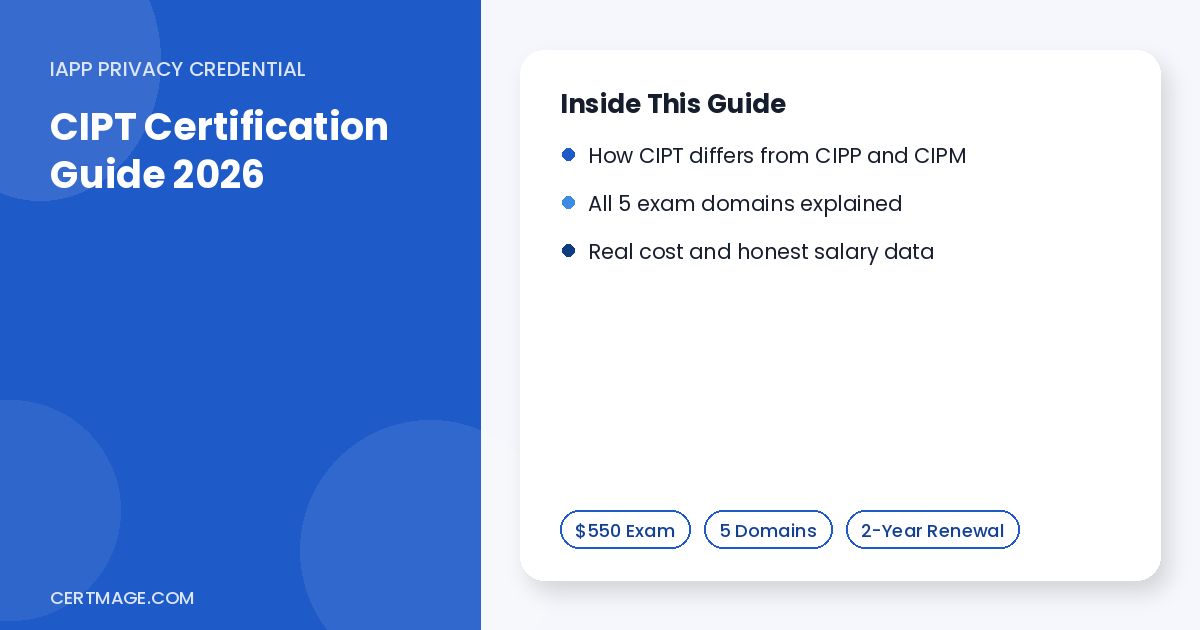
- 90 questions, 2.5 hours, passing score 300/500, 5 domains, no formal prerequisites
- Costs $550 for a first attempt, identical to every other IAPP credential, so cost never decides between CIPT, CIPP, and CIPM
- IAPP recommends roughly 30 hours of study built around 2 specific textbooks named later in this guide
- Real postings at companies like Robinhood, Roblox, and Apple describe exactly the work CIPT certifies, even when they don’t name the credential directly
- Salary data specific to CIPT is thinner than CIPM’s ($100,600 average per ZipRecruiter), and this guide explains exactly why that gap exists rather than papering over it
- Skip this credential if your role is compliance, legal, or program management; get CIPM or a jurisdictional CIPP instead
The IAPP Three-Credential System, Side by Side
Most confusion around CIPT starts with a simple problem: IAPP never clearly tells you where it fits next to its 2 more famous siblings. Here’s the comparison nobody puts in one place.
| CIPP | CIPM | CIPT | |
| What it certifies | Knowledge of privacy laws by jurisdiction | Ability to build and run a privacy program | Ability to build privacy into technology itself |
| Who it’s for | Lawyers, compliance officers, policy analysts | Privacy program managers, DPOs | Engineers, architects, product managers, technical PMs |
| Core question it answers | “What does the law require here?” | “How do I operationalize compliance?” | “How do I build this so it’s compliant by design?” |
| Typical prior role | Legal, compliance, GRC | Compliance, risk management | Software engineering, data engineering, product |
| Where CertMage covers it | CIPP vs CIPM comparison | CIPM cost guide, CIPM exam syllabus | This guide |
The honest reason people skip CIPT: it’s the least marketed of the 3, and most “which IAPP certification should I get” content online is written by compliance and legal professionals who never seriously considered it, because it’s genuinely not built for their role. If you write code, design data pipelines, or architect systems that touch personal data, that gap in the content is exactly why this guide exists.
Quick Facts: CIPT Certification
| Detail | Specification |
| Full name | Certified Information Privacy Technologist |
| Issuing body | IAPP |
| Number of questions | 90 |
| Duration | 2.5 hours |
| Passing score | 300 out of 500 (scaled score) |
| Format | Closed-book, proctored, computer-based |
| Number of domains | 5 |
| Prerequisites | None formally required |
| Exam fee | $550 (first attempt) |
| Retake fee | $375 |
| Annual maintenance fee | $250 every 2 years (waived for IAPP members) |
| Validity | 2 years, renewable via CPE credits |
Who Actually Needs CIPT: The Role Sorter
Rather than a generic “is this for me” checklist, here’s how CIPT maps against real job titles, since that’s usually the fastest way to tell if a credential fits.
| CIPT Fits Well | CIPT Fits Sometimes | CIPT Is the Wrong Certification |
| Privacy Engineer | Backend Software Engineer at a data-heavy company | Privacy Compliance Officer |
| Data Protection by Design Lead | Data Engineer building customer-data pipelines | Data Protection Officer (DPO) |
| Technical Product Manager (privacy-facing products) | Solutions Architect at a regulated-industry vendor | Privacy Program Manager |
| Security Engineer working on data protection controls | DevOps/Platform Engineer at a company under GDPR/CCPA scope | Corporate Privacy Counsel |
| IoT/embedded systems engineer handling personal data | QA Engineer testing privacy-sensitive features | Compliance Analyst with no technical role |
Reading the middle column correctly matters. These are roles where CIPT adds real, specific value, engineers and architects who touch personal data regularly, but where it isn’t the obvious default the way it is for a dedicated privacy engineer. If your job title sits in that column, the deciding factor is usually how much of your actual day-to-day work involves designing systems around personal data versus building generic infrastructure that happens to touch it occasionally.
The right-column roles aren’t wrong to want privacy expertise, they need a different credential. A Privacy Program Manager needs CIPM. A Data Protection Officer typically needs CIPM plus a jurisdiction-specific CIPP. Compliance-facing roles are looking for “how do we run this program and stay compliant,” which is precisely what CIPT does not teach.
The 5 CIPT Domains, Explained
| Domain | Approx. Question Share | What It Actually Tests |
| I. Privacy Technologist’s Role | 15 to 19 questions | What a privacy technologist is responsible for inside an organization, and how that role interacts with legal, compliance, and engineering |
| II. Data Collection, Use, Dissemination & Destruction | 19 to 23 questions | The complete personal-data lifecycle, from collection through processing to deletion, roughly half the exam between this domain and the next |
| III. Privacy Risk Management | 17 to 21 questions | Identifying and mitigating privacy risk within technical systems, the second-largest domain |
| IV. Privacy by Design | 7 to 9 questions | Privacy by design as an engineering discipline: data minimization, purpose limitation, and default privacy settings, not just a compliance slogan |
| V. Privacy Engineering & Governance | 9 to 11 questions | Converting privacy principles into maintainable, auditable technical controls |
Domain I: Privacy Technologist’s Role
This domain sets scope before testing anything technical. It covers where a privacy technologist sits relative to legal, compliance, and product teams, and what decisions genuinely belong to engineering versus what has to be escalated to a DPO or legal counsel. Candidates coming from a pure engineering background sometimes underestimate this domain because it feels procedural rather than technical, but it’s exactly the content that keeps a technically excellent engineer from overstepping into decisions, like interpreting a specific regulatory clause, that aren’t theirs to make alone.
Domain II: Data Collection, Use, Dissemination & Destruction
The largest domain, and the one with the most concrete technical content. It tracks personal data through its full lifecycle and expects familiarity with specific privacy-enhancing technologies (PETs) at each stage: pseudonymization and tokenization during collection and storage, differential privacy and k-anonymity for aggregate reporting and analytics, and secure deletion and cryptographic erasure at the destruction stage. Expect scenario questions that ask you to select the correct technique for a specific data-handling situation, not just define each term. Nonrepudiation and identifiability concepts, meaning how confidently a system can (or cannot) tie a data point back to a specific individual, run throughout this domain as a recurring theme.
Domain III: Privacy Risk Management
This domain assumes you can conduct or contribute meaningfully to a Privacy Impact Assessment (PIA) or Data Protection Impact Assessment (DPIA), identify where a proposed system design creates disproportionate privacy risk, and recommend a proportionate technical mitigation. It leans on risk-assessment methodology familiar from security frameworks, applied specifically to privacy harm rather than general security risk, which is a subtle but real distinction the exam tests directly.
Domain IV: Privacy by Design
GDPR Article 25 formally requires “data protection by design and by default,” and this domain is IAPP’s technical translation of that legal requirement into engineering practice: data minimization, purpose limitation, storage limitation, and privacy-protective default settings, treated as design constraints from the first architecture diagram rather than a compliance review bolted on before launch. Fewer questions than Domain II, but concentrated and specific.
Domain V: Privacy Engineering & Governance
Where technical professionals actually struggle. It’s rarely the technical content itself, since encryption, access control, and data minimization are familiar territory for most engineers. It’s this domain’s governance framing, translating a technical control into language an auditor or legal team can verify and sign off on, that catches experienced engineers off guard. Frameworks worth knowing going in include ISO/IEC 27701 (the privacy information management extension to ISO 27001) and the NIST Privacy Framework, since both give vocabulary the exam expects you to recognize even though it doesn’t test either framework exhaustively on its own. If you’re strong technically but have never had to document a control for a compliance audit, budget extra study time here specifically.
Realistic Study Plan
IAPP’s own guidance recommends roughly 30 hours of dedicated study, allocated in proportion to each domain’s question share above rather than spread evenly. Two textbooks form the backbone of most structured CIPT preparation:
| Resource | What It Covers |
| An Introduction to Privacy for Technology Professionals by Travis Breaux | Privacy’s impact on engineering, encryption, nonrepudiation, identifiability, anonymity, surveillance, privacy interfaces |
| Strategic Privacy by Design by Jason Cronk | Practical privacy-by-design scenarios, workflows, and governance integration, directly relevant to Domains IV and V |
Beyond the textbooks, IAPP’s own glossary is worth a full read-through before exam day, since the exam frequently hinges on precise terminology (the exact distinction between anonymization and pseudonymization, for instance) rather than general conceptual understanding. Engineers with hands-on experience implementing any PET, even something as simple as field-level tokenization in a production database, typically find Domain II moves faster than expected, while Domain V benefits most from deliberate practice translating a technical decision into an auditable justification.
What CIPT Costs, Compared to CIPP and CIPM
| Item | CIPT | CIPM | CIPP (any track) |
| First-attempt exam fee | $550 | $550 | $550 |
| Retake fee | $375 | $375 | $375 |
| Annual maintenance fee | $250 every 2 years | $250 every 2 years | $250 every 2 years |
| IAPP Professional Membership (waives AMF) | $295/year | $295/year | $295/year |
| Typical training course | $400 to $600 | $400 to $600 | $400 to $600 |
The good news for anyone comparing all 3: pricing is identical across the entire IAPP credential family, so cost is never actually the deciding factor between CIPP, CIPM, and CIPT. For a full breakdown of how these fees compound with membership decisions over time, our CIPM certification cost guide walks through the multi-year math in more detail, and the same math applies here unchanged.
CIPT Career Impact and Salary: What’s Actually Verifiable
Necessary honesty up front: CIPT-specific salary tracking is thinner than CIPM’s, largely because job postings rarely list “CIPT” as a standalone required credential the way they list CIPM for privacy program manager roles. Most CIPT holders carry it as an add-on to an engineering title rather than as the credential defining their job title, which makes clean salary attribution genuinely harder than it is for CIPM.
| Metric | CIPT | For Comparison: General Privacy Roles |
| Average annual salary | $100,600 | N/A |
| 25th to 75th percentile range | $65,500 to $132,500 | N/A |
| Top-end salary | $146,000 | N/A |
| Hourly rate equivalent | $48.37 | N/A |
Source: ZipRecruiter, September 2026 US data. Treat this range with the same caution you’d apply to any certification-specific salary aggregator figure: it reflects postings that happen to mention CIPT explicitly, which skews toward roles where privacy engineering is a named, prioritized skill rather than a general background expectation.
What real job postings actually ask for, even when they never say “CIPT”: current Privacy Engineer listings make the pattern clear. Robinhood’s Privacy Engineer posting in New York asks for “2+ years of experience in data privacy, security, or privacy engineering,” explicit knowledge of GLBA, GDPR, and CCPA, and hands-on experience with “privacy-enhancing technologies and data anonymization,” which is a near word-for-word description of CIPT’s Domain II content. Roblox’s Senior Privacy Engineer role centers on leading a “Privacy Review Program, the technical and process backbone” of the company’s privacy work, language that maps directly onto CIPT’s Domain V governance content. Apple’s Privacy Engineer, User Privacy role asks candidates to “design architectures that reduce the exposure of user data,” which is Domain IV’s privacy-by-design principle stated as a literal job function. None of these 3 postings names CIPT as a required credential, which matches the myth addressed below, but all 3 describe the exact competencies the exam certifies.
Where the real value shows up isn’t a salary line, it’s hireability for a specific and growing role type. Privacy-by-design requirements are now written directly into GDPR, several US state privacy laws, and increasingly into procurement requirements for vendors selling into regulated industries. Engineers who can demonstrate they understand these requirements at a technical level, not just a policy level, are solving a hiring problem many companies genuinely have and few candidates can credibly claim to solve.
Common Myths About CIPT
“CIPT is a coding certification.” It isn’t. There’s no hands-on coding component, no language-specific content, and no simulation environment. It’s a knowledge exam about privacy principles applied to technical systems, closer to how Security+ tests security concepts than how a coding bootcamp certificate tests actual code.
“You need CIPM before CIPT.” No formal prerequisite connects the 2, and IAPP does not require or recommend a specific order. Many technical professionals take CIPT first and never pursue CIPM at all, since their role never requires program-management-level privacy knowledge.
“CIPT is only useful in the EU because of GDPR.” The exam blueprint is deliberately jurisdiction-agnostic engineering content, not a GDPR-specific technical guide. Data minimization, privacy by design, and lifecycle management principles apply equally under CCPA, PIPEDA, and most other major privacy frameworks, which is exactly why IAPP built it as a standalone technical credential rather than folding it into a regional CIPP track.
“Nobody actually hires for this specifically.” True in the narrow sense that few job postings list “CIPT required” the way they list “CIPM required” for DPO roles. False in the broader sense that privacy-by-design competency is increasingly an explicit hiring criterion for senior engineering and architecture roles at companies with real regulatory exposure, even when the posting doesn’t name the certification directly.
Decision Checklist
- If your day-to-day work involves designing systems, pipelines, or products that collect or process personal data, and you’ve never had formal training connecting that work to privacy law, CIPT directly addresses that gap
- If you’re choosing between CIPT and CIPM and your role is program management or compliance rather than engineering, take CIPM instead, full stop
- If you’re already IAPP-certified in CIPP or CIPM and want a technical credential to round out a governance career, CIPT is a reasonable next step, but confirm your target roles actually value the technical depth before paying for a third IAPP credential
- Budget real study time for Domain V’s governance-translation content specifically, since it’s the most common gap for otherwise strong technical candidates
- Since exam pricing is identical across the entire IAPP family, don’t let cost be a factor in choosing between CIPT, CIPM, and CIPP; choose based on what your actual job requires
FAQS
What is the CIPT certification?
CIPT, Certified Information Privacy Technologist, is IAPP’s credential for professionals who build privacy into technology systems directly, covering data lifecycle management, privacy risk management, and privacy engineering rather than legal or program-management content.
Is CIPT harder than CIPM?
Neither is definitively harder; they test different skill sets. CIPT is more approachable for engineers with existing technical backgrounds, since much of the exam maps to familiar concepts like access control and data minimization, while CIPM assumes more comfort with program governance and organizational process, which technical professionals sometimes find less intuitive.
Do I need CIPP before taking CIPT?
No. There is no prerequisite connecting any of the 3 IAPP credentials. You can take CIPT as your first and only IAPP certification.
How much does the CIPT exam cost?
$550 for a first attempt, $375 for a retake, identical to CIPP and CIPM pricing across the board.
Is CIPT worth it for software engineers?
For engineers who regularly design systems handling personal data, especially at companies with GDPR, CCPA, or similar regulatory exposure, yes, since it’s currently the only major vendor-neutral credential that validates privacy engineering knowledge specifically rather than general security knowledge.
What jobs actually require CIPT?
Few postings list it as a hard requirement by name, similar to most specialized engineering credentials. It shows up more often as a preferred qualification for privacy engineer, data protection by design lead, and senior technical roles at regulated-industry companies, and as a resume differentiator for engineers competing for privacy-sensitive product work.
How long is CIPT valid, and what does renewal require?
2 years, renewable through IAPP’s continuing privacy education (CPE) credit system, the same renewal structure used across all IAPP credentials.
What is the difference between CIPT and a general security certification like Security+?
Security+ covers security controls broadly across networks, systems, and data. CIPT covers privacy specifically, including legal-adjacent concepts like data minimization, purpose limitation, and consent that a general security certification does not address at all. They’re complementary rather than overlapping, and some technical privacy roles expect both.
Can I prepare for CIPT using CIPM study materials?
Not effectively. The exams share almost no content overlap, since CIPM is built around program management and operational compliance while CIPT is built around technical implementation. Use CIPT-specific materials, including practice questions built around the current exam blueprint.
Which IAPP certification should I get first if I’m unsure of my career direction?
Match the credential to your current role rather than guessing at a future one. If you’re in legal, compliance, or GRC, start with CIPP for your relevant jurisdiction. If you’re in program management, start with CIPM. If you’re an engineer, architect, or technical product manager, CIPT is very likely your correct starting point, and our full IAPP audit and compliance certification roundup covers how these fit alongside non-IAPP options too.
How many hours should I budget to study for CIPT?
IAPP’s own guidance points to roughly 30 hours of dedicated study, weighted toward Domains II and III since they carry the most exam questions between them. Engineers with existing hands-on experience implementing privacy-enhancing technologies often need less time on Domain II specifically, but should not skip Domain V’s governance content, which is unfamiliar territory even for strong technical candidates.
What specific technical topics does the CIPT exam cover?
Pseudonymization and tokenization, differential privacy and k-anonymity for analytics and aggregate reporting, encryption and secure deletion, nonrepudiation and identifiability concepts, and privacy-by-design principles derived from GDPR Article 25, including data minimization and purpose limitation. Domain V additionally expects familiarity with governance frameworks like ISO/IEC 27701 and the NIST Privacy Framework at a conceptual level.
Do real employers actually ask for privacy engineering skills without naming CIPT directly?
Yes, consistently. Current postings from companies including Robinhood, Roblox, and Apple describe privacy-by-design responsibilities, privacy-enhancing technology experience, and privacy review program leadership in detail, without listing CIPT by name as a requirement. The certification validates exactly the skill set these postings are written around, even when the job description itself never mentions it.