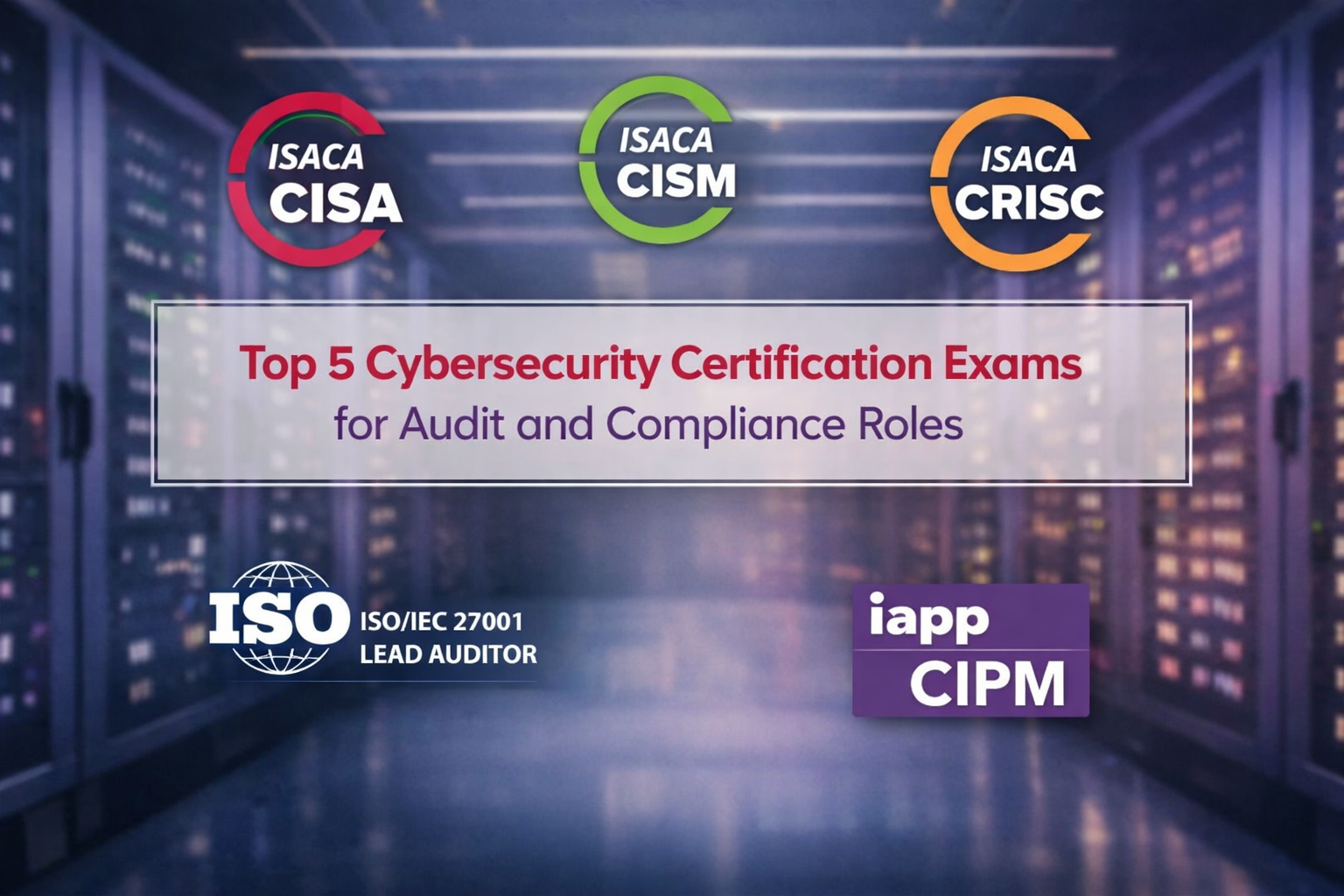
The top 5 Cybersecurity Certification Exams for audit and compliance roles are ISACA CISA, ISACA CISM, ISACA CRISC, ISO/IEC 27001 Lead Auditor, and IAPP CIPM. These five are popular for one reason: they match the real work behind audits, risk reviews, and compliance checks.
Audit and compliance teams are under more pressure than before. Breaches are expensive, and partners want proof that your controls actually work.
IBM reported the average global cost of a data breach reached USD 4.88 million in 2024. At the same time, the talent shortage is real. ISC2’s workforce study showed a global cybersecurity workforce gap of about 4.8 million professionals.
That’s exactly what these Cybersecurity Certification Exams are designed to test.
What do Audit and Compliance Roles Actually Do?
Companies lean on people who can do both security and compliance thinking: controls, evidence, risk language, and governance. This shift is also happening alongside new risks from automation and AI systems, which is why some professionals will be starting to explore generative AI certification exams in 2026 to understand governance, risk, and compliance impacts tied to AI use. If you strip away the job titles, most audit and compliance security work comes down to four things:
- Check controls: “Is MFA enabled for admins?”
- Collect evidence: policies, screenshots, logs, tickets, approvals
- Explain risk: “What could go wrong, and how bad is it?”
- Prove improvement: “We found a gap, fixed it, and confirmed it stayed fixed.”
This is why certifications help. They give you a structured way to think and talk, especially when you deal with auditors, legal teams, or leadership.
Many audit and compliance roles now overlap with cloud environments, which is why understanding cloud certification roadmap for 2026 becomes useful even for non-cloud specialists.
If you want credentials that hiring managers recognize in audit and compliance hiring, these are the exams to look for. They’re widely requested because they map directly to real audit tasks: control testing, evidence handling, risk reporting, and privacy governance.
1) ISACA CISA (Certified Information Systems Auditor)
CISA is the most direct certification for IT audit and assurance work. It teaches you how to audit systems in a way that is consistent, defensible, and easy to explain.
ISACA states the CISA exam has 150 questions covering 5 job practice domains.
You learn these:
- How to plan an audit (scope, objectives, sampling)
- How to test controls (not just “ask,” but “verify”)
- And how to write findings that management can act on
A company says, “We review user access every quarter.” A CISA-style check is not one screenshot. You ask for the access review record, evidence of approval, proof that removed access was actually removed, and any exceptions with a documented reason. That’s audit-ready evidence.
Best fit roles:
IT auditor, internal audit analyst, security assurance, SOC 2 evidence owner, compliance analyst.
2) ISACA CISM (Certified Information Security Manager)
CISM is for people who run or support a security program, not just individual controls. It’s the certification that helps you speak “security + business” at the same time.
ISACA states the CISM exam has 150 questions covering 4 job practice domains.
What you learn:
- Security governance (who owns what, and how decisions are made)
- Risk management from a leadership view
- Program management (building a program that stays consistent)
- Incident management planning at a high level
An auditor asks, “How do you ensure policies are followed?” A CISM answer is not “we trained people.” You explain ownership, enforcement, monitoring, exceptions, and metrics. That’s what makes a security program audit-ready.
Best fit roles:
GRC manager, security manager, governance lead, compliance lead moving toward leadership.
3) ISACA CRISC (Certified in Risk and Information Systems Control)
CRISC is for risk-heavy roles. If you spend time in risk registers, vendor risk, or control design, CRISC is a strong fit.
ISACA states the CRISC exam has 150 questions covering 4 job practice domains.
What you learn
- How to identify and assess risk in a consistent way
- How to choose controls that actually reduce that risk
- And how to report risk so leaders can make decisions
A vendor wants access to customer data. CRISC thinking helps you map risk (data exposure), choose controls (least privilege, encryption, monitoring, contract clauses), and set reporting (alerts, review frequency). That turns “fear” into a controlled decision.
Best fit roles:
Third-party risk, enterprise risk, GRC analyst, compliance analyst working with risk decisions.
4) ISO/IEC 27001 Lead Auditor
If your company works with ISO 27001 (or wants it), this is the most targeted certification. It focuses on how to run audits and evaluate an ISMS (Information Security Management System).
ISO 27001 expects internal audits at planned intervals and a cycle of nonconformity handling and corrective actions.
What you learn:
- Audit planning, interviewing, sampling, and reporting
- How to raise nonconformities that are clear and evidence-based
- How corrective actions are tracked and verified
Policy says “laptops must be encrypted,” but you can’t prove encryption on a chunk of assets. A Lead Auditor approach is to document the gap, tie it to the ISMS process, and track corrective action until you have proof the issue is fixed and stays fixed.
Best fit roles:
ISO audit teams, compliance managers, security assurance, and consultants supporting ISO readiness.
5) IAPP CIPM (Certified Information Privacy Manager)
CIPM is a privacy program-focused. It’s very useful when audit and compliance include personal data, privacy requests, and privacy operations.
IAPP states the CIPM exam has 90 multiple-choice questions and 2.5 hours (plus a break).
What you learn:
- How privacy programs run in real organizations
- How to manage privacy controls through the operational life cycle
- And how to align privacy work with business operations
Your company adds a new analytics tool. CIPM helps you ask: what personal data is collected, what consent is needed, how long data is kept, where it is stored, and how deletion works. Those questions become audit evidence later.
Best fit roles:
Privacy manager, compliance analyst supporting GDPR-style work, GRC teams handling privacy risk.
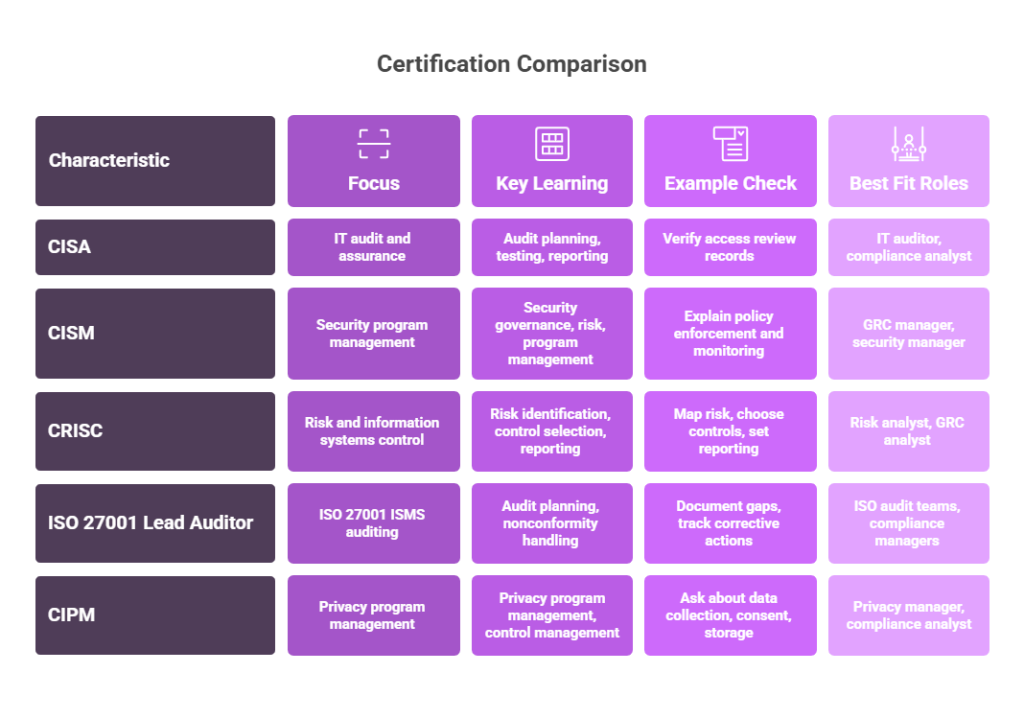
Cybersecurity Certification Exams Comparison
| Certification | Main focus | If your job is mostly… |
| CISA | audit + evidence | control testing, audit reports, assurance work |
| CISM | security program + governance | leadership, policies, program design, metrics |
| CRISC | risk + controls | risk registers, vendor risk, control decisions |
| ISO 27001 Lead Auditor | ISMS auditing | ISO audits, nonconformities, corrective actions |
| CIPM | privacy operations | privacy program, personal data controls, compliance ops |
Where do these certifications fit in SOC 2 and NIST work?
SOC 2 is basically a way to prove your company has the right controls in place for security, availability, processing integrity, confidentiality, and privacy (AICPA & CIMA).
The NIST Cybersecurity Framework is a practical security structure that many teams use, and it’s commonly explained as five functions: Identify, Protect, Detect, Respond, Recover (NIST).
If your work touches SOC 2 evidence or NIST-style security controls, here’s how these exams line up:
- CISA helps you test controls and collect evidence the right way, so your SOC 2 support doesn’t turn into messy screenshots and guessing
- CISM helps you explain governance and security program management, like who owns policies, how exceptions work, and how leadership tracks security progress.
- CRISC helps you translate security gaps into clear risk language, so stakeholders understand impact, likelihood, and the control plan.
- CIPM fits when SOC 2 or your internal program includes privacy controls, like data handling, retention, access requests, and vendor privacy operations.
- ISO/IEC 27001 Lead Auditor is a strong match if your organization runs an ISMS and wants formal, repeatable audits with corrective actions, which often complements SOC 2 work too.
In simple words: SOC 2 asks, “Show me proof your controls work,” and NIST asks, “Do you have a complete security program shape?” These certifications help you answer both without confusion.
If your long-term goal is to move beyond audits into designing secure systems and frameworks, you may also want to look at advanced IT architect certification exams, which build on governance and risk knowledge at a higher level.
Final Note!
Pick one of these Cybersecurity Certification Exams based on the work you want to do next, not just what sounds popular. Write your target job title, list 5 daily tasks from that job, then choose the exam that trains those tasks best.
If you are preparing for any of these exams and want focused practice, you can use Cert Mage to get up-to-date exam questions and dumps, so you can practice scenarios, spot weak areas fast, and stay consistent in revision.
FAQs
Which certification is best for a beginner in audit and compliance?
CISA is usually the cleanest start because it is built around audit steps, evidence, and reporting. It matches what many assurance roles actually do day to day.
If i work in risk and vendor reviews, what should i choose?
CRISC is strong for risk assessment and choosing controls that reduce risk. It fits third-party risk and GRC work very well.
Is ISO/IEC 27001 Lead Auditor only for external auditors?
No. Internal audit teams and ISMS owners use it too, because ISO expects internal audits and corrective action cycles. It helps you build the “audit habit,” not just pass one audit.
Does privacy work really matter for cybersecurity roles?
Yes, because personal data handling creates security and compliance risk at the same time. CIPM helps you run privacy controls operationally, which shows up in audits and vendor reviews.