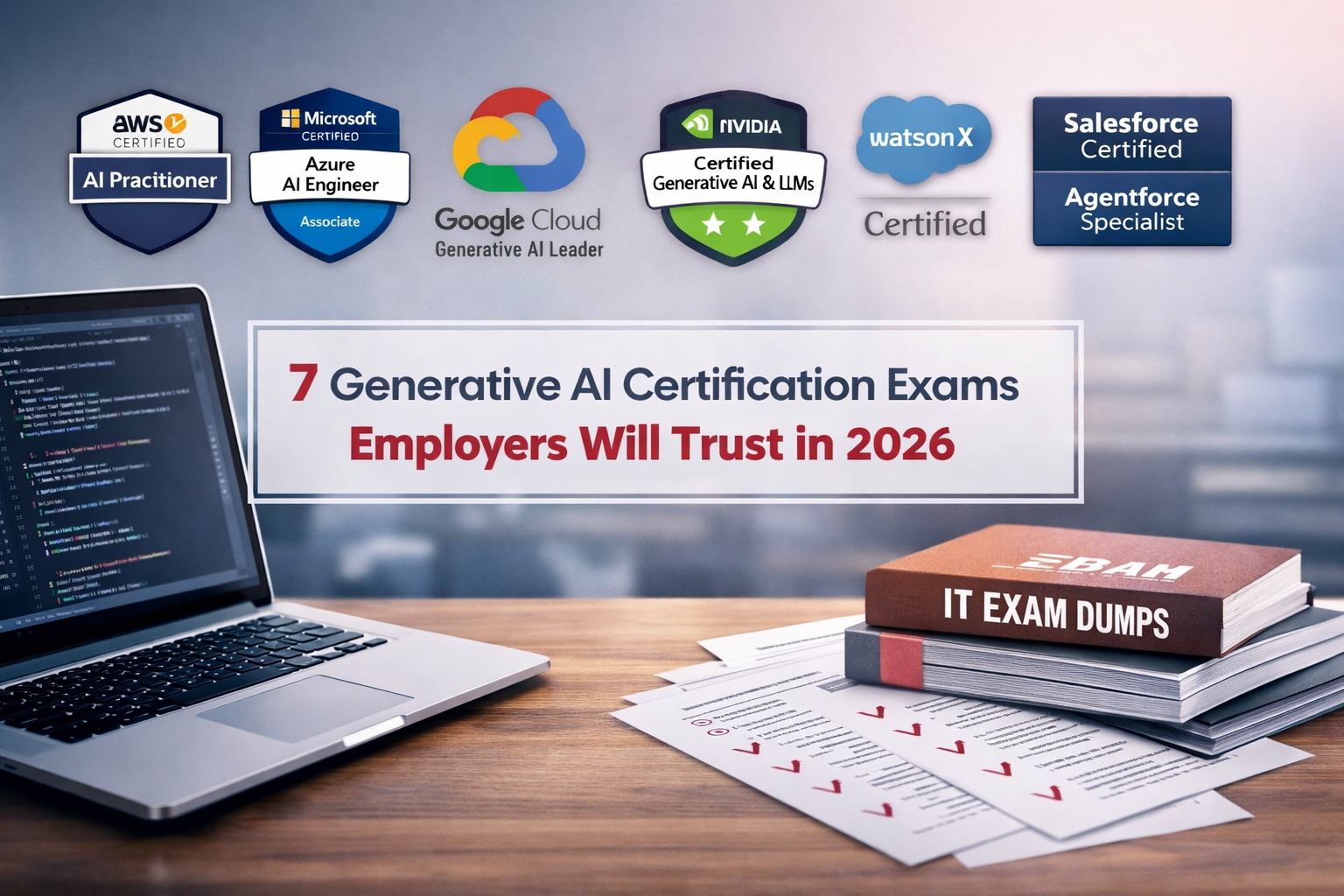
In 2026, employers will trust Generative AI Certification Exams that are run by major vendors, proctored, and tied to real job skills like building, deploying, and governing AI systems.
Generative AI is no longer “nice to have.” Many teams already use it at work. Microsoft and LinkedIn reported that 75% of knowledge workers were using AI at work in 2024. McKinsey’s 2026 global survey also reported high and rising AI use across business functions. And Stanford’s AI Index shows broad growth in AI usage and investment.
So hiring managers want proof you can work with AI safely and correctly, not just talk about it.
What makes a Generative AI certification “trusted” to employers?
This is the simple truth: employers trust signals that are hard to fake.
Vendor-backed and current
When AWS, Microsoft, Google, NVIDIA, Databricks, IBM, or Salesforce puts their name on an exam, it usually maps to tools companies actually use.
Proctored exams and verified badges
A timed, proctored exam plus a public credential page is more believable than a random course completion certificate.
Role-based skill coverage
Trusted exams test tasks you would do on the job: choosing models, setting up guardrails, building retrieval systems, monitoring quality, and managing risk, similar to what employers expect from advanced IT architect certification paths.
Responsible AI and security basics
In real companies, you can’t ignore privacy, data leakage, bias, or unsafe output. Good exams include these topics because mistakes cost money and reputation.
The employer-trusted Generative AI Certification Exams for 2026
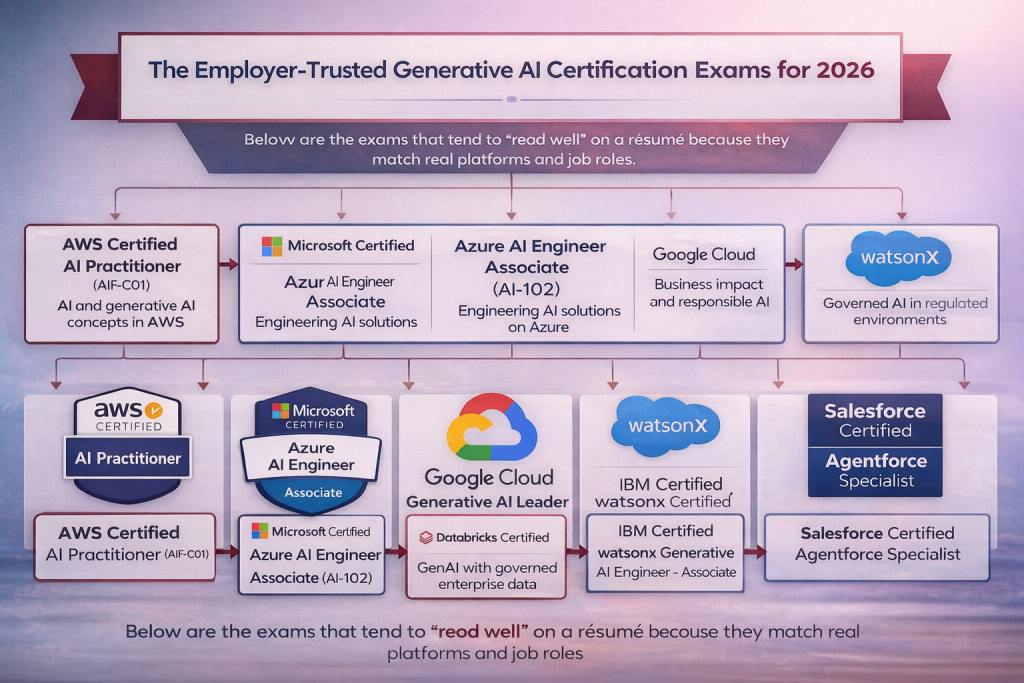
1) AWS Certified AI Practitioner (AIF-C01)
The AWS Certified AI Practitioner (AIF-C01) is designed to prove that you understand how Generative AI actually works inside the AWS ecosystem, not just theory. Employers trust this certification because AWS powers a huge portion of enterprise cloud workloads, and this exam aligns directly with how companies deploy AI today.
This certification validates knowledge of AI fundamentals, machine learning basics, and generative AI use cases, including where tools like Amazon Bedrock fit into real systems. It helps employers know that you can discuss model choices, managed services, cost tradeoffs, and risks without guessing.
For teams using AWS AI services, this certification signals that you can communicate clearly with engineers, architects, and product managers and make safe, informed decisions about GenAI adoption.
2) Microsoft Certified: Azure AI Engineer Associate (AI-102)
The Microsoft Certified: Azure AI Engineer Associate (AI-102) is one of the most trusted hands-on Generative AI certifications because many enterprises already rely on the Microsoft ecosystem.
Employers value this exam because it focuses on building and integrating AI solutions, not just understanding them. It reflects real responsibilities of an Azure AI Engineer, such as designing AI-powered applications, connecting models to business data, and implementing safeguards around outputs.
In practice, this certification shows you can build systems like internal assistants, knowledge search tools, or customer-facing AI features that are grounded in company data and compliant with enterprise policies. For organizations running on Microsoft Azure, this credential carries strong credibility.
3) Google Cloud Generative AI Leader
The Google Cloud Generative AI Leader certification targets professionals who need to guide GenAI adoption at the organizational level, rather than focus only on code.
Employers trust this certification because many GenAI initiatives fail due to poor planning, unclear ownership, or unmanaged risk. This exam focuses on business impact, responsible AI principles, governance, and organizational readiness using Google Cloud technologies.
It’s especially valuable for roles where decisions affect teams, budgets, and compliance. Holding this certification tells employers you can connect GenAI capabilities to business outcomes, while understanding legal, ethical, and operational constraints, supported by strong foundations in Google Cloud data engineering certifications.
4) NVIDIA-Certified Associate: Generative AI and LLMs (NCA-GENL)
The NVIDIA-Certified Associate: Generative AI and LLMs (NCA-GENL) stands out because it focuses on how large language models run in the real world, not just how they’re prompted.
Employers trust NVIDIA certifications because NVIDIA hardware and software sit at the core of modern AI infrastructure. This certification demonstrates understanding of LLM performance, inference efficiency, GPU utilization, and deployment tradeoffs.
For teams concerned with latency, scalability, and cost control, this credential signals that you understand what happens after the prototype stage. It’s especially relevant for AI engineers and platform teams working close to production systems.
5) Databricks Certified Generative AI Engineer Associate
The Databricks Certified Generative AI Engineer Associate is highly trusted in data-driven organizations because it reflects how GenAI is actually used with enterprise data platforms.
Employers value this certification because it focuses on building LLM-enabled applications that interact with governed, real-world data, not public demos. It validates skills in designing retrieval-based systems, selecting models, and ensuring outputs are traceable and reliable.
This certification signals that you can build GenAI solutions that respect data access rules, reduce hallucinations, and support business decision-making, which is exactly what most enterprises want from GenAI today.
6) IBM Certified Watsonx Generative AI Engineer – Associate (C1000-185)
The IBM Certified Watsonx Generative AI Engineer – Associate (C1000-185) is trusted mainly in large enterprises and regulated industries, where governance and control matter more than speed alone.
Employers see this certification as proof that you understand how to build and deploy Generative AI solutions responsibly using IBM watsonx.ai. It emphasizes model selection, prompt design, and controlled deployment within enterprise systems.
This credential is especially relevant where data privacy, auditability, and compliance are critical. It tells employers you can work within strict environments without breaking rules or introducing unnecessary risk.
7) Salesforce Certified Agentforce Specialist
Employers trust the Salesforce Certified Agentforce Specialist because it aligns directly with CRM-driven business workflows, not abstract AI concepts.
Salesforce environments power sales, service, and support operations for many companies, which is why many professionals start with Salesforce Administrator certification preparation before moving into Agentforce and AI-driven automation.
This certification proves that you understand how to configure, manage, and optimize AI-driven agents inside Salesforce while respecting platform rules and data boundaries.
Since Salesforce has announced the retirement of the AI Associate certification in February 2026, employers are likely to favor Agentforce-focused credentials that better match current and future Salesforce AI capabilities.
How to choose the right Generative AI certification exam (a practical way)?
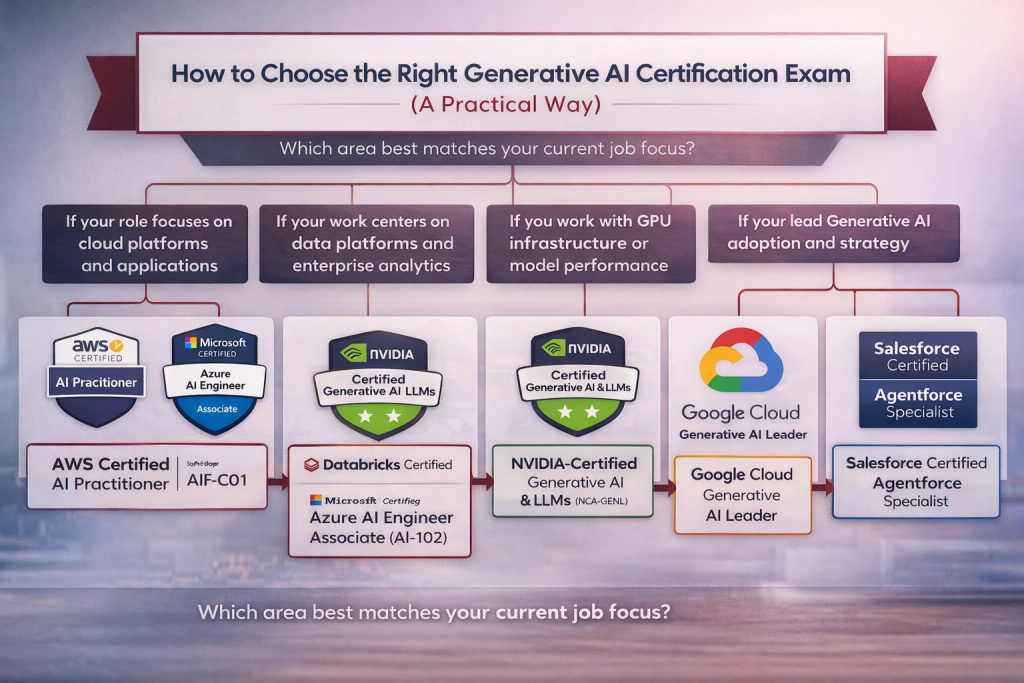
Choosing the right Generative AI certification exam is easier when you match it directly to how you work today, not just what sounds impressive. Employers care most about alignment between your role and the platform you certify on.
1- If your role focuses on cloud platforms and applications
If you work with cloud infrastructure, application development, or cloud-based services, start with AWS Certified AI Practitioner (AIF-C01) or Microsoft Certified: Azure AI Engineer Associate (AI-102).
These certifications align closely with how organizations build and integrate AI features inside production cloud environments using Amazon Web Services and Microsoft Azure.
2- If your work centers on data platforms and enterprise analytics
For roles that deal heavily with structured and unstructured data, analytics pipelines, and governed datasets, the Databricks Certified Generative AI Engineer Associate is a strong match. Employers see this as proof that you can connect Generative AI systems to real enterprise data using Databricks in a controlled, reliable way.
3- If you work with GPU infrastructure or model performance
If your responsibilities include model performance, inference efficiency, or AI infrastructure decisions, NVIDIA-Certified Associate: Generative AI and LLMs (NCA-GENL) stands out.
It signals that you understand how large language models behave at scale and how NVIDIA technologies impact speed, cost, and deployment.
4- If you lead Generative AI adoption and strategy
For professionals who guide teams, manage risk, or shape AI strategy, the Google Cloud Generative AI Leader certification fits well.
Employers value it because it shows you can connect Generative AI capabilities to business goals while working within governance and compliance boundaries using Google Cloud.
5- If your role is focused on CRM automation and customer workflows
If you work in sales operations, service management, or CRM customization, the Salesforce Certified Agentforce Specialist is the most relevant choice.
It aligns directly with AI-driven automation inside Salesforce and shows employers you understand how to apply Generative AI through Trailhead-aligned Salesforce tools in real business workflows.
What employers really want to see with the certification?
A cert alone is helpful, but what gets you hired is proof you can apply it.
A simple portfolio idea that works in 2026:
Build a small GenAI app that answers questions from a set of documents (a basic RAG app).
Add two safety rules:
(1) it must cite the source doc for every key claim, and
(2) It must refuse when the answer is not in the documents.
That one project quietly shows engineering discipline and risk awareness.
Final Note!
If you are preparing for any of these Generative AI Certification Exams and you want extra practice, you can use exam questions and exam dumps from Cert Mage.
Frequently Asked Questions (FAQs)
Which Generative AI certifications look best to employers in 2026?
Employers tend to trust vendor-backed certifications from cloud and enterprise platforms like AWS, Microsoft, Google, Databricks, NVIDIA, IBM, and Salesforce. These map to real tools and are harder to fake than generic course certificates.
Do employers prefer a foundational or engineering-level GenAI exam?
It depends on the role. Foundational exams help if you need shared language and safe usage, while engineering exams matter if you are expected to build and deploy solutions.
Is it still worth taking Salesforce AI Associate in 2026?
Salesforce states the AI Associate certification is being retired in February 2026, so it may not be the best long-term pick. A safer option is choosing the newer Agentforce-focused path.
How long does it take to prepare for a Generative AI certification exam?
For most people, a foundational exam can take a few weeks, while engineering-focused exams often take longer because you need hands-on practice. The fastest way is to study concepts and build one small working project alongside.
What’s the biggest mistake people make with GenAI certifications?
They focus on memorizing terms and skip practice. Employers care more about whether you can design a safe workflow, pick the right approach, and explain tradeoffs in plain words.