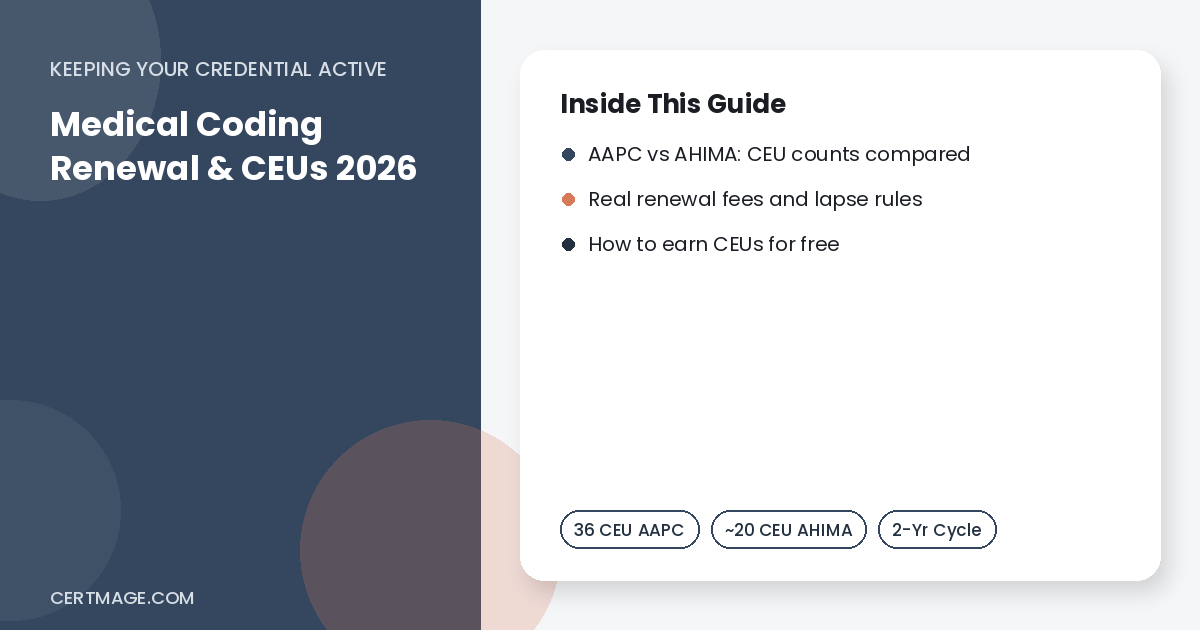
AAPC requires 36 CEUs every 2 years to keep a single credential active, while AHIMA’s requirement varies by credential but runs around 20 CEUs every 2 years for most certifications, and the bigger practical difference isn’t the CEU count itself, it’s what happens to your credential if you miss the deadline, which the 2 organizations handle very differently.
If you’re still choosing between AAPC and AHIMA as your first certification, this isn’t that comparison, our AAPC vs AHIMA overview covers that broader decision. This guide is for people who already hold, or are about to earn, a credential from either body and need to understand what keeping it active actually costs and requires.
TL;DR
- AAPC: 36 CEUs per 2-year cycle for a first credential, plus 16 additional CEUs for each extra AAPC credential you hold
- AHIMA: CEU requirement varies by credential, around 20 CEUs every 2 years for most, with at least 80% tied to AHIMA’s specified HIIM domains
- AAPC credentials lapse automatically at midnight December 31 of your cycle-end year if CEUs and fees aren’t submitted, with a 30-day grace period before suspension risk begins
- AHIMA moves a non-compliant credential to inactive status rather than immediate lapse, recoverable by paying a $50 late fee per certification and completing recertification
- Full reinstatement after an extended lapse is expensive either way: AAPC can require retaking the entire certification exam at full price, AHIMA’s reinstatement runs $368 per credential
- Renewal fee reporting is inconsistent across sources for AAPC specifically, this guide discloses that disagreement directly rather than picking one number and presenting it as certain
The Renewal Timeline: What Actually Happens and When
Rather than a static fact table, here’s the sequence both organizations put you through, since understanding the timeline matters more than memorizing a CEU count in isolation.
| Stage | AAPC | AHIMA |
| Cycle length | 2 years | 2 years (biennial) |
| CEUs due by | End of your 2-year cycle | End of your biennial cycle |
| What happens at the deadline | Credential lapses automatically at midnight December 31 of the cycle-end year if CEUs and fees aren’t submitted | Credential moves to inactive status if CEUs aren’t entered by the cycle end date |
| Grace period | 30 days, with a late fee | Can pay a $50 late fee per certification and recertify after the deadline |
| What happens if you still don’t act | Suspension, possibly requiring additional CEUs or a competency reassessment | Certification stays inactive until recertified |
| Point of no return | Extended lapse can mean full credential revocation, requiring you to retake the entire exam at full cost | Reinstatement after prolonged inactivity runs $368 per credential |
The practical difference worth understanding: AAPC’s language is built around automatic lapse at a hard deadline, which creates a harder cliff edge if you miss it entirely. AHIMA’s inactive-status model is comparatively more forgiving in the short term, a $50 late fee and recertification gets you back to active status, but full reinstatement after a longer lapse is still a real, meaningful cost at $368 per credential.
CEU Requirements Compared
| AAPC | AHIMA | |
| Base requirement, 1 credential | 36 CEUs per 2-year cycle | Approximately 20 CEUs per 2-year cycle for most credentials |
| Each additional credential | 16 CEUs specific to that credential | Requirement varies; check your specific credential’s published requirement |
| Content requirement | CEUs must relate to relevant coding/billing scope of practice | At least 80% of CEUs must be related to one of AHIMA’s specified HIIM domains |
| Double-counting across credentials | Not always permitted, particularly for specialty credentials requiring content tied to that specialty’s specific scope | Not detailed publicly per credential; confirm with AHIMA for your specific combination |
Holding multiple credentials compounds the workload faster with AAPC than the requirement might first suggest. A coder holding CPC plus a specialty credential doesn’t simply need 36 CEUs total, they need 36 for the primary credential plus 16 more specific to the second, and those 16 often can’t be satisfied by the same generic CEU activity that covers the primary credential. Anyone stacking multiple AAPC credentials, which is common for coders also pursuing CPB alongside CPC or a specialty credential like CIRCC alongside CPMA, should budget CEU time accordingly rather than assuming credentials share a CEU pool.
AHIMA’s per-credential variance matters too. RHIA and RHIT both fall under the roughly-20-CEU baseline, but higher-tier credentials can carry different requirements, and someone holding RHIA alongside CCS or building toward a specialized credential like CHDA should confirm each credential’s specific CEU count individually rather than assuming a flat 20-CEU rule applies uniformly across AHIMA’s entire credential catalog.
Renewal Costs: Where Sources Disagree, and What’s Confirmed
This section requires more honesty than most renewal comparisons offer. AAPC’s own published renewal fee is not consistently reported across sources. One figure puts it at $55 per 2-year cycle for members; another reports a $200 annual renewal fee. Both numbers appear in circulation, and without a single authoritative figure confirmed directly on AAPC’s own maintenance page at the time of writing, the honest approach is to disclose the disagreement rather than present either number as settled. Confirm your exact renewal fee directly through your AAPC member account before budgeting.
AHIMA’s fee structure is more consistently documented:
| AHIMA Renewal Fee | Non-Member | Member |
| Single credential, per 2-year cycle | $249 | $100 |
| Each additional credential | $50 | $20 |
| Late fee, per credential | $50 | $50 |
| Reinstatement after lapse | $368 per credential | $368 per credential |
The membership math matters here more than it might first appear. An AHIMA member holding a single credential pays $100 every 2 years to stay active, versus $249 for a non-member, a $149 difference that likely exceeds the cost of AHIMA membership itself over the same period, making membership close to a break-even or net-positive decision purely on renewal fees alone, before counting membership’s other benefits.
How to Actually Earn CEUs Without Overspending
Both organizations accept a range of CEU-generating activities, and the honest reality is that free or low-cost options exist if you plan ahead rather than scrambling near your deadline.
- Free webinars and workshops offered directly by AAPC and AHIMA regularly count toward CEU requirements and cost nothing beyond your existing membership
- Employer-sponsored training at many hospitals and practices doubles as CEU credit; check with your employer’s education department before paying out of pocket for equivalent content
- Conference attendance, whether AAPC’s or AHIMA’s national or regional events, typically generates a large batch of CEUs in a single event, useful for candidates behind on their cycle
- Published articles, presentations, or teaching in your specialty area can count toward CEUs for both organizations, a route often overlooked by coders who assume CEUs only come from passive coursework
- Volunteer work with your certifying body, such as serving on a local chapter committee, frequently qualifies for CEU credit and is underused relative to how accessible it is
Avoid the common last-minute mistake: cramming CEUs in the final weeks of a 2-year cycle usually means paying for expensive rush webinars or courses that free, planned-ahead options would have covered at no cost. Spreading CEU activity across your full cycle, roughly 18 CEUs per year for a single AAPC credential or 10 per year for a typical AHIMA credential, keeps this a non-event rather than a scramble.
What Happens If You Do Nothing: A Realistic Scenario
Picture a CPC holder who lets their 2-year cycle lapse without submitting CEUs or paying the renewal fee. At midnight December 31 of the cycle-end year, the credential lapses automatically. A 30-day grace period follows, still recoverable with a late fee. Beyond that window, AAPC may require additional CEUs or a competency reassessment, and an extended lapse can mean full revocation, forcing a complete retake of the CPC exam at full price, effectively resetting years of standing back to zero.
Now picture the AHIMA equivalent: an RHIT holder misses their biennial CEU deadline. The credential moves to inactive status rather than lapsing outright. Paying a $50 late fee and completing recertification restores active status. Only a prolonged inactive period escalates to the $368 reinstatement cost. The practical lesson: AHIMA’s model punishes procrastination more gradually, while AAPC’s automatic-lapse structure means the cost of inaction accelerates faster once the grace period closes.
Common Mistakes That Lead to a Lapsed Certification
Assuming a “reminder email” will save you. Both organizations send renewal notices, but relying on email as your only tracking system means one missed or filtered message can cost you a certification you’ve held for years. Calendar your own deadline independently.
Treating the 30-day AAPC grace period as a full second chance. It’s a narrow window with a late fee attached, not an informal extension. Candidates who treat it casually often discover the escalation to suspension or revocation happens faster than expected.
Not realizing multiple credentials don’t share a CEU pool. Coders holding 2 or more AAPC credentials sometimes assume general CEU activity covers every credential equally, then discover close to their deadline that 16 credential-specific CEUs for a second certification weren’t actually satisfied by generic coursework.
Letting an inactive AHIMA credential sit for too long. The $50 late fee and recertification path is genuinely forgiving in the short term, which paradoxically makes it easy to procrastinate past the point where the $368 reinstatement fee becomes the only option left.
Paying for CEUs that free options would have covered. Rushing to hit a deadline with paid webinars or courses, when employer-sponsored training, free association webinars, or conference attendance already scheduled in your cycle would have satisfied the same requirement at no additional cost, is one of the most avoidable expenses in maintaining either credential.
Decision Checklist
- Calendar your cycle-end date the moment you earn either credential, not when you start worrying about it; AAPC’s automatic lapse at midnight December 31 gives no informal buffer beyond the 30-day grace period
- If you hold or plan to hold multiple AAPC credentials, budget CEU time per credential rather than assuming a shared pool, since only 16 of the 36 required CEUs for a second credential can typically double as general credit
- Confirm your exact AAPC renewal fee directly through your member account rather than trusting any single third-party figure, given the disagreement documented in this guide
- If you’re an AHIMA credential holder deciding whether membership is worth it, run the renewal math first, since member renewal pricing often nets out cheaper than non-member renewal plus the cost of membership itself
- Spread CEU-earning activity across your full cycle using free options (webinars, employer training, conferences) rather than paying for rushed options near your deadline
FAQS
How many CEUs do I need to renew my AAPC certification?
36 CEUs per 2-year cycle for a single credential. Each additional AAPC credential you hold requires 16 more CEUs specific to that credential, on top of the base 36.
How many CEUs does AHIMA require for renewal?
Approximately 20 CEUs every 2 years for most AHIMA credentials, with at least 80% of those CEUs tied to AHIMA’s specified HIIM domains. Exact requirements can vary by specific credential, so confirm the figure for your particular certification.
What happens if I miss my AAPC CEU deadline?
Your credential lapses automatically at midnight December 31 of your cycle-end year. A 30-day grace period with a late fee follows. Beyond that, AAPC may require additional CEUs or a competency reassessment, and an extended lapse can result in full revocation, requiring a complete retake of your original certification exam at full cost.
What happens if I miss my AHIMA CEU deadline?
Your certification moves to inactive status rather than lapsing immediately. You can typically restore active status by paying a $50 late fee per certification and completing recertification. A prolonged inactive period escalates to a $368 reinstatement fee per credential.
How much does it cost to renew an AAPC certification?
Reported figures disagree: one source states $55 per 2-year cycle for members, another reports a $200 annual fee. Confirm your specific renewal cost directly through your AAPC member account, since this guide could not verify a single authoritative figure at the time of writing.
How much does it cost to renew an AHIMA certification?
$100 per 2-year cycle for members holding a single credential, or $249 for non-members. Each additional credential adds $20 (members) or $50 (non-members) to that cycle’s renewal cost.
Is AHIMA membership worth it just for the renewal fee savings?
Often, yes, on renewal cost alone. A member pays $100 every 2 years for a single credential versus $249 as a non-member, a $149 savings per cycle that frequently exceeds or closely matches the cost of AHIMA membership itself, before counting any other membership benefits.
Can I earn CEUs for free?
Yes. AAPC and AHIMA both regularly offer free webinars and workshops that count toward CEU requirements, and employer-sponsored training, conference attendance, published work, and volunteer committee service can all generate CEU credit without significant additional cost.
Do CEUs count toward multiple certifications at once if I hold more than one?
Not always. AAPC’s structure requires 16 CEUs specific to each additional credential beyond the first 36, and specialty credentials in particular often require content tied specifically to that specialty’s scope of practice rather than generic overlap credit.
What’s the fastest way to lose a medical coding certification entirely?
Letting an AAPC credential stay lapsed well past its 30-day grace period, since extended non-compliance can escalate to full revocation and require retaking the entire certification exam at full price, effectively erasing your certified standing regardless of how many years you’d previously held it.