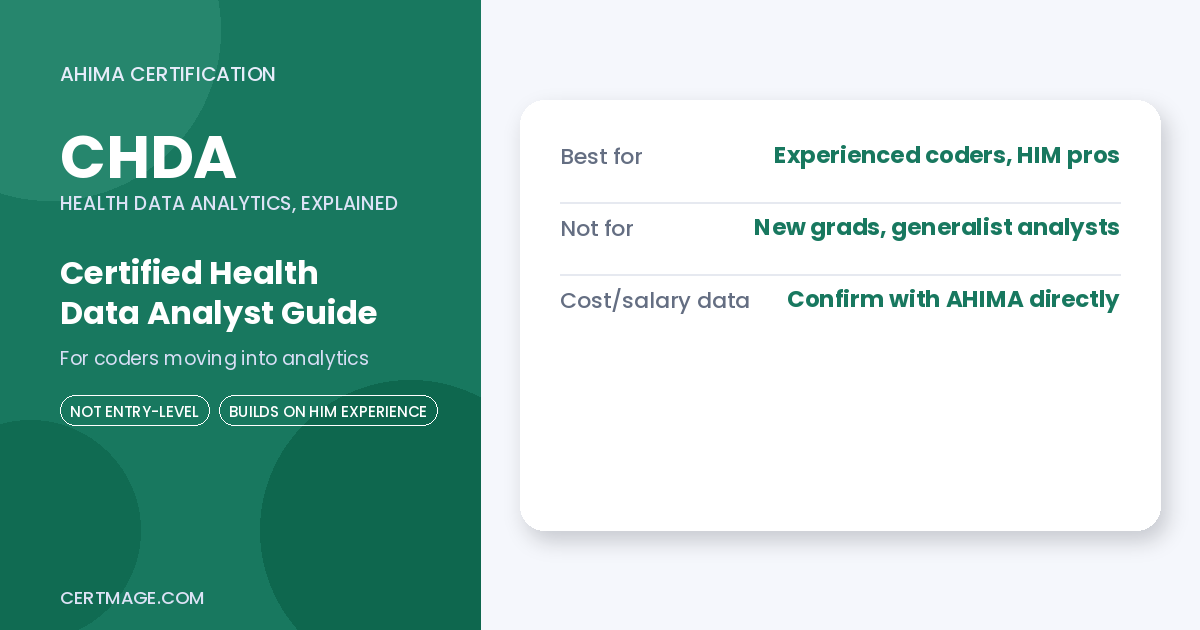
CHDA sits at an unusual intersection: it’s an AHIMA credential built for people who work with healthcare data at a level beyond basic coding or health information management, and it’s genuinely exclusive, only 356 people held it as of December 31, 2025, according to AHIMA’s own certification page. Despite that, it’s mentioned constantly in passing across broader healthcare certification guides without ever getting a dedicated, honest explanation of what it actually tests, what it actually pays, and who it’s genuinely built for.
What CHDA Actually Validates
Certified Health Data Analyst, issued by AHIMA, evaluates competency across a specific set of data-focused responsibilities: healthcare data analysis, reporting, business needs assessment, data acquisition, data management, data interpretation, and data governance. This isn’t a coding certification, and it isn’t a general IT data analytics certification either. It sits specifically at the intersection of healthcare domain knowledge and data analytics skill, testing your ability to work with healthcare-specific datasets, quality measures, and classification systems, not generic business intelligence tools.
| Content Area | What It Covers |
| Healthcare datasets | Understanding the structure and use of major healthcare data sources |
| Quality measures | Interpreting and applying healthcare quality metrics correctly |
| Healthcare classification systems | Working with the coding and classification frameworks underlying healthcare data |
| Electronic health records | How EHR systems generate and structure the data being analyzed |
| Analytics levels | Distinguishing descriptive, diagnostic, predictive, and prescriptive analytics approaches |
| Data visualization | Presenting healthcare data in formats decision-makers can actually use |
| Health data laws and regulations | Legal and compliance considerations specific to healthcare data handling |
Key point: CHDA emphasizes recall, application, and analysis in roughly equal measure, with a strong focus on transforming raw healthcare data into accurate, consistent, and timely information for organizational decision-making. This is a meaningfully different emphasis than a coding exam, which tests your ability to assign correct codes to documented encounters. CHDA tests whether you can take data that’s already been generated and turn it into something an organization can actually act on.
Exam Format and Real Numbers
| Detail | Value |
| Passing score | 300, on AHIMA’s scaled scoring system |
| Reported pass rate | Approximately 54 percent |
| Delivery | Computer-based at a Pearson VUE testing center, or remote via OnVue proctoring |
| Exam fee | Approximately $259 for AHIMA members |
| Retake wait period | 90 days, with a new application and fee required |
| Recertification cycle | Every 2 years |
| Recertification requirement | 30 continuing education units per cycle |
| Recertification fee | $218 for members, $298 for non-members |
| Certified professionals as of 12/31/2025 | 356, making this one of the smaller active AHIMA credentials by holder count |
Important: AHIMA does not authorize waiving the 90-day retest waiting period under any circumstances, citing test security policy. If you fail, budget that full 90 days into your timeline before you can schedule again, and know that your prior transcripts stay on file, so you won’t need to resubmit your eligibility documentation for a retake.
The Real Eligibility Requirements
Unlike some AHIMA credentials with looser entry paths, CHDA has clearly defined eligibility routes, and you need to satisfy at least one of them before you can even register:
- Hold the RHIT credential and have a minimum of 3 years of experience working with healthcare data
- Hold a bachelor’s degree and have a minimum of 3 years of experience working with healthcare data
- Hold the RHIA credential, with no separate experience requirement specified beyond the credential itself
- Hold a master’s degree in Health Information Management or Health Informatics from an accredited program
Note: RHIA and RHIT are frequently described as precursor credentials that naturally lead into CHDA, and the eligibility structure above confirms why, both provide a direct qualifying path, with RHIT requiring the additional 3 years of data experience that RHIA alone does not.
Who This Certification Is Actually Built For
CHDA is generally intended for professionals already working in, or preparing for, roles connected to health data analytics specifically, not entry-level coders and not generic data analysts without healthcare context. According to AHIMA’s own certification catalog, CHDA also functions as a foundation that can lead toward more advanced specialization, since the analytical and governance skills it validates apply across several more senior health information management paths.
| Your Background | Fit |
| RHIT holder with 3+ years of healthcare data experience | Directly eligible, strong fit |
| RHIA holder | Directly eligible, strong fit |
| Bachelor’s degree holder with 3+ years of healthcare data experience, no HIM credential | Directly eligible if the experience requirement is genuinely met |
| Master’s degree in HIM or Health Informatics | Directly eligible regardless of prior work experience |
| General data analyst with no healthcare-specific background | Not eligible without meeting one of the paths above, and a weaker fit even if technically eligible, since CHDA assumes healthcare domain context |
| New graduate with no healthcare data experience | Not the right starting point. This is better approached after building foundational healthcare or coding experience first |
What CHDA Actually Pays, Told Honestly
This is where most guides either go silent or make CHDA sound more lucrative than the data supports, so here’s the honest picture across every source available. ZipRecruiter’s 2026 data puts the national average for CHDA-related roles at $82,640 a year, with a typical range of $62,500 to $97,000. A broader “Healthcare Data Analyst” search on Glassdoor, covering roles that don’t necessarily require CHDA specifically, shows a considerably higher average of $107,162, with the 25th to 75th percentile spanning $81,299 to $142,535, but that higher figure is pulled up by senior analyst roles at large payers and health tech companies, including organizations like Optum, Elevance, and Humana, that typically don’t require CHDA at all and instead screen for SQL, Python, and Tableau skills directly.
AHIMA’s own marketing describes CHDA-certified professionals as earning 10 to 15 percent more than non-certified peers, a claim worth treating as vendor-sourced rather than independently verified. The most honest framing: CHDA correlates most consistently with mid-career HIM analyst roles in the $70,000 to $95,000 band. The genuinely large, six-figure healthcare analyst salaries tend to sit at payer organizations and tech companies, and those roles are won primarily with SQL, Python, and Tableau skills, not with CHDA on its own. CHDA functions as a real differentiator on a resume within HIM-adjacent analytics work, not as a standalone ticket to six-figure pay.
Older AHIMA survey data breaking down pay by job family showed Operations-Medical Records Administration roles averaging $81,950, while professionals who move into the broader Medical and Health Services Managers category, a path some CHDA holders eventually take, see a median of $101,340, with the top 10 percent exceeding $205,620.
Why This Credential Is Becoming More Relevant Right Now
There’s a genuinely current reason CHDA’s position is shifting, tied to a change happening in a completely different part of the healthcare certification landscape. ISC2’s HCISPP credential, a healthcare-specific security certification, becomes fully inactive on December 1, 2026, 3 years after its final exam administration in 2023. As of late 2026, this leaves CHDA as effectively the only actively administered, healthcare-specific credential remaining in AHIMA’s analytics lane specifically. It’s worth framing this accurately: this is market consolidation, not CHDA winning some head-to-head competition, since HCISPP covered security, a genuinely different discipline from CHDA’s data analytics focus. But for anyone comparing what’s actually still active and testable in this general space, CHDA’s field has narrowed by default.
CHDA’s broader competitive position holds up reasonably well on its own terms too. PMI’s Business Analysis credential is broader and not healthcare-specific. SAS-branded analytics credentials are tool-locked to one vendor’s software and lean pharma-focused. CHDA remains the only vendor-neutral, healthcare-specific data analytics credential from a recognized health information management body, a genuinely narrow but real lane.
How CHDA Fits With Other AHIMA Credentials
CHDA is frequently mentioned as a natural complement to, or next step from, foundational AHIMA credentials like CCA, RHIT, or coding-focused credentials such as CCS or CCS-P. The eligibility requirements confirm this directly, RHIT and RHIA both provide qualifying paths into CHDA. The progression makes practical sense beyond just satisfying eligibility rules: coding and health information management experience builds the domain knowledge that makes CHDA’s data governance and analytics content meaningfully easier to apply, rather than learning healthcare data structures from scratch alongside analytics methodology at the same time.
Decision Checklist
- Confirm you actually satisfy one of the 4 specific eligibility paths, RHIT plus 3 years of data experience, a bachelor’s degree plus 3 years of data experience, RHIA, or a qualifying master’s degree, before planning around this certification at all.
- Set realistic salary expectations: CHDA correlates most reliably with $70,000 to $95,000 mid-career HIM analyst roles, not the six-figure healthcare analyst salaries that require SQL, Python, and Tableau skills instead.
- Budget for the exam fee around $259, plus recertification every 2 years requiring 30 CEUs and a $218 to $298 renewal fee, an ongoing cost commitment beyond the initial exam.
- If you fail the exam, plan around the mandatory, non-waivable 90-day retest waiting period rather than assuming you can schedule a retake quickly.
- If you’re an experienced coder or HIM professional considering a pivot away from production coding, CHDA represents a genuine lateral move into analytics that leverages your existing knowledge, and its status as one of the few remaining active healthcare-specific analytics credentials, following HCISPP’s sunset, adds to its relevance right now.
- Consider CHDA as a next step after, not instead of, foundational coding or health information management credentials, since both the exam content and the formal eligibility requirements assume that base knowledge already exists.
For the foundational entry-level medical coding credentials that often precede a move into CHDA, see our CPC vs CCA guide. If auditing and compliance is a different specialty direction you’re weighing instead of data analytics, see our CIRCC vs CPMA comparison for how that path compares.
FAQS
What does CHDA actually certify?
Competency in healthcare data analysis, reporting, data acquisition and management, data interpretation, and data governance, specifically applied to healthcare datasets, quality measures, and classification systems.
How many people currently hold the CHDA credential?
356, as of December 31, 2025, according to AHIMA’s own certification page, making it one of the smaller active AHIMA credentials by holder count.
What is the CHDA exam’s pass rate and passing score?
Approximately 54 percent pass, with a required scaled score of 300 to pass.
What are the eligibility requirements for CHDA?
You need at least one of: RHIT plus 3 years of healthcare data experience, a bachelor’s degree plus 3 years of healthcare data experience, the RHIA credential, or a master’s degree in Health Information Management or Health Informatics from an accredited program.
How much does the CHDA exam cost?
Approximately $259 for AHIMA members, with recertification every 2 years costing $218 for members or $298 for non-members, plus 30 required continuing education units per cycle.
Does CHDA pay well?
It correlates most reliably with $70,000 to $95,000 mid-career HIM analyst roles. The larger six-figure healthcare analyst salaries at payers and tech companies typically require SQL, Python, and Tableau skills rather than CHDA specifically.
What happens if I fail the CHDA exam?
You must wait 90 days before reapplying, with a new application and exam fee required. AHIMA does not waive this waiting period under any circumstances.
Why is CHDA becoming more relevant in late 2026 specifically?
ISC2’s HCISPP credential, a different, security-focused healthcare certification, becomes fully inactive on December 1, 2026, leaving CHDA as effectively the only actively administered, healthcare-specific analytics credential remaining in AHIMA’s lane, a case of market consolidation rather than direct competition.
Should I get CHDA before or after a coding credential like CPC or CCS?
After. CHDA’s own eligibility requirements assume healthcare domain knowledge that foundational coding or health information management experience provides, making it a natural next step rather than a starting point.