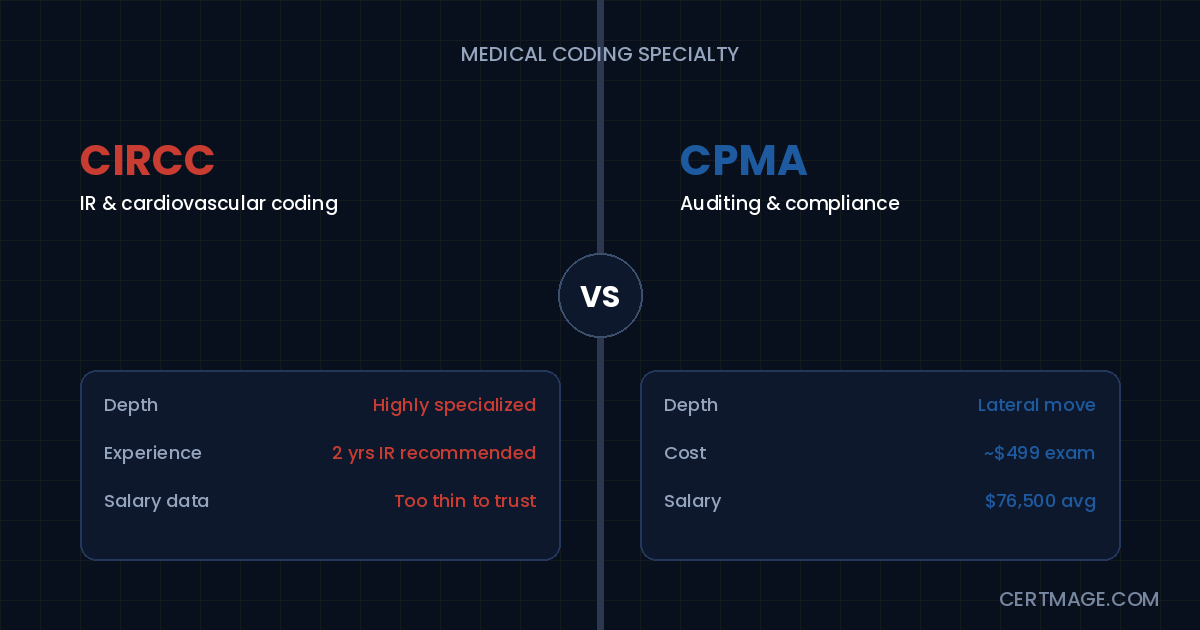
Once you’ve held a foundational coding credential for a year or two, the next real decision isn’t whether to specialize, it’s which direction. CIRCC and CPMA represent 2 of the most distinct specialty paths AAPC offers, and they pull in genuinely different directions: CIRCC goes deep into one of the most technically demanding procedural areas in medicine, interventional radiology and cardiovascular coding. CPMA goes sideways into auditing and compliance, reviewing other coders’ work rather than producing more of your own.
A Pricing Structure Worth Knowing Upfront
AAPC prices its exams in tiers, and CIRCC and CPMA sit in different ones. CPMA is priced as a Core exam, currently $425 for one attempt or $499 for 2 attempts, the same tier as CPC, COC, CRC, and CIC. CIRCC is priced separately as a specialty-tier exam, running $400 to $425 for one attempt and $450 for 2 attempts depending on the specific pricing cycle, generally less expensive than the Core tier despite testing genuinely narrower, more technical content. If you’re budgeting for either, confirm the current exact figure directly on AAPC’s own certification exam cost page, since AAPC’s own published pricing has shown minor internal inconsistencies between different pages on its own site.
What Each Credential Actually Requires
CIRCC, Certified Interventional Radiology Cardiovascular Coder, was developed by AAPC specifically because error rates in this coding area run high, interventional radiology and cardiovascular procedures involve complex, highly technical documentation that generic CPT knowledge doesn’t adequately prepare coders for. AAPC doesn’t formally require prior experience to sit the exam, but recommends a minimum of 2 years of coding experience in interventional radiology specifically before attempting it. The exam leans heavily on case-report format questions rather than simple code lookups, and the domain weighting reflects genuinely specialized content.
| CIRCC Domain | Approximate Weight |
| Diagnostic angiography | 25 percent |
| Non-vascular interventions | 25 percent |
| Percutaneous vascular interventions | 25 percent |
| Diagnostic cardiac catheterization and basic coronary arterial interventions | 10 percent |
| Basic coding, anatomy, and terminology | Remaining balance, under 10 percent each |
A caution worth stating directly: you may encounter third-party practice test sites describing CIRCC as covering domains like “Quality Leadership,” “Population Health,” or “Patient Safety.” That content describes a completely different type of credential, likely a general healthcare quality certification, not interventional radiology and cardiovascular coding. If a CIRCC prep resource lists domains that sound like hospital administration or population health management rather than angiography and vascular interventions, that resource has the wrong exam, and you should not trust its practice questions.
CPMA, Certified Professional Medical Auditor, assumes you already hold a coding credential, typically with 2 or more years of coding experience, and it shifts your role entirely: instead of assigning codes, you’re reviewing other people’s coding for accuracy, compliance, and audit risk. The exam runs 100 questions over 4 hours, open-book with approved CPT, ICD-10-CM, and HCPCS manuals, requiring a 70 percent passing score. Preparation typically runs 8 to 12 weeks.
| CPMA Domain | Approximate Weight |
| Medical Record Auditing and Abstraction | 35 percent |
| Remaining 5 domains, covering theory, legal and regulatory issues, coding concepts, and modifiers | Balance of the exam |
Note: CPMA’s questions test practical audit judgment specifically, not isolated code lookup. Candidates describe the real skill being tested as deciding whether a documented clinical narrative actually justifies the coding and billing outcome, evaluating E/M documentation for medical necessity, validating modifier use in ambiguous scenarios, and communicating audit findings clearly, rather than simply picking the technically correct code from a list.
| Detail | CIRCC | CPMA |
| Issuing body | AAPC | AAPC |
| Pricing tier | Specialty, $400-425 for 1 attempt, $450 for 2 | Core, $425 for 1 attempt, $499 for 2 |
| Prior credential required | Not formally, though 2 years IR coding experience is strongly recommended | Yes, assumes you already hold a coding credential with roughly 2 years of experience |
| Core skill | Deep procedural coding in a technically complex specialty | Auditing and reviewing other coders’ work for accuracy and compliance |
| Question format | Heavily case-report based | 100 questions, 4 hours, open-book |
| Typical prep time | Varies, longer for coders without direct IR experience | 8 to 12 weeks |
The Real Difference: Going Deeper vs Going Sideways
CIRCC is a depth play. You’re becoming a genuine specialist in one of the most complex procedural coding areas in medicine, and that specialization is valuable precisely because so few coders have it. CPMA is a lateral move into a different function entirely, auditing and compliance, that draws on your existing coding knowledge but applies it to reviewing accuracy rather than producing new codes. Neither is “more advanced” than the other in a strict sense, they represent 2 different career directions available once you’ve built foundational coding experience.
| Your Career Direction | Better Fit |
| You want to specialize deeply in one of the highest-complexity procedural areas | CIRCC |
| You’re drawn to auditing, compliance, and quality review rather than production coding | CPMA |
| You already work in or near interventional radiology or cardiovascular coding | CIRCC |
| You want a credential broadly applicable across many coding specialties, not tied to one procedural area | CPMA |
| You want the lower-cost specialty option and already have IR-adjacent experience | CIRCC |
| You’re building toward compliance officer or internal audit leadership roles | CPMA |
What This Actually Pays, Told Honestly
Here’s where this comparison needs real caution rather than confident numbers. CIRCC-specific salary data is genuinely thin and inconsistent across sources. Some cited figures come from extremely small samples, one Glassdoor estimate is based on a single salary submission, and a PayScale estimate is based on only 4 survey responses. A separate industry analysis places CIRCC-related salaries in a broader $80,000 to $105,000 range, describing it as top-tier compensation for cardiology and radiology coding specifically. None of these 3 reference points share a clearly documented methodology, and any guide presenting a single precise CIRCC salary figure with confidence is overstating what the data actually supports. What’s more reliably reported is directional: interventional radiology coding is consistently described as one of the highest average paying medical coding specialties generally, which lines up with CIRCC’s reputation as a high-value, high-complexity credential, even without one single trustworthy number attached to it.
CPMA’s earning picture is better documented. AAPC’s own salary survey puts average CPMA pay at $76,500, and industry analysis describes it as one of the highest-earning AAPC credentials overall, with experienced auditors crossing $100,000. Other sources place the broader CPMA and compliance-track range at $72,000 to $94,000.
Decision Checklist
- If you’re drawn to CIRCC, confirm you have genuine hands-on exposure to interventional radiology or cardiovascular coding first, or a realistic path to get it, since AAPC’s recommended 2 years of specific experience reflects how technically demanding this exam actually is.
- Don’t trust any single precise CIRCC salary figure. Treat “one of the highest-paying coding specialties, roughly $80,000 to $105,000 on the higher end of industry estimates” as the honest, defensible claim, not a guaranteed specific number.
- Be skeptical of any CIRCC prep resource describing domains related to quality leadership, population health, or patient safety. Genuine CIRCC content centers on diagnostic angiography, vascular interventions, and cardiac catheterization coding specifically.
- If auditing and compliance work appeals to you more than continuing to produce new codes, CPMA is the better-documented, more financially predictable specialty path of the two.
- Confirm you already hold a foundational coding credential with roughly 2 years of experience before pursuing CPMA specifically, since it assumes that base rather than teaching coding from scratch.
- Budget realistically: CIRCC runs $400 to $425 for a single attempt as a specialty-tier exam, while CPMA runs $425 as a core-tier exam, with both allowing a second attempt bundled at a higher combined price.
For the foundational credential most specialty paths build on, see our CPC vs CCA comparison. If risk adjustment coding is another specialty direction you’re weighing, see our CRC certification guide, and for the outpatient facility-coding specialty specifically, see our COC vs CPC comparison.
FAQS
What is CIRCC used for?
Certifying deep expertise in interventional radiology and cardiovascular procedural coding, one of the most technically complex and error-prone coding specialties in medicine.
Do I need prior experience for CIRCC?
Not formally required by AAPC, but a minimum of 2 years of coding experience in interventional radiology specifically is strongly recommended given the exam’s difficulty.
What does CPMA actually qualify me to do?
Audit and review other coders’ work for accuracy, compliance, and audit risk, a distinct function from producing new codes yourself, tested through 100 questions over 4 hours.
How much does CPMA cost?
$425 for one attempt or $499 for 2 attempts as an AAPC Core-tier exam, with most candidates completing preparation in 8 to 12 weeks.
How mu
ch does CIRCC cost compared to CPMA?
CIRCC is priced as a specialty-tier exam, generally $400 to $425 for one attempt and $450 for 2, somewhat less than CPMA’s Core-tier pricing.
Is the reported CIRCC salary of over $170,000 accurate?
Treat it with significant skepticism. That figure comes from a Glassdoor estimate based on a single salary submission, not a statistically reliable sample. A separate, broader industry estimate places CIRCC salaries at $80,000 to $105,000.
What is the largest single domain on the CPMA exam?
Medical Record Auditing and Abstraction, comprising roughly 35 percent of the exam, the single heaviest domain by a wide margin.
Which pays more, CIRCC or CPMA?
CPMA has meaningfully better-documented salary data, averaging $76,500 with experienced auditors exceeding $100,000. CIRCC’s specific salary data is inconsistent across sources, though industry estimates suggest a comparable or higher range of $80,000 to $105,000.
Are CIRCC practice test domains describing “Quality Leadership” or “Population Health” accurate?
No. Those domains describe a different type of credential entirely, likely a healthcare quality certification, not interventional radiology and cardiovascular coding. Legitimate CIRCC content centers on angiography, vascular interventions, and cardiac catheterization coding.