COC and CPC are both AAPC credentials, both focus on outpatient work, and both get lumped together in generic “medical coding certification” roundups as if they’re interchangeable. They aren’t. CPC certifies physician and professional-fee coding, the codes tied to what a doctor personally did during a visit. COC certifies facility-side outpatient coding, the codes tied to what the hospital outpatient department, ambulatory surgery center, or emergency department billed for the space, staff, and resources used. Coders who understand this distinction early save themselves a wrong first certification, and a bit of naming history explains why so many people get confused about this pairing in the first place.
A Naming History Worth Knowing First
COC wasn’t always called COC. It was originally launched as CPC-H, Certified Professional Coder-Hospital, and the credential was later rebranded to its current name, Certified Outpatient Coding. If you’re researching this online and stumble across older material, government occupational databases, older forum posts, or outdated study guides, referencing “CPC-H,” that’s this exact same credential under its earlier name, not a separate, third certification. This naming history is also a big part of why CPC and COC get confused so easily today, the old name for COC literally had “CPC” embedded inside it.
What Each Credential Actually Covers
CPC, Certified Professional Coder, is AAPC’s flagship entry-level credential, and it’s built around physician-office and professional-fee coding: CPT procedure codes, ICD-10-CM diagnosis codes, and HCPCS Level II codes, applied to what happens in a physician’s office, clinic, or professional service setting. AAPC built CPC specifically around outpatient coding broadly, physician offices, ambulatory surgery, urgent care, and outpatient hospital or freestanding clinic encounters, and it remains the credential recruiters mention most often across job listings of any kind.
COC, Certified Outpatient Coder, formerly CPC-H, shifts the lens specifically to the facility side of outpatient care: hospital outpatient departments, ambulatory surgery centers, and emergency department coding. The exam tests real, applied knowledge of Ambulatory Payment Classifications, or APCs, and payment status indicators, the specific reimbursement methodology that governs how hospital outpatient facilities get paid, distinct from the physician-fee schedule logic CPC tests. Importantly, COC does not test ICD-10-PCS code assignment or DRG methodology, that inpatient-specific coding work belongs to AHIMA’s CCS credential instead, so COC sits squarely in outpatient territory even though it’s facility-focused rather than physician-focused.
| Detail | CPC | COC |
| Full name | Certified Professional Coder | Certified Outpatient Coder |
| Former name | N/A | Certified Professional Coder-Hospital (CPC-H) |
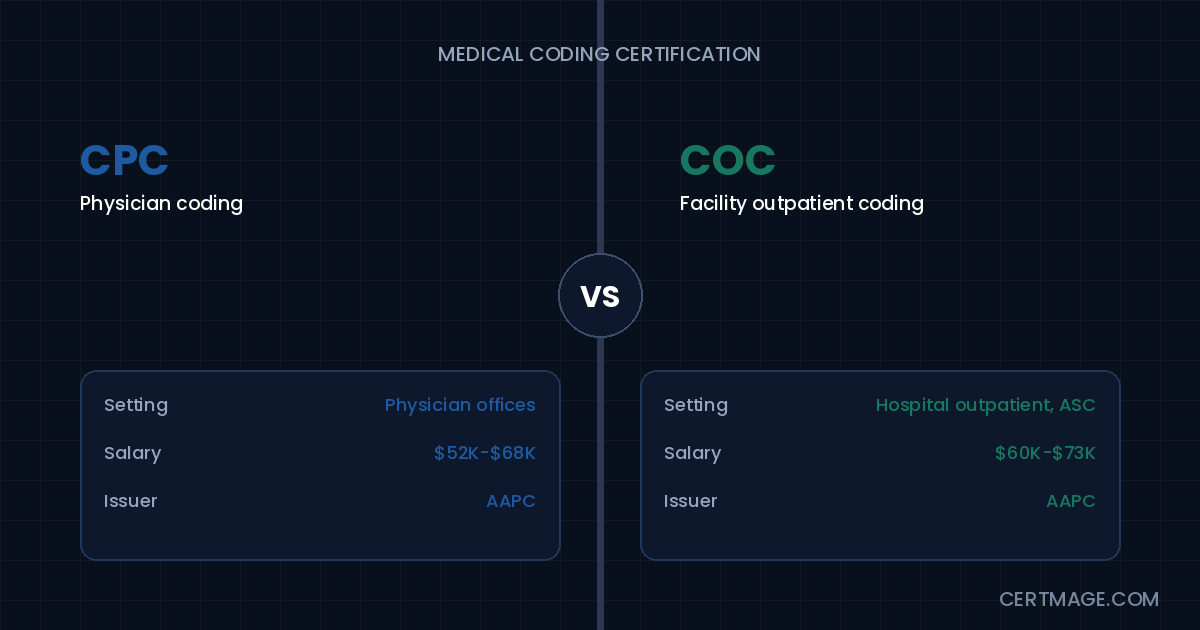
| Setting | Physician offices, clinics, professional services, outpatient hospital and freestanding clinics | Hospital outpatient departments, ambulatory surgery centers, ED |
| Coding focus | Professional-fee coding: CPT, ICD-10-CM, HCPCS Level II | Facility-side outpatient billing, APCs, payment status indicators |
| Tests ICD-10-PCS or DRG assignment | No | No, that inpatient-specific work belongs to CCS instead |
| Format | 100 multiple-choice questions, 4 hours, open codebook | Case-based and documentation-driven questions covering CPT, ICD-10-CM, HCPCS Level II, E/M, modifiers, NCCI edits, and Medicare reimbursement methodology |
| Passing score | 70 percent | Not published with the same specificity as CPC’s |
| Issuing body | AAPC | AAPC |
| Membership required | Yes, AAPC membership required to sit any AAPC exam | Yes, same requirement |
| Exam fee | Reported as $399 to $425 for members depending on source, $499 for non-members or a second attempt | Comparable AAPC core exam pricing structure |
| Salary range | Roughly $55,000 to $75,000 | Roughly $60,000 to $73,000, with ambulatory surgery center roles averaging around $70,800 |
Note on pricing: Sources describe CPC’s member pricing slightly differently, some cite $399 with a free retake included, others cite $425 for a single attempt with $499 covering 2 attempts. Confirm the current exact structure directly with AAPC before registering, since fee structures shift periodically.
The Real Difference: Who Did What vs What Was Provided
This is the distinction that trips up new coders more than any other in this comparison. A patient visits a hospital outpatient surgery center for an outpatient procedure. The surgeon’s professional work, the actual procedure performed, gets coded one way for the physician’s billing, potentially under CPC-style logic. The facility’s side of that same encounter, the operating room time, the equipment, the recovery space, the nursing resources, gets coded separately under facility-side outpatient logic using APC-based reimbursement rules, which is COC’s territory. Many complex outpatient encounters generate both types of coding simultaneously, for 2 different billing entities, which is exactly why COC is frequently described as complementing a CPC rather than replacing it.
Real job postings show this distinction isn’t always cleanly separated in practice, though. One recent posting at Bertrand-Chaffee Hospital in Springville, New York, for an on-site Outpatient Clinic Coder role, requires CPC certification specifically, despite the role coding outpatient and specialty services, a reminder that some employers use CPC as their default outpatient requirement even in settings where COC’s facility-specific knowledge would also apply. Other roles, including remote positions coding for reference labs, ancillary services, emergency rooms, endoscopy, and ambulatory surgery, describe exactly the kind of facility-outpatient work COC is built to validate, even when the posting itself doesn’t always specify which exact credential is preferred.
| Your Situation | Better Fit |
| You work in a physician’s office or clinic, coding what the doctor did | CPC |
| You work in a hospital outpatient department, ASC, or ED coding facility charges | COC |
| Your facility handles both professional and facility billing | Consider both, since they cover genuinely different sides of the same encounter |
| You’re brand new to coding with no clear setting yet | CPC, since it’s the more broadly recognized starting credential |
| A specific job posting names one credential explicitly | Match that exact requirement, since as the Bertrand-Chaffee example shows, employers don’t always ask for the “textbook correct” credential for the setting |
A Real Market Trend Worth Knowing
Physicians are increasingly joining hospital-owned practice groups rather than staying in independent private practice, a trend that’s been accelerating for years and shows no sign of reversing. Every time a physician practice gets absorbed into a hospital system, coding work that used to run through pure professional-fee CPC logic increasingly shifts into hospital outpatient department billing structures, the exact territory COC covers. Industry commentary describes this consolidation trend as making COC certification an increasingly smart career move specifically because of it, not just a niche alternative to CPC.
Salary Reality Check
COC pays a modest but real premium over general CPC averages in specific settings. Ambulatory surgery center coders holding COC average around $70,800, about 9 percent above the general CPC median, according to 2026 salary data. Broader COC salary ranges run $60,000 to $73,000, while general CPC ranges typically fall between $55,000 and $75,000, before specialty stacking. Neither figure tells the whole story on its own, both credentials show meaningful spread based on geography, employer type, and years of experience, with metro markets in California, New York, Washington, and Massachusetts commonly paying 18 to 25 percent above national averages for equivalent experience.
Can You Stack Them?
Yes, and it’s a common, financially sensible move. AAPC’s own salary survey data shows dual-credentialed coders averaging meaningfully more than CPC-only holders, and coders holding 3 or more credentials averaging higher still. Since COC specifically complements CPC by covering the facility side of outpatient coding that CPC doesn’t touch, the 2 together build a genuinely broader outpatient coding skill set than either alone, useful if your facility or career goals span both physician and facility billing, and especially relevant given the physician-practice consolidation trend pushing more coding work into facility-billing structures.
Decision Checklist
- Identify which side of outpatient billing your actual job, or target job, involves: physician professional fees, or facility charges. This single question resolves most of the CPC-versus-COC confusion immediately.
- If you’re brand new to coding with no specific employer or setting locked in yet, start with CPC, since it remains the more broadly recognized entry credential across the widest range of coding jobs.
- If you already hold CPC and work in or want to move into hospital outpatient, ambulatory surgery center, or ED coding specifically, COC is a logical next credential rather than a replacement.
- Don’t assume COC is a lesser or niche credential because it’s less universally known than CPC. In ambulatory surgery center settings specifically, it carries a real, measurable pay premium, and physician-practice consolidation is expanding its relevance over time.
- If you encounter the name “CPC-H” anywhere, older job postings, government occupational listings, outdated guides, know that it refers to this exact same COC credential under its original name, not a separate certification.
- Read actual job postings carefully rather than assuming the “textbook correct” credential applies. Some outpatient facility roles still list CPC as their stated requirement.
- Confirm your AAPC membership status before assuming you can sit either exam. Both require active AAPC membership as a prerequisite to testing.
For a broader view of how these credentials fit into the full AAPC and AHIMA coding landscape, see our CPC vs CCA guide and our CRC certification guide for how risk adjustment coding compares as another specialty path. If you’re weighing AAPC’s outpatient credential against AHIMA’s competing physician-based option, see our CCS-P vs CPC comparison, and for another specialty fork beyond these foundational credentials, see our CIRCC vs CPMA guide.
FAQS
What is the main difference between COC and CPC?
CPC certifies physician and professional-fee coding, what a doctor did during a visit. COC certifies facility-side outpatient coding, what a hospital outpatient department, ambulatory surgery center, or emergency department billed for space and resources, using APC-based reimbursement rules.
Is COC the same thing as CPC-H?
Yes. COC was originally launched under the name Certified Professional Coder-Hospital, or CPC-H, and was later renamed to its current title, Certified Outpatient Coder. Any reference to CPC-H refers to this same credential.
Does COC test inpatient coding like ICD-10-PCS or DRG assignment?
No. COC stays entirely within outpatient territory. ICD-10-PCS code assignment and DRG methodology are inpatient-specific skills tested under AHIMA’s CCS credential instead.
Which pays more, COC or CPC?
COC shows a modest premium in specific settings, averaging around $70,800 in ambulatory surgery centers specifically, about 9 percent above the general CPC median. Broader ranges overlap significantly between the two.
Should I get COC or CPC first?
CPC first if you’re new to coding with no specific setting locked in, since it’s the more broadly recognized entry credential. COC makes sense once you’re working in or targeting hospital outpatient, ASC, or ED coding specifically.
Can I hold both COC and CPC?
Yes, and it’s a common, financially favorable combination, since the two cover different but complementary sides of outpatient coding, particularly valuable given the ongoing trend of physician practices joining hospital-owned groups.
Do COC and CPC require AAPC membership?
Yes, both require active AAPC membership to sit the exam.
Is COC harder than CPC?
Not necessarily harder, but it tests different logic, facility-side billing rules and APC methodology rather than professional-fee coding, so prior CPC knowledge doesn’t fully transfer without additional study.
Why is COC becoming more relevant even though CPC is more widely known?
Physicians are increasingly joining hospital-owned practice groups rather than staying independent, which shifts more coding work from pure physician-fee billing into hospital outpatient department billing structures, exactly the territory COC covers.