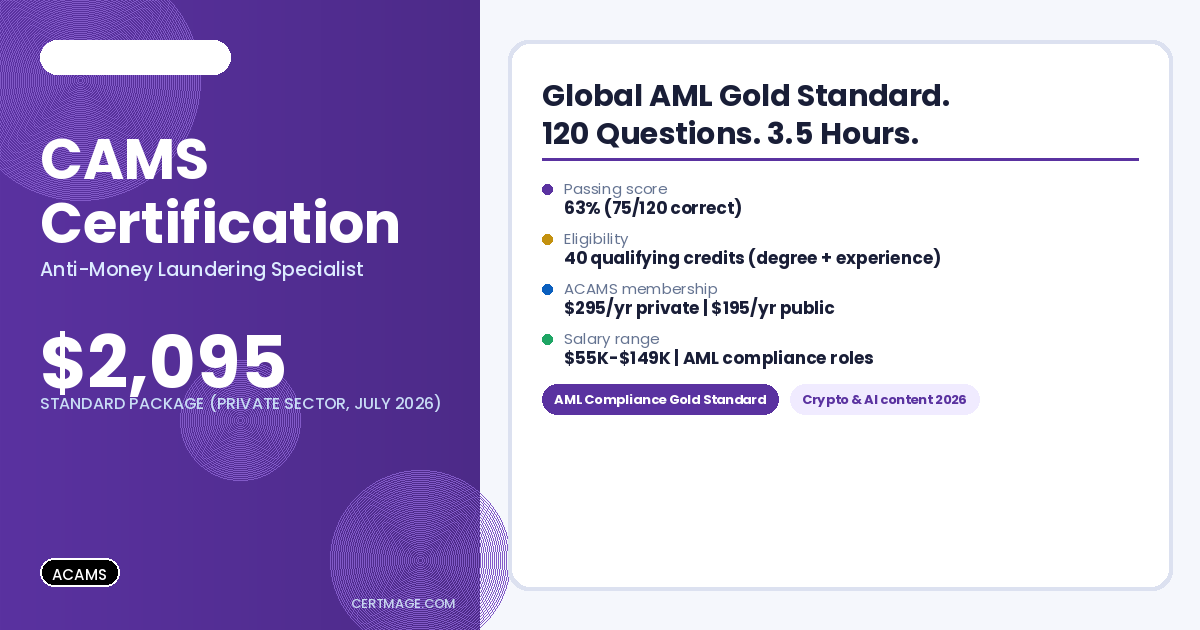
The Certified Anti-Money Laundering Specialist (CAMS) is the global gold standard credential for financial crime compliance professionals, issued by ACAMS (Association of Certified Anti-Money Laundering Specialists). The standard package costs $2,095 for private-sector candidates (verified July 2026 at acams.org), requires 40 qualifying credits based on education and experience, covers four AML-specific courses, and earns a certified passing rate on a 3.5-hour, 120-question computer-based exam requiring 63% to pass (75 of 120 questions correct). US professionals with CAMS certification average $55,000 to $149,000 annually depending on role and seniority, with compliance officers and AML directors consistently earning above $100,000.
Who the CAMS Is Built For
ACAMS positions CAMS for professionals with 18 to 24 months of experience in anti-financial crime. It is not a beginner credential. It is designed to validate and formalize expertise that professionals are already applying.
The CAMS is right for you if you:
- Work as an AML analyst, KYC analyst, or transaction monitoring specialist
- Hold a role as compliance officer, BSA officer, or risk manager at a bank, credit union, or financial institution
- Work in the second or third line of defense (compliance oversight, internal audit) in a financial institution
- Work for a fintech company building AML compliance programs
- Work in government or regulatory roles overseeing financial crime compliance
- Are a consultant advising financial institutions on AML programs and regulatory compliance
- Hold the CIA, CISA, or CFE and want to add a financial crime compliance specialization
The CAMS may not be your immediate priority if you:
- Are in your first year of compliance or financial services work with no AML exposure
- Work in a sector not subject to AML regulatory requirements (consider building domain experience first)
- Need a certification that directly satisfies DoD or government IT requirements (CISA is better suited)
CAMS Exam: Complete Details
| Detail | Specification |
| Issuing organization | ACAMS (Association of Certified Anti-Money Laundering Specialists) |
| Exam questions | 120 multiple choice |
| Exam duration | 3.5 hours |
| Passing score | 63% (75 correct out of 120) |
| Exam format | Computer-based, Pearson VUE test centers globally |
| Delivery languages | English and multiple regional language versions |
| Prerequisite | ACAMS membership + 40 qualifying credits |
| ACAMS membership (private sector) | $295/year (verified July 2026) |
| ACAMS membership (public sector/gov/NGO) | $195/year |
| Standard CAMS package (private sector) | $2,095 USD – includes study guide, practice materials, one exam attempt |
| Standard CAMS package (public sector) | $1,595 USD |
| Retake policy | 30-day waiting period after first failed attempt |
| Certification validity | 3 years |
| Renewal | 60 CAMS credits per 3-year cycle; $250 renewal fee |
| Most recent content update | June 2026 (ACAMS updates exam content regularly) |
The 40 Qualifying Credits System
Before you can sit the CAMS exam, you must accumulate 40 qualifying credits. ACAMS calculates these from a combination of education, professional experience, and professional designations.
| Qualification | Credits |
| Bachelor’s degree | 20 credits |
| Master’s degree or JD | 30 credits |
| Relevant professional certification (CISA, CIA, CFE, CPA, etc.) | 5-10 credits each |
| Each year of relevant AML/compliance work experience | 5 credits per year |
| Completion of ACAMS training courses | Variable credits per course |
| Published articles in compliance or AML field | 5 credits per article |
Common qualification paths:
Most private-sector professionals qualify through Bachelor’s degree (20 credits) + 4 years of AML/compliance work experience (20 credits) = 40 credits exactly. Candidates with master’s degrees can qualify with just 2 years of experience. Professionals holding CIA, CPA, or CISA can combine those designations with fewer years of experience.
What the CAMS Exam Tests: The Four Course Areas
The CAMS certification program is built around four integrated online courses. The exam tests comprehensively across all four.
Course 1: AML Compliance
This course covers the foundational regulatory and compliance framework within which AML programs operate.
| Topic | What it covers |
| Money laundering process | Placement, layering, integration – the three-stage model |
| AML regulatory framework | USA PATRIOT Act, Bank Secrecy Act (BSA), FATF Recommendations |
| EU AML Directives | 4th, 5th, and 6th AMLD – key requirements and member state implementation |
| Customer Due Diligence (CDD) | KYC requirements, beneficial ownership identification, enhanced due diligence |
| Suspicious Activity Reporting | SAR/STR thresholds, filing obligations, tipping-off prohibitions |
| Regulatory expectations | US FinCEN, UK FCA, EU regulatory bodies, FATF membership obligations |
| AML penalties | Enforcement actions, fines, debarment, criminal liability for compliance failures |
Course 2: Compliance Standards and Bank Examination
This course covers how AML programs are built, structured, and examined by regulators.
| Topic | What it covers |
| AML program elements | Five pillars (US BSA): internal controls, independent testing, AML officer, training, CDD |
| Risk-based approach | Customer risk scoring, product/service risk, geographic risk, channel risk |
| Transaction monitoring | Rule-based vs AI/ML-based monitoring, alert thresholds, alert management |
| Bank examination process | FFIEC examination procedures, examination scope, findings and remediation |
| Independent testing | Internal audit of AML programs, testing frequency, testing methodology |
| AML officer requirements | MLRO qualifications, responsibility scope, reporting lines |
Course 3: Financial Crime Investigation
This course covers how financial crime is identified, investigated, and reported.
| Topic | What it covers |
| Typologies | Common money laundering schemes: trade-based ML, real estate ML, shell company structures |
| Terrorist financing | Distinguishing ML from TF, small-transaction patterns, new payment methods |
| Sanctions compliance | OFAC, UN, EU sanctions screening, sanctions evasion techniques |
| Cryptocurrency and virtual assets | FATF guidance on virtual assets, VASP regulation, crypto-specific ML typologies |
| Correspondent banking | Nested relationships, correspondent due diligence, SWIFT messaging risks |
| Trade finance | Documentary fraud, over/under invoicing, TBML indicators |
| Investigation tools | Open-source intelligence, financial analysis, graph analytics for network tracing |
Course 4: AML Governance and Risk Management
This course covers the organizational and strategic aspects of managing AML compliance programs at the enterprise level.
| Topic | What it covers |
| Governance structure | Board oversight, senior management responsibility, three lines of defense |
| AML risk assessment | Enterprise-wide AML risk assessment methodology, regulatory expectations |
| Data management | Data quality for AML, regulatory reporting data, privacy considerations |
| Technology in AML | AI/ML in transaction monitoring, robotic process automation, natural language processing for SAR |
| Vendor and third-party risk | AML obligations in correspondent relationships, outsourcing AML functions |
| Regulatory reporting | Currency Transaction Reports (CTRs), SARs, international equivalents |
| Culture and ethics | Tone at the top, compliance culture metrics, whistleblower protection in AML context |
How CAMS Compares to Related Credentials
| Factor | CAMS | CFE | CISA | CIA |
| Issuing body | ACAMS | ACFE | ISACA | IIA |
| Primary domain | AML / financial crime compliance | Fraud examination | IT audit | Internal audit |
| Total cost (first year) | $2,095-$2,500 | $600-$1,300 | $1,500 | $2,000+ |
| Experience required | 40 qualifying credits | 50 points (2yr + degree typical) | 5 years IS audit | 1-2 years |
| Exam format | 120 questions, 3.5 hours | 4 sections, 75% pass each | 150 questions, 4 hours | 3 parts, 100Q each |
| Average US salary | $55,000-$149,000 | $95,000-$152,000 | $95,000-$155,000 | $85,000-$145,000 |
| Global recognition | Very high in banking/fintech | High in corporate/audit | Very high in IT audit | Very high in IA |
| DoD 8570 recognition | No | No | Yes | No |
CAMS Salary and Career Roles
CAMS is one of the more expensive professional certifications to obtain, and the salary data justifies the investment for professionals working in financial crime compliance.
| Role | Industry | US Salary Range |
| AML Analyst | Banking, Fintech | $55,000-$80,000 |
| KYC Analyst (with CAMS) | Banking, Investment | $65,000-$90,000 |
| Compliance Officer | Banking, Insurance | $80,000-$115,000 |
| BSA/AML Officer | Community Banks, Credit Unions | $85,000-$120,000 |
| Senior AML Manager | Global Banks, Fintech | $110,000-$150,000 |
| Head of Financial Crime Compliance | Regional Banks | $130,000-$170,000 |
| Chief Compliance Officer | Financial Services | $150,000-$250,000+ |
PayScale data places the CAMS salary range at $55,000 to $149,000, consistent with the range between entry-level AML analyst roles and senior compliance leadership. The certification is a strong differentiator at the middle and senior levels where compliance programs are regulated to require specific expertise.
The ACAMS Certification Track Beyond CAMS
CAMS is the foundation. ACAMS offers advanced and specialist certifications for experienced AML professionals.
| Certification | Focus | Who it is for |
| CAMS | Foundational AML compliance | All financial crime compliance professionals |
| CAMS-Audit | AML program audit methodology | Internal auditors specializing in AML compliance |
| CAMS-RM | AML risk management | Risk managers in complex financial institutions |
| CAMS-FCI | Financial crimes investigation | Investigators and law enforcement professionals |
| CGSS | Global Sanctions Specialist | Sanctions compliance officers |
| CTMA | Certified Transnational Money Laundering | Senior financial crime professionals |
Most professionals pursue CAMS first and then choose a specialty track based on their functional role. CAMS-Audit is particularly relevant for professionals who have both CIA or internal audit backgrounds and work on AML compliance auditing. See our CISA vs CRISC guide for related audit credential context.
2026 Updates Affecting CAMS Candidates
Cryptocurrency and Virtual Asset Expanded Coverage: FATF updated its guidance on virtual assets and virtual asset service providers (VASPs) in 2024-2025, and ACAMS has incorporated this into the current CAMS curriculum. Candidates should specifically understand the Travel Rule as it applies to crypto transfers, how VASPs are classified under different regulatory frameworks, and the AML risk indicators specific to decentralized finance (DeFi).
AI in Transaction Monitoring: The use of machine learning for transaction monitoring is now mainstream at global banks and is explicitly tested in the CAMS program. Understanding the difference between rule-based and ML-based monitoring, how AI can reduce false positive rates, and what regulatory expectations exist for explainability of AI-driven alerts is current exam content.
Beneficial Ownership Registry Requirements: The US Corporate Transparency Act (CTA) FinCEN beneficial ownership registry went into effect January 1, 2024 and subsequent enforcement phases in 2025. CAMS now tests understanding of beneficial ownership reporting requirements, which entities must report, and how this information integrates with KYC programs.
How to Prepare for the CAMS Exam
Step 1: Verify your 40 qualifying credits. Use the ACAMS credit calculator on their website. Most professionals with a bachelor’s degree and 4 years of AML/compliance work qualify easily.
Step 2: Purchase the CAMS package through ACAMS. The standard package ($2,095 private sector) includes the electronic study guide, flashcards, practice exam simulation tool, and the exam fee. Buying the package rather than the components separately is typically more economical.
Step 3: Focus on typologies and regulatory frameworks. The most commonly tested content areas are money laundering typologies (trade-based ML, real estate ML, cryptocurrency, shell company structures), regulatory framework requirements (BSA, FATF, EU AMDs), and SAR/STR obligations. Candidates who treat these as rote memorization rather than applied knowledge do not perform as well on scenario questions.
Step 4: Study the FATF Recommendations specifically. The FATF 40 Recommendations are the international AML standard that most national frameworks derive from. Understanding the structure and key requirements of the FATF Recommendations is directly testable and appears in scenario questions throughout all four course areas.
Step 5: Practice with scenario-based questions. CertMage’s CAMS practice questions are structured around the scenario format the actual exam uses. Practicing under the 3.5-hour time constraint is important because the 120-question volume requires consistent pacing.
| Candidate background | Recommended prep time |
| AML analyst with 3+ years experience | 6-8 weeks of focused study |
| Compliance professional new to AML | 10-14 weeks |
| CFE or CIA holder adding AML specialization | 8-10 weeks |
| First professional certification attempt | 14-18 weeks |
FAQs
What is the CAMS certification?
CAMS stands for Certified Anti-Money Laundering Specialist, issued by ACAMS. It is the globally recognized benchmark for AML compliance professionals and validates knowledge of AML regulations, financial crime typologies, suspicious activity detection, and compliance program design. Over 40,000 professionals globally hold the CAMS designation.
How much does the CAMS exam cost in 2026?
The standard CAMS package for private-sector candidates costs $2,095 USD (verified July 2026 at acams.org). This includes the study guide, practice materials, and one exam attempt. Public sector/government candidates pay $1,595. ACAMS membership is required and costs $295/year (private) or $195/year (public/NGO).
How hard is the CAMS exam?
Community consensus rates it as moderately difficult for professionals with relevant AML experience. The 120-question exam in 3.5 hours allows approximately 1.75 minutes per question. The 63% passing score is achievable with focused preparation. Candidates without AML work experience find it significantly harder because the scenario questions assume operational familiarity with AML processes.
What experience do I need to take the CAMS exam?
ACAMS requires 40 qualifying credits based on education plus experience. A bachelor’s degree contributes 20 credits; each year of relevant work experience contributes 5 credits. Most candidates with a bachelor’s degree and 4 years of AML/compliance experience qualify exactly. A master’s degree contributes 30 credits, reducing the experience requirement.
What is FATF and why does it matter for CAMS?
The Financial Action Task Force (FATF) is the international standard-setting body for AML/CFT policy. The FATF 40 Recommendations form the basis for most national AML regulatory frameworks. Understanding FATF Recommendations and how they are implemented in US (BSA/FinCEN), EU (AMLD), and UK regulations is heavily tested throughout the CAMS exam.
What is the difference between CAMS and CFE?
CAMS validates AML compliance knowledge specific to financial crime prevention in financial institutions. CFE (Certified Fraud Examiner) validates broader fraud examination skills across any industry. CAMS is the credential for compliance officers in banking and fintech. CFE is the credential for fraud investigators and forensic accountants. Many professionals in financial crime roles hold both. See our CFE Complete Guide for the full CFE breakdown.
How do I renew my CAMS certification?
CAMS is valid for 3 years. Renewal requires completing 60 CAMS credits (continuing education) in the 3-year period and paying a $250 renewal fee. ACAMS provides multiple ways to earn credits including webinars, conferences, articles, and approved training courses.
Is CAMS recognized in countries outside the US?
Yes. CAMS is the most globally recognized AML certification available. Unlike some credentials that are jurisdiction-specific, CAMS focuses on international frameworks (FATF, FATF-Style Regional Bodies) alongside major national frameworks. It is required or preferred by major financial institutions across the US, UK, EU, Middle East, Asia-Pacific, and Latin America.
What is the Travel Rule in cryptocurrency and why is it on the CAMS exam?
The Travel Rule requires financial institutions and virtual asset service providers (VASPs) to pass certain identifying information alongside wire transfers above specified thresholds. FATF extended the Travel Rule to virtual asset transfers in 2019, and implementation has been ongoing globally. CAMS tests your understanding of how the Travel Rule applies to crypto transactions and what compliance programs must do to comply.
Where can I practice CAMS exam questions?
CertMage provides CAMS practice questions aligned to the current ACAMS exam framework. Visit our CAMS exam questions page for preparation material, and check our Top Auditing Certifications guide for the broader financial crime credential landscape.