
ACFE certification practice
Free CFE Practice Test
10 free CFE exam-style questions for CFE Exam (Certified Fraud Examiner), with answers, explanations and source references.
Full set: 186 questionsThe CFE exam leads to the Certified Fraud Examiner credential from the ACFE. It is for anti-fraud professionals who detect, investigate and prevent fraud, and only ACFE members who meet the points-based eligibility can earn the credential. The current version launched on June 2, 2026, with three separately timed sections and 310 multiple-choice and true/false questions in total. You must answer at least 75% correctly in each section to pass.
Section 1, Fraud Schemes and Financial Crimes, is broad: twenty topics from fraudulent disbursements and procurement fraud to money laundering and cyberfraud, none of them dominant, so plan to cover all of them. Section 2 tests investigation and law, where collecting evidence, interview theory and non-criminal actions are among the most heavily weighted topics, and the legal topics call for close attention to detail. In Section 3, fraud risk assessment, fraud prevention programs and ethics for fraud examiners together make up about half the section.
Use the free CFE questions below one section at a time. Check each answer as you go and read every explanation, since many items hinge on a single legal or accounting detail. Track which topics you miss and revisit those before moving to the next section, because each section must be passed on its own.
FILL IN THE BLANK One of the simplest ways to justify unacceptable conduct and avoid guilt feelings is to invent a good reason for ________.
About the exam
CFE exam at a glance
Key facts for the CFE Exam (Certified Fraud Examiner) exam, taken from the official exam page.
| Exam code | New exam structure launched June 2, 2026 (content outline last updated May 2026) |
|---|---|
| Number of questions | 310 |
| Time allowed | 390 minutes |
| Passing score | At least 75% of the questions in each section answered correctly |
| Question types | Multiple-choice and True/False |
| Exam price | $480 exam application fee, covering the first attempt at each section (retakes $110 per failed section) |
| Delivery | Live-proctored by Prometric or the ACFE: online remote proctoring via Prometric ProProctor, Prometric test centers, or paper-based at in-person ACFE CFE Exam Review Courses |
| Languages | English only |
| Prerequisites | Only ACFE members can earn the CFE credential. Eligibility to take the exam is determined by a points system. |
| Version status | A new version of the CFE Exam, based on the ACFE's 2024 Job Task Analysis, launched on June 2, 2026 and replaced the previous exam. |
Source: official CFE exam page. Verified . Prices and policies can change, so confirm with the provider before booking.
Exam objectives
What the CFE exam covers
The CFE exam is organized into 44 official domains. Weight shows the share of the exam each domain represents, so spend your study time in proportion.
- Accounting Concepts 6% of Section 1
- Financial Statement Fraud 4% of Section 1
- Asset Misappropriation: Cash Receipts 5% of Section 1
- Asset Misappropriation: Fraudulent Disbursements 13% of Section 1
- Asset Misappropriation: Inventory and Other Assets 2% of Section 1
- Corruption 6% of Section 1
- Theft of Data and Intellectual Property 4% of Section 1
- Identity Theft 4% of Section 1
- Financial Institution Fraud 4% of Section 1
- Money Laundering 7% of Section 1
- Securities Fraud 4% of Section 1
- Payment Fraud 6% of Section 1
- Insurance Fraud 4% of Section 1
- Health Care Fraud 3% of Section 1
- Consumer Fraud and Scams 4% of Section 1
- Bankruptcy Fraud 4% of Section 1
- Tax Fraud 3% of Section 1
- Cyberfraud 6% of Section 1
- Government and Public Sector Fraud 3% of Section 1
- Procurement Fraud 8% of Section 1
- Planning and Conducting a Fraud Examination 6% of Section 2
- Legal Issues in Conducting Investigations 8% of Section 2
- The Law Related to Fraud 7% of Section 2
- Basic Principles of Evidence 7% of Section 2
- Collecting Evidence 11% of Section 2
- Data Analysis and Reporting Tools 5% of Section 2
- Sources of Information 6% of Section 2
- Tracing Assets 5% of Section 2
- Interview Theory and Application 9% of Section 2
- Admission-Seeking Interviews 6% of Section 2
- Covert Operations 5% of Section 2
- Report Writing 3% of Section 2
- Overview of the Legal System 3% of Section 2
- Criminal Prosecutions 7% of Section 2
- Non-Criminal Actions 8% of Section 2
- Testifying 4% of Section 2
- Understanding Financial Crime 10% of Section 3
- Corporate Governance 8% of Section 3
- Management’s Fraud-Related Responsibilities 6% of Section 3
- Auditors’ Fraud-Related Responsibilities 11% of Section 3
- Fraud Prevention Programs 16% of Section 3
- Fraud Risk Assessment 20% of Section 3
- Fraud Risk Management 14% of Section 3
- Ethics for Fraud Examiners 15% of Section 3
Domains and weights from the official CFE exam outline.
Quick answers
CFE exam FAQ
How many questions are on the CFE exam?
The CFE exam has 310 questions and gives you 390 minutes to finish. Question types include multiple-choice and True/False.
What is the passing score for CFE?
You need At least 75% of the questions in each section answered correctly to pass the CFE Exam (Certified Fraud Examiner) exam.
How much does the CFE exam cost?
The CFE exam costs $480 exam application fee, covering the first attempt at each section (retakes $110 per failed section). Check the official exam page for the price in your country.
Study resources
CFE study guides and comparisons
Go deeper than the practice questions: certification comparisons, study plans, and career context for CFE.
 Healthcare & Medical Certifications · 12 min read
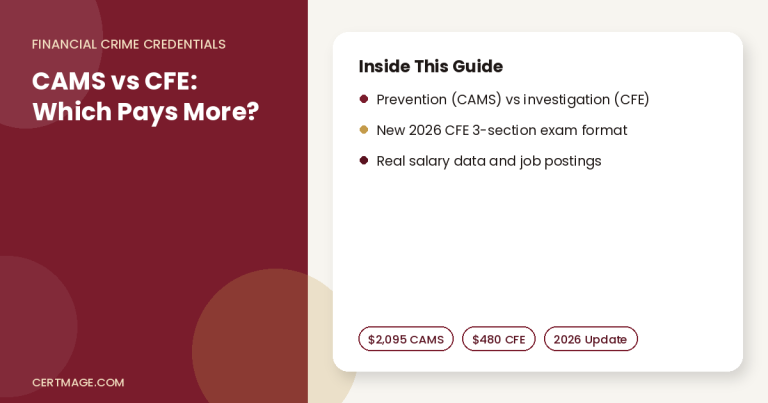
CAMS vs CFE: Which Financial Crime Certification Pays More in 2026?
Read the guide
 IT Careers & Certification Insights · 9 min read
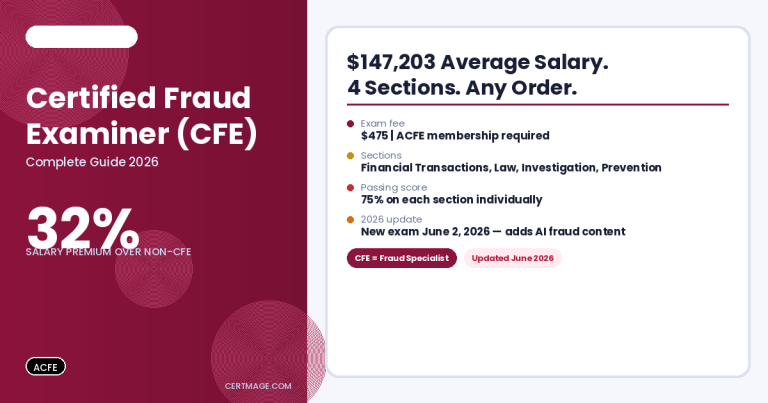
Certified Fraud Examiner (CFE) Complete Guide 2026: Exam, Salary, and Career Path
Read the guide
 IT Careers & Certification Insights · 10 min read
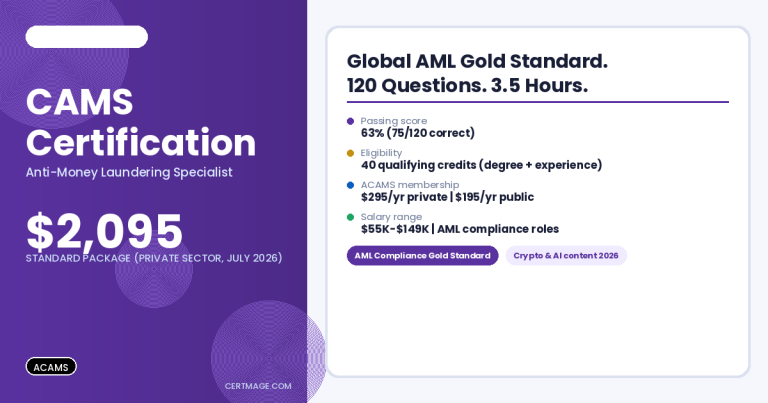
CAMS (Certified Anti-Money Laundering Specialist) Complete Guide 2026
Read the guide
Source context
How this practice set is maintained
Maintained by the CertMage content team, this page loads questions from the exam dataset connected to its preparation resource. When an answer includes a supporting reference, it is shown with that answer so you can review the underlying vendor documentation.
Certification objectives, interfaces, and vendor services can change. Verify important details against the provider's current exam guide and documentation before your exam.
Reviewed by Alexandra Stone CISSP, CISM, CISA, Security+, CEH